
SMIC(00981)

Search documents
港股半导体、科网股,集体上涨
Di Yi Cai Jing Zi Xun· 2026-02-26 01:48
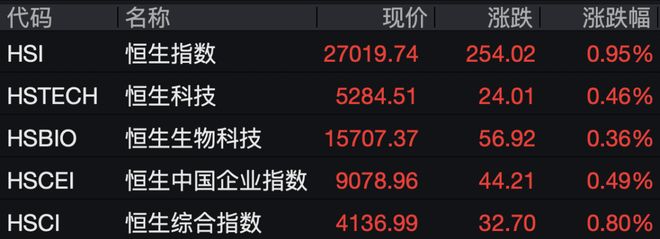
Market Overview - The Hang Seng Index opened up by 0.95%, reaching 27,019.74, with an increase of 254.02 points [2] - The Hang Seng Technology Index rose by 0.46%, closing at 5,284.51 [2] Sector Performance - The technology sector saw a general increase, with notable gains from JD Health, which rose over 2%, and other major companies like Tencent, SMIC, Alibaba Health, Kuaishou, and Baidu also experiencing collective gains [2] - The semiconductor sector strengthened, with companies like Zhaoyi Innovation increasing by over 3%, alongside other firms such as Lattice Semiconductor and Tianxu Zhixin also showing positive performance [3][4] Individual Stock Highlights - JD Health: Current price at 58.30, up by 2.82% [3] - Tencent Holdings: Current price at 529.00, up by 1.24% [3] - Zhaoyi Innovation: Current price at 425.00, up by 3.01% [4] - MINIMAX-WP: Current price at 779.00, up by 3.38% [5] Emerging Trends - The large model concept stocks collectively rose, with companies like Zhiyu and MINIMAX-WP both increasing by over 3% [5]






中芯国际2月25日获融资买入3.94亿元,融资余额127.38亿元
Xin Lang Cai Jing· 2026-02-26 01:22
Core Viewpoint - SMIC's stock performance shows a slight increase, with significant trading activity and a notable balance in margin trading, indicating investor interest and market dynamics [1][2]. Group 1: Financial Performance - As of September 30, SMIC reported a revenue of 49.51 billion yuan for the first nine months of 2025, representing a year-on-year growth of 18.22% [2]. - The net profit attributable to shareholders for the same period was 3.82 billion yuan, reflecting a year-on-year increase of 41.09% [2]. Group 2: Shareholder and Trading Activity - The number of shareholders for SMIC reached 336,200, an increase of 33.27% compared to the previous period [2]. - The average number of tradable shares per shareholder decreased by 25.41% to 6,134 shares [2]. - On February 25, SMIC had a financing buy-in of 394 million yuan, with a net financing outflow of 43.28 million yuan, indicating a high level of trading activity [1]. - The total margin trading balance for SMIC was 12.76 billion yuan, accounting for 5.49% of its market capitalization, which is above the 50% percentile level for the past year [1].
中芯国际集成电路制造有限公司关于发行股份购买资产暨关联交易的申报文件获得上海证券交易所受理的公告
Shang Hai Zheng Quan Bao· 2026-02-25 18:16
Group 1 - The core point of the announcement is that the company plans to issue shares to acquire a 49% stake in Zhongxin Northern Integrated Circuit Manufacturing (Beijing) Co., Ltd. from several investment entities [1][2] - The transaction involves multiple investors, including the National Integrated Circuit Industry Investment Fund Co., Ltd. and Beijing Economic Development Investment Management Co., Ltd. [1] - The application for the share issuance has been accepted by the Shanghai Stock Exchange, which deems the application documents complete and in compliance with legal requirements [2] Group 2 - The transaction is subject to approval from the Shanghai Stock Exchange and the China Securities Regulatory Commission, indicating that there is uncertainty regarding the approval timeline [2] - The company commits to timely information disclosure in accordance with legal regulations as the transaction progresses [2]
中芯国际:收入创新高-20260225
China Post Securities· 2026-02-25 13:35
Investment Rating - The investment rating for the company is "Buy" and is maintained [1] Core Insights - The company has achieved record high revenues, with Q4 2025 sales revenue reaching $2.489 billion, a quarter-on-quarter increase of 4.5%. This growth is attributed to a continued shift in the semiconductor supply chain towards localization, with significant contributions from increased sales of photomasks [4] - The company is expected to maintain high capital expenditures in 2026, projected at $8.1 billion, to meet strong customer demand and adapt to external changes. The guidance for Q1 2026 indicates stable sales revenue and a gross margin between 18% and 20% [5] - Revenue forecasts for 2025, 2026, and 2027 are estimated at 67.3 billion, 79.1 billion, and 91.0 billion yuan respectively, with net profits of 5.04 billion, 6.32 billion, and 7.61 billion yuan respectively, supporting the "Buy" rating [6] Company Overview - The latest closing price of the company's stock is 115.82 yuan, with a total market capitalization of 92.66 billion yuan and a circulating market value of 23.16 billion yuan. The company has a debt-to-asset ratio of 35.2% and a price-to-earnings ratio of 251.78 [3]
今日晚间重要公告抢先看——中芯国际称发行股份购买资产暨关联交易的申报文件获得上交所受理;格力电器称第一大股东珠海明骏拟减持不超2%公司股份
Jin Rong Jie· 2026-02-25 13:07
Major Announcements - SMIC's application for issuing shares to purchase assets has been accepted by the Shanghai Stock Exchange [2] - Gree Electric's largest shareholder plans to reduce its stake by no more than 2% [35] - Haiguang Information expects a net profit increase of 22.56% to 42.32% in Q1 2026 [18] Company Developments - SMIC plans to issue shares to acquire 49% of the equity in Zhongke North Integrated Circuit Manufacturing [2] - Bona Film Group reports normal operations with no significant changes in the internal and external business environment [2] - ST Xinhua Jin is under investigation by the CSRC for information disclosure violations [3] - Shandong Haihua plans to invest 48.37 billion yuan in a soda ash facility upgrade for energy efficiency [4] - ST Yanshi warns of potential delisting risks due to significant stock price fluctuations and unresolved audit issues [5] - Saifutian's subsidiary has resumed production, stabilizing the supply of photovoltaic battery products [6] - Jin'an Guoji's subsidiary has been recognized as a high-tech enterprise, benefiting from tax incentives [7] - Chuanjinno reports market rumors regarding U.S. national security priorities affecting its operations [8] - Lingyi Zhi Manufacturing plans to invest in a fund focused on advanced equipment manufacturing [9] - Songsheng Co. is establishing a joint venture for digital energy products [10] - Longbai Group's subsidiary has partially resumed production after safety inspections [10] - Tongyuan Petroleum reports no significant changes in its business environment despite stock price fluctuations [11] Financial Performance - Haiguang Information's 2025 revenue reached 14.376 billion yuan, a 56.91% increase, with a net profit of 2.542 billion yuan, up 31.66% [18] - Sainuo Medical's 2025 revenue was 525 million yuan, a 14.53% increase, with a net profit of 47.286 million yuan, up 3057.05% [19] - Koweil's 2025 revenue was 514 million yuan, a 7.39% increase, with a net profit of 64.8996 million yuan, up 32.32% [20] - United Imaging's 2025 revenue reached 13.821 billion yuan, a 34.18% increase, with a net profit of 1.888 billion yuan, up 49.6% [21] - Nanya New Materials reported a 2025 net profit of 241 million yuan, a 378.65% increase [22] - Yanzhou Coal's Australian subsidiary reported a 2025 after-tax profit of 440 million AUD [23] - Lante Optical's 2025 net profit was 388 million yuan, a 76.09% increase [24] - Huafeng Measurement's 2025 net profit was 538 million yuan, a 61.22% increase [26] - Hancable's 2025 net profit was 592 million yuan, a 9.59% decrease [27] - Transsion Holdings reported a 2025 net profit of 2.584 billion yuan, a 53.43% decrease [27] - Aiko Optoelectronics reported a 2025 net profit of 64.0919 million yuan, a 307.63% increase [28] - Huachuang Technology's 2025 net profit was 42.678 million yuan, an 89.45% increase [29] - Honghua Digital's 2025 net profit was 529 million yuan, a 27.63% increase [29] - Zhujiang Beer reported a 2025 net profit of 903 million yuan, an 11.42% increase [30] - Xindong Lian Ke's 2025 net profit was 302 million yuan, a 36.1% increase [31] - Qingda Environmental's 2025 net profit was 181 million yuan, a 94.62% increase [33] - Shenkong Co.'s 2025 net profit was 101 million yuan, a 146.54% increase [34] - Chip Micro's 2025 net profit was 290 million yuan, an 80.42% increase [34]


A股公告精选 | 中芯国际(688981.SH)拟购中芯北方49%股权 *ST岩石可能被终止上市
Zhi Tong Cai Jing· 2026-02-25 12:17
Group 1 - ST Xifa received a court decision to extend its pre-restructuring period by one month, from February 26, 2026, to March 25, 2026, due to complex historical debt issues [1] - China Cinda did not reduce its stake in Founder Securities during the planned reduction period, which was set to sell up to 82.32 million shares, approximately 1.00% of the total share capital [1] - Chuanjinno's stock price increased by 34.18% over two trading days amid rumors that the U.S. may prioritize phosphorus and glyphosate under national security, though the impact on the company remains unclear [2] Group 2 - Huylong New Materials announced a potential change in control due to significant matters being planned by its controlling shareholder, leading to a stock suspension starting February 26, 2026 [3] - SMIC's application to issue shares for acquiring 49% of Zhongxin North has been accepted by the Shanghai Stock Exchange, pending further regulatory approvals [4] - Haiguang Information expects a net profit of 620 million to 720 million yuan for Q1 2026, representing a year-on-year growth of 22.56% to 42.32% [5] Group 3 - Falan Technology's stock will be suspended starting February 26, 2026, due to its controlling shareholder planning a share transfer that may lead to a change in control [6] - Zhang Jianhua, the actual controller of ST Xinhuajin, is under investigation for suspected violations of information disclosure laws, while the company continues normal operations [14] - The stock of *ST Yanshi may face delisting risks due to significant price fluctuations and ongoing financial issues, including non-standard audit opinions [12][13]
氪星晚报|英特尔与SambaNova达成多年战略合作;宗馥莉任浙江娃哈哈管理咨询公司董事;特斯拉指控法国饮料公司恶意抢注Cybercab商标
3 6 Ke· 2026-02-25 10:39
Group 1: Company Updates - Hengdian Film's stock price has deviated by over 20% in the last two trading days, indicating abnormal volatility, but the company confirms no undisclosed significant information exists [1] - Maiwei Co. plans to invest 50 million yuan in Wenzhou Chaoquan Venture Capital Partnership to expand its business scope and enhance competitiveness [2] - SMIC's application to issue shares for acquiring a 49% stake in SMIC North has been accepted by the Shanghai Stock Exchange, pending further approvals [3] - The Arnault family has increased its stake in LVMH to 50.01% of capital and 65.94% of voting rights [4] - Lenovo's infrastructure business reported over 30% year-on-year revenue growth in Q3, with significant increases in various segments, including a 300% rise in liquid cooling solutions [5] Group 2: Market Movements - Tongyuan Petroleum's stock price has increased by over 30% in two consecutive trading days, with no significant changes in its operational environment [6] - DoorDash is exiting four markets, including Qatar and Singapore, as part of a strategic review [8] - WiseTech Global plans to reduce its workforce by nearly 30% while leveraging AI for cost savings [11] Group 3: Investment and Financing - Wuliangye Group has acquired a stake in Sanjiang Huihai Financing Leasing Company, increasing its registered capital by approximately 60% [9] - Warner Bros. is considering a new acquisition offer from Paramount, which may surpass its existing agreement with Netflix [10]




中芯国际拟发行股份购买中芯北方49%股权的申请文件获上交所受理
Zhi Tong Cai Jing· 2026-02-25 10:39
Core Viewpoint - Semiconductor Manufacturing International Corporation (SMIC) plans to acquire 49% equity of SMIC North China Integrated Circuit Manufacturing Co., Ltd. through a share issuance to several investment entities [1] Group 1: Transaction Details - The transaction involves issuing shares to the National Integrated Circuit Industry Investment Fund Co., Ltd., Beijing Integrated Circuit Manufacturing and Equipment Equity Investment Center (Limited Partnership), Beijing E-Town International Investment and Development Co., Ltd., Zhongguancun Development Group Co., Ltd., and Beijing Industrial Development Investment Management Co., Ltd. [1] - The Shanghai Stock Exchange has accepted the application for the share issuance to purchase assets, confirming that the application documents are complete and comply with legal requirements [1]
中芯国际(688981) - 中芯国际关于发行股份购买资产暨关联交易的申请文件获得上海证券交易所受理的公告
2026-02-25 10:30
特此公告。 中芯国际集成电路制造有限公司(以下简称"公司")拟向国家集成电路产 业投资基金股份有限公司、北京集成电路制造和装备股权投资中心(有限合伙)、 北京亦庄国际投资发展有限公司、中关村发展集团股份有限公司及北京工业发展 投资管理有限公司发行股份购买其所合计持有的中芯北方集成电路制造(北京) 有限公司 49%的股权(以下简称"本次交易")。 2026 年 2 月 25 日,公司收到上海证券交易所(以下简称"上交所")出具 的《关于受理中芯国际集成电路制造有限公司发行股份购买资产申请的通知》(上 证科审(并购重组)〔2026〕7 号),上交所依据相关规定对公司报送的发行股份 购买资产的申请文件进行了核对,认为该项申请文件齐备,符合法定形式,决定 予以受理并依法进行审核。 本次交易尚需上交所审核通过及中国证券监督管理委员会同意注册等。本次 交易能否通过上述审批及最终取得批准或同意注册的时间均存在不确定性。公司 将根据本次交易的进展情况,按照有关法律法规要求及时履行信息披露义务,敬 请广大投资者注意投资风险。 A股代码:688981 A股简称:中芯国际 公告编号:2026-006 港股代码:00981 港股简称 ...
净卖出超40亿港元 抛售三大ETF继续加仓腾讯
Xin Lang Cai Jing· 2026-02-25 10:25
Core Viewpoint - Southbound capital flow decreased significantly today, with a total transaction of approximately HKD 925.13 billion, accounting for 39.07% of the total turnover of the Hang Seng Index [1] Group 1: Southbound Capital Flow - Southbound capital outflow amounted to approximately HKD 40.57 billion today, with net outflow from the Shanghai-Hong Kong Stock Connect at about HKD 54.95 billion and net inflow from the Shenzhen-Hong Kong Stock Connect at approximately HKD 14.38 billion [1] - Major ETFs such as the Tracker Fund of Hong Kong, Hang Seng China Enterprises, and Southern Hang Seng Technology experienced significant sell-offs, with net sales of HKD 44.1 billion, HKD 11.36 billion, and HKD 3 billion respectively [1] Group 2: Individual Stock Performance - Tencent Holdings saw a net buy of HKD 8.18 billion, with a price increase of 0.48% [2][3] - Meituan-W recorded a net buy of HKD 6.78 billion, with a price increase of 1.60% [2][3] - Alibaba-W had a net buy of HKD 6.06 billion, with a price increase of 0.20% [2][3] - Xiaomi Group-W experienced a net buy of HKD 5.38 billion, but saw a price decrease of 0.39% [2][3] - Changfei Optical Fiber Cable had a net buy of HKD 1.82 billion, with a price increase of 1.63% [2][3] - China Merchants Energy had a net outflow of HKD 3.58 billion, with a price increase of 0.96% [2][3]



