SMIC(00981)

Search documents
资金逢低布局,港股科技ETF(159751)盘中净申购1000万份
Sou Hu Cai Jing· 2025-12-03 02:39
Core Viewpoint - The Hong Kong stock market is experiencing a pullback, but there is a counter-trend inflow of funds, particularly into the Hong Kong Technology ETF (159751), which saw a net subscription of 10 million units. The market is expected to continue its upward trend due to strong overall profitability and the scarcity of assets in sectors like the internet, new consumption, and innovative pharmaceuticals, alongside the anticipated interest rate cut by the Federal Reserve in December [1]. Group 1 - The Hong Kong Technology ETF (159751) closely tracks the CSI Hong Kong Stock Connect Technology Index, which selects 50 large-cap, high R&D investment, and high revenue growth technology companies to reflect the overall performance of technology leaders in the Hong Kong Stock Connect [1]. - As of December 3, 2025, the CSI Hong Kong Stock Connect Technology Index (931573) shows mixed performance among its constituent stocks, with Huahong Semiconductor (01347) leading with a 2.40% increase, followed by Gao Wei Electronics (01415) at 1.81%, and BYD Electronics (00285) at 1.28% [1]. - The overall valuation of the Hong Kong stock market remains low despite several months of increases, indicating a high long-term allocation cost-performance ratio [1]. Group 2 - As of November 28, 2025, the top ten weighted stocks in the CSI Hong Kong Stock Connect Technology Index (931573) include Alibaba-W (09988), Tencent Holdings (00700), and SMIC (00981), with these ten stocks accounting for 67.26% of the index [2].
布局AI科技正当时
2025-12-17 02:27
Summary of Conference Call Records Industry Overview - **Market Outlook**: Investors are generally optimistic about the market in 2026, expecting the index to reach 4,300-4,500 points in Q1 2026, providing a solid foundation for positioning in December after digesting negative factors [1][3][4] - **Computing Power Sector**: The overseas computing power sector experienced fluctuations from September to November, but stocks like NVIDIA have stabilized, indicating positive market sentiment for future prospects [1][4] Key Points and Arguments - **Catalysts for Q1 2026**: Multiple significant events are expected to drive the tech market, including Q4 earnings forecasts, CES, NVIDIA GTC conference, and OFC optical communication exhibition [1][4] - **Focus Stocks**: - **Zhongji Xuchuang**: Projected market value could reach 1 trillion to 1.2 trillion by mid-2026, reflecting high growth and explosive performance [1][5] - **New Yisheng**: High cost-performance ratio with conservative revenue estimates of 20 billion next year [1][5] - **Industrial Fulian and Shenghong Technology**: Companies related to 1.6T optical modules are also highlighted [1][5] Domestic and International Tech Companies - **Domestic Focus**: Companies like SMIC and Huahong Semiconductor in chip, liquid cooling, power supply, and switch sectors are expected to see performance inflection points in 2026 [1][7] - **International Recommendations**: Companies such as Sega Light, Yuanjie Technology, and others are recommended for investment [1][7] AI Chip Competition - **Market Shift**: The AI chip market is transitioning from pure computing power competition to system-level competition, with NVIDIA's NVLink leading in interconnect protocols [1][10] - **Google TPU Growth**: Driven by Gemini and nano banana models, leading to increased value in the PCB, copper, and optical module supply chains [1][10] Storage Market Insights - **DRAM Market**: Prices are expected to rise quarterly in 2026, with DDR5 projected to increase by 18%-23% and NAND prices expected to rise by 58%-63% throughout the year [2][14][15][16] - **AI Storage Software**: Companies like MongoDB are benefiting from the demand for external memory systems for large models, with a 22% stock price increase following their latest earnings report [2][21] Investment Opportunities in Vertical Fields - **AI Marketing and Healthcare**: Companies like Hand Information and JD Health are highlighted for their strong data capabilities [12][13] - **General Field**: Companies like Kingdee and Sun Xinfeng are also recommended for investment [12][13] Conclusion - The current market conditions and upcoming technological advancements present significant investment opportunities, particularly in the computing power and storage sectors, as well as in specific domestic and international tech companies. The focus on AI and system-level competition in the chip market indicates a shift that could reshape industry dynamics in the coming years [1][10][21]




智通港股通资金流向统计(T+2)|12月3日





智通财经网· 2025-12-02 23:37
Key Points - The top three companies with net inflows from southbound funds are Alibaba-W (09988) with 1.093 billion, Pop Mart (09992) with 0.551 billion, and Xiaomi Group-W (01810) with 0.471 billion [1] - The top three companies with net outflows are Lenovo Group (00992) with -0.363 billion, Zijin Mining (02899) with -0.303 billion, and SMIC (00981) with -0.301 billion [1] - In terms of net inflow ratios, China National Freight (00598) leads with 76.27%, followed by CITIC International Telecom (01883) at 75.55%, and Shenzhen Expressway (00548) at 73.87% [1] - The companies with the highest net outflow ratios include 361 Degrees (01361) at -66.47%, Zhongyu Energy (03633) at -58.68%, and Andeli Juice (02218) at -55.47% [1] Top 10 Net Inflows - Alibaba-W (09988) had a net inflow of 1.093 billion, representing a 10.81% increase in closing price to 151.500 [2] - Pop Mart (09992) saw a net inflow of 0.551 billion, with a closing price increase of 2.84% to 224.800 [2] - Xiaomi Group-W (01810) recorded a net inflow of 0.471 billion, with a slight decrease in closing price of 0.19% to 41.020 [2] Top 10 Net Outflows - Lenovo Group (00992) experienced a net outflow of -0.363 billion, with a closing price decrease of 0.92% to 9.680 [2] - Zijin Mining (02899) had a net outflow of -0.303 billion, maintaining a stable closing price of 30.700 [2] - SMIC (00981) faced a net outflow of -0.301 billion, with a closing price increase of 0.66% to 68.800 [2] Net Inflow Ratios - China National Freight (00598) achieved a net inflow ratio of 76.27% with a net inflow of 12.9113 million, closing at 5.200 [3] - CITIC International Telecom (01883) had a net inflow ratio of 75.55% with a net inflow of 6.5979 million, closing at 2.570 [3] - Shenzhen Expressway (00548) recorded a net inflow ratio of 73.87% with a net inflow of 4.1251 million, closing at 7.420 [3] Net Outflow Ratios - 361 Degrees (01361) had a net outflow ratio of -66.47% with a net outflow of -6.9484 million, closing at 6.000 [3] - Zhongyu Energy (03633) recorded a net outflow ratio of -58.68% with a net outflow of -3.0169 million, closing at 2.940 [3] - Andeli Juice (02218) faced a net outflow ratio of -55.47% with a net outflow of -1.0273 million, closing at 14.080 [3]
12月2日内地消费电子(983105)指数跌0.04%,成份股美图公司(01357)领跌
Sou Hu Cai Jing· 2025-12-02 16:15
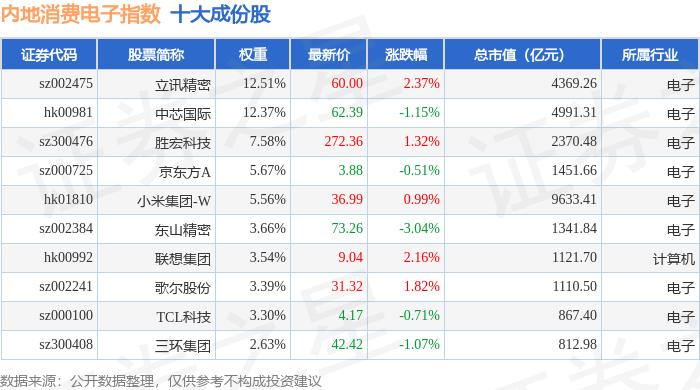
Core Points - The mainland consumer electronics index (983105) closed at 4679.66 points, down 0.04%, with a trading volume of 75.462 billion yuan and a turnover rate of 1.56% [1] - Among the index constituents, 20 stocks rose while 29 fell, with AAC Technologies leading the gainers at 3.95% and Meitu leading the decliners at 6.0% [1] Index Constituents Summary - The top ten constituents of the mainland consumer electronics index are as follows: - Luxshare Precision (sz002475) holds a weight of 12.51%, latest price at 60.00 yuan, with a market cap of 436.926 billion yuan and a rise of 2.37% [1] - SMIC (hk00981) has a weight of 12.37%, latest price at 62.39 yuan, with a market cap of 499.131 billion yuan and a decline of 1.15% [1] - Other notable constituents include BOE Technology (sz000725) with a weight of 5.67% and a market cap of 145.166 billion yuan, and Xiaomi (hk01810) with a weight of 5.56% and a market cap of 963.341 billion yuan [1] Capital Flow Analysis - The net inflow of main funds into the index constituents totaled 775 million yuan, while retail funds saw a net outflow of 347 million yuan [3] - Key stocks with significant fund flows include: - Luxshare Precision with a net inflow of 604 million yuan, accounting for 5.53% of the main funds [3] - Other stocks like GoerTek (sz002241) and Shenghong Technology (300476) also experienced notable fund movements [3]



港股通成交活跃股追踪 巨子生物近一个月首次上榜


Zheng Quan Shi Bao Wang· 2025-12-02 15:00
Core Insights - On December 2, 2023, Juzibio made its debut on the Hong Kong Stock Connect active trading list for the first time in a month, with a trading volume of 9.17 billion HKD and a net buy of 1.32 billion HKD, closing up 8.53% [1][2] Trading Activity Summary - The total trading volume for active stocks on the Hong Kong Stock Connect on December 2 was 292.74 billion HKD, accounting for 37.92% of the day's total trading amount, with a net buying amount of 16.86 billion HKD [1] - Alibaba-W led the trading volume with 83.40 billion HKD, followed by Xiaomi Group-W at 38.44 billion HKD and Meituan-W at 36.15 billion HKD [1][2] - The most frequently listed stocks in the past month were Alibaba-W and Tencent Holdings, each appearing 22 times, indicating strong interest from Hong Kong Stock Connect investors [1]
港股通(深)净买入30.71亿港元
Zheng Quan Shi Bao Wang· 2025-12-02 14:57
12月2日港股通成交活跃股 | 代码 | 简称 | 类型 | 成交金额(万港元) | 成交净买入(万港元) | 日涨跌幅(%) | | --- | --- | --- | --- | --- | --- | | 09988 | 阿里巴巴-W | 港股通(沪) | 512623.30 | 36697.46 | 1.36 | | 09988 | 阿里巴巴-W | 港股通(深) | 321347.00 | -995.27 | 1.36 | | 03690 | 美团-W | 港股通(沪) | 249509.11 | 17125.97 | -3.06 | | 00700 | 腾讯控股 | 港股通(沪) | 212952.76 | -68401.90 | -0.40 | | 01810 | 小米集团-W | 港股通(深) | 208598.00 | 42111.80 | 0.99 | | 01810 | 小米集团-W | 港股通(沪) | 175816.18 | -4105.95 | 0.99 | | 00763 | 中兴通讯 | 港股通(沪) | 148079.84 | 9383.77 | -5.64 | | 0070 ...
近3年中芯国际收入断崖:22年495亿,23年跌至452亿,24年如何
Sou Hu Cai Jing· 2025-12-02 11:09
Core Viewpoint - SMIC has experienced significant fluctuations in revenue and profit over the years, reflecting the broader trends in the semiconductor industry and the impact of domestic policies on its operations [1][8][19] Group 1: Company Growth and Development - SMIC, established in 2000, has become the largest foundry in mainland China, initially focusing on logic and memory chips [1] - The company progressed from 0.35-micron technology to 28-nanometer processes, expanding its production capacity across multiple cities in China [3] - By 2022, during the global chip shortage, SMIC's revenue surged to 495.16 billion yuan, with a net profit of 121.33 billion yuan and a gross margin of 38% [4][6] Group 2: Challenges and Declines - In 2023, SMIC faced a downturn with revenue dropping to 452.50 billion yuan, an 8.6% year-on-year decline, and net profit plummeting by 60% to 48.23 billion yuan [8][10] - The company struggled with reduced demand due to inventory adjustments in the smartphone market, leading to a price war and decreased capacity utilization [8][10] Group 3: Strategic Adjustments and Future Outlook - Despite the challenges, SMIC continued to invest heavily in capacity expansion, maintaining high capital expenditures to secure its market position [10][14] - In 2024, revenue rebounded to 577.96 billion yuan, a 27.7% increase, although net profit fell to 36.99 billion yuan, reflecting ongoing pressures from high depreciation costs [12][14] - By 2025, SMIC showed signs of recovery with a 16.2% year-on-year revenue increase in Q2, driven by strong domestic demand and improved capacity utilization [16][18]
智通港股通活跃成交|12月2日

智通财经网· 2025-12-02 11:02
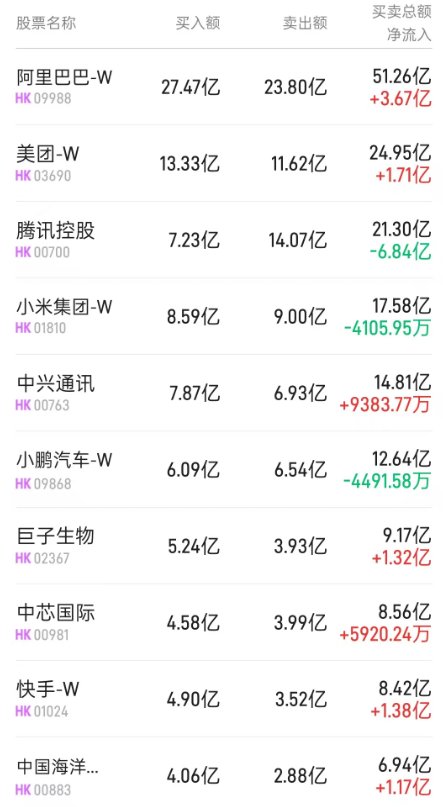
| 公司名称 | 成交金额 | 净买入额 | | --- | --- | --- | | 阿里巴巴-W(09988) | 51.26 亿元 | +3.67 亿元 | | 美团-W(03690) | 24.95 亿元 | +1.71 亿元 | | 腾讯控股(00700) | 21.30 亿元 | -6.84 亿元 | | 小米集团-W(01810) | 17.58 亿元 | -4105.95 万元 | | 中兴通讯(00763) | 14.81 亿元 | +9383.77 万元 | | 小鹏汽车-W(09868) | 12.64 亿元 | -4491.58 万元 | | 巨子生物(02367) | 9.17 亿元 | +1.32 亿元 | | 中芯国际(00981) | 8.56 亿元 | +5920.24 万元 | | 快手-W(01024) | 8.42 亿元 | +1.38 亿元 | | 中国海洋石油(00883) | 6.94 亿元 | +1.17 亿元 | 智通财经APP获悉,2025年12月2日当天,阿里巴巴-W(09988)、美团-W(03690)、腾讯控股(00700)位居 沪港通(南向)成交额 ...
中信证券、华泰证券、国泰海通等六大券商11月高目标价个股曝光!
私募排排网· 2025-12-02 10:00
Core Viewpoint - The A-share market experienced its first significant adjustment after a slow bull run in November, with various brokerages providing research reports that serve as important guides for understanding company values and predicting future trends [2][9]. Group 1: Key Insights from Citic Securities - Citic Securities believes the market adjustment may present a good opportunity for building positions, with a focus on structural selection amid macroeconomic challenges [2][3]. - In November, Citic Securities covered 186 listed companies, with the highest target price increase for Great Wall Motors at 73.52%, indicating significant upside potential [3][5]. Group 2: High Target Price Companies from Huatai Securities - Huatai Securities identified seven major investment themes for 2026, with 27 companies having target price increases exceeding 50%, including SAIC Motor and China State Construction [7][8]. - Notably, Huatai Securities adjusted the target price for SMIC from 238 yuan to 196 yuan, still reflecting a 72.54% upside potential [7]. Group 3: Insights from Guotai Junan - Guotai Junan sees a favorable window for policy and liquidity in late 2025 to early 2026, with 23 companies having target price increases over 50%, led by Beijing Human Resources with a target price of 35.6 yuan [9][10]. - The company has seen a decline of 5.68% this year despite the bullish outlook [9]. Group 4: Focus on Baijiu Stocks from Huachuang Securities - Huachuang Securities maintains an optimistic long-term outlook, particularly for liquor stocks, with 10 companies having target price increases over 50%, including Kweichow Moutai with a target price of 2600 yuan [11][13]. - Kweichow Moutai has repurchased over 6 billion yuan worth of shares this year, indicating strong confidence in its future performance [11]. Group 5: Insights from Guotou Securities - Guotou Securities highlighted a structural shift in the A-share market, with 2 companies having target price increases over 50%, including Yunda Co. with a target price of 27.94 yuan [15][16]. - The firm anticipates significant profit recovery in wind turbine manufacturing due to rising prices [15]. Group 6: Insights from Dongfang Securities - Dongfang Securities covered 74 companies in November, with 3 having target price increases over 50%, including Aikodi with a target price of 30.5 yuan [17][21]. - The company is expected to expand its robot parts product matrix, projecting significant profit growth in the coming years [17].





北水动向|北水成交净买入41.01亿 北水继续加仓科网股 全天买入美团(03690)近6亿港元
智通财经网· 2025-12-02 09:57
Core Insights - The Hong Kong stock market saw a net inflow of 41.01 billion HKD from northbound trading on December 2, with 10.3 billion HKD from the Shanghai Stock Connect and 30.71 billion HKD from the Shenzhen Stock Connect [1] Group 1: Stock Performance - Meituan-W (03690) received a net inflow of 5.92 billion HKD, with expectations of reduced losses in its food delivery business in Q4 [4] - Xiaomi Group-W (01810) had a net inflow of 3.8 billion HKD, reporting over 500,000 cumulative deliveries of its cars and a share buyback of approximately 4.02 billion HKD [4] - Alibaba-W (09988) saw a net inflow of 3.57 billion HKD, launching an updated image generation and editing model, Qwen-Image [5] - Kuaishou-W (01024) received a net inflow of 2.5 billion HKD, introducing a new multi-modal creation tool [5] - ZhiZi Bio (02367) had a net inflow of 1.31 billion HKD, announcing a share buyback plan [5] Group 2: Net Selling - Semiconductor Manufacturing International Corporation (00981) faced a net outflow of 762.7 million HKD due to the termination of a significant acquisition [6] - Tencent (00700) experienced a net outflow of 3.81 billion HKD, indicating a negative sentiment towards the stock [6] - China Life (02628) had a net outflow of 16.42 million HKD, reflecting a similar trend [6]