AGRICULTURAL BANK OF CHINA(01288)

Search documents
“短短几天坐了一趟过山车!”金价剧烈波动,银行密集发公告
Sou Hu Cai Jing· 2026-02-04 04:16
Core Viewpoint - International gold prices have experienced significant volatility, rebounding from a previous drop and surpassing the $5000 per ounce mark as of February 4, 2026, following a sharp decline earlier in the week [2][3]. Market Dynamics - Gold prices saw a dramatic fluctuation, peaking near $5600 per ounce on January 29, 2026, before plummeting nearly 10% on January 30, dropping below $4500 per ounce by February 2, and then rebounding with over a 6% increase on February 3 [3]. - Analysts from Guangzhou Futures Co. noted that concerns over future monetary policy, coupled with technical selling pressure due to crowded positions, contributed to the price drop. However, long-term factors such as central bank gold purchases and geopolitical risks are expected to support gold prices [5]. Risk Management Adjustments - Major state-owned banks have announced measures to strengthen risk management for gold investment businesses in response to price volatility. For instance, China Bank adjusted margin requirements and trading limits for gold and silver contracts starting February 3 and 4, respectively [6][8]. - Agricultural Bank also modified trading limits for gold and silver contracts effective February 3 and 4, respectively, to mitigate risks associated with market fluctuations [7][8]. Changes in Investment Products - Industrial and Commercial Bank of China announced limits on its gold accumulation business starting February 7, 2026, particularly on non-trading days, to manage risk exposure [10]. - Construction Bank raised the minimum investment amount for personal gold accumulation to 1500 yuan, reflecting a tightening of investment conditions amid increased market volatility [11]. Investor Guidance - Banks have urged clients to monitor changes in trading limits and manage their positions wisely, emphasizing the importance of rational investment strategies [9][11]. - Financial experts recommend a systematic approach to gold investment, such as regular contributions, to avoid the pitfalls of emotional trading during volatile periods [12].



中国移动链长基金领投苇渡C1轮融资
Xin Lang Cai Jing· 2026-02-04 00:36
Group 1 - The company Windrose has announced the initiation of a Series C financing round exceeding $100 million [1] - The C1 round is led by China Mobile Chain Long Fund, with participation from Windrose's founder Han Wen and French industrial real estate firm PRD [1] - The financing round has also received credit support from major banks including Industrial and Commercial Bank of China, China Construction Bank, and Agricultural Bank of China [1] Group 2 - The funds from the Series C financing will primarily be used to accelerate the mass production and delivery of the company's pure electric heavy trucks after obtaining certifications in China, the US, and Europe [1] - The company plans to promote the establishment of assembly delivery bases and supporting infrastructure for wind and solar energy, energy storage, and fast charging in Belgium, France, and the United States [1]

丈量地方性银行(2):浙江163家区域性银行全梳理-20260203
GF SECURITIES· 2026-02-03 13:31
Investment Rating - The industry investment rating is "Buy" [2] Core Insights - The report provides a comprehensive analysis of 163 regional banks in Zhejiang Province, highlighting their asset and liability structures, profitability, and asset quality [6][20] - The asset growth rate for major city commercial banks in Zhejiang is 9.4%, which is lower than the 14.2% growth rate of listed city commercial banks, while major rural commercial banks show an asset growth rate of 8.0%, exceeding the 6.7% growth rate of listed rural commercial banks [6][25] - The report indicates that the loan-to-asset ratio for city commercial banks is projected to reach 55.5% in 2024, an increase of 95 basis points year-on-year, while rural commercial banks will see a decrease to 59.3%, down 19 basis points [31] - Profitability metrics show that the average Return on Assets (ROA) for city commercial banks in Zhejiang is 0.78%, slightly above the average of listed city commercial banks, while rural commercial banks have an average ROA of 0.82%, which is below the average of listed rural commercial banks [6][31] - The asset quality of regional banks in Zhejiang is reported to be better than that of listed banks, with non-performing loan ratios lower by 16 basis points for city commercial banks and 9 basis points for rural commercial banks compared to their listed counterparts [6][31] Summary by Sections Section 1: Economic Structure of Zhejiang Province - Zhejiang Province is focused on high-quality development and aims to become a model for common prosperity [13] - The province's GDP is heavily concentrated in cities like Hangzhou, Ningbo, and Wenzhou, with Hangzhou accounting for 24.3% of the total GDP in 2025 [15] Section 2: Overview of 163 Regional Banks - The report categorizes the banks into city commercial banks, rural banks, and others, with a total of 163 banks in the region [20] - The distribution of registered capital among these banks is relatively balanced, with 63 banks having over 500 million yuan in registered capital [22] Section 3: Asset and Liability Structure - The asset growth of major city and rural commercial banks has been declining since 2019, with city banks showing a growth rate of 9.4% in the first half of 2025 [25] - The liability structure indicates that customer deposits account for 77.5% of liabilities for city commercial banks, which is higher than the 66.2% for listed city banks [44] Section 4: Profitability and Asset Quality - The average ROE for city commercial banks in Zhejiang is 11.98%, slightly lower than the average of listed city banks [6][31] - The report highlights that the non-performing loan ratio for city commercial banks is lower than that of listed banks, indicating better asset quality [6][31]



银行行业深度报告:2026年净息差展望:筑底企稳
KAIYUAN SECURITIES· 2026-02-03 05:46
Investment Rating - The industry investment rating is "Positive" (maintained) [1] Core Insights - The report indicates that the net interest margin (NIM) for listed banks is expected to slightly narrow by 4 basis points in 2026, with pressure concentrated in the first half of the year [5][49] - The theoretical NIM is estimated to support a risk-weighted asset (RWA) growth rate of around 6%, with a bottom line NIM of approximately 1.44%-1.57% [17] - The report highlights that the deposit pricing structure has improved, leading to a reduction in deposit costs, which supports the stabilization of NIM [4][23] Summary by Sections 1. NIM Outlook - The NIM for listed banks is projected to narrow by 4 basis points in 2026, primarily due to factors affecting both the asset and liability sides [5][49] - The asset side will experience a negative impact from loan repricing and bond investment returns, while the liability side will benefit from the repricing of high-interest deposits [49][53] 2. Deposit Pricing Dynamics - The average deposit cost for listed banks is expected to decrease by 15 basis points to 1.35% in 2026, driven by the maturity of high-interest deposits [7][8] - The report notes that the repricing of maturing deposits will contribute positively to the improvement of deposit costs by approximately 14.7 basis points [8][29] 3. Investment Recommendations - The report recommends a bottom-line allocation to large state-owned banks, with specific beneficiaries identified as Agricultural Bank of China and Industrial and Commercial Bank of China [9] - Core allocations should focus on leading comprehensive banks, with China Merchants Bank and Industrial Bank highlighted as key beneficiaries [9] 4. Market Trends - The report discusses the trend of deposit non-bankization, which negatively impacts the overall deposit cost rate, indicating a shift in deposit structures [34][37] - It also mentions that the competitive landscape for deposit pricing has eased, reducing the "involution" in deposit competition among banks [45][46]



中国农业银行取得资源迁移方法专利
Sou Hu Cai Jing· 2026-02-03 03:34
声明:市场有风险,投资需谨慎。本文为AI基于第三方数据生成,仅供参考,不构成个人投资建议。 来源:市场资讯 国家知识产权局信息显示,中国农业银行股份有限公司取得一项名为"一种资源迁移方法、装置、设备 及存储介质"的专利,授权公告号CN114327875B,申请日期为2021年12月。 天眼查资料显示,中国农业银行股份有限公司,成立于1986年,位于北京市,是一家以从事货币金融服 务为主的企业。企业注册资本34998303.3873万人民币。通过天眼查大数据分析,中国农业银行股份有 限公司共对外投资了16家企业,参与招投标项目5000次,财产线索方面有商标信息1240条,专利信息 5000条,此外企业还拥有行政许可119个。 ...
国有大行部署2026年经营工作,重点聚焦何处?
Xin Lang Cai Jing· 2026-02-03 01:29
Core Viewpoint - The recent meetings of major state-owned banks in China emphasized "high-quality development" as a key theme for 2025 and outlined strategic focuses for 2026, including enhancing credit issuance and effectively managing risks in key areas [1][3][4]. Group 1: High-Quality Development - Several banks, including Agricultural Bank and China Bank, reported successful completion of their targets for 2025, indicating progress in high-quality development [1][3]. - The banks plan to focus on five major financial initiatives and prioritize credit issuance while managing risks effectively in 2026 [1][3]. Group 2: Service Focus - Agricultural Bank highlighted its commitment to serving the "three rural issues" as a priority, while China Bank aims to consolidate and expand its global advantages [5][6]. - Construction Bank emphasized the integration of commercial and investment banking, as well as public and private banking, to enhance service adaptability [7]. Group 3: Risk Management and Innovation - The banks are focusing on enhancing their risk management frameworks through digitalization and intelligent systems to address credit risks in key sectors like local government debt and real estate [10][11]. - Agricultural Bank and Industrial and Commercial Bank are both committed to increasing loan support in critical areas, including rural finance and consumer sectors [4][10]. Group 4: Reform and Efficiency - The banks are targeting reforms to improve customer and employee satisfaction, with a focus on enhancing operational efficiency and reducing costs [8]. - Postal Savings Bank aims to leverage strategic opportunities during the 14th Five-Year Plan period to enhance its service capabilities and achieve sustainable growth [7].

金价大跳水!银行密集提示市场风险,为黄金投资“降温”
Xin Lang Cai Jing· 2026-02-03 01:29
Core Viewpoint - The global precious metals market is experiencing significant volatility, with gold prices dropping below $5000 per ounce and silver prices falling over 35% in late January and early February 2026, prompting banks to issue risk warnings and adjust their gold-related business practices [1][2][3]. Group 1: Market Volatility and Bank Responses - On January 31, 2026, gold prices saw a maximum drop of over 12%, falling below $5000 per ounce, and on February 2, they dipped below $4500 per ounce with a daily decline exceeding 9% [1]. - Major banks, including Industrial and Agricultural Banks, have issued multiple risk warnings to clients, advising them to assess their risk tolerance and avoid speculative trading in the current volatile market [3][5][6]. - Banks are increasing the minimum purchase amounts for gold accumulation products and raising the margin requirements for precious metal contracts to mitigate risks associated with market fluctuations [9][11]. Group 2: Changes in Investment Thresholds and Interest Rates - Industrial Bank raised the minimum investment for its gold accumulation product from 1000 yuan to 1100 yuan, while other banks like Construction Bank and Ping An Bank have also increased their minimum investment thresholds [9][10]. - Many banks have collectively reduced the interest rates on gold deposit products, with some rates dropping to near zero, indicating a shift back to the core investment logic of gold price fluctuations rather than interest income [10]. - The margin requirements for various gold trading contracts have been significantly increased, with some banks raising them from around 43% to as high as 80% to limit high-leverage trading [11][12]. Group 3: Demand for Physical Gold - Despite the price corrections in the gold market, there is a surge in demand for physical gold, with many consumers attempting to purchase gold bars, leading to stock shortages at several banks [13][14]. - The World Gold Council reported that global gold demand reached a record high of 5002 tons in 2025, with China's demand alone totaling 1003 tons, marking a 6% year-on-year increase [15]. - Experts emphasize that the primary function of gold is to preserve value and serve as a hedge against risks, advising investors to approach gold investments with caution and a long-term perspective rather than short-term speculation [16].

2026年经营部署如何“划重点”?六大行全扫描
Xin Lang Cai Jing· 2026-02-03 00:48
Core Viewpoint - The major banks in China are transitioning from the "14th Five-Year Plan" to the "15th Five-Year Plan," focusing on serving the real economy and preventing financial risks while adapting to their own development needs [1][2]. Group 1: Transition from "14th Five-Year Plan" to "15th Five-Year Plan" - In 2025, banks aimed to complete the "14th Five-Year Plan" with a focus on risk prevention and stable performance [1]. - For 2026, banks are shifting their focus to the "15th Five-Year Plan," with institutions like ICBC and Bank of Communications outlining their strategic plans for this new phase [1]. Group 2: Support for Key Areas - Banks are increasing loan disbursements and bond investments, particularly in areas like domestic demand expansion, technological innovation, and support for small and micro enterprises [2]. - Agricultural Bank of China emphasizes serving rural areas and has reported a continuous increase in county loans, exceeding 1 trillion yuan for four consecutive years, with a total balance surpassing 10 trillion yuan [2]. Group 3: Risk Prevention Strategies - Financial institutions are prioritizing risk prevention, particularly in local government debt and real estate sectors, with specific measures outlined by Agricultural Bank and China Construction Bank [4]. - China Bank is focusing on centralized credit risk management and proactive trend risk control to maintain asset quality [4]. Group 4: Digital Transformation - Digital transformation is a common focus among state-owned banks, with initiatives aimed at enhancing operational capabilities and integrating AI into business processes [5][6]. - Postal Savings Bank is advancing a comprehensive upgrade strategy that includes digitalization and aims to create a "second growth curve" [6]. Group 5: Shift from Scale Expansion to Value Creation - In 2026, banks are moving from a focus on scale expansion to value creation, with institutions like Postal Savings Bank emphasizing a shift from scale-driven to value-driven strategies [7]. - The consensus among banks is to improve efficiency and reduce costs through digital transformation, especially in a low-interest-rate environment [7].

房地产融资协调“白名单”机制两周年:主办银行制成核心
Feng Huang Wang· 2026-02-03 00:41
Group 1 - The core viewpoint of the article highlights the establishment and implementation of a coordinated financing mechanism for urban real estate, which aims to streamline financing processes and ensure that reasonable financing demands are met by banks [1][3] - The "white list" mechanism has been in place for two years, with the main bank system being recognized as a key component for real estate project financing, ensuring that information sharing among banks is improved and reducing the risk of over-lending [2][3] - Recent data indicates that while the financing support for "white list" projects has been significant, the growth rate of new loans has slowed down considerably compared to the initial year of implementation [4][5] Group 2 - As of the end of last year, banks in Beijing had provided loans totaling 215.6 billion yuan for 219 "white list" projects, while Hunan province reported 1,830.9 billion yuan in loans for 1,386 projects, demonstrating the effectiveness of the financing coordination mechanism [4][5] - The overall loan amount for "white list" projects exceeded 7 trillion yuan, supporting nearly 20 million housing units, but the growth in loan amounts has significantly decreased, with only 1.4 trillion yuan added in the last six months of the previous year [4][5] - The recent adjustments to the "white list" financing mechanism include allowing for a five-year extension on loans for qualifying projects, which aims to alleviate short-term repayment pressures for real estate companies while maintaining cautious lending practices for new projects [6][7]
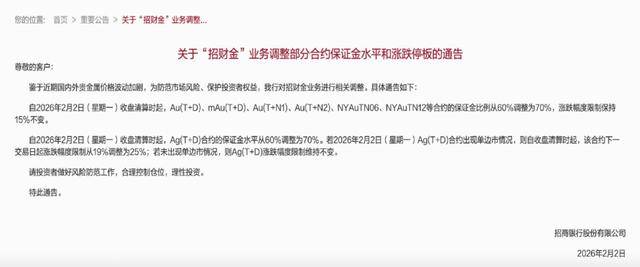
最新!黄金与白银价格新高后剧烈波动 多家银行紧急调整!
Sou Hu Cai Jing· 2026-02-03 00:05
Core Viewpoint - Recent fluctuations in international gold and silver prices have prompted banks to adjust their operations and issue risk warnings to protect investors amid significant market volatility [1][2][4][5][6][7] Group 1: Market Fluctuations - On February 2, gold futures dropped below $4,500 per ounce, with silver prices experiencing a cumulative decline of approximately 40% from the peak on January 29, while gold prices fell by about 20% [1] - The recent volatility in precious metals is attributed to macroeconomic expectations, technical overbought conditions, and profit-taking by some investors, indicating a high volatility phase in the market [7] Group 2: Bank Responses - China Merchants Bank announced an increase in margin requirements for various gold and silver contracts from 60% to 70% to mitigate market risks [1] - The bank also suspended new account openings and new positions in its "Zhaocai Gold" business due to the changing market conditions [2] - Other banks, including Postal Savings Bank of China and Agricultural Bank of China, have issued similar warnings and adjusted their business practices to enhance risk management and protect client interests [2][4][5] Group 3: Risk Management Strategies - Banks are implementing a multi-layered approach to risk management, including increasing entry barriers, limiting leverage, and guiding rational investment behaviors [7] - The adjustments made by banks reflect a proactive stance in managing risks associated with precious metals trading, aiming to maintain market stability and protect investor interests [7]