
HUA HONG SEMI(01347)

Search documents
港股异动丨半导体股拉升 华虹半导体涨超5% 半导体景气超预期
Ge Long Hui· 2026-01-14 02:29
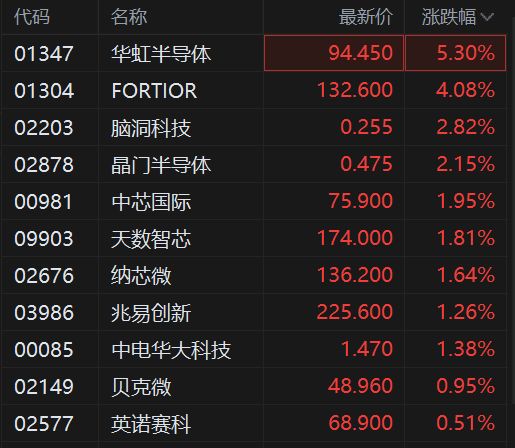
Group 1 - Semiconductor stocks in Hong Kong experienced a collective surge, with Huahong Semiconductor rising over 5%, and other companies like Jingmen Semiconductor and SMIC increasing by 2% [1] - Guosen Securities' latest report indicates that the semiconductor sector is performing better than expected, with price increases across multiple segments and the imminent release of AI glasses [1] - Research institutions predict that the average capacity utilization rate of global 8-inch wafer fabs will rise to the range of 85% to 90% by 2026, a significant improvement from 75% to 80% in 2025, reflecting a recovery in downstream applications and signaling a potential new price adjustment cycle in the foundry industry [1] Group 2 - The latest stock prices and changes for key semiconductor companies include: Huahong Semiconductor at 94.450 with a 5.30% increase, Jingmen Semiconductor at 0.475 with a 2.15% increase, and SMIC at 75.900 with a 1.95% increase [2] - Other notable companies include Naxin Micro at 136.200 with a 1.64% increase, and Zhaoyi Innovation at 225.600 with a 1.26% increase [2] - The easing of export regulations by the U.S. for Nvidia's H200 chips to China was noted, which may impact the semiconductor market dynamics [1]

港股异动 | 华虹半导体(01347)再涨超6% 高盛称高产能利用率支持产品组合优化及均价提升
智通财经网· 2026-01-14 02:20
Group 1 - The core viewpoint of the article is that Huahong Semiconductor (01347) is experiencing a significant stock price increase, attributed to its acquisition of a majority stake in Huali Micro, which is expected to enhance its long-term production capacity [1] - Huahong Semiconductor plans to acquire approximately 97.5% of Huali Micro for a transaction price of 8.268 billion yuan, which is anticipated to add 38,000 wafers per month of 65/55nm and 40nm capacity [1] - Goldman Sachs reports that the management of Huahong expects stable demand across its technology platforms, which will support high capacity utilization and enhance product mix and average pricing [1] Group 2 - The management aims to optimize the product mix and improve pricing, alongside ongoing cost control measures, maintaining a positive outlook on future profitability [1] - Fab9B is projected to gradually increase its capacity to 83,000 wafers per month by 2027, with further expansions in 28/22nm capacity planned between 2027 and 2029 [1] - The company intends to increase the proportion of domestic supply chain equipment and materials used, which is expected to have a positive impact on profit margins [1]
华虹半导体再涨超6% 高盛称高产能利用率支持产品组合优化及均价提升
Zhi Tong Cai Jing· 2026-01-14 02:17
Core Viewpoint - Huahong Semiconductor (01347) has seen a significant stock increase of over 6%, currently trading at HKD 94.75 with a transaction volume of HKD 1.209 billion, following the announcement of its acquisition of approximately 97.5% stake in Huali Micro for a transaction price of HKD 8.268 billion [1] Group 1: Acquisition Details - The acquisition of Huali Micro is viewed as a valuable addition to Huahong's wafer foundry assets, expected to enhance the company's long-term production capacity [1] - The company will add a monthly capacity of 38,000 wafers at 65/55nm and 40nm nodes as a result of this acquisition [1] Group 2: Market Outlook and Management Insights - Goldman Sachs reports that Huahong's management anticipates stable demand across its technology platforms, which will support high capacity utilization and facilitate product mix optimization and price increases [1] - Management plans to optimize the product mix and enhance pricing, alongside ongoing cost control measures, maintaining a positive outlook on future profitability [1] Group 3: Future Capacity Expansion - Fab9B is expected to gradually increase its monthly capacity to 83,000 wafers by 2027, with further expansions in 28/22nm capacity planned between 2027 and 2029 [1] - The management has indicated a strategy to increase the proportion of domestic supply chain equipment and materials, which is expected to positively impact profit margins [1]
智通港股通资金流向统计(T+2)|1月13日





智通财经网· 2026-01-12 23:32
Core Insights - The article highlights the net inflow and outflow of funds in the Hong Kong stock market, with Xiaomi Group, Tencent Holdings, and China Construction Bank leading in net inflows, while the Yingfu Fund, Hang Seng China Enterprises, and Southern Hang Seng Technology experienced the highest net outflows [1] Group 1: Net Inflows - Xiaomi Group-W (01810) recorded a net inflow of 1.07 billion, representing a 16.36% increase in its closing price [2] - Tencent Holdings (00700) saw a net inflow of 863 million, with a 7.49% increase in its closing price [2] - China Construction Bank (00939) had a net inflow of 699 million, with a significant 41.06% increase in its closing price [2] Group 2: Net Outflows - Yingfu Fund (02800) experienced the largest net outflow of 6.289 billion, reflecting a -31.44% change in its closing price [2] - Hang Seng China Enterprises (02828) had a net outflow of 2.880 billion, with a -17.89% change in its closing price [2] - Southern Hang Seng Technology (03033) faced a net outflow of 1.289 billion, showing a -11.37% change in its closing price [2] Group 3: Net Inflow Ratios - 361 Degrees (01361) led with a net inflow ratio of 74.40%, with a net inflow of 8.9117 million [3] - BRILLIANCE CHI (01114) followed with a net inflow ratio of 64.04%, amounting to a net inflow of 36.4910 million [3] - Qin Port Co. (03369) had a net inflow ratio of 61.05%, with a net inflow of 846,600 [3] Group 4: Net Outflow Ratios - Wisdom Hong Kong 100 (02825) had a net outflow ratio of -100.00%, with a net outflow of -18,200 [3] - Stone Pharmaceutical Group (02005) recorded a net outflow ratio of -68.86%, with a net outflow of -14.1501 million [3] - Dexion Shipping (02510) experienced a net outflow ratio of -53.53%, with a net outflow of -10.0204 million [3]
中国算力行业决策建议及项目可行性研究报告2026-2032年
Sou Hu Cai Jing· 2026-01-12 21:05
Group 1 - The report outlines the strategic importance of computing power as a new type of infrastructure and its collaborative relationship with data and algorithms [3][4] - The global computing power market is characterized by a significant scale and growth, with North America leading and the Asia-Pacific region rapidly catching up [4][5] - The report highlights the evolution of computing power technology, with heterogeneous computing architectures becoming mainstream [4][5] Group 2 - During the "14th Five-Year Plan" period, China's computing power scale has expanded significantly, with the total computing power surpassing previous levels [5][6] - The report discusses the impact of the East Data West Computing project on the geographical restructuring of computing power in China [5][6] - The establishment of a domestic computing ecosystem is underway, with a notable increase in the annual growth rate of domestic AI chip shipments [6][7] Group 3 - The report identifies key segments of the computing power industry chain, including advancements in chiplet technology and optical interconnects that enhance computing density [4][5] - The deployment of edge computing nodes in industrial and automotive internet applications is increasing, reflecting a shift towards more decentralized computing solutions [5][6] - The demand for computing power in various applications, such as AI model training, scientific computing, and smart manufacturing, is analyzed, indicating a growing need for high-performance computing resources [6][7] Group 4 - The competitive landscape of the global computing power industry is dominated by American companies, with major players like NVIDIA, AMD, and Intel leading the high-end computing ecosystem [6][7] - In China, the report highlights the emergence of a "national team" in domestic computing power, with traditional hardware manufacturers transitioning to computing service providers [7][8] - Key competitive dimensions include hardware performance, software ecosystem compatibility, and the ability to deliver comprehensive solutions [6][7] Group 5 - The report forecasts significant growth in the computing power market from 2026 to 2032, with an expected compound annual growth rate and a shift in the market structure towards AI computing power [10][11] - The analysis indicates that the domestic market share of Chinese computing power is projected to exceed 50% under certain scenarios [10][11] - The report emphasizes the importance of establishing a sustainable and efficient computing power ecosystem, with a focus on energy efficiency and green technologies [10][11]


1月8日港股通净卖出49.01亿港元


Zheng Quan Shi Bao Wang· 2026-01-08 15:16
Market Overview - On January 8, the Hang Seng Index fell by 1.17%, closing at 26,149.31 points, with a total net sell of HKD 4.901 billion through the southbound trading channel [1][3] - The total trading volume for the southbound trading was HKD 117.906 billion, with a net sell of HKD 4.901 billion [1] Trading Activity - In the Shanghai-Hong Kong Stock Connect, the trading volume was HKD 70.891 billion, with a net sell of HKD 3.968 billion; in the Shenzhen-Hong Kong Stock Connect, the trading volume was HKD 47.015 billion, with a net sell of HKD 0.933 billion [1] - The most actively traded stock in the Shanghai-Hong Kong Stock Connect was Alibaba-W, with a trading volume of HKD 57.22 billion, followed by the Tracker Fund of Hong Kong and SMIC, with trading volumes of HKD 48.64 billion and HKD 33.52 billion, respectively [1] Net Buy/Sell Analysis - Tencent Holdings had the highest net buy amount of HKD 0.585 billion, despite a closing price drop of 1.36% [1] - The Tracker Fund of Hong Kong recorded the highest net sell amount of HKD 4.631 billion, closing down by 1.28% [1] - In the Shenzhen-Hong Kong Stock Connect, Alibaba-W also led in trading volume with HKD 37.64 billion, while Xiaomi Group-W had the highest net buy of HKD 0.494 billion, closing down by 0.37% [2]
港股通1月8日成交活跃股名单
Zheng Quan Shi Bao Wang· 2026-01-08 15:07
Market Overview - On January 8, the Hang Seng Index fell by 1.17%, with southbound capital totaling HKD 117.906 billion, comprising HKD 56.503 billion in buying and HKD 61.403 billion in selling, resulting in a net sell of HKD 4.901 billion [1] Southbound Trading Activity - The southbound trading through Stock Connect (Shenzhen) had a total turnover of HKD 47.015 billion, with buying at HKD 23.041 billion and selling at HKD 23.974 billion, leading to a net sell of HKD 0.933 billion [1] - The southbound trading through Stock Connect (Shanghai) recorded a total turnover of HKD 70.891 billion, with buying at HKD 33.461 billion and selling at HKD 37.429 billion, resulting in a net sell of HKD 3.968 billion [1] Active Stocks - Alibaba-W had the highest trading volume among southbound stocks, with a total turnover of HKD 94.86 billion, followed by the Tracker Fund of Hong Kong and SMIC, with turnovers of HKD 65.30 billion and HKD 55.70 billion respectively [1] - The top net buying stocks included Xiaomi Group-W with a net buy of HKD 10.72 billion, Tencent Holdings with HKD 8.64 billion, and SMIC with HKD 5.63 billion [1] - The stock with the highest net sell was the Tracker Fund of Hong Kong, with a net sell of HKD 62.84 billion, followed by Hang Seng China Enterprises and Southern Hang Seng Technology with net sells of HKD 28.78 billion and HKD 12.88 billion respectively [1] Continuous Net Buying and Selling - Xiaomi Group-W, Tencent Holdings, and SMIC were among the eight stocks that appeared on both the Shenzhen and Shanghai Stock Connect active lists, with Xiaomi Group-W having a total turnover of HKD 41.07 billion and a net buy of HKD 10.72 billion, while Tencent Holdings had a turnover of HKD 45.90 billion and a net buy of HKD 8.64 billion [2] - Over a continuous period, Xiaomi Group-W, Alibaba-W, and Goldwind Technology saw net buying for more than three days, with Xiaomi Group-W leading with a total net buy of HKD 46.84 billion [2] - Conversely, China Mobile and Hua Hong Semiconductor experienced continuous net selling, with net sells of HKD 31.39 billion and HKD 6.88 billion respectively [2]
华虹公司大宗交易成交710.85万元
Zheng Quan Shi Bao Wang· 2026-01-08 15:06
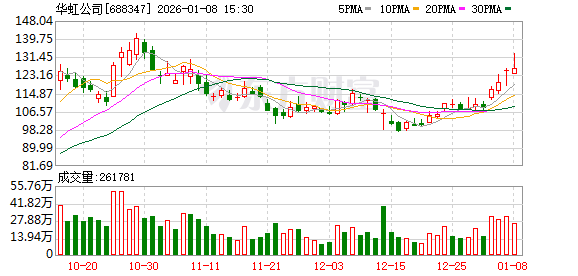
Core Viewpoint - A significant block trade occurred for Huahong Company on January 8, with a transaction volume of 70,000 shares and a transaction value of 7.1085 million yuan, reflecting a discount of 19.60% compared to the closing price of the day [2] Group 1: Block Trade Details - The block trade price was 101.55 yuan, which is lower than the closing price of 126.30 yuan [2] - The buyer was Ping An Securities Co., Ltd. Shanghai Branch, and the seller was Ping An Securities Co., Ltd. Shanghai Minhang District Minhong Road Securities Branch [2] - In the last three months, Huahong Company has recorded a total of 2 block trades, with a cumulative transaction value of 9.7346 million yuan [2] Group 2: Stock Performance - On the day of the block trade, Huahong Company's stock closed at 126.30 yuan, up 0.74%, with a turnover rate of 6.42% and a total transaction amount of 3.369 billion yuan [2] - The net outflow of main funds for the day was 6.4139 million yuan, while the stock has increased by 14.92% over the past five days, with a total net inflow of funds amounting to 537 million yuan [2] Group 3: Margin Financing Data - The latest margin financing balance for Huahong Company is 2.475 billion yuan, which has increased by 531 million yuan over the past five days, representing a growth rate of 27.29% [2]
行业投资策略:AI算力自主可控的全景蓝图与投资机遇
KAIYUAN SECURITIES· 2026-01-08 14:22
Group 1 - The semiconductor industry is expected to experience significant growth, with the domestic semiconductor index outperforming the CSI 300 index, showing a cumulative increase of 54.51% as of October 28, 2025, driven by factors such as national subsidies, AI computing demand, and domestic substitution [16][21]. - The AI chip market in China is projected to grow from 142.54 billion yuan in 2024 to 1,336.79 billion yuan by 2029, with a compound annual growth rate (CAGR) of 53.7% from 2025 to 2029, indicating a critical development opportunity for domestic AI chip manufacturers [42][44]. - The global GPU market is expected to grow from $77.39 billion in 2024 to $472.45 billion by 2030, with a CAGR of 35.19%, reflecting strong demand for AI computing [37][40]. Group 2 - The domestic AI chip industry is categorized into three stages: the first stage focuses on the self-sufficiency of computing, storage, and power chips; the second stage emphasizes the self-sufficiency of chip manufacturing processes; and the third stage targets the self-sufficiency of foundational hard technologies such as equipment materials and EDA [5][6]. - The demand for AI computing chips is driven by the rapid growth of generative AI applications, with NVIDIA's data center revenue increasing by 69% year-on-year to $44.1 billion in the first quarter of fiscal 2026, highlighting the accelerating demand for AI computing power [37][44]. - The semiconductor equipment sector is experiencing a significant increase in domestic production capacity, with the domestic semiconductor equipment localization rate expected to rise rapidly, particularly in dry etching and thin film deposition processes [6][15]. Group 3 - The report indicates that the advanced packaging technology, such as CoWoS, is expected to play a crucial role in the evolution of AI computing power, with domestic companies making significant advancements in this area [7][11]. - The semiconductor industry is witnessing a recovery in profitability, with the average gross margin and net profit margin for the semiconductor sector showing improvements in the first half of 2025 [36][34]. - The report highlights the importance of advanced wafer manufacturing as the physical foundation for AI chips, with a long-term demand for advanced foundry services expected to drive growth in this segment [7][11].


近850亿资本涌入,中芯、华虹、晶合密集动作
3 6 Ke· 2026-01-08 12:09
Group 1 - The core point of the article highlights significant movements in the semiconductor industry, particularly acquisitions and investments by major players like SMIC, Huahong Semiconductor, and Jinghe Integrated [1][2][3] - SMIC announced plans to acquire 49% of the shares of its subsidiary, SMIC North, for 40.6 billion yuan, aiming to fully own the company and consolidate its operations [1][4][5] - Huahong Semiconductor plans to acquire 97.4988% of Huahong Micro for 8.268 billion yuan, enhancing its control over the company and addressing competition within its group [2][6][7] - Jinghe Integrated has initiated a new project with a total investment of 35.5 billion yuan, focusing on expanding its production capacity and technological capabilities in the semiconductor sector [2][8] Group 2 - SMIC North, established in 2013, has become a key production base for SMIC, with a monthly capacity of 70,000 wafers and advanced technology covering 40nm and 28nm processes [4][5] - The financial performance of SMIC North is strong, with projected revenues of 11.575 billion yuan and 12.98 billion yuan for 2023 and 2024, respectively, indicating significant profit contributions to SMIC [5] - Huahong Micro's core asset is a fully automated 12-inch wafer production line with a monthly capacity of 38,000 wafers, which will enhance Huahong Semiconductor's market position post-acquisition [7] - Jinghe Integrated's new project will add a 55,000 wafers/month production line, focusing on 40nm and 28nm processes, catering to various applications including AI and smart devices [8][9] Group 3 - The global wafer foundry market is expected to grow, with projections indicating an 18.3% increase in the semiconductor market size by 2026, reaching $880 billion [10] - The demand for mature process nodes (22-28nm) is anticipated to shift, with China's share in the global market expected to rise significantly by 2030 [10] - Major foundries, including SMIC and Huahong Semiconductor, are operating at high capacity utilization rates, indicating strong demand and potential for revenue growth [11][12] - Recent trends show a price increase in wafer foundry services, with SMIC and other companies raising prices by approximately 10% for certain processes, reflecting the industry's tightening supply and demand dynamics [12]
