
HUA HONG SEMI(01347)

Search documents
港股半导体板块午后异动拉升,宏光半导体(06908.HK)涨超2%,华虹半导体(01347.HK)涨近2%,中芯国际(00981.HK)、纳芯微(026...
Jin Rong Jie· 2026-01-15 06:12
Group 1 - The semiconductor sector in Hong Kong experienced a notable afternoon rally, with several companies showing significant gains [1] - Hongguang Semiconductor (06908.HK) rose over 2%, indicating positive market sentiment towards the company [1] - Huahong Semiconductor (01347.HK) increased nearly 2%, reflecting a broader trend of growth within the sector [1] Group 2 - Other companies such as SMIC (00981.HK) and Naxin Micro (02676.HK) also saw upward movement, contributing to the overall positive performance of the semiconductor industry [1]


港股收盘:恒生指数涨0.564%,恒生科技指数涨0.655%





Jin Rong Jie· 2026-01-14 08:27
本文源自:金融界AI电报 阿里健康涨18.960%,海底捞涨9.154%,农夫山泉涨6.023%,阿里巴巴-W涨5.691%,哔哩哔哩-W涨 5.135%,快手-W涨4.461%,华虹半导体涨4.292%。 ...
港股午评|恒生指数早盘涨0.92% 智谱大涨16%领涨AI概念
智通财经网· 2026-01-14 04:03
Group 1 - The Hang Seng Index rose by 0.92%, gaining 245 points to reach 27,094 points, while the Hang Seng Tech Index increased by 1.54% [1] - Zhipu Technology (02513) surged over 16% after launching the first domestic chip training multimodal SOTA model in collaboration with Huawei [1] - Alibaba (09988) saw a rise of over 5% as it announced a significant increase in capital expenditure for Alibaba Cloud, with expectations of resilient profitability [1] - Alibaba Health (00241) increased by over 15% after the exclusive launch of Beimei Jing® and receiving the first overseas drug price certification [1] - Yidu Tech (02158) rose over 9% after winning first place in a smart healthcare innovation competition, showcasing its strong AI capabilities [1] - Tongdao Recruitment (06100) jumped over 10% due to market reassessment of its AI strategy and solid financials [1] - Baiaosaitu-B (02315) increased by over 6% after localizing its AI-driven antibody drug development platform [1] - Maifushi (02556) rose over 8%, with its stock price nearly doubling in three weeks after launching the GEO intelligent assistant [1] - MicroPort Scientific-B (02252) increased by over 8%, as the surgical robot industry is expected to enter a commercialization and policy acceleration phase [1] Group 2 - Hua Hong Semiconductor (01347) rose over 5% as Goldman Sachs noted that high capacity utilization supports product mix optimization and price increases [2] - Restaurant stocks led the gains, with expectations that most leading restaurant brands will see a recovery in customer traffic, leading to more rational competition [2] - Haidilao (06862) increased by 7%, while Jiumaojiu (09922) rose by over 5% [2] - Qiutai Technology (01478) surged by 13% after announcing a profit warning, projecting a 400% to 450% year-on-year increase in comprehensive profit for 2025 [2]
港股异动 | 光通信板块集体回暖 英伟达Rubin平台完整版发布 机构看好Scaleup CPO大规模产业化
智通财经网· 2026-01-14 04:03
Group 1 - The optical communication sector is experiencing a collective rebound, with notable stock price increases for companies such as Huahong Semiconductor (up 5.69% to HKD 94.8), Jingxin Communication (up 5.44% to HKD 2.52), Hongteng Precision (up 5.66% to HKD 4.67), and Huiju Technology (up 2.11% to HKD 14.99) [1][1][1] Group 2 - At CES 2026, NVIDIA announced the Rubin architecture, which is a significant milestone in its data center hardware roadmap, integrating CPU, GPU, DPU, NIC, NVLink interconnect, and Ethernet switching into a comprehensive solution [1][1] - The primary goal of the Rubin platform is to significantly enhance AI performance and energy efficiency, with single GPU AI inference performance improving by 5 times and training performance by 3.5 times compared to previous generations [1][1] - Shanxi Securities released a report indicating that Rubin Ultra is expected to become a crucial milestone for the large-scale industrialization of Scaleup CPO, with Trainium4 and TPUv8 anticipated to be important drivers for CPO/NPO in 2027/28 [1][1] - Key investment aspects of CPO include high-density plug cores and extensive fiber optics resulting from shufflebox and multi-segment fiber wiring, advanced packaging of OE, and a large number of customized FAUs [1][1]

异动盘点0114 | 餐饮股涨幅居前,阿里健康再涨超14%;比特币概念股走高,支付概念板块延续昨日跌势
贝塔投资智库· 2026-01-14 04:01
Group 1 - The stock of Tongdao Liepin (06100) rose by 10.17%, reflecting market recognition of its "AI recruitment strategy" and "financial stability" [1] - The restaurant sector saw significant gains, with Haidilao (06862) up 7.7%, Jiumaojiu (09922) up 5.38%, and Helens (09869) up 6.67%, driven by demand recovery since early 2023 [1] - Voice Technology (02495) surged over 10% after announcing a share issuance of 6.73 million shares at HKD 46.3 each, with approximately 50% of the proceeds allocated for R&D [1] Group 2 - Alibaba-W (09988) increased by nearly 5%, following announcements at the 2025 Cloud Summit regarding changes to hardware infrastructure in response to new market demands [1] - Hua Hong Semiconductor (01347) rose over 5.3% after announcing a plan to acquire approximately 97.5% of Huali Micro for CNY 8.268 billion [2] - Jiufang Zhitu Holdings (09636) saw an increase of nearly 8%, attributed to active market trading with a daily turnover reaching CNY 3.6 trillion [2] Group 3 - Jingtai Holdings (02228) rose over 5.5%, with a month-to-date increase of nearly 50%, following the successful dual approval of its incubated company ReviR's innovative drug RTX-117 [2] - Xun Ce (03317) briefly rose over 6%, reaching a new high of HKD 68, due to a strategic cooperation framework agreement with Jinyong Investment [2] - Alibaba Health (00241) surged over 14.2%, with a month-to-date increase exceeding 30%, following the announcement of a milestone solution in the infant vascular tumor treatment field [3] Group 4 - Bitcoin rose over 2.5%, reaching USD 93,500, with Bitcoin-related stocks also increasing, including MSTR up 6.63% and COIN up 4% [4] - GCDT, a green decarbonization technology company, saw its stock price surge 25% after its IPO, which aims to raise approximately USD 10 million for factory construction and debt repayment [4] - Lithium giant Albemarle (ALB.US) rose 4.46%, with analysts noting a reduction in concerns over its balance sheet as it achieves leverage optimization [4] Group 5 - Gold concept stocks showed mixed performance, with AngloGold Ashanti (AU.US) up 1.11% and Barrick Mining (B.US) up 1.39%, while some others declined [5] - Google (GOOGL.US) increased by 1.24% following a significant partnership with Apple to advance AI technology, with Google's Gemini model becoming a core support for future Apple devices [5] - Payment concept stocks continued to decline, with major banks also falling, amid concerns over potential impacts from proposed credit card interest rate caps [6] Group 6 - Intel (INTC.US) and AMD (AMD.US) saw initial gains of 7.33% and 6.39%, respectively, after KeyBanc Capital Markets upgraded their ratings to "overweight" [6] - Rezolve AI (RZLV.US) fell 9.23% despite raising its long-term revenue forecast, indicating significant commercialization progress [7] - Satellogic (SATL.US) declined 1.11% after a previous surge, following the announcement of a contract for two high-resolution satellites [7]


最高涨 20%!8 英寸晶圆代工开启全行业涨价
是说芯语· 2026-01-14 03:30
Core Viewpoint - The global 8-inch wafer foundry capacity is expected to decrease by 2.4% in 2026 due to TSMC and Samsung Electronics reducing their production capacity, while demand for AI-driven power management chips remains strong, leading to an anticipated increase in capacity utilization rates to 90% this year [2][8]. Group 1: Company-Specific Insights - TSMC plans to gradually exit the 6-inch wafer manufacturing business within two years and continue to reduce 8-inch wafer capacity, with a current monthly capacity of approximately 528,000 wafers [4]. - Samsung Electronics will also reduce its 8-inch wafer production starting in the second half of 2025, aiming to allocate more resources to the 12-inch wafer market, with a similar monthly capacity of 528,000 wafers [4]. - UMC's 8-inch wafer monthly capacity was previously over 360,000 wafers, with a current utilization rate of about 70%, and the company is optimistic about continued growth in 2026 [5]. - SMIC has a monthly capacity of approximately 355,000 8-inch wafers, with a utilization rate of 95.8% as of Q3 2025, and has raised prices by about 10% due to high demand [5]. - Hua Hong Semiconductor's 8-inch wafer foundry utilization rate reached 109.5%, indicating overcapacity, and the company is expanding its production capacity [6]. - Powerchip's 8-inch wafer monthly capacity is around 120,000 wafers, benefiting from the tight supply of memory chips and the recovery of logic process products [6]. - GlobalFoundries is focusing on expanding its 12-inch wafer production, with a projected decline of about 0.3% in global 8-inch wafer foundry capacity in 2025 [7]. Group 2: Market Trends and Projections - The average capacity utilization rate for global 8-inch wafer foundries is expected to rise to 85% to 90% in 2026, significantly better than the 75% to 80% range in 2025 [8]. - Some foundries are notifying customers of price increases ranging from 5% to 20% due to tightening capacity, marking a shift from previous selective price adjustments [8].


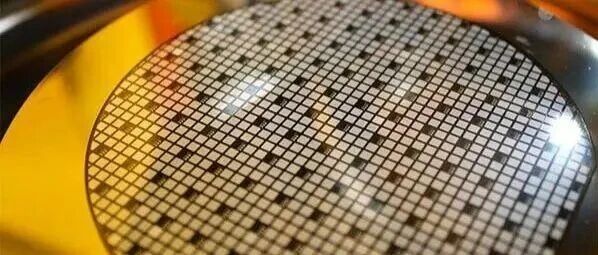
半导体股拉升 华虹半导体涨超5% 半导体景气超预期
Ge Long Hui· 2026-01-14 03:27
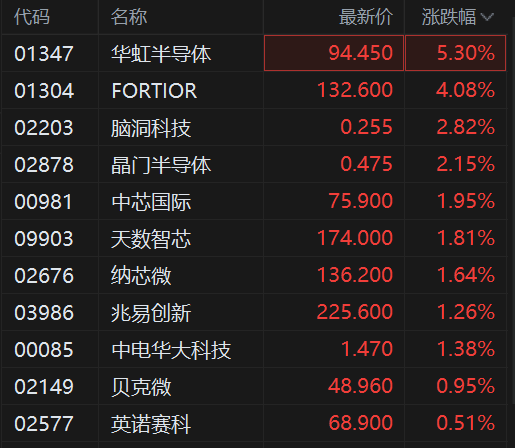
Group 1 - Semiconductor stocks in Hong Kong experienced a collective surge, with Huahong Semiconductor rising over 5%, and other companies like Jingmen Semiconductor and SMIC increasing by 2% [1] - Guosen Securities' latest report indicates that the semiconductor sector is performing better than expected, with price increases across multiple segments and the imminent release of AI glasses [1] - Research institutions predict that the average capacity utilization rate of global 8-inch wafer fabs will rise to the range of 85% to 90% by 2026, a significant improvement from 75% to 80% in 2025, reflecting a recovery in downstream application areas [1] Group 2 - The U.S. has relaxed export regulations on Nvidia's H200 chips to China, which may impact the semiconductor market dynamics [1] - The stock performance of various semiconductor companies includes Huahong Semiconductor at 94.450 with a 5.30% increase, and SMIC at 75.900 with a 1.95% increase [2]
华虹公司股价涨5.11%,华银基金管理旗下1只基金重仓,持有4529股浮盈赚取2.8万元
Xin Lang Cai Jing· 2026-01-14 03:03
Group 1 - The core viewpoint of the news is that Huahong Semiconductor has seen a significant increase in its stock price, reflecting positive market sentiment and investor interest [1] - As of January 14, Huahong's stock price rose by 5.11% to 127.14 CNY per share, with a trading volume of 804 million CNY and a turnover rate of 1.59%, resulting in a total market capitalization of 220.92 billion CNY [1] - Huahong Semiconductor, established on January 21, 2005, specializes in wafer foundry services with a focus on specialty processes, including embedded/non-volatile memory, power devices, analog and power management, and logic/RF [1] Group 2 - Huayin Fund Management has a fund that heavily invests in Huahong Semiconductor, with the Beixin Ruifeng Research Select Fund (004352) holding 4,529 shares, accounting for 2.79% of the fund's net value, making it the fifth-largest holding [2] - The Beixin Ruifeng Research Select Fund has a total scale of 18.5997 million CNY and has achieved a year-to-date return of 6.64%, ranking 1,891 out of 5,520 in its category [2] - The fund has performed well over the past year, with a return of 56.02%, ranking 1,128 out of 4,203 in its category, and a cumulative return of 87.96% since its inception [2]