
HUA HONG SEMI(01347)

Search documents
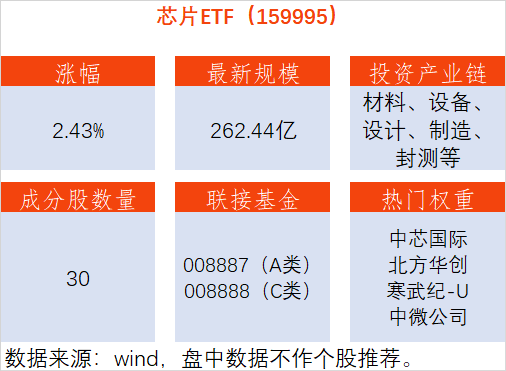
国产替代加速!芯片ETF(159995)上涨2.43%,华海清科上涨7.88%
Mei Ri Jing Ji Xin Wen· 2026-01-06 02:29
Group 1 - The A-share market saw a collective rise on January 6, with the Shanghai Composite Index increasing by 0.73%, driven by gains in precious metals, brokerage, and basic metals sectors [1] - The chip technology sector continued to strengthen, with the chip ETF (159995) rising by 2.43% as of 10:04 AM, and notable increases in constituent stocks such as Huahai Qingke (+7.88%), Zhongwei Company (+6.80%), and others [1] Group 2 - Changxin announced plans to raise 29.5 billion, allocating 7.5 billion for upgrading the manufacturing line for memory chips, 13 billion for DRAM technology upgrades, and 9 billion for R&D in dynamic random-access memory [3] - SMIC plans to issue 547 million shares at 74.20 yuan per share to acquire a 49% stake in SMIC North, while Huahong Semiconductor intends to issue 191 million shares at 43.34 yuan per share to acquire a 97.4988% stake in Huali Micro [3] - According to Zhongshan Securities, the AI-related industry is expected to maintain a favorable outlook through 2026, with domestic semiconductor opportunities arising from accelerated localization [3] - Predictions indicate that capital expenditure by cloud computing giants may sustain over 40% growth by 2026, with the AI sector remaining robust [3] - The chip ETF (159995) tracks the National Chip Index, comprising 30 leading companies in the A-share chip industry, including SMIC, Cambricon, Changdian Technology, and Northern Huachuang [3]






华虹公司股价涨5.91%,银河基金旗下1只基金重仓,持有930万股浮盈赚取6398.4万元
Xin Lang Cai Jing· 2026-01-06 02:11
1月6日,华虹公司涨5.91%,截至发稿,报123.37元/股,成交11.29亿元,换手率2.32%,总市值2141.70 亿元。 资料显示,华虹半导体有限公司位于上海张江高科技园区哈雷路288号,香港中环夏悫道12号美国银行中 心2212室,成立日期2005年1月21日,上市日期2023年8月7日,公司主营业务涉及华虹半导体有限公司 是一家主要从事特色工艺晶圆代工的中国投资控股公司。该公司提供包括嵌入式/独立式非易失性存储 器、功率器件、模拟与电源管理、逻辑与射频等多元化特色工艺平台的晶圆代工及配套服务。该公司还 从事提供包括知识产权(IP)设计、测试等配套服务。该公司主要在国内市场从事其业务。主营业务收 入构成为:集成电路晶圆代工94.60%,其他4.78%,租赁收入0.62%。 从华虹公司十大流通股东角度 数据显示,银河基金旗下1只基金位居华虹公司十大流通股东。银河创新混合A(519674)三季度新进 十大流通股东,持有股数930万股,占流通股的比例为0.54%。根据测算,今日浮盈赚取约6398.4万元。 银河创新混合A(519674)基金经理为郑巍山。 截至发稿,郑巍山累计任职时间6年243天,现任基 ...
4500点?
Xin Lang Cai Jing· 2026-01-06 01:17
MACD金叉信号形成,这些股涨势不错! 责任编辑:石秀珍 SF183 2026年真是起个好头啊,假期发酵的脑机题材直接起飞,带飞了医药;存储又带飞了半导体。基本上算 全线起飞,尤其是港股,撑住了获利跑的资金,生物科技更是大涨4%,港股信息技术 ETF(159131) 大涨3.2%~ 港股信息技术 ETF(159131)是一只非常有特色且稀缺的ETF品种,也是目前全市场唯一一只跟踪中证 港股通信息技术综合指数的 ETF,其标的指数创新性地采用 "70% 硬件 + 30% 软件" 的配置结构,剔除 大市值互联网企业,聚焦 "半导体 + 电子 + 计算机软件" 三大核心领域。 从成分股构成看,该指数涵盖 42 家港股硬科技龙头,前十大权重股合计占比达 70.71%,龙头效应显 著,其中中芯国际以 20.48% 的权重稳居第一,华虹半导体、小米等芯片与电子制造龙头紧随其后,形 成 "国产替代核心 + 终端应用龙头" 的立体布局。港股信息技术 ETF(159131)不受 QDII 额度限制, 支持日内 T+0 交易。 2026年大家要重视港股行情,尤其是港股的稀缺资产,通过ETF投资港股应该是普通人最好的选择,没 有之 ...
三家半导体龙头企业齐推重组交易,科创板并购迈向“质变”新阶段
Xin Lang Cai Jing· 2026-01-05 22:50
Group 1 - Core viewpoint: Recent mergers and acquisitions by companies such as SMIC, Hua Hong, and Zhongwei reflect a significant trend in the semiconductor industry, with distinct integration strategies being employed [1] - Hua Hong plans to issue shares to acquire 97.5% of its "brother company" Huali Micro [1] - Zhongwei intends to issue shares and pay cash to purchase 64.69% of Hangzhou Zhonggui's equity [1] - SMIC announced a draft transaction to acquire 49% equity of its subsidiary, SMIC North [1] Group 2 - Since the release of the "Science and Technology Innovation Board Eight Articles," nearly 170 equity acquisition transactions have been disclosed by companies on the Science and Technology Innovation Board [1] - In 2025, over 100 transactions are expected, indicating a significant policy effect [1] - Major asset restructurings have reached 50 transactions, with 37 occurring in 2025, surpassing the total of 17 from 2019 to 2023 [1]
南京熊猫电子股份近一个月首次上榜港股通成交活跃榜




Zheng Quan Shi Bao Wang· 2026-01-05 14:51
Core Viewpoint - On January 5, Nanjing Panda Electronics Co., Ltd. made its debut on the Hong Kong Stock Connect active trading list, marking its first appearance in the past month [2]. Group 1: Trading Activity - On January 5, the total trading volume of active stocks on the Hong Kong Stock Connect reached 529.01 billion HKD, accounting for 36.84% of the day's total trading amount [2]. - The net buying amount for the day was 99.89 billion HKD [2]. - Alibaba-W led the trading volume with 95.60 billion HKD, followed by SMIC and the Tracker Fund of Hong Kong with 87.99 billion HKD and 68.45 billion HKD, respectively [2]. Group 2: Stock Performance - Nanjing Panda Electronics recorded a trading volume of 16.35 billion HKD on its first day on the active list, with a net buying amount of 1.05 billion HKD and a closing price increase of 39.75% [2]. - Among the stocks listed, Alibaba-W, Tencent Holdings, and others appeared most frequently, each making the list 17 times in the past month, indicating strong interest from Hong Kong Stock Connect investors [2].

港股通1月5日成交活跃股名单
Zheng Quan Shi Bao Wang· 2026-01-05 14:44
成交活跃股方面,今日上榜个股中,南向资金成交金额最多的是阿里巴巴-W,合计成交额95.60亿港 元,中芯国际、盈富基金成交额紧随其后,分别成交87.99亿港元、68.45亿港元。以净买卖金额统计, 净买入的个股共有10只,盈富基金净买入额为68.26亿港元,净买入金额居首,该股收盘股价下跌 0.08%,快手-W净买入额为15.56亿港元,小米集团-W净买入额为10.19亿港元。净卖出金额最多的是腾 讯控股,净卖出9.19亿港元,该股收盘股价上涨0.24%,中国移动、南京熊猫电子股份遭净卖出4.06亿 港元、1.05亿港元。 今日上榜个股中,盈富基金、快手-W、小米集团-W等8只股同时上榜港股通(深)、港股通(沪)成 交活跃股, 盈富基金合计成交额68.45亿港元,成交净买入68.26亿港元,快手-W合计成交额53.10亿港 元,成交净买入15.56亿港元。腾讯控股合计成交额64.57亿港元,成交净卖出9.19亿港元。 从连续性进行统计, 有3只股获南向资金连续3天以上净买入,连续净买入天数较多的有华虹半导体、 小米集团-W、中芯国际,连续净买入天数分别为5天、3天、3天。以其间净买入金额统计,净买入金额 最多 ...

港股通净买入187.23亿港元
Zheng Quan Shi Bao Wang· 2026-01-05 14:43
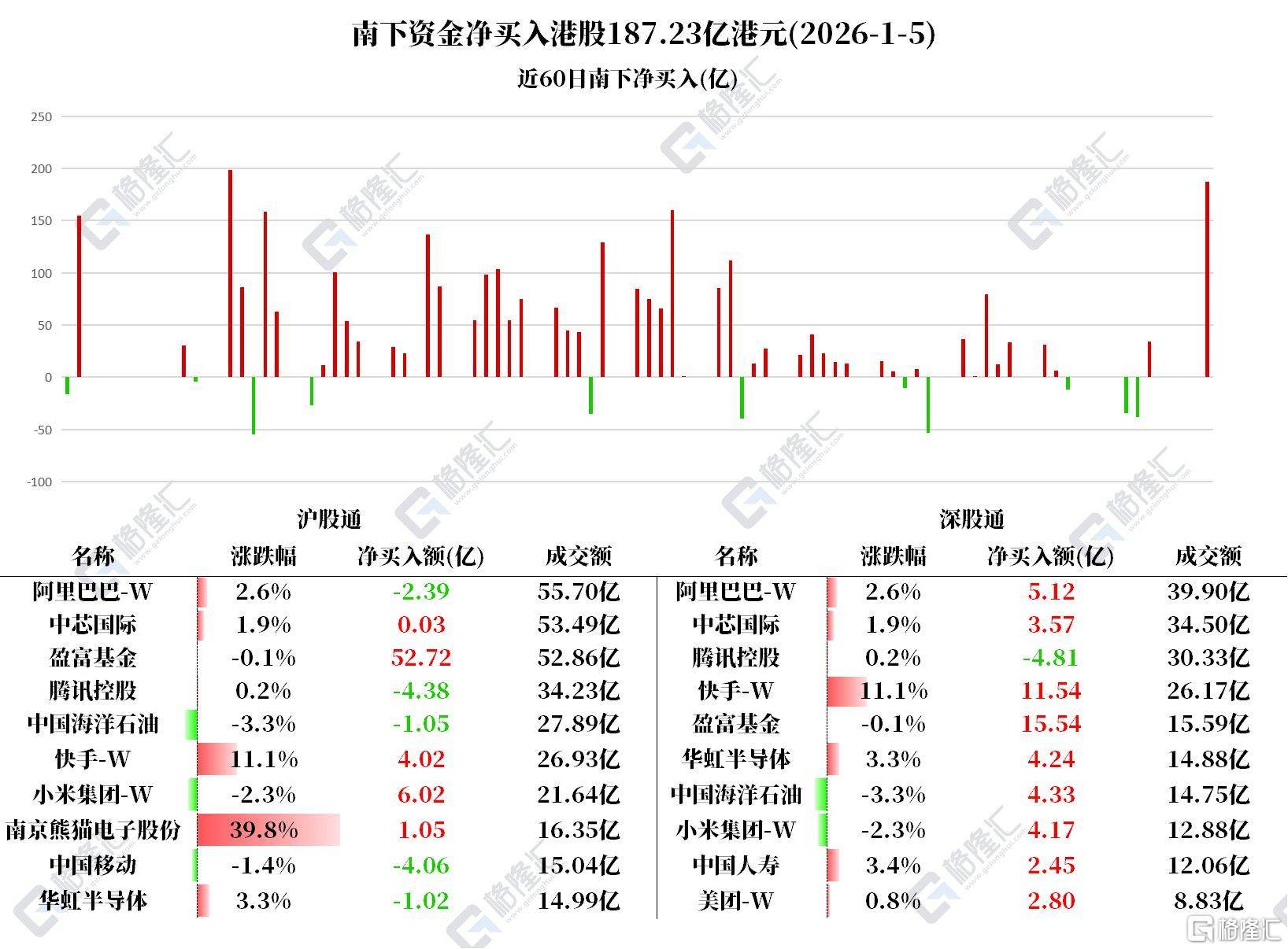
1月5日恒生指数上涨0.03%,报收26347.24点,全天南向资金通过港股通渠道合计净买入187.23亿港 元。 证券时报·数据宝统计,1月5日港股通全天合计成交金额为1436.06亿港元,成交净买入187.23亿港元。 具体来看,沪市港股通成交金额871.38亿港元,成交净买入98.09亿港元;深市港股通成交金额564.68亿 港元,成交净买入89.14亿港元。 成交活跃股方面,沪市港股通前十大成交活跃股中,阿里巴巴-W成交额为55.70亿港元,成交金额居 首;其次是中芯国际、盈富基金,成交金额分别为53.49亿港元、52.86亿港元。以净买卖金额统计,盈 富基金净买入额为52.72亿港元,净买入金额居首,该股收盘股价下跌0.08%。净卖出金额最多的是腾讯 控股,净卖出4.38亿港元,收盘股价上涨0.24%。 深市港股通前十大成交活跃股中,成交额居首的是阿里巴巴-W,成交金额39.90亿港元;其次是中芯国 际、腾讯控股,成交金额分别为34.50亿港元、30.33亿港元。以净买卖金额统计,有9只股为净买入,净 买入金额最多的是盈富基金,净买入15.54亿港元,该股收盘下跌0.08%。净卖出金额最多的是腾讯控 ...
资金动向 | 北水爆买港股超187亿港元,连续5日加仓华虹半导体
Sou Hu Cai Jing· 2026-01-05 12:43
Group 1 - The net buying amounts for various stocks include: 6.826 billion for Yingfu Fund, 1.556 billion for Kuaishou-W, 1.019 billion for Xiaomi Group-W, 360 million for SMIC, 328 million for CNOOC, 322 million for Hua Hong Semiconductor, 279 million for Meituan-W, 272 million for Alibaba-W, 245 million for China Life, and 105 million for Nanjing Panda Electronics [1] - The net selling amounts include: 918 million for Tencent Holdings and 406 million for China Mobile [1] - Southbound funds have continuously net sold Tencent for 6 days, totaling 4.86189 billion HKD; they have also net bought Hua Hong Semiconductor for 5 consecutive days, totaling 936.63 million HKD [1] Group 2 - Kuaishou-W has ranked first in graphic and design applications in South Korea, with 500,000 downloads and revenue of 900,000 USD in December [3] - SMIC has received an investment from the National Integrated Circuit Industry Investment Fund, increasing its stake from 4.79% to 9.25%, involving approximately 26.515 billion RMB [3] - Alibaba-W is launching a service to help restaurants utilize AI to showcase their environments, enhancing competition with Meituan in the Chinese dining sector [4]
资金动向 | 北水爆买港股超187亿港元,连续5日加仓华虹半导体
Ge Long Hui· 2026-01-05 12:41
Group 1 - Southbound funds net bought Hong Kong stocks worth 18.723 billion HKD on January 5, with notable purchases including 6.826 billion HKD in the Tracker Fund, 1.556 billion HKD in Kuaishou-W, and 1.019 billion HKD in Xiaomi Group-W [1] - Tencent Holdings experienced a net sell-off of 9.18 billion HKD, marking six consecutive days of net selling totaling 4.86189 billion HKD [1] - Semiconductor companies saw increased interest, with SMIC receiving net purchases totaling 1.5115 billion HKD over three days and Hua Hong Semiconductor seeing net buys of 936.63 million HKD over five days [1] Group 2 - Kuaishou-W ranked first in graphic and design applications in South Korea and was among the top ten in markets like the US, Turkey, and Vietnam, with 500,000 downloads and 900,000 USD in revenue in December [3] - SMIC was significantly supported by the National Integrated Circuit Industry Investment Fund, which increased its stake from 4.79% to 9.25% by acquiring over 357 million shares at an average price of 74.2 RMB per share [3] - China National Offshore Oil Corporation (CNOOC) faced a decline in oil prices due to concerns over supply despite political turmoil in Venezuela, with Brent crude falling to around 60 USD per barrel [3] - Alibaba Group is launching a service to help restaurants utilize AI to showcase their environments, part of a broader strategy to compete with Meituan in the Chinese dining sector [3]
智通港股通活跃成交|1月5日


智通财经网· 2026-01-05 11:02
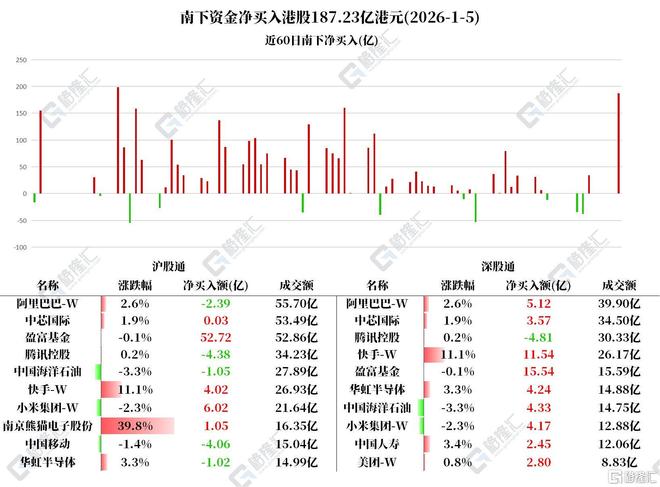
深港通(南向)十大活跃成交公司 沪港通(南向)十大活跃成交公司 | 公司名称 | 成交金额 | 净买入额 | | --- | --- | --- | | 阿里巴巴-W(09988) | 55.70 亿元 | -2.39 亿元 | | 中芯国际(00981) | 53.49 亿元 | +296.90 万元 | | 盈富基金(02800) | 52.86 亿元 | +52.72 亿元 | | 腾讯控股(00700) | 34.23 亿元 | -4.38 亿元 | | 中国海洋石油(00883) | 27.89 亿元 | -1.05 亿元 | | 快手-W(01024) | 26.93 亿元 | +4.02 亿元 | | 小米集团-W(01810) | 21.64 亿元 | +6.02 亿元 | | 南京熊猫电子股份(00553) | 16.35 亿元 | +1.05 亿元 | | 中国移动(00941) | 15.04 亿元 | -4.06 亿元 | | 华虹半导体(01347) | 14.99 亿元 | -1.02 亿元 | 智通财经APP获悉,2026年1月5日当天,阿里巴巴-W(09988)、中芯国际(00 ...