XIAOMI(01810)

Search documents
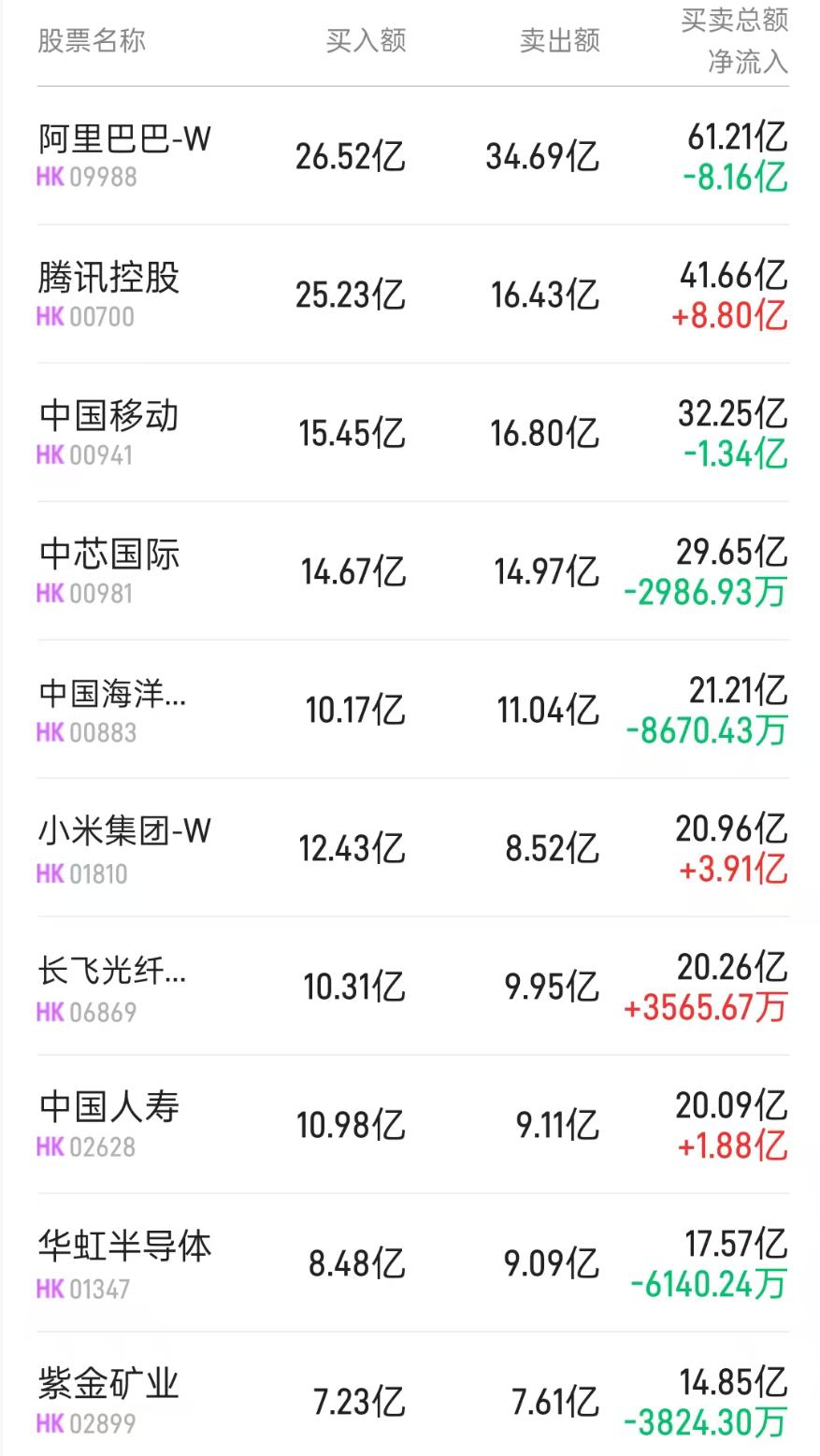
智通港股通活跃成交|2月2日
智通财经网· 2026-02-02 11:01
Core Insights - On February 2, 2026, Alibaba-W (09988), Tencent Holdings (00700), and China Mobile (00941) were the top three companies by trading volume in the Southbound Stock Connect, with transaction amounts of 6.121 billion, 4.166 billion, and 3.225 billion respectively [1] - In the Shenzhen-Hong Kong Stock Connect, Alibaba-W (09988), Tencent Holdings (00700), and SMIC (00981) also led the trading volume, with transaction amounts of 3.730 billion, 2.511 billion, and 2.012 billion respectively [1] Southbound Stock Connect Top Active Companies - Alibaba-W (09988) had a trading amount of 6.121 billion with a net buy of -0.816 billion [2] - Tencent Holdings (00700) recorded a trading amount of 4.166 billion with a net buy of +0.880 billion [2] - China Mobile (00941) had a trading amount of 3.225 billion with a net buy of -0.134 billion [2] - SMIC (00981) had a trading amount of 2.965 billion with a net buy of -29.8693 million [2] - Other notable companies included Xiaomi Group-W (01810) with a trading amount of 2.096 billion and a net buy of +0.391 billion [2] Shenzhen-Hong Kong Stock Connect Top Active Companies - Alibaba-W (09988) had a trading amount of 3.730 billion with a net buy of +0.488 billion [2] - Tencent Holdings (00700) recorded a trading amount of 2.511 billion with a net buy of +0.424 billion [2] - SMIC (00981) had a trading amount of 2.012 billion with a net buy of -1.32 billion [2] - Other significant companies included China Mobile (00941) with a trading amount of 1.401 billion and a net buy of +0.0651447 billion [2]





雷军回应小米汽车1月份交付量下滑
新华网财经· 2026-02-02 10:40
Core Viewpoint - Xiaomi's January delivery of over 39,000 vehicles is being compared unfavorably to December's over 50,000, leading to perceptions of a decline in delivery volume, which the company's CEO Lei Jun argues is an unfair comparison due to seasonal factors and the discontinuation of the first-generation SU7 model [3][4]. Group 1: Delivery Performance - Xiaomi's cumulative delivery volume has approached 600,000 vehicles, with a target of 550,000 for 2026 and over 410,000 for 2025, exceeding the original plan of 300,000 [4]. - Lei Jun emphasized that achieving 39,000 deliveries in January is commendable given it is typically a slow month for the automotive market [4]. Group 2: Resale Value and Market Position - The one-year resale value of the Xiaomi SU7 is reported at 86%, ranking first among pure electric vehicles for 2025, outperforming Porsche Taycan and Tesla Model X [6]. - Lei Jun addressed concerns about the SU7's resale value, suggesting that some competitors may be spreading misinformation for publicity [6]. Group 3: New Model Development - The next-generation SU7 is expected to launch in April 2026, featuring the Xiaomi Super Motor V6s Plus, which will enhance production efficiency and reduce delivery times [7]. - Xiaomi has established over 100 self-built laboratories and two comprehensive vehicle testing grounds, with a testing team exceeding 800 members and over 2,300 test vehicles covering more than 300 cities [7].


据港交所公告,小米集团(01810.HK)于2月2日以2.092亿港元回购600万B类股份。
Jin Rong Jie· 2026-02-02 10:38
据港交所公告,小米集团(01810.HK)于2月2日以2.092亿港元回购600万B类股份。 本文源自:金融界AI电报 ...
小米集团-W2月2日斥资2.09亿港元回购600万股
Zhi Tong Cai Jing· 2026-02-02 10:33
小米集团-W(01810)发布公告,于2026年2月2日该公司斥资2.09亿港元回购600万股,回购价格为每股 34.54-35.00港元。 ...
小米集团-W(01810)2月2日斥资2.09亿港元回购600万股
智通财经网· 2026-02-02 10:33
智通财经APP讯,小米集团-W(01810)发布公告,于2026年2月2日该公司斥资2.09亿港元回购600万股, 回购价格为每股34.54-35.00港元。 ...
小米集团(01810) - 翌日披露报表
2026-02-02 10:25
FF305 翌日披露報表 (股份發行人 ── 已發行股份或庫存股份變動、股份購回及/或在場内出售庫存股份) 表格類別: 股票 狀態: 新提交 公司名稱: 小米集团 (於開曼群島註冊成立以不同投票權控制的有限公司) | | B. 贖回/購回股份 (擬註銷但截至期終結存日期尚未註銷) (註5及6) | | | | | | --- | --- | --- | --- | --- | --- | | 1). | 購回股份 (擬註銷但截至期終結存日期尚未註銷) | 13,500,000 | 0.052 % | HKD | 37.61 | | | 變動日期 2025年11月20日 | | | | | | 2). | 購回股份 (擬註銷但截至期終結存日期尚未註銷) | 8,000,000 | 0.031 % | HKD | 37.92 | | | 變動日期 2025年11月21日 | | | | | | 3). | 購回股份 (擬註銷但截至期終結存日期尚未註銷) | 2,500,000 | 0.01 % | HKD | 40.29 | | | 變動日期 2025年11月25日 | | | | | | 4). | 購回股份 ...
净买入约19亿港元 加仓腾讯流出紫金矿业及华虹半导体
Xin Lang Cai Jing· 2026-02-02 10:16
Market Overview - Southbound funds traded approximately HKD 138.285 billion today, a significant increase of about HKD 21.8 billion compared to the previous day, accounting for 39.75% of the total turnover of the Hang Seng Index, which has been below 40% for several consecutive days [2] - Despite the Hong Kong stock market accelerating downward, southbound funds saw a net inflow of approximately HKD 1.907 billion, with the Shanghai-Hong Kong Stock Connect recording a net inflow of about HKD 2.738 billion, while the Shenzhen-Hong Kong Stock Connect experienced a net outflow of approximately HKD 0.83 billion [2] Individual Stock Performance - Tencent Holdings (0700.HK) saw a significant net buy of HKD 1.304 billion, while its stock price fell by 1.24% [2][3] - Xiaomi Group-W (01810.HK) had a net buy of HKD 0.278 billion, with a stock price decline of 1.24% [2][3] - Huahong Semiconductor (01347.HK) experienced a net outflow of HKD 0.615 billion and a sharp decline of 11.24% [2][4] - Zijin Mining (02899.HK) had a net outflow of HKD 0.464 billion, with a stock price drop of 5.58% [2][4] - CSPC Pharmaceutical Group (01093.HK) saw a net outflow of HKD 0.393 billion and a decline of 4.69% [2][4] - Alibaba-W (09988.HK) experienced a net outflow of HKD 0.329 billion, with a stock price decrease of 3.49% [2][4] - SMIC (00981.HK) had a net outflow of HKD 0.162 billion, with a decline of 4.24% [2][4] Trading Activity - In the top ten active stocks on the Hong Kong Stock Connect (Shanghai), Alibaba-W had a net outflow of HKD 0.816 billion, while Tencent Holdings had a net inflow of HKD 0.880 billion [5] - On the Shenzhen Stock Connect, Alibaba-W recorded a net inflow of HKD 0.488 billion, while Huahong Semiconductor had a significant net outflow of HKD 0.554 billion [5]


北水动向|北水成交净买入19.07亿 元宝春节红包活动启动 北水抢筹腾讯(00700)超13亿港元
智通财经网· 2026-02-02 10:01
Summary of Key Points Core Viewpoint - The Hong Kong stock market experienced significant net inflows from northbound capital, with a total net buy of HKD 19.07 billion on February 2, 2023, indicating strong investor interest in certain stocks while others faced net sell-offs [1]. Group 1: Northbound Capital Activity - Northbound capital recorded a net buy of HKD 27.38 billion through the Shanghai Stock Connect and a net sell of HKD 8.3 billion through the Shenzhen Stock Connect [1]. - The most bought stocks included Tencent (00700), Xiaomi Group-W (01810), and China Life (02628) [1]. - The most sold stocks were Hua Hong Semiconductor (01347), Zijin Mining (02899), and CSPC Pharmaceutical Group (01093) [1]. Group 2: Individual Stock Performance - Alibaba-W (09988) had a net sell of HKD 3.28 billion, with plans to invest HKD 30 billion in a "Spring Festival Treat Plan" [6][7]. - Tencent (00700) saw a net buy of HKD 13.03 billion, boosted by the launch of its "Yuanbao" Spring Festival red envelope activity, which is expected to increase downloads and user engagement [4]. - China Life (02628) received a net buy of HKD 1.87 billion, supported by positive forecasts for its individual insurance sales [5]. - Hua Hong Semiconductor (01347) faced a net sell of HKD 6.15 billion, amid tightening order reviews from major chip manufacturers [6]. - Zijin Mining (02899) experienced a net sell of HKD 4.64 billion, as it announced plans to issue USD 1.5 billion zero-coupon convertible bonds for project financing [7].


南向资金今日净买入约19亿港元 腾讯控股获净买入居前
Xin Lang Cai Jing· 2026-02-02 09:51
Group 1 - Southbound funds recorded a net purchase of approximately 19.07 billion HKD today [1] - Tencent Holdings received the highest net purchase of about 13.04 billion HKD [1] - Xiaomi Group-W also saw a net purchase of approximately 2.78 billion HKD [1] Group 2 - Hua Hong Semiconductor experienced a net sell-off of 6.15 billion HKD [1]
雷军回应小米汽车交付量下滑
Sou Hu Cai Jing· 2026-02-02 08:56
Group 1 - Xiaomi's January delivery volume exceeded 39,000 units, which is lower than December's over 50,000 units, but CEO Lei Jun argues that this comparison is not objective due to January being a traditional off-peak season for car sales [2] - The first-generation Xiaomi SU7 has been discontinued, with deliveries in January primarily consisting of the new YU7 model [2] - Xiaomi's cumulative delivery volume has approached 600,000 units, with a target of 550,000 units for the entire year of 2026, and an expectation to exceed the previous year's target of 410,000 units [2] Group 2 - The Xiaomi SU7 has an impressive one-year resale value of 86%, ranking first among pure electric vehicles in the 2025 annual valuation report, outperforming Porsche Taycan and Tesla Model X [5] - Lei Jun addressed concerns about the resale value of Xiaomi vehicles, suggesting that some dealers are spreading misinformation for publicity [5] - The new generation SU7 is set to have its display vehicles showcased in seven major cities starting February 13, with the development and testing phase already completed [5] Group 3 - Xiaomi has established over 100 self-built laboratories in cities including Beijing, Shanghai, Nanjing, and Wuhan, along with two comprehensive vehicle testing grounds in Anhui and Jiangsu [6] - The testing team for Xiaomi vehicles has grown to over 800 members, with road tests covering more than 300 cities and over 2,300 test vehicles having accumulated over 28 million kilometers [6]