XIAOMI(01810)

Search documents
1月21日港股回购一览



Zheng Quan Shi Bao Wang· 2026-01-22 02:09
Group 1 - On January 21, 42 Hong Kong-listed companies conducted share buybacks, totaling 29.73 million shares and an amount of HKD 512 million [1] - Xiaomi Group-W had the highest buyback amount of HKD 248 million, repurchasing 7 million shares [1] - Other notable buybacks included Pop Mart with HKD 96.49 million and Sunny Optical Technology with HKD 61.39 million [1] Group 2 - The highest buyback price for Xiaomi was HKD 35.480, while the lowest was HKD 35.220, with a cumulative buyback amount of HKD 20.49 billion for the year [1] - Pop Mart's buyback ranged from HKD 194.900 to HKD 191.100, with a cumulative buyback amount of HKD 348 million for the year [1] - Sunny Optical Technology's buyback prices were between HKD 63.950 and HKD 62.300, with a cumulative buyback amount of HKD 686 million for the year [1]
港股开盘:恒指涨0.62%、科指涨0.85%,科网股、芯片股走高,创新药概念股活跃,黄金股回调
Jin Rong Jie· 2026-01-22 01:30
Market Overview - The Hong Kong stock market opened higher on January 22, with the Hang Seng Index rising by 0.62% to 26,750.51 points, the Hang Seng Tech Index increasing by 0.85% to 5,795 points, and the National Enterprises Index up by 0.55% to 9,173.54 points [1] - Major tech stocks mostly rose, with Alibaba up 1.72%, Tencent Holdings up 0.33%, JD Group up 0.98%, and Xiaomi Group up 0.9% [1] - Chip stocks opened high, with Zhaoyi Innovation rising over 7% [1] - The innovative drug concept was active, with WuXi Biologics rising over 1% [1] - Gold stocks generally fell, with Shandong Gold down over 2% [1] - Longqi Technology's IPO on the Hong Kong stock market saw a nearly 13% increase on its first day [1] Company News - Shanghai Electric (02727.HK) expects a net profit of RMB 1.1 billion to RMB 1.32 billion for 2025, an increase of approximately 47% to 76% year-on-year [2] - Kingdee International (00268.HK) anticipates total revenue of approximately RMB 6.95 billion to RMB 7.05 billion for 2025, a year-on-year growth of about 11.1% to 12.7% [2] - Beijing Machinery Electric (00187.HK) expects a net loss of RMB 46 million to RMB 55.2 million for 2025, primarily due to intensified international trade frictions affecting its gas storage and transportation export business [2] - Chow Tai Fook (01929.HK) reported a retail value growth of 17.8% for the three months ending December 31, 2025, with mainland China retail value increasing by 16.9% [2] - Zai Lab (09911.HK) anticipates a cumulative download of approximately 970 million for its social business by 2025, a year-on-year increase of about 5.9% [2] Strategic Developments - Ruiri Medical Technology (01696.HK) signed a letter of intent for cooperation with Stryker Medical to establish localized production in China [3] - Cathay Pacific (00293.HK) and Hong Kong Express expect to carry over 36 million passengers in 2025, a year-on-year increase of 27% [4] - Shenyang Public Development (00747.HK) has initiated edge computing infrastructure and service business [5] - Flat Glass Group (06865.HK) plans to absorb and merge with Zhongda Quartz Development [6] Share Buybacks - Xiaomi Group (01810.HK) repurchased 7 million shares for HKD 248 million at prices between HKD 35.22 and HKD 35.48 [7] - Pop Mart (09992.HK) repurchased 500,000 shares for HKD 96.49 million at prices between HKD 191.1 and HKD 194.9 [8] - Sunny Optical Technology (02382.HK) repurchased 970,000 shares for HKD 61.39 million at prices between HKD 62.30 and HKD 63.95 [9] - Geely Automobile (00175.HK) repurchased 2.376 million shares for HKD 39.62 million at prices between HKD 16.62 and HKD 16.81 [10] Financial Instruments - Huaneng International Power (00902.HK) completed the issuance of RMB 2 billion medium-term notes [11] - CICC (03908.HK) plans to issue up to RMB 5 billion in bonds for technology innovation companies [12] Institutional Insights - Dongwu Securities noted that despite a general reduction in the Fed's interest rate cut expectations in overseas markets, domestic investors remain optimistic [13] - Orient Securities highlighted that recent U.S. measures against Venezuela and Greenland have increased geopolitical risks, supporting gold prices [14] - Zheshang Securities suggested that the humanoid robot sector has formed an ecological closed loop, recommending attention to component suppliers and undervalued transformation targets [14] - CITIC Securities indicated that new policies from the National Medical Insurance Administration will accelerate the promotion of surgical robots in China [14]

港股股票回购一览:38只个股获公司回购
Mei Ri Jing Ji Xin Wen· 2026-01-22 01:25
Group 1 - On January 21, a total of 38 Hong Kong stocks were repurchased by companies, with 5 stocks having repurchase amounts exceeding 10 million HKD [1] - The companies with the largest repurchase amounts included Xiaomi Group-W, Pop Mart, and Sunny Optical Technology, with repurchase amounts of 248 million HKD, 96.49 million HKD, and 61.39 million HKD respectively [1] - As of January 21, 105 Hong Kong stocks have been repurchased this year, with 7 stocks having cumulative repurchase amounts exceeding 100 million HKD [1] Group 2 - The companies with the highest cumulative repurchase amounts this year are Tencent Holdings, Xiaomi Group-W, and Sunny Optical Technology, with repurchase amounts of 6.358 billion HKD, 2.049 billion HKD, and 686 million HKD respectively [1]

小米国内激活量超苹果 卢伟冰:竞争极其焦灼
Xin Lang Cai Jing· 2026-01-22 01:23
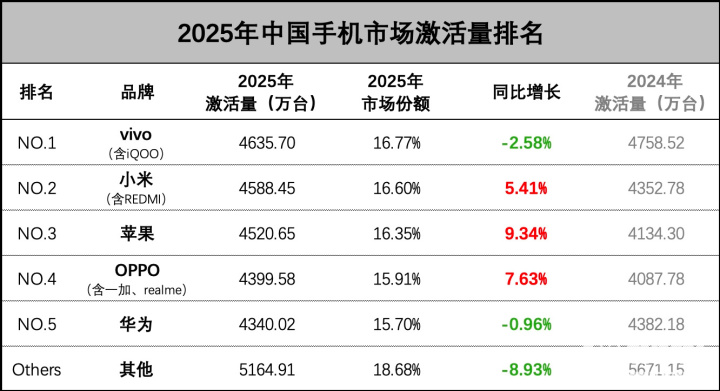
Core Insights - The top three smartphone brands in China by activation volume in 2025 are vivo, Xiaomi, and Apple, with vivo maintaining the first position despite a slight decline in activation volume [1][5] - Xiaomi surpassed Apple to claim the second position, largely due to the success of the Xiaomi 17 series, which includes models with activation volumes exceeding one million [2][6] - The activation volume gap between the top five brands is minimal, with less than 3 million units separating vivo from Huawei, indicating a highly competitive market where a single popular model can significantly influence brand rankings [1][5] Brand Performance Summary - **Vivo**: Ranked first with an activation volume of 4,635.70 thousand units, a market share of 16.77%, and a year-on-year decline of 2.58% from 4,758.52 thousand units in 2024 [2][6] - **Xiaomi**: Ranked second with an activation volume of 4,588.45 thousand units, a market share of 16.60%, and a year-on-year growth of 5.41% from 4,352.78 thousand units in 2024 [2][6] - **Apple**: Ranked third with an activation volume of 4,520.65 thousand units, a market share of 16.35%, and a year-on-year growth of 9.34% from 4,134.30 thousand units in 2024 [2][6] - **OPPO**: Ranked fourth with an activation volume of 4,399.58 thousand units, a market share of 15.91%, and a year-on-year growth of 7.63% from 4,087.78 thousand units in 2024 [2][6] - **Huawei**: Ranked fifth with an activation volume of 4,340.02 thousand units, a market share of 15.70%, and a year-on-year decline of 0.96% from 4,382.18 thousand units in 2024 [2][6] - **Others**: The remaining brands collectively accounted for 5,164.91 thousand units, with a market share of 18.68% and a year-on-year decline of 8.93% from 5,671.15 thousand units in 2024 [2][6] Market Dynamics - The competition among the top brands is extremely tight, with minor differences in activation volumes leading to significant shifts in rankings [5][9] - The timing of new product launches, such as the Huawei Mate 80 series, can greatly impact market standings, suggesting that strategic release schedules are crucial for maintaining competitive positions [5][8] - Xiaomi's Lu Weibing emphasized the intense competition in the Chinese market, indicating that the leading positions are very fragile and require continuous effort to maintain [9]


个人消费贷款贴息延长至2026年底
Sou Hu Cai Jing· 2026-01-22 01:23
Group 1 - The Ministry of Finance extends the implementation period of the personal consumption loan interest subsidy policy to the end of 2026 and raises the subsidy standards [1] - The subsidy cap of 500 yuan for a single consumption loan is removed, and the cumulative subsidy limit of 1,000 yuan for each borrower at one institution is also eliminated, while maintaining the annual limit of 3,000 yuan [1] - The range of institutions eligible for the subsidy is expanded to include various financial entities such as city commercial banks and foreign banks [1] Group 2 - The National Development and Reform Commission announces a unified subsidy standard for the "two new" policies, focusing on the replacement of old consumer goods, including cars and home appliances [2] - A national-level merger fund is being considered, along with the establishment of regulations for a unified national market [2] - Plans for a strategic implementation scheme to expand domestic demand from 2026 to 2030 are being developed [2] Group 3 - The Ministry of Finance emphasizes support for small and micro enterprises through loan interest subsidies, particularly in key industries such as new energy and automotive [3] - The policy targets 14 key industrial chains, including industrial robots and medical equipment [3] Group 4 - The State Administration for Market Regulation will implement a verification and evaluation standard for domestically produced testing instruments in the automotive sector by 2026 [4] - The focus will be on creating authoritative standards and addressing critical technologies in high-end equipment [4] Group 5 - By 2025, the number of cars owned per 100 households in China is projected to increase by 1.7 vehicles, reaching 52.9 vehicles [5] - The production and sales of new energy vehicles are expected to exceed 16 million units annually [5] Group 6 - A new interim measure for the recycling and comprehensive utilization of used power batteries from electric vehicles will be implemented starting April 1, 2026 [6] - The measure aims to enhance lifecycle management and establish a nationwide information platform for battery tracking [6] Group 7 - GAC Group announces the establishment of a new business unit (BU) for its Trumpchi brand, aimed at enhancing operational efficiency and market responsiveness [7][8] - The new BU will focus on brand rejuvenation and product innovation, emphasizing a high-quality brand positioning [7][8] Group 8 - Hyundai Motor plans to introduce its high-end brand to the Chinese market, leveraging local channels for better market competitiveness [9] - This move aligns with the deepening economic cooperation between China and South Korea [9] Group 9 - Xiaomi launches a 7-year low-interest car purchase policy for its new electric SUV, the Xiaomi YU7, following a similar initiative by Tesla [10] - The policy includes a low down payment and monthly payment options, indicating a competitive strategy in the electric vehicle market [10]

趋势研判!2026年中国智能设备行业发展历程、政策、发展现状、重点企业及未来趋势:全场景智能化生态加速形成,引领智能设备规模达万亿级别[图]
Chan Ye Xin Xi Wang· 2026-01-22 01:07
Core Insights - The smart device industry is experiencing significant growth driven by increasing consumer demand and advancements in technology, with the market size in China projected to grow from 5,133 billion yuan in 2018 to 17,157 billion yuan by 2024, representing a compound annual growth rate (CAGR) of 22.28% [1][14][15] - The industry is categorized into three main segments: smart home, smart wearables, and smart mobility, each with distinct applications and market dynamics [3][16][17] Industry Overview - Smart devices integrate hardware, software, and internet technologies, enabling them to perform tasks such as data collection and self-optimization [1][14] - The market is expected to reach 20,979 billion yuan by 2025, indicating continued growth and innovation in the sector [1][14] Industry Development Stages - The smart device industry in China has evolved through three phases: the initial stage (1990s to early 2000s), the development stage (2000 to 2015), and the explosive growth stage (2015 to present), with significant technological advancements and market expansion occurring in the latter two phases [6][8] Industry Policies - The Chinese government has implemented various policies to support the smart device industry, including initiatives to promote digital transformation and the development of smart products across multiple sectors [8][9] Industry Value Chain - The smart device industry value chain consists of upstream raw materials, hardware, and software systems; midstream manufacturing; and downstream applications in sectors such as healthcare, education, and transportation [10][11] Market Segmentation - The smart home market is characterized by diverse competition among traditional appliance manufacturers and tech companies, with a focus on integrated solutions and consumer experience [15] - The smart wearable segment includes products like smart glasses and smartwatches, with significant growth potential driven by consumer acceptance and technological advancements [16][17] - The smart mobility sector, particularly smart cars, is rapidly expanding, with the market size projected to grow from 777 billion yuan in 2020 to 2,152 billion yuan by 2024, reflecting a CAGR of 29% [17][18] Competitive Landscape - The smart device industry is marked by an ecosystem of competition, with leading companies leveraging core technologies and brand advantages to create comprehensive solutions across various applications [18][19] Future Trends - The industry is expected to see innovations in human-computer interaction, moving towards more natural and multi-modal interfaces [21] - There will be a shift from single-product intelligence to integrated scene intelligence, enhancing cross-device collaboration and user experience [22] - Smart devices will increasingly focus on personalized health management, evolving into digital health assistants capable of providing tailored recommendations [24]




智通港股通持股解析|1月22日
智通财经网· 2026-01-22 00:31
Group 1 - The top three companies by Hong Kong Stock Connect holding ratios are China Telecom (00728) at 70.91%, Green Power Environmental (01330) at 69.45%, and Tianjin Chuangye Environmental (01065) at 67.62% [1][2] - The largest increases in holding amounts over the last five trading days were seen in Alibaba-W (09988) with an increase of 2.229 billion, SMIC (00981) with an increase of 1.693 billion, and Huahong Semiconductor (01347) with an increase of 1.379 billion [1][2] - The largest decreases in holding amounts over the last five trading days were recorded for China Mobile (00941) with a decrease of 2.613 billion, UBTECH (09880) with a decrease of 787 million, and Kuaishou-W (01024) with a decrease of 739 million [1][3] Group 2 - The latest holding ratio rankings for Hong Kong Stock Connect show that China Telecom holds 9.842 billion shares, Green Power Environmental holds 0.281 billion shares, and Tianjin Chuangye Environmental holds 0.230 billion shares [2] - The top ten companies with the largest increases in holdings over the last five trading days include Tencent Holdings (00700) with an increase of 917 million and China Construction Bank (00939) with an increase of 866 million [2] - The top ten companies with the largest decreases in holdings over the last five trading days also include Alibaba Health (00241) with a decrease of 665 million and China Hongqiao (01378) with a decrease of 647 million [3]

智通港股沽空统计|1月22日
智通财经网· 2026-01-22 00:24
Group 1 - The top short-selling stocks include Sun Hung Kai Properties (80016), China Resources Beer (80291), and AIA Group (81299), all with a short-selling ratio of 100.00% [1][2] - The highest short-selling amounts are recorded for Xiaomi Group (01810) at 1.128 billion, Baidu Group (09888) at 1.106 billion, and Alibaba Group (09988) at 995 million [1][2] - The highest deviation values are for Ping An Insurance (82318) at 58.81%, JD Group (89618) at 38.75%, and Sun Hung Kai Properties (80016) at 35.83% [1][2] Group 2 - The top short-selling ratio rankings show Sun Hung Kai Properties (80016) with a short-selling amount of 196,700 and a ratio of 100.00%, followed by China Resources Beer (80291) with 11,500 and 100.00% [2] - The top short-selling amounts list Xiaomi Group (01810) with 1.128 billion, Baidu Group (09888) with 1.106 billion, and Alibaba Group (09988) with 995 million [2] - The top deviation values list Ping An Insurance (82318) with a short-selling amount of 3.2371 million and a ratio of 92.98%, followed by JD Group (89618) with 320,900 and 98.46% [2]



今天,传统实业逻辑正在崩塌,好产品在认知面前不堪一击
Sou Hu Cai Jing· 2026-01-21 22:31
Core Viewpoint - The article emphasizes that the traditional logic of manufacturing is collapsing, and companies must adapt to a new environment where media and consumer perception play a crucial role in business success [5][10]. Group 1: Changes in Market Dynamics - The market has shifted from scarcity to abundance, where production capabilities are no longer a scarce resource, and good products are merely the entry ticket rather than a competitive advantage [11]. - The linear chain of "R&D - production - marketing - sales" has been disrupted, with the new logic being "content - fans - demand - production," highlighting the importance of understanding user pain points through digital channels [12]. - The focus has shifted from production efficiency to user perception, where companies must prioritize brand recognition and media presence over merely upgrading production capabilities [13]. Group 2: Importance of Media and Perception - The article stresses that facts are less impactful than perceptions; companies must translate their product quality into consumer-friendly narratives to remain relevant [17]. - The "ladder theory" suggests that consumers can only remember a few brands in each category, making it essential for companies to establish a strong presence in digital media to be recognized [19]. - Understanding how media reshapes the business environment is crucial for gaining a competitive edge in consumer perception [20]. Group 3: Strategies for Success - Companies should aim to occupy the "first" cognitive advantage in their market segment, creating unique brand recognition through comprehensive media strategies [20]. - The founder's personal brand is highlighted as a powerful public relations tool, as consumers tend to trust relatable individuals over faceless corporations [23]. - A matrixed survival strategy is necessary, where brands utilize multiple accounts to cover various aspects of consumer engagement and education, moving away from a centralized approach [25]. Group 4: New Business Logic - The logic of doing business has not failed; rather, the old model of focusing solely on manufacturing without effective communication is outdated [27]. - Companies must evolve into "amphibious species," balancing product development with digital engagement to capture consumer attention and market share [27].
智通ADR统计 | 1月22日
智通财经网· 2026-01-21 22:19
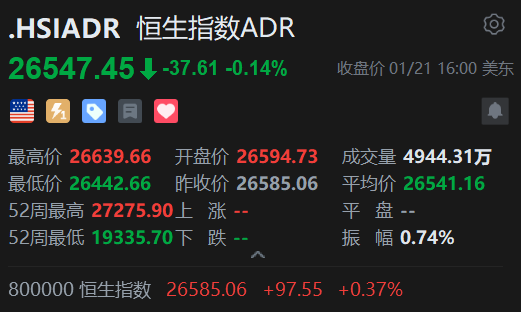
Market Overview - The Hang Seng Index (HSI) closed at 26,547.45, down by 37.61 points or 0.14% [1] - The index reached a high of 26,639.66 and a low of 26,442.66 during the trading session [1] - The average price for the day was 26,541.16, with a trading volume of 49.443 million shares [1] Blue-Chip Stocks Performance - HSBC Holdings closed at 129.700 HKD, up by 1.17% compared to the previous close [2] - Tencent Holdings closed at 599.924 HKD, down by 0.43% compared to the previous close [2] - Alibaba Group (ADR) saw an increase of 2.19%, closing at 163.200 HKD [3] - Notable declines included NetEase, which fell by 3.70% to 208.000 HKD [3] Individual Stock Movements - Tencent Holdings (ADR) was priced at 599.924, reflecting a decrease of 0.43% compared to its Hong Kong price [3] - Alibaba's ADR was at 164.396, showing an increase of 0.73% compared to its Hong Kong price [3] - HSBC's ADR was at 129.700, indicating an increase of 1.17% compared to its Hong Kong price [3] - Other notable movements included Baidu Group, which increased by 3.29% to 153.700 HKD [3]