
XIAOMI(01810)

Search documents
南向资金7天“扫货”超630亿港元,港股底部之争再升温
2 1 Shi Ji Jing Ji Bao Dao· 2026-02-09 12:32
Core Viewpoint - Despite a phase of adjustment in the Hong Kong stock market, particularly in the technology sector, a significant influx of "hot money" from southbound capital has been observed, indicating potential bottom-fishing opportunities in the market [1][4]. Group 1: Southbound Capital Inflow - Southbound capital has seen a continuous net inflow of 637 billion HKD over seven trading days, with notable single-day net purchases exceeding 100 billion HKD on multiple occasions [1][4]. - The inflow is characterized by a "buying on dips" strategy, particularly during the accelerated decline of the Hang Seng Technology Index [4]. - The top sectors attracting southbound capital include Information Technology (71.24 billion HKD), Financials (60.84 billion HKD), Consumer Discretionary (51.41 billion HKD), and Real Estate (41.46 billion HKD) [4]. Group 2: ETF and Institutional Investment - Significant net inflows have also been recorded in the cross-border ETF sector, with 113 billion HKD into the Hang Seng Technology ETF and 28.1 billion HKD into the Hang Seng Internet Technology ETF [5]. - The total scale of ETFs directed towards the Hong Kong market has expanded to 423.24 billion HKD, with notable contributions from both southbound and QDII ETFs [5]. - The influx is primarily driven by long-term institutional funds, such as public offerings and insurance, utilizing ETF tools for accelerated positioning [5]. Group 3: Market Sentiment and Valuation - Despite the influx of southbound capital, market sentiment remains cautious, with a notable shift to net outflows of 18.87 billion HKD on February 9, indicating ongoing market divergence [8]. - The Hang Seng Technology Index is currently valued at approximately 22.13 times earnings, representing a historical low of 24.31% [9]. - Analysts suggest that while the market is in a deep value zone, confirmation of a market bottom requires additional conditions [10]. Group 4: Investment Strategies - Investment strategies are recommended to focus on a balanced approach, emphasizing both growth and value sectors [12]. - Key areas of interest include AI-related industries, high-dividend stocks, and sectors benefiting from supply-demand dynamics in metals [12]. - The current low valuation of Hong Kong stocks presents an opportunity for investment, particularly in high-quality assets and new productivity sectors [12].


苹果第一,小米第三!2025年全球手机出货数据出炉
Shen Zhen Shang Bao· 2026-02-09 11:10
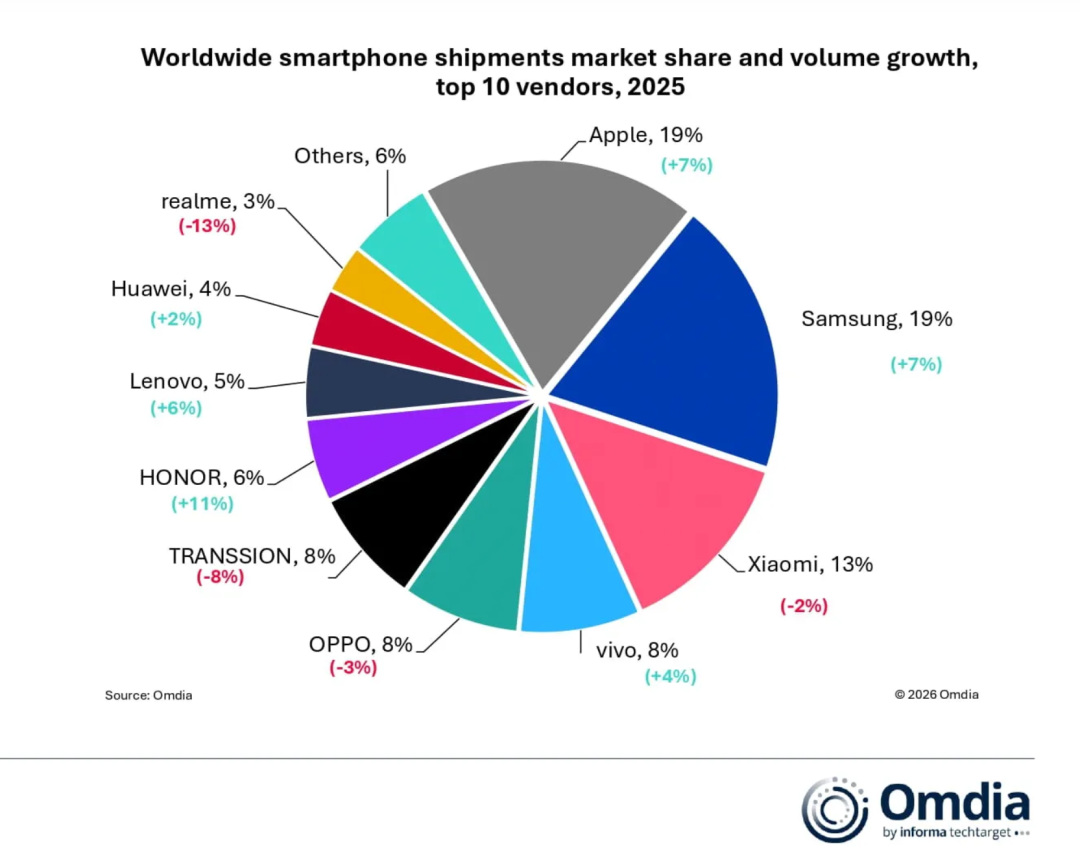
Group 1 - In 2025, Apple achieved a record annual shipment of 240.6 million iPhones, marking a 7% year-on-year increase, maintaining its position as the world's largest smartphone manufacturer for the third consecutive year [2] - Samsung rebounded in 2025 with a 7% year-on-year increase in shipments, following three years of decline, with a notable 16% increase in the fourth quarter driven by strong demand for flagship models and a recovery in the mass market [2] - Xiaomi retained its position among the top three manufacturers, but experienced a 2% decline in fourth-quarter shipments, while Vivo entered the fourth position for the first time with a 4% year-on-year increase in annual shipments [2] Group 2 - Honor achieved the highest global growth rate of 11% among the top ten manufacturers in 2025, leading in overseas shipment growth in the high-end and mid-high-end segments [3] - The global launch of the first "robot phone" HONOR ROBOT PHONE and the Honor Magic V6 foldable phone is scheduled for March 2026 at the Mobile World Congress in Barcelona [3] - Transsion, Lenovo, and Huawei reported annual shipment growth rates of 8%, 5%, and 4% respectively in 2025 [3]

智通港股通活跃成交|2月9日





智通财经网· 2026-02-09 11:02
Core Viewpoint - On February 9, 2026, Tencent Holdings, Alibaba-W, and the Yingfu Fund were the top three companies by trading volume in the Southbound Stock Connect, with trading amounts of 4.681 billion, 3.740 billion, and 2.531 billion respectively [1] Group 1: Southbound Stock Connect Trading - Tencent Holdings ranked first in Southbound Stock Connect trading with a total trading amount of 4.681 billion and a net buying amount of 0.904 billion [2] - Alibaba-W ranked second with a trading amount of 3.740 billion and a net selling amount of 0.100 billion [2] - The Yingfu Fund ranked third with a trading amount of 2.531 billion and a significant net selling amount of 2.515 billion [2] Group 2: Deep Southbound Stock Connect Trading - Tencent Holdings also led in Deep Southbound Stock Connect trading with a trading amount of 3.490 billion and a net buying amount of 0.896 billion [2] - The Yingfu Fund was second with a trading amount of 2.051 billion and a net selling amount of 2.040 billion [2] - Alibaba-W ranked third with a trading amount of 1.611 billion and a net buying amount of 0.151 billion [2]
小米集团:2月9日回购150万股,支付总价5272.68万港元
Jin Rong Jie· 2026-02-09 10:56
Group 1 - The company announced a share buyback of 1.5 million shares on February 9, 2026 [1] - The repurchase price per share ranged from HKD 35.04 to HKD 35.24 [1] - The total amount paid for the buyback was HKD 52.7268 million [1]
2月9日南向资金追踪:腾讯控股、南方恒生科技、小米集团-W净买入额居前,分别为18.00亿港元、6.40亿港元、2.09亿港元
Jin Rong Jie· 2026-02-09 10:55
Market Performance - The Hang Seng Index increased by 1.76%, closing at 27,027.16 points, with a total market turnover of 255.14 billion HKD [1] Southbound Trading Data - Tencent Holdings received a net inflow of 1.8 billion HKD, closing at 560.00 HKD with a price increase of 2.28% [2] - Southern Hang Seng Technology saw a net inflow of 640 million HKD, closing at 5.30 HKD with a price increase of 1.34% [2] - Xiaomi Group-W had a net inflow of 209 million HKD, closing at 35.20 HKD with a slight price increase of 0.06% [2] Notable Net Outflows - The Tracker Fund of Hong Kong experienced a significant net outflow of 45.55 billion HKD, closing at 27.22 HKD with a price increase of 1.72% [2] - Hang Seng China Enterprises faced a net outflow of 10.00 billion HKD, closing at 93.94 HKD with a price increase of 1.56% [2] - Kuaishou-W had a net outflow of 5.69 billion HKD, closing at 69.30 HKD with a price decrease of 2.74% [2]
小米集团今日斥资约5272万港元回购股份
Xin Lang Cai Jing· 2026-02-09 10:54
据港交所文件披露,小米集团于2月9日斥资约5272.68万港元回购150万股B类股份。 据港交所文件披露,小米集团于2月9日斥资约5272.68万港元回购150万股B类股份。 ...
小米集团-W2月9日斥资5272.68万港元回购150万股
Zhi Tong Cai Jing· 2026-02-09 10:49
于2026年2月9日,该公司根据股份计划发行4万股股份。 小米集团-W(01810)发布公告,于2026年2月9日,该公司斥资5272.68万港元回购150万股股份,每股回 购价35.04-35.24港元。 ...
工信部发布《减免车辆购置税的新能源汽车车型目录》(第二十七批)
Xin Lang Cai Jing· 2026-02-09 10:49
Core Viewpoint - The Ministry of Industry and Information Technology (MIIT) has released the 27th batch of the directory for new energy vehicle models eligible for vehicle purchase tax exemptions, which includes models from Xiaomi and BYD [1][1]. Group 1 - The MIIT's announcement includes several new energy vehicle models, specifically highlighting the Xiaomi SU7 and BYD Fangchengbao Titanium 3 [1][1].

小米集团-W(01810.HK)2月9日耗资5272.7万港元回购150万股
Ge Long Hui· 2026-02-09 10:46
格隆汇2月9日丨小米集团-W(01810.HK)公告,2月9日耗资5272.7万港元回购150万股。 ...
小米集团-W(01810)2月9日斥资5272.68万港元回购150万股
智通财经网· 2026-02-09 10:44
于2026年2月9日,该公司根据股份计划发行4万股股份。 智通财经APP讯,小米集团-W(01810)发布公告,于2026年2月9日,该公司斥资5272.68万港元回购150 万股股份,每股回购价35.04-35.24港元。 ...