CMBC(01988)

Search documents
民生银行“海运快汇”落地株洲 高效赋能外贸企业跨境结算
Chang Sha Wan Bao· 2025-12-02 14:51
Core Insights - The core viewpoint of the news is the successful implementation of the "Sea Freight Quick Remittance" service by Minsheng Bank's Zhuzhou branch, which addresses the pain points of traditional cross-border payment processes for foreign trade enterprises [1][2]. Group 1: Product Overview - "Sea Freight Quick Remittance" is an innovative smart remittance product launched by Minsheng Bank, specifically designed for the settlement of sea freight payments for foreign trade enterprises [1]. - The service allows clients to upload sea freight invoices via corporate online banking, where the system intelligently recognizes key information and automatically generates standardized remittance instructions, facilitating a fully electronic process [1][2]. Group 2: Operational Efficiency - Compared to traditional settlement methods, "Sea Freight Quick Remittance" significantly reduces manual intervention, saving time and labor costs while enhancing cross-border settlement efficiency [2]. - The Zhuzhou branch's proactive customer service included on-site guidance for the enterprise to complete online banking permissions and operational training, leading to a successful first online remittance without the need for paper documents [1][2]. Group 3: Future Plans and Commitment - The successful launch of "Sea Freight Quick Remittance" in Zhuzhou reflects Minsheng Bank's commitment to a customer-centric service philosophy and its focus on providing financial services tailored to the needs of foreign trade enterprises [2]. - Moving forward, the Zhuzhou branch aims to leverage its product innovation and professional service capabilities to continuously optimize financial service solutions for more foreign trade enterprises, thereby supporting the high-quality development of the regional foreign trade economy [2].

多家银行上调近100只基金风险等级
21世纪经济报道· 2025-12-02 09:45
记者丨叶麦穗 编辑|曾芳 股市出现波动,部分基金开始亏钱,银行紧急上调代销基金的风险等级。 近期, 包括建设银行、民生银行、邮储银行、中信银行在内的多家银行纷纷上调部分代销公募基金产品风险等级,有些银行年内甚至 7次上调基金的风险等级。 有分析师认为银行集中上调代销公募基金风险等级,是产品、市场与监管三方因素共振的结果。 今年前三季度市场出现明显的上涨。特别是上证指数冲上4000点之后,市场热情高涨,"日光基"再现,风险偏好大幅提升,资金涌入 市场。 日前,建设银行发布公告称,批量上调87只代销公募基金产品的风险等级。这也是该行年内第4次调整代销公募产品风险等级。 一旦市场波动,将会给投资人带来损失,因此银行上调代销基金风险等级,也是给投资人提醒,避免盲目入市遭遇亏损。 多家银行上调公募基金风险等级 展望未来,此举将趋于常态化。 这要求投资者理性看待:短期或引发部分保守投资者调整持仓,但长期看,动态评级能提升风险透明 度,减少错配。 建议投资者: 一是 养成定期检视产品风险等级的习惯; 二是 坚持分散配置,避免过度集中; 三是 主动寻求专业建议,确保自身风 险偏好与产品相匹配。 | 图/建行公告 | | -- ...


股市高位震荡 银行上调近100只基金风险等级
2 1 Shi Ji Jing Ji Bao Dao· 2025-12-02 08:45
Core Viewpoint - Recent fluctuations in the stock market have led several banks to raise the risk levels of their distributed public funds, indicating a response to market volatility and regulatory requirements [1][2][3]. Group 1: Bank Actions - Multiple banks, including China Construction Bank and Minsheng Bank, have raised the risk levels of various public fund products, with some banks adjusting risk levels up to seven times this year [1][3]. - China Construction Bank announced an adjustment of 87 public fund products, with 32 moving from medium-low risk (R2) to medium risk (R3) and 55 from medium risk (R3) to medium-high risk (R4) [3]. - Minsheng Bank also raised the risk levels of eight funds from low to medium risk, marking its fourth adjustment in October alone [4]. Group 2: Market and Regulatory Context - Analysts suggest that the banks' actions are a result of a combination of product, market, and regulatory factors, particularly after a significant market rally that saw the Shanghai Composite Index exceed 4000 points [2][4]. - The adjustments are seen as a precautionary measure to protect investors from potential losses due to market volatility [2][4]. - Regulatory frameworks, such as the "Commercial Banks' Agency Sales Business Management Measures," emphasize the need for banks to independently assess and adjust risk ratings for the products they sell [5]. Group 3: Compliance and Regulatory Actions - Several banks have faced regulatory penalties for inadequate risk assessment and compliance failures in their fund sales operations, highlighting the importance of proper risk management practices [6][7]. - Regulatory bodies have issued corrective measures against banks like Zhejiang Chouzhou Bank and Huaxia Bank for failing to meet compliance standards in fund sales [6][7]. - The ongoing regulatory scrutiny is expected to lead to more frequent adjustments in risk ratings as banks strive to align with compliance requirements and protect investor interests [4][6].

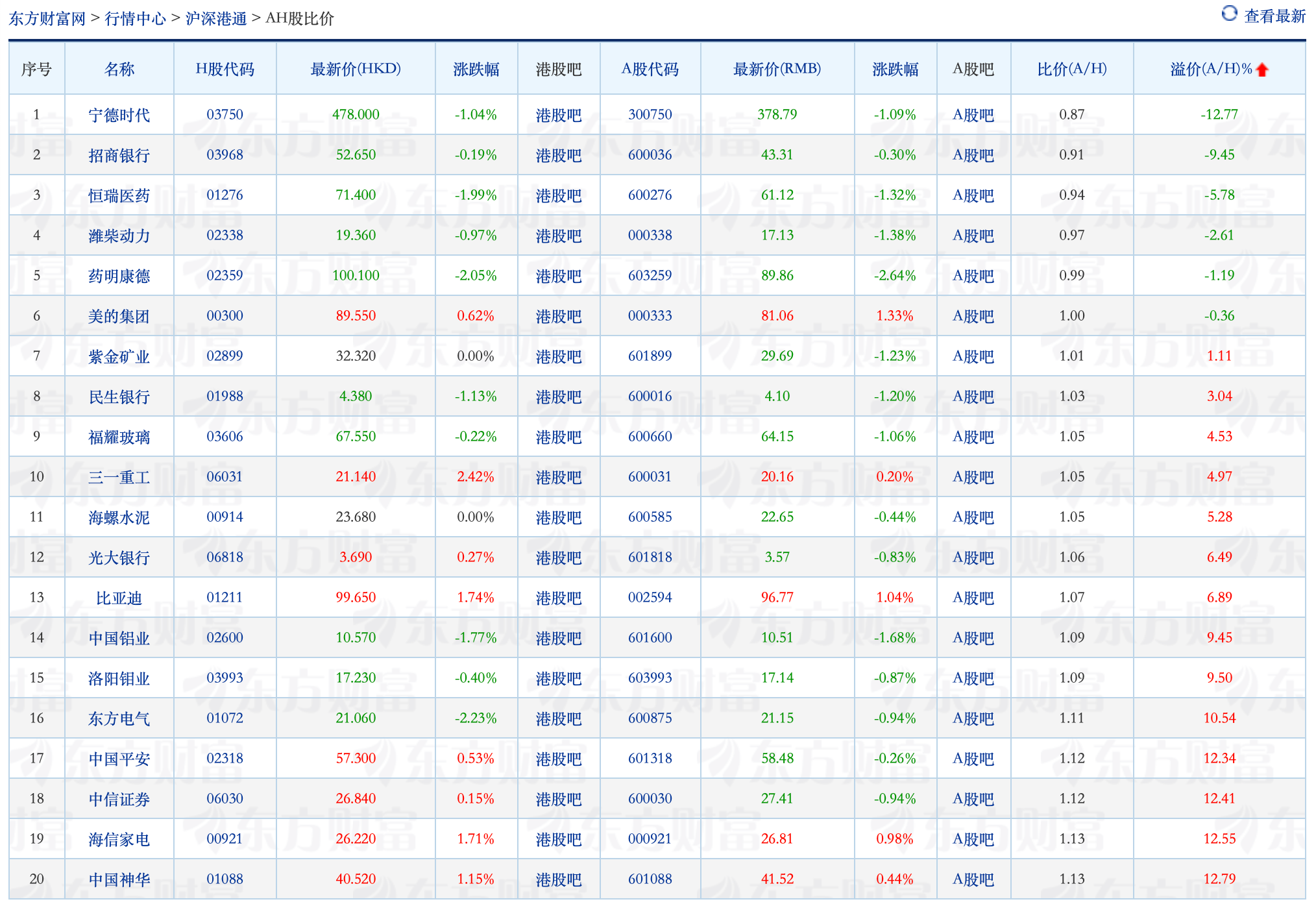
6家AH股“倒挂”背后:流通股比例小,外资更爱行业龙头
第一财经· 2025-12-02 06:29
Core Viewpoint - A-shares have lower trading costs and better market liquidity compared to H-shares, with a current premium of about 20% for A-shares as indicated by the Hang Seng AH Premium Index (HSAHP) being above 120. However, certain companies like CATL have shown a reverse phenomenon where H-shares are priced higher than A-shares [2][4]. Group 1: Market Dynamics - The phenomenon of H-shares trading at a premium over A-shares is attributed to the smaller market capitalization of H-shares compared to A-shares, leading to relative scarcity in liquidity [5]. - Among the six companies exhibiting this "inversion," three are newly listed, resulting in lower liquidity for H-shares, which can lead to inflated prices due to concentrated holdings by large institutions [5][6]. - As institutional investors gradually exit their positions, the liquidity of H-shares is expected to increase, potentially narrowing the premium of H-shares over A-shares [5]. Group 2: Characteristics of A-H Share Companies - Companies with inverted pricing typically share common traits: they are large enterprises with stable operating histories and solid financials, often in traditional industries like finance and energy [6]. - The valuation of these companies tends to be higher in the A-share market, reflecting differing expectations from overseas investors regarding future growth potential [6][8]. Group 3: Foreign Investment Preferences - Foreign investors prefer industry leaders that have a competitive edge in the market, which are often scarce in the international market [8]. - These leading companies usually possess strong brand recognition, stable profitability, and good governance structures, aligning with foreign investors' long-term investment criteria [8][9]. - The preference for H-shares over A-shares is also influenced by the perceived monopolistic characteristics of certain companies, which can lead to higher valuations in the H-share market [9].



6家AH股“倒挂”背后:流通股比例小,外资更爱行业龙头|市场观察
Di Yi Cai Jing· 2025-12-02 04:52
Core Insights - A-shares have lower trading costs and better market liquidity compared to H-shares, with an overall premium of 20% for A-shares as indicated by the Hang Seng AH Premium Index (HSAHP) remaining above 120 [1][2] - A peculiar situation has arisen where H-shares of certain companies, such as CATL, are trading at higher prices than their A-shares, attributed to factors like limited liquidity and the preference of overseas investors for industry leaders [1][2][3] Group 1: Market Dynamics - The six companies experiencing H-share price premiums over A-shares include CATL, China Merchants Bank, Hengrui Medicine, Weichai Power, WuXi AppTec, and Midea Group, with others like Zijin Mining and BYD showing closer price alignment [2][3] - The phenomenon of "inverted pricing" is largely due to the smaller market capitalization of H-shares compared to A-shares, leading to relative scarcity in liquidity which drives up prices [2][3] Group 2: Investor Preferences - Foreign investors show a strong preference for industry leaders that are scarce in the international market, often leading to higher valuations for these companies in H-shares [4][5] - Companies with stable financials and established operational histories, particularly in traditional sectors like finance and energy, tend to attract more foreign investment, reflecting differing growth expectations between domestic and international investors [3][4] Group 3: Future Outlook - As large institutional investors gradually exit their positions, the liquidity of H-shares is expected to increase, potentially narrowing the premium of H-shares over A-shares [2][4] - The case of CATL illustrates this trend, where its H-share premium over A-shares decreased from over 30% to approximately 13% following the unlocking of shares held by certain investors [2][4]
多家银行上调代销基金产品风险等级 业内专家:或成常态化趋势
Sou Hu Cai Jing· 2025-12-01 11:39
Core Viewpoint - Several banks, including China Construction Bank, Minsheng Bank, Postal Savings Bank, and Citic Bank, have raised the risk levels of certain mutual fund products they distribute, reflecting a proactive approach to investor suitability management and compliance with regulatory requirements [1][2][3] Group 1: Risk Level Adjustments - China Construction Bank announced adjustments to 87 mutual fund products, with 32 products upgraded from R2 (low to medium risk) to R3 (medium risk) and 55 products from R3 to R4 (medium to high risk) [1] - Minsheng Bank also adjusted the risk ratings of 8 funds, moving them from lower risk to medium risk, emphasizing the priority of investor interests [1][2] - Citic Bank has made its fourth adjustment to risk ratings this year, indicating a trend of ongoing evaluations and adjustments in response to market conditions [2][3] Group 2: Regulatory Compliance and Market Conditions - The adjustments are primarily driven by regulatory compliance requirements, necessitating banks to dynamically assess and accurately disclose product risks [3] - The current market volatility, particularly in equity funds due to increased asset fluctuations and high concentration, has led to a more realistic reflection of risk characteristics through these adjustments [3] - The trend of banks adjusting risk ratings is expected to become a standard practice in the industry, aligning with the ongoing regulatory emphasis on investor suitability management [3] Group 3: Investor Guidance - Banks are encouraging investors to reassess their risk tolerance in light of the new risk ratings, providing options for redemption or conversion to more suitable products [2][3] - Investors are advised to verify their mutual fund holdings through various channels and make informed decisions based on their risk capacity [2]
智通AH统计|12月1日
智通财经网· 2025-12-01 08:16
Core Insights - The article highlights the top and bottom AH premium rates for various stocks as of December 1, with Northeast Electric (00042) leading with a premium rate of 881.82% [1] - The article also lists the stocks with the highest and lowest deviation values, indicating significant discrepancies between their A-shares and H-shares [1] Summary of Top AH Premium Rates - Northeast Electric (00042) has the highest AH premium rate at 881.82%, followed by Hongye Futures (03678) at 274.55% and Sinopec Oilfield Service (01033) at 269.74% [1] - The top ten stocks with high premium rates include Zhejiang Shibao (01057) at 261.98% and Chenming Paper (01812) at 245.83% [1] Summary of Bottom AH Premium Rates - The stocks with the lowest AH premium rates include Ningde Times (03750) at -5.03%, China Merchants Bank (03968) at -1.36%, and Heng Rui Medicine (01276) at 1.50% [1] - Other notable mentions in the bottom list include Weichai Power (02338) at 6.45% and Midea Group (00300) at 7.66% [1] Summary of Deviation Values - The stocks with the highest deviation values are Guanghe Communication (00638) at 31.56%, Dazhong Public Utilities (01635) at 23.38%, and Beijing Jingcheng Machinery Electric (00187) at 20.11% [1] - Conversely, the stocks with the lowest deviation values include Jiangsu Ninghu Expressway (00177) at -13.73%, Junsheng Electronics (00699) at -12.81%, and China Life (02628) at -11.45% [1]

银行5折卖房潮来袭!上万套房产大甩卖,普通人该不该接盘?
Sou Hu Cai Jing· 2025-11-30 18:06
Core Viewpoint - Banks are aggressively selling properties at significant discounts, with prices as low as 50-70% of market value, in response to the declining real estate market and increasing non-performing loans [1][3]. Group 1: Market Dynamics - The real estate market has undergone drastic changes, leading to a rise in loan defaults as borrowers choose to stop payments, forcing banks to reclaim properties [3]. - Banks are facing a saturation in the foreclosure market, with many properties being returned after failing to sell at auction, necessitating urgent liquidation efforts [3][5]. - Major banks, including Agricultural Bank and Postal Savings Bank, are participating in this property sell-off, with significant numbers of properties listed for sale [1][3]. Group 2: Pricing Examples - In Beijing, a bank-listed property is priced at 51,000 yuan per square meter, compared to a market price of 70,000 yuan, representing a 27% discount [5]. - In Lanzhou, a property is listed at only 2,000 yuan per square meter, while the market price is 5,000 yuan, indicating a 60% reduction [5]. Group 3: Buyer Considerations - Buyers must be prepared to pay in full, as banks are not offering financing options for these discounted properties, which may pose a financial burden [8]. - There are potential risks associated with existing rental agreements that may complicate ownership transfer, as well as issues related to unpaid utility fees and household registration [8][10]. - Due diligence is essential, as highlighted by individual experiences of buyers facing unexpected costs and complications after purchase [10]. Group 4: Market Impact - The large-scale sale of discounted properties by banks is accelerating the decline in real estate prices, further straining developers and real estate agents [10]. - Banks are likely to adopt more stringent lending practices in the future, tightening the availability of credit in the real estate market [10][15]. Group 5: Future Outlook - The ongoing trend of banks selling properties reflects a significant transformation in the Chinese real estate market, shifting from a speculative mindset to a more cautious approach among buyers [15]. - As banks continue to clear their inventory, more discounted properties may become available, presenting both opportunities and risks for potential buyers [15].




民生银行在港机构捐款1000万港元支援香港火灾善后
Zhong Jin Zai Xian· 2025-11-30 06:45
Core Viewpoint - The article highlights the swift response of various sectors in Hong Kong to support disaster relief efforts following a fire incident at Wong Fuk Court in Tai Po, New Territories. Minsheng Bank has played a significant role in providing financial assistance and resources for the affected community [1]. Group 1: Company Actions - Minsheng Bank activated its emergency financial service mechanism to support disaster relief efforts [1]. - The bank's Hong Kong branch and Minsheng International donated 10 million HKD to aid in rescue operations, transitional housing, and post-disaster reconstruction [1]. - The bank provided immediate living supplies and emergency financial support to affected residents [1]. Group 2: Financial Services - Minsheng Bank established a green channel for emergency services, prioritizing the processing of disaster relief fund transfers [1]. - The bank ensured timely provision of financial services to support the affected community [1].
超百家企业捐赠总额超12亿港元,企业驰援香港大埔火灾救援


第一财经· 2025-11-29 07:06
Core Points - A significant fire occurred in Hong Kong's Tai Po district, resulting in major casualties and prompting over 100 companies and foundations to donate for emergency relief and community recovery efforts, with total donations exceeding HKD 1.2 billion [2][4]. Donation Summary - Major companies such as Yuexiu Group donated HKD 10 million, while China Overseas and China State Construction contributed HKD 20 million [3]. - Tencent donated HKD 30 million, and Alibaba made an initial donation of HKD 20 million [3]. - Other notable contributions include HKD 30 million from the Li Ka Shing Foundation and HKD 12 million from the Chaozhou Association [4]. - The total amount of donations has surpassed HKD 1.2 billion as of the latest reports [4].