
GAC GROUP(02238)

Search documents
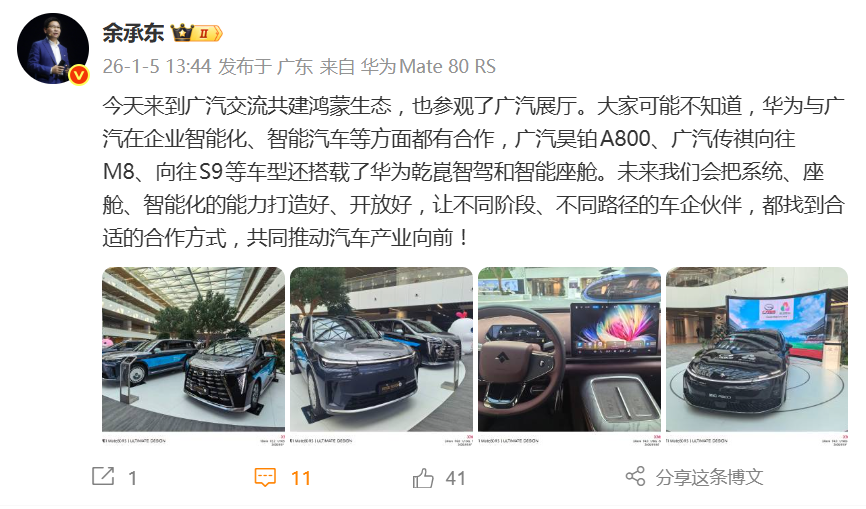
余承东到访广汽集团交流共建鸿蒙生态
Jin Rong Jie· 2026-01-05 06:39
Core Insights - Huawei's Executive Director and Chairman of the Terminal BG, Yu Chengdong, visited GAC Group to discuss building the HarmonyOS ecosystem and toured GAC's exhibition hall [1] - Huawei and GAC have established cooperation in enterprise intelligence and smart vehicles, with some GAC models already equipped with Huawei's advanced driving and intelligent cockpit technologies [1] - Huawei aims to enhance its technical capabilities in systems, intelligent cockpits, and smart technologies, and is open to collaborating with car manufacturers at different development stages and technological routes to promote the automotive industry's shift towards intelligence and connectivity [1]


汽车早报|红旗全固态电池启动上车验证 广汽本田完成收购东风本田发动机公司
Xin Lang Cai Jing· 2026-01-05 00:39
Group 1: Automotive Exports and Imports - In November 2025, China's automotive exports reached 818,000 units, a year-on-year increase of 49.2%, with an export value of $13.87 billion, reflecting a year-on-year growth of 53% [1] - In November 2025, automotive imports totaled 43,000 units, a year-on-year decrease of 29.1%, with an import value of $1.92 billion, down 41.1% year-on-year [1] Group 2: Company Sales Performance - SAIC Motor Corporation reported total vehicle sales of 4.507 million units in 2025, marking a year-on-year increase of 12.3%, with 1.643 million units being new energy vehicles, up 33.1% year-on-year [1] - BAIC Blue Valley's subsidiary, Beijing Electric Vehicle Co., Ltd., achieved a cumulative vehicle sales increase of 84.06% in 2025, with December sales reaching 35,205 units, a year-on-year increase of 114.56% [3] - Wuling Hongguang MINIEV sold 435,598 units in 2025, maintaining its position as the top seller in the A00 electric vehicle segment for 65 consecutive months [4] Group 3: Corporate Developments - GAC Honda completed the acquisition of Dongfeng Honda Engine Company, which is now wholly owned by GAC Honda, with a registered capital increase from approximately $12 million to about 970 million RMB [5] - CATL announced a share buyback of 15.99 million A-shares, utilizing a total of 4.386 billion RMB, with the buyback price ranging from 231.5 RMB to 317.63 RMB per share [6] - EVE Energy responded to the expiration of its Hong Kong IPO prospectus, stating that it will promptly re-submit the application without significant impact on the overall IPO process [7]




2025年杀青汽车渠道瘦身进行时
Xin Lang Cai Jing· 2026-01-04 01:19
Core Viewpoint - In 2025, the Chinese automotive industry is at a historic turning point, with the penetration rate of new energy vehicles exceeding 50%, marking a shift towards a high-quality development phase characterized by a balance between traditional and electric vehicles [2][16]. Group 1: Industry Transformation - The automotive channel system is undergoing unprecedented restructuring, shifting from scale expansion to integration optimization, model innovation, and deepening market penetration [2][16]. - The era of merely pursuing the number of outlets has ended, with a focus on quality improvement and efficiency optimization becoming the core issues [2][3]. - The automotive channel transformation is clearly presenting three major trends: lightweight, hybrid, and downward expansion, aimed at addressing high costs and low efficiency in the industry [2][3][11]. Group 2: Lightweight Trend - The traditional heavy asset 4S stores are facing high rent and inventory pressures, prompting automakers to explore lightweight outlet models [4][19]. - Lincoln China's "Spark Plan" serves as a benchmark for lightweight transformation, significantly reducing single-store investment from 20-30 million yuan to 4 million yuan, leading to a 40% decrease in dealer operating costs [4][18]. - The optimization of profit structure in lightweight stores allows after-sales profits to fully cover operating costs, enhancing profitability [4][18]. Group 3: Hybrid Trend - The trend of channel hybridization, which began in 2024, continues to deepen in 2025, with brands exploring flexible combinations of direct sales, agency, and authorization models [7][21]. - NIO is cautiously adopting a hybrid approach, allowing local agents to manage market operations while maintaining brand control [7][21]. - BYD's Tengshi and Fangchengbao brands are implementing a dual-track system of direct sales and authorization to enhance channel efficiency [8][22]. Group 4: Downward Expansion Trend - The trend of channel downward expansion is accelerating, with significant sales growth in lower-tier cities, reflecting a clear shift in the automotive consumption market [11][25]. - Leap Motor's strategy of lowering the price of main models to the 150,000 yuan range has led to a 113.42% year-on-year increase in deliveries, with over 60% of sales coming from lower-tier markets [11][25]. - Third-party involvement, such as JD Auto's collaboration with GAC and CATL, is creating new models for the lower-tier market, significantly reducing the purchase threshold [12][26]. Group 5: Efficiency Revolution - The core of channel transformation is an efficiency revolution, focusing on serving more users at lower costs [12][26]. - The automotive channel is undergoing structural reshaping through lightweight, hybrid, and downward expansion trends, but the evolution of channels is far from over [12][26].


从这里读懂中国车企老大们的心思
汽车商业评论· 2026-01-03 23:04
Core Viewpoint - The Chinese automotive industry in 2025 is characterized by a focus on "progress" rather than just sales figures, emphasizing product quality and brand value enhancement [5][10][13]. Group 1: Sales and Market Position - BAIC Group announced that its self-owned brand sales have returned to over one million units after six years, highlighting a significant increase in the proportion of new energy vehicles [5]. - Changan Automobile reported that its new energy vehicle sales have surpassed one million units for the first time, marking the establishment of its three-brand matrix: Avita, Deep Blue, and Qiyuan, which target different market segments [7]. - Dongfeng Motor also achieved over one million new energy vehicle sales, with its self-owned brand accounting for over 60% of total sales, driven by strategic adjustments [10]. Group 2: Technological Advancements - The industry is focusing on technological breakthroughs, with companies like GAC and Dongfeng establishing solid-state battery pilot lines and achieving significant advancements in key components such as high-efficiency engines and hybrid transmission systems [13][15]. - Companies are enhancing their AI technology capabilities, with Geely and GAC developing comprehensive AI systems to improve vehicle decision-making and environmental understanding [14]. - The progress in autonomous driving is notable, with BAIC and Changan receiving the first L3 autonomous driving licenses in China, indicating a new phase in regulatory acceptance [15]. Group 3: Global Expansion and Collaboration - Chinese automakers are shifting from merely selling cars abroad to establishing roots in foreign markets, exemplified by Geely's technical cooperation with Renault in Brazil [16]. - Companies like CATL are making strides in overseas manufacturing, while Chery is focusing on cultural integration in international markets [17]. - The industry is moving towards collaborative efforts, with BAIC easing financial pressures on suppliers and GAC partnering with major tech firms to build a smart electric vehicle ecosystem [17][18]. Group 4: Internal Reforms and Strategic Focus - Automakers are undergoing significant internal reforms, transitioning from broad growth strategies to lean operations and collaborative efforts [26][30]. - GAC has relocated its headquarters to its manufacturing base to enhance operational efficiency, while BAIC is implementing top-down management strategies to improve marketing and quality [29][30]. - The focus is on building resilient and efficient systems rather than just increasing sales, with companies emphasizing user-centric approaches in product development [30][35]. Group 5: Future Outlook - The competition in the automotive industry is evolving from individual companies to ecosystems, where collaboration and strategic partnerships will determine success [20][24]. - The industry is at a critical juncture, with companies emphasizing the importance of strategic determination amidst changing external environments and user expectations [22][23]. - The long-term winners will be those who focus on core values and sustainable growth rather than opportunistic trends [24][35].




广汽集团董事会通过董事选举等多项议案
Cai Jing Wang· 2026-01-02 02:10
Core Viewpoint - GAC Group announced the convening of its 17th meeting of the 7th Board of Directors on December 31, 2025, to review several important proposals [1] Group 1: Board Decisions - The board approved the election of the current general manager, He Xianqing, as a director of the 7th Board of Directors, with a term consistent with the current board [1] - The board also passed amendments to 12 company regulations, including the "Independent Director System" and "Related Party Transaction Decision Management System," some of which require approval from the shareholders' meeting [1]
智通港股通持股解析|1月1日



智通财经网· 2026-01-01 00:35
Core Insights - The top three companies by stockholding ratio in the Hong Kong Stock Connect are China Telecom (71.90%), GCL-Poly Energy (69.96%), and Da Zhong Public Utilities (68.75%) [1][2] - The companies with the largest increase in stockholding over the last five trading days include SMIC (+1.092 billion), China Merchants Bank (+1.052 billion), and Hong Kong Exchanges and Clearing (+790 million) [1][2] - The companies with the largest decrease in stockholding over the last five trading days include China Mobile (-3.216 billion), Tencent Holdings (-1.107 billion), and the Tracker Fund of Hong Kong (-465 million) [1][2] Stockholding Ratios - China Telecom (00728) holds 99.79 million shares with a stockholding ratio of 71.90% [2] - GCL-Poly Energy (01330) holds 28.3 million shares with a stockholding ratio of 69.96% [2] - Da Zhong Public Utilities (01635) holds 36.7 million shares with a stockholding ratio of 68.75% [2] - Other notable companies in the top 20 include China Shenhua (66.39%) and China Merchants Energy (64.43%) [2] Recent Trading Activity - The top three companies with increased holdings in the last five trading days are: - SMIC (00981): +1.092 billion, +15.28 million shares [2][3] - China Merchants Bank (03968): +1.052 billion, +19.92 million shares [2][3] - Hong Kong Exchanges and Clearing (00388): +790 million, +1.93 million shares [2][3] - The top three companies with decreased holdings in the last five trading days are: - China Mobile (00941): -3.216 billion, -39.36 million shares [2][3] - Tencent Holdings (00700): -1.107 billion, -1.84 million shares [2][3] - Tracker Fund of Hong Kong (02800): -465 million, -18.01 million shares [2][3]
广汽集团(02238) - 董事会审计委员会实施细则
2025-12-31 11:03
广州汽车集团股份有限公司 董事会审计委员会实施细则 (2025年12月修订) 第一章 总 则 第一条 为充分发挥广州汽车集团股份有限公司(以下 简称集团)董事会审计委员会(以下简称审计委员会)的审 核、监督和评估作用,确保审计委员会能够有效行使《中华 人民共和国公司法》规定的监事会职权,现根据《中华人民共 和国公司法》《上市公司治理准则》《香港联合交易所有限公 司证券上市规则》《上海证券交易所上市公司自律监管指引第 1号——规范运作(2025年5月修订)》等国家法律法规、监管 政策或指引以及《广州汽车集团股份有限公司章程》(以下简 称公司章程)的规定,结合集团经营实际制定本细则。 第二条 审计委员会是董事会设立的专门工作机构,主 要负责审核集团财务信息及其披露,监督及评估集团内外部 审计、内部控制、风险管理和合规管理工作,行使《中华人 民共和国公司法》规定的监事会职权,以及必要的内外部沟 通、协调等工作。 第三条 审计委员会对董事会负责,向董事会提供专业 意见或根据董事会授权就专业事项进行决策。 第四条 集团审计部承担审计委员会的工作联络、会议 组织、材料准备和档案管理等日常工作。审计委员会履行职 责时,集团 ...
广汽集团(02238) - 董事会战略委员会实施细则
2025-12-31 11:00
广州汽车集团股份有限公司 董事会战略委员会实施细则 (2025 年 12 月修订) 第一章 总 则 第一条 为适应广州汽车集团股份有限公司(以下简称"公 司")战略发展需要,增强公司核心竞争力,确定公司发展规划, 健全投资决策程序,加强决策科学性,提高重大投资决策的效益和 决策的质量,完善公司治理结构,根据《中华人民共和国公司法》、 《上市公司治理准则》、《广州汽车集团股份有限公司章程》(以 下简称"《公司章程》")及其他有关规定,公司特设立董事会战 略委员会(以下简称"战略委员会"),并制定本实施细则。 第二条 战略委员会是公司董事会设立的专门工作机构,主要 负责对公司长期发展战略和重大投资决策进行研究并提出建议。 第二章 人员组成 第三条 战略委员会成员由六名董事组成,其中应至少包括一 名独立董事(注:独立董事于香港联合交易所有限公司证券上市规 则中称为独立非执行董事,以下相同)。 第四条 战略委员会委员由董事长、过半数独立董事或者三分 之一以上的董事提名,并由董事会选举产生。 — 1 — 第五条 战略委员会设主任委员(召集人)一名,由战略委员 会委员选举产生,若公司董事长当选为战略委员会委员,则由公司 ...
广汽集团(02238) - 董事会提名委员会实施细则
2025-12-31 10:58
第三条 提名委员会成员由三名董事组成,其中独立董事 (注:独立董事于香港上市规则中称为独立非执行董事,以下相同) 占两名以上,且至少应包含一名不同性别的董事。 第四条 提名委员会委员由董事长、过半数独立董事或者三 分之一的董事的提名,并由董事会选举产生。 第五条 提名委员会设主任委员(召集人)一名,由独立董 事委员担任,负责主持提名委员会工作;主任委员在独立董事委 员内选举,并报请董事会批准产生。 广州汽车集团股份有限公司 董事会提名委员会实施细则 (2025年12月修订) 第一章 总 则 第一条 为规范广州汽车集团股份有限公司(简称"公司") 董事、高级管理人员的聘任准则和产生程序,优化公司董事会(简 称"董事会")人员组成,完善公司法人治理结构,根据《中华 人民共和国公司法》《上市公司治理准则》《上市公司独立董事 管理办法》《上海证券交易所股票上市规则》《香港联合交易所 有限公司证券上市规则》(简称"香港上市规则")《公司章程》 (简称"章程")及其他有关规定公司设立董事会提名委员会 (简称"提名委员会"),并制定本实施细则。 第二条 提名委员会是董事会设立的专门工作机构,主要负 责拟定公司董事、高级管理 ...
广汽集团(02238) - 董事会薪酬与考核委员会实施细则
2025-12-31 10:55
广州汽车集团股份有限公司 董事会薪酬与考核委员会实施细则 (2025 年 12 月修订) 第五条 薪酬与考核委员会委员由董事长、过半数独立 董事或者全体董事的三分之一提名,并由董事会选举产生。 1 第六条 薪酬与考核委员会设主任委员(召集人)一名, 由独立董事委员担任,负责主持薪酬与考核委员会工作;主 任委员在独立董事委员内选举,并报请董事会批准产生。 第七条 薪酬与考核委员会任期与董事会任期一致,委 员任期届满,连选可以连任。期间如有委员不再担任公司董 事职务,自动失去委员资格,并由委员会根据上述第四至第 六条规定补足委员人数。 第八条 薪酬与考核委员会召开会议,由董事会办公室 协调组织,相关职能部门具体负责并提供资料。 第一章 总 则 第一条 为进一步建立健全广州汽车集团股份有限公 司(下称公司)董事及高级管理人员的考核和薪酬管理制度, 完善公司法人治理结构,根据《中华人民共和国公司法》《上 市公司治理准则》《上海证券交易所股票上市规则》《香港 联合交易所有限公司证券上市规则》(下称《香港上市规则》) 及《广州汽车集团股份有限公司章程》(下称《公司章程》) 等有关规定,公司特设立董事会薪酬与考核委员会(下 ...