
PING AN OF CHINA(02318)

Search documents
近2600只个股下跌
第一财经· 2025-12-15 03:49
2025.12. 15 本文字数:1402,阅读时长大约2分钟 作者 | 一财 阿驴 11:31 A股午盘丨创业板指半日跌1.29% 截至午盘,上证指数跌0.11%,深证成指跌0.71%,创业板指跌1.29%。 盘面上,大消费走强,白酒、零售方向活跃;商业航天概念继续活跃,雷科防务、通宇通讯等涨停。保 险板块走强,中国平安涨近5%,创4年多新高。CPO概念股深度回调,摩尔线程、超硬材料、锂矿等 板块跌幅靠前。 | 板块名称 | 涨幅 | 张束 | 涨停数 | | --- | --- | --- | --- | | 277 | +3.84% | -0.11% | પ્ | | 保险 | +3.57% | -0.04% | D | | 橡胶制品 | +3.01% | -0.08% | n | | 饮料制造 | +2.92% | -0.07% | પ્ય | | 零售 | +2.47% | +0.05% | 5 | | 啤酒概念 | +1.93% | -0.09% | 2 | | 特钢概念 | +1.89% | +0.00% | 2 | | 化学纤维 | +1.85% | -0.05% | - | | 钢铁 | + ...



A股午评 | 指数弱势震荡 零售、保险股走高 中国平安涨近5%创4年多新高
智通财经网· 2025-12-15 03:44
12月15日,早盘指数弱势震荡,逾2600股飘红,半日成交1.2万亿,较昨日缩量529.3亿。截至午间收 盘,上证指数跌0.11%,深证成指跌0.71%,创业板指跌1.29%。 分析人士认为以下原因可能影响市场: 加密货币市场亦全线崩跌,比特币大跌超2%。有分析指出,受甲骨文推迟建设OpenAI数据中心的消息 影响,市场的主基调是避险。 与此同时,日本央行的加息预期进一步加剧了市场谨慎情绪。目前,外界普遍预期日本央行将在本周五 召开的议息会议上,宣布加息25个基点。 盘面上,保险板块大涨,中国平安涨近5%创4年多新高;大消费方向走强,其中乳业概念快速拉升,阳 光乳业涨停;白酒概念活跃,皇台酒业涨停;零售表现强势,百大集团3连板;商业航天概念延续活 跃,华菱线缆、中超控股双双3连板。品等跟涨。下跌方面,影视院线、算力硬件等板块回调。 展望后市,中信证券认为,明年外需继续超预期的难度在加大,但内需可期待的因素在增多。 热门板块 1、白酒板块反弹 白酒板块反弹,皇台酒业领涨,酒鬼酒、古井贡酒、舍得酒业等跟涨。 点评:消息面上,12日晚间,有消息人士称,贵州茅台近期将推出一个涵盖短期和中长期的控量政策。 短期方面,贵 ...
A股午评:创业板指半日跌1.29%,保险及大消费概念股走强,白酒、商业航天概念股活跃
Jin Rong Jie· 2025-12-15 03:40
Market Overview - The A-share market showed a mixed performance with the Shanghai Composite Index down 0.11% at 3884.93 points, the Shenzhen Component down 0.71% at 13164.03 points, and the ChiNext Index down 1.29% at 3153.07 points, as of midday trading [1] - The total trading volume in the Shanghai and Shenzhen markets reached 1.18 trillion yuan, with nearly 2700 stocks rising [1] Sector Highlights - The insurance sector experienced significant gains, with China Ping An rising nearly 5%, reaching a four-year high [1][3] - The consumer sector showed strength, particularly in the dairy industry, with Yangguang Dairy hitting the daily limit, and the liquor sector also active, led by Huangtai Liquor [1][2] - Retail stocks were robust, with Baida Group achieving three consecutive trading limits [1][4] - The commercial aerospace sector continued to perform well, with Hualing Cable and Zhongchao Holdings both achieving three consecutive trading limits [1] - Conversely, the computing hardware sector saw a collective decline, with Longfei Optical Fiber hitting the daily limit down, and the film and television sector also faced declines [1] Regulatory and Policy Updates - The insurance sector's positive performance was supported by a recent notification from the financial regulatory authority, which adjusted risk factors for insurance companies investing in certain indices [3] - The Ministry of Commerce and other departments issued a notice to strengthen the collaboration between commerce and finance to boost consumption [4] Institutional Insights - CITIC Securities noted that while external demand may face challenges, there are increasing factors to expect better internal demand in the coming year [5] - CITIC Jian Investment believes the underlying logic of a bull market remains intact, with expectations for a new wave of market activity as adjustments have largely completed [6] - Guotai Junan expressed optimism about the market's cross-year momentum, particularly in technology, brokerage, insurance, and consumer sectors [8]



内险股早盘继续走高 新华保险及中国太保均涨超3%
Xin Lang Cai Jing· 2025-12-15 03:19
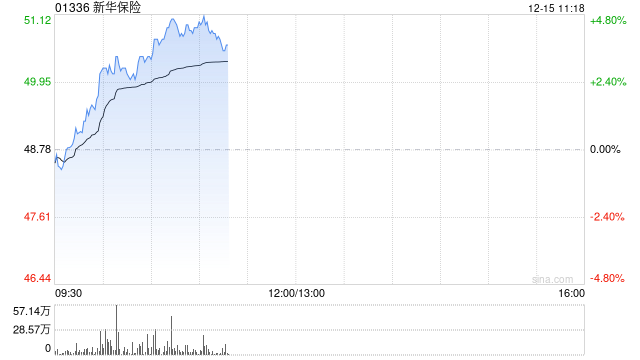
内险股早盘继续走高,截至发稿,新华保险(01336)上涨3.53%,报50.50港元;中国太保(02601)上 涨3.06%,报35.66港元;中国平安(02318)上涨2.82%,报65.55港元;中国人寿(02628)上涨 1.13%,报28.62港元。 内险股早盘继续走高,截至发稿,新华保险(01336)上涨3.53%,报50.50港元;中国太保(02601)上 涨3.06%,报35.66港元;中国平安(02318)上涨2.82%,报65.55港元;中国人寿(02628)上涨 1.13%,报28.62港元。 责任编辑:卢昱君 热点栏目 自选股 数据中心 行情中心 资金流向 模拟交易 客户端 责任编辑:卢昱君 热点栏目 自选股 数据中心 行情中心 资金流向 模拟交易 客户端 ...


内险股继续走高 新华保险(01336.HK)涨近5%
Mei Ri Jing Ji Xin Wen· 2025-12-15 03:00
每经AI快讯,内险股继续走高。截至发稿,新华保险(01336.HK)涨4.65%,报51.05港元;中国太保 (02601.HK)涨4.34%,报36.1港元;中国平安(02318.HK)涨3.37%,报65.9港元;中国人寿(02628.HK)涨 2.4%,报28.98港元。 ...
保险股逆势走强,中国平安涨幅超4%
Bei Jing Shang Bao· 2025-12-15 02:56
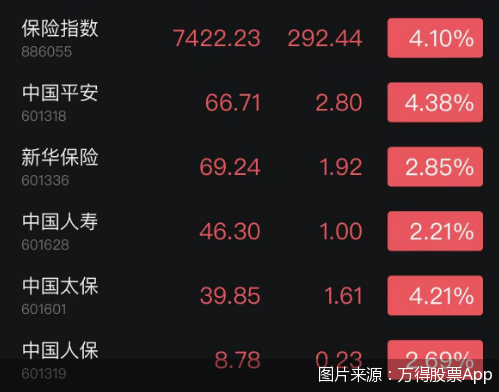
北京商报讯(记者 李秀梅)12月15日,A股三大股指低位震荡,保险板块逆势走强。截至北京商报记者 发稿,A股保险板块中,中国平安、中国太保涨幅均超4%,中国人寿、中国人保和新华保险涨幅也超 过了2%。 | 保险指数 | 7422.23 | 292.44 | 4.10% | | --- | --- | --- | --- | | 886055 | | | | | 中国平安 | 66.71 | 2.80 | 4.38% | | 601318 | | | | | 新华保险 601336 | 69.24 | 1.92 | 2.85% | | 中国人寿 601628 | 46.30 | 1.00 | 2.21% | | 中国太保 | 39.85 | 1.61 | 4.21% | | 601601 | | | | | 中国人保 601319 | 8.78 | | 图片来源:万得股票App | ...



中国平安 - 投资者反馈:增长潜力仍被低估
2025-12-15 02:51
Summary of Ping An Insurance Group Co of China Ltd Conference Call Company Overview - **Company**: Ping An Insurance Group Co of China Ltd - **Industry**: Insurance - **Market Cap**: US$158,490 million - **Stock Rating**: Overweight - **Price Target**: HK$89.00, representing a 40% upside from the current price of HK$63.75 as of December 12, 2025 [7][42] Key Insights Growth Potential - Ping An's growth and profitability potential are believed to be underestimated by the market, indicating substantial valuation upside [1] - Long-term structural growth is supported by: - Strong growth in household assets in China - Attractive insurance products compared to retirement savings alternatives - Value-added health and senior care options [2] - Expected 23% growth in Value of New Business (VNB) for 2026, with banca channel growth at 74% and agency channel growth at 6% [20] Investment Strategy - Ping An is shifting towards more flexible equity investments and stable bond yields, which should enhance investment returns and reduce concerns regarding Embedded Value (EV) [3] - The company has increased its stock holdings significantly, with a shift towards growth stocks, now holding approximately 45% in growth versus 55% in dividend stocks [25] Risk Management - Property exposure remains a concern for investors, but de-risking efforts across Life, Bank, Trust, and Asset Management (AM) segments are ongoing [4][26] - The AM segment is expected to reflect risks largely by 2027, with 40-50% provision recognized between 2021-2027 [4][26] - Concerns about potential further losses in the AM segment due to property market deterioration are noted, but the scenario is considered overly bearish [27] Financial Metrics - Projected operating ROE could rise to 14-15% in the medium term, driven by lower losses from the AM segment and improvements in the Life business [14] - Dividend per share (DPS) is expected to increase, supported by sufficient capital levels [30][36] Market Dynamics - Investors are expected to shift focus from beta trading to VNB growth and business quality, reducing concerns about interest rate spread loss risks [19] - The banca channel is anticipated to benefit top insurers, with Ping An expected to achieve a higher-than-peer margin of approximately 30% starting in 2025 [21] Valuation Methodology - Different valuation methodologies indicate similar upside potential, with a 40% upside in H-share base case value and 33% in A-share base case value [42] - The company is valued using a three-stage Dividend Discount Model (DDM) with varying dividend payout assumptions [51] Additional Considerations - Ping An's home-based elderly care services have expanded to 100 cities, contributing approximately RMB 240 billion in premium inflows since 2021 [13] - The company is seen as a key player in China's senior care market, leveraging its strong bargaining power in healthcare services [12] This summary encapsulates the key points from the conference call, highlighting Ping An's growth potential, investment strategies, risk management, financial metrics, market dynamics, and valuation methodologies.
内险股继续走高 新华保险涨近5% 机构预计开门红新单保费和NBV将实现双位数增长
Zhi Tong Cai Jing· 2025-12-15 02:48
Core Viewpoint - The insurance stocks continue to rise, with significant gains observed in major companies, indicating a positive market sentiment and potential for growth in the sector [1] Group 1: Stock Performance - Xinhua Insurance (01336) increased by 4.65%, reaching HKD 51.05 - China Pacific Insurance (601601) (02601) rose by 4.34%, reaching HKD 36.1 - Ping An Insurance (601318) (02318) saw a 3.37% increase, reaching HKD 65.9 - China Life Insurance (601628) (02628) grew by 2.4%, reaching HKD 28.98 [1] Group 2: Research Insights - Guojin Securities released a report indicating an upward trend in the "opening red" season, maintaining a positive recommendation for the sector - The report anticipates a significant number of fixed deposits maturing next year, making dividend insurance attractive for low-risk investors seeking long-term wealth preservation and growth - It is expected that the new single premium and NBV for the "opening red" will achieve double-digit growth, with large companies increasing their market share [1][1] Group 3: Regulatory Changes - Shenwan Hongyuan Securities published a report noting that regulatory authorities have recently lowered the risk factors for insurance companies holding long-term equity assets - This change is expected to release a substantial amount of incremental capital, estimated in the hundreds of billions, in the short term - The report highlights that with the replenishment of insurance capital and increased willingness to allocate, high-dividend stocks with stable returns and defensive attributes will become a key focus for investment [1][1]
港股异动 | 内险股继续走高 新华保险(01336)涨近5% 机构预计开门红新单保费和NBV将实现双位数增长
智通财经网· 2025-12-15 02:48
Core Viewpoint - The insurance sector is experiencing a positive trend, with significant stock price increases for major companies, driven by favorable market conditions and regulatory changes [1] Group 1: Stock Performance - Xinhua Insurance (01336) increased by 4.65%, reaching HKD 51.05 - China Pacific Insurance (02601) rose by 4.34%, reaching HKD 36.1 - Ping An Insurance (02318) saw a 3.37% increase, reaching HKD 65.9 - China Life Insurance (02628) grew by 2.4%, reaching HKD 28.98 [1] Group 2: Market Outlook - Guojin Securities maintains a positive recommendation, citing an upward trend in the "opening red" season, with expectations of double-digit growth in new single premiums and NBV due to the upcoming maturity of a large number of fixed deposits [1] - The attractiveness of dividend insurance is highlighted for low-risk investors seeking long-term wealth preservation and growth, with major companies expected to increase market share amid a shift in the industry [1] Group 3: Regulatory Impact - Shenwan Hongyuan Securities reports that recent regulatory adjustments have lowered risk factors for insurance companies holding long-term equity assets, potentially releasing over RMB 100 billion in incremental capital [1] - The report emphasizes that with enhanced capital allocation willingness, high-dividend sectors with stable returns will become a key focus for insurance capital [1]
中国平安AH股齐涨,均创逾4年新高,近期获多家大行看好
Ge Long Hui A P P· 2025-12-15 02:27
Core Viewpoint - China Ping An's A-shares rose by 4.5%, reaching a high of 66.81 yuan, the highest since April 2021; H-shares increased by 2.6%, peaking at 65.4 HKD, the highest since June 2021, driven by favorable regulatory changes and positive market sentiment [1] Group 1: Regulatory Impact - The National Financial Regulatory Administration recently issued a notice to adjust risk factors related to insurance companies, reinforcing policies that encourage long-term patient capital, which has boosted market sentiment [1] Group 2: Analyst Ratings and Forecasts - Citic Securities updated its 2025 stock selection, listing China Ping An as a high-potential stock, citing its forward-looking judgment on interest rate cycles, leading positions in long-term bond holdings and high dividend layouts, and improvements in insurance contract service margins [1] - CICC forecasts that the life insurance industry will enter a golden development period by 2026, with a more positive trend in liabilities, suggesting a shift in investment logic towards growth capabilities, with China Ping An expected to lead the next valuation recovery [1] - CICC raised its target price for China Ping An's A-shares from 74.4 yuan to 89.8 yuan and for H-shares from 71 HKD to 99.4 HKD, maintaining an "outperform" rating [1] - UBS reiterated China Ping An as a top industry pick with a "buy" rating and a target price of 70 HKD, citing attractive risk-reward dynamics due to accelerated operating profit growth in Q4 and clear dividend policies [2] - Morgan Stanley expressed an increasingly optimistic view on China Ping An, highlighting opportunities in wealth management, healthcare, and pension services, raising its target price from 70 HKD to 89 HKD while maintaining an "overweight" rating [2]