PING AN OF CHINA(02318)

Search documents
一周保险速览(2.23—2.27)
Cai Jing Wang· 2026-02-28 03:58
Regulatory Insights - The People's Bank of China, along with financial regulatory authorities, has issued guidelines to enhance financial support mechanisms aimed at preventing poverty and promoting rural revitalization, emphasizing the development of specialized credit products and innovative financing tools such as "loans + external direct investment" and agricultural insurance [1] Industry Focus - The solvency assessment for Q4 2025 revealed that while most insurance companies met solvency standards, five companies, including Qianhai Property Insurance and Asia-Pacific Property Insurance, failed to meet the requirements due to governance issues and financial pressures, with Changsheng Life Insurance reporting a solvency adequacy ratio of only 79.7% [2] - In Q4 2025, nearly 90% of 144 non-listed insurance companies reported profitability, with life insurance companies' net profits increasing by 169.68% year-on-year and property insurance companies' net profits rising by 154.82%, driven by policy reforms and increased demand for stable insurance products [3] - Data from Q4 2025 indicates significant variation in average car insurance premiums among 58 non-listed property insurance companies, with over 60% charging less than 2000 yuan, while the highest premium reached 13438.68 yuan [4] Corporate Developments - Ant Insurance and Tencent Weibo have announced a premium increase for several popular term life insurance products effective March 1, with some products seeing a price adjustment of approximately 7.2% [5] - Ping An Life has announced that Yang Zheng plans to resign from his position as chairman, with Vice Chairman and Deputy General Manager Cai Ting taking over the chairman's responsibilities [6]
东莞监管分局同意平安产险东莞市粤丰大厦支公司变更营业场所
Jin Tou Wang· 2026-02-28 03:48
Core Viewpoint - The National Financial Supervision Administration of Dongguan has approved the address change for China Ping An Property & Casualty Insurance Company Limited's Dongguan branch, indicating regulatory compliance and operational adjustments for the company [1]. Group 1 - The Dongguan branch of China Ping An Property & Casualty Insurance Company will change its business location to Room 301 and 401, Building 22, Zhenwanhui Garden, Shizhu Road 5, Nancheng Street, Dongguan City, Guangdong Province [1]. - The company is required to handle the change and obtain new permits in accordance with relevant regulations [1].

智通ADR统计 | 2月28日





智通财经网· 2026-02-27 23:41
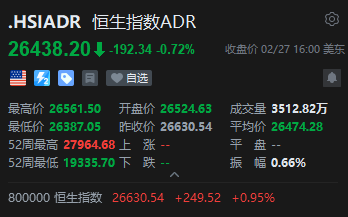
Market Overview - US stock indices experienced a decline on Friday, with the Hang Seng Index ADR closing at 26,438.20 points, down 192.34 points or 0.72% from the Hong Kong close [1] - The highest price for the ADR was 26,561.50, while the lowest was 26,387.05, with a trading volume of 35.1282 million [1] Major Blue-Chip Stocks - Most large-cap stocks fell, with HSBC Holdings closing at HKD 145.765, down 1.04% from the Hong Kong close [2] - Tencent Holdings closed at HKD 513.995, down 0.77% from the Hong Kong close [2] Stock Performance Summary - Tencent Holdings (00700) latest price: HKD 518.000, up 1.17% with an ADR price of USD 65.700, down 0.77% [3] - Alibaba Group (09988) latest price: HKD 142.900, down 0.07% with an ADR price of USD 144.110, down 1.38% [3] - HSBC Holdings (00005) latest price: HKD 147.300, up 1.59% with an ADR price of USD 93.160, down 1.04% [3] - Other notable stocks include AIA Group (01299) up 2.48%, and NetEase (099999) up 2.40% [3]

中国平安(02318.HK):利润数据大幅增长 寿险NBV持续高增
Ge Long Hui· 2026-02-27 23:07
Core Viewpoint - China Ping An's Q3 2025 performance shows significant growth in both OPAT and net profit, indicating strong operational performance and effective management strategies [1] Overall and Segment Analysis - In Q3 2025, China Ping An's net profit exceeded OPAT by 26.5 billion yuan, primarily driven by positive contributions from short-term investment fluctuations in life insurance, despite a 2.4 billion yuan loss from the sale of Autohome [1] - The growth rates for OPAT in life insurance, property insurance, and banking segments were 0.6%, 26.2%, and -2.8% respectively, with life insurance remaining the core business, accounting for 68.3% of total OPAT [1] - Asset management reported a minor loss of 0.7 million yuan, significantly improved from a 3.6 billion yuan loss in the same period last year, indicating reduced impact from non-recurring capital transactions [1] Life Insurance Business - The NBV growth rate for life insurance in the first three quarters of 2025 increased to 46.2%, driven by strong performance in both agency and bancassurance channels [2] - The increase in NBV was attributed to the effects of a switch in the predetermined interest rate and the expansion of bancassurance distribution channels [2] - The strategy of combining products with medical and elderly care services is expected to sustain NBV growth in the agency channel through 2026 [2] Investment Situation - The comprehensive investment return rate for China Ping An in the first three quarters of 2025 improved by 1 percentage point to 5.4%, mainly due to an increase in equity asset scale [2] - The core solvency ratio for life insurance decreased by 32.5 percentage points to 135%, attributed to a significant rise in minimum capital requirements [2] Profit Forecast and Rating - Profit, net assets, NBV growth, and investment returns for Q3 2025 were strong, with projected net profits for 2025-2027 at 135.2 billion, 173.0 billion, and 202.2 billion yuan respectively, reflecting growth rates of 6.77%, 27.95%, and 16.93% [3] - The estimated embedded value per share for 2025-2027 is projected at 84.78, 92.20, and 98.87 yuan, with a current PEV valuation of 0.74, 0.68, and 0.64 times [3] - The company is initiated with a "buy" rating based on its strong financial performance [3]
蹄疾步稳踏新程 春潮涌动启新篇 平安产险福建分公司领导班子新春走基层凝聚奋进力量
Zhong Jin Zai Xian· 2026-02-27 13:56
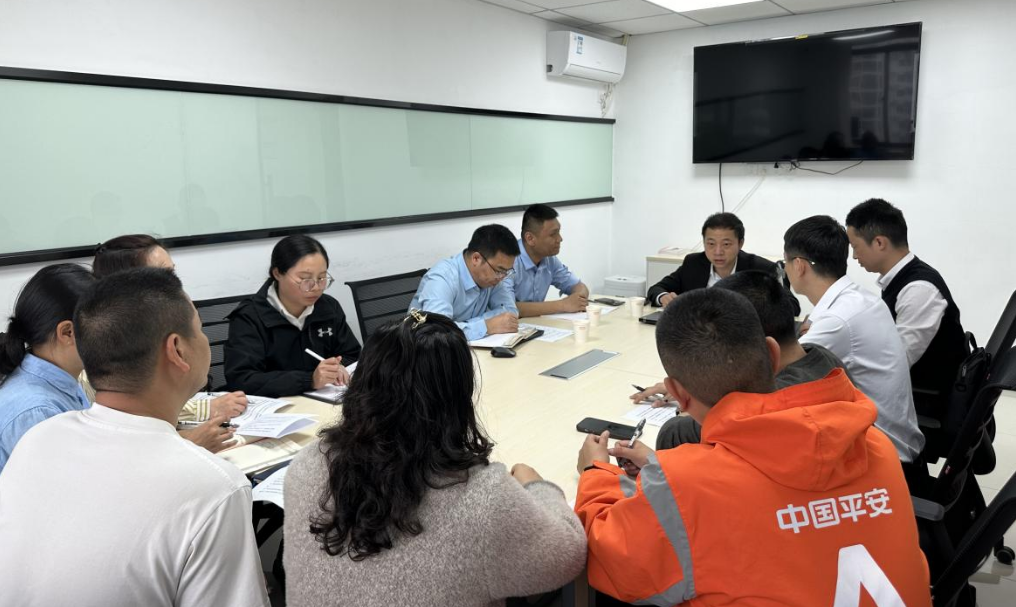
Core Viewpoint - The company is initiating a grassroots action titled "True Grasping and Practical Action" to enhance communication and collaboration with frontline employees, aiming to address challenges and stimulate motivation for high-quality development in the insurance sector [1][10]. Group 1: Leadership Engagement - The leadership team is visiting various county-level institutions to convey organizational care and listen to the voices of frontline employees, documenting their concerns and suggestions to transform real issues into driving forces for the company's progress [1][9]. - During face-to-face discussions, the leadership is actively addressing topics such as business transformation, market opportunities, and service innovation, helping institutions clarify development bottlenecks and work challenges [3]. Group 2: Focus on County Markets - The county market is identified as a "testing ground" for high-quality development in property insurance, emphasizing the need for innovation and the use of technology to enhance service quality and risk management [6]. - The leadership encourages frontline employees to embrace a pioneering spirit and continuously explore customer needs, translating the company's commitment to "finance for the people" into actions that ensure safety for families [6]. Group 3: Collaborative Efforts - All nine provincial-level institutions are simultaneously conducting grassroots activities to deliver New Year care to every employee and collect suggestions, forming a list of issues and needs to coordinate resources for solutions [9]. - The grassroots initiative is described as a "two-way effort" to build consensus, with leadership explaining the significance of innovative practices in technology insurance and risk reduction, while frontline employees contribute ideas on digital services and localized operations [10]. Group 4: Future Direction - The company aims to transform grassroots feedback into actionable plans and development momentum, committing to high-quality service that supports local development and fosters a new chapter of growth [10].
深耕“三农”沃土,以保险助推农业农村现代化
Ren Min Ri Bao· 2026-02-27 13:31
Core Viewpoint - The insurance industry, particularly Ping An Property & Casualty Insurance, plays a crucial role in supporting rural revitalization and enhancing agricultural productivity through tailored insurance products and services [1][2][3]. Group 1: Agricultural Insurance Innovations - Ping An Property & Casualty Insurance has developed specialized insurance products such as the "rice-fish symbiosis" insurance, which provides coverage for both rice and aquaculture, ensuring farmers can secure income even in adverse conditions [2][3]. - The company has launched innovative insurance solutions like low-temperature index insurance for olive farmers and target price insurance for dairy farmers, addressing specific agricultural challenges [3][4]. - During the "14th Five-Year Plan" period, the company has created over 4,500 agricultural insurance products, providing risk coverage exceeding 16 trillion yuan for more than 47 million farming households [3][5]. Group 2: Technological Integration in Insurance - Ping An Property & Casualty Insurance has implemented advanced technologies such as big data, cloud computing, and IoT to enhance the efficiency of underwriting and claims processes, exemplified by the "flash claim" project that streamlines claims handling [6][7]. - The company utilizes satellite remote sensing technology to monitor crop growth, improving the accuracy of insurance assessments and enhancing farmers' confidence in the insurance system [7]. - A comprehensive disaster prevention and reduction system has been established, integrating monitoring, early warning, and emergency response to mitigate agricultural risks [7]. Group 3: Economic Impact and Community Support - The "Nine Strengths" industry support model has facilitated the emergence of specialty agricultural towns, significantly boosting local economies and increasing farmers' incomes by over 23 billion yuan [5][6]. - Ping An Property & Casualty Insurance has supported the development of local agricultural industries by providing financial assistance, talent cultivation, and brand marketing, contributing to the overall enhancement of rural livelihoods [4][5]. - The company has actively engaged in community support initiatives, such as building processing lines and cold storage facilities, to help farmers transition from raw material sales to brand marketing [4][5].
平安人寿增资计划落地,注册资本已达360亿
Hua Er Jie Jian Wen· 2026-02-27 12:45
Core Insights - Ping An Life has made substantial progress in its capital replenishment efforts, with registered capital increasing from 33.8 billion to 36.003 billion RMB, indicating the gradual implementation of its previously announced capital increase plan [1][2] Group 1: Capital Increase Details - The increase in registered capital is part of a commitment made in April 2025, where all shareholders planned to inject approximately 20 billion RMB into the company, with 2.2 billion RMB directly added to registered capital and the remaining 17.8 billion RMB expected to enhance net assets through capital reserves [2] - This approach of allocating a small portion to registered capital and a larger portion to capital reserves is common in the insurance industry, aimed at rapidly increasing the company's net asset scale and solidifying actual capital [2] Group 2: Industry Context and Implications - The life insurance sector has been facing dual pressures on both asset and liability sides, with low interest rates compressing asset yields and stricter capital recognition regulations leading to accelerated core capital consumption [4] - As a core profit engine of China Ping An Group, the capital adequacy of Ping An Life is crucial for the overall risk resilience of the group. The 20 billion RMB injection will significantly enhance its comprehensive and core solvency ratios, providing a stronger buffer against potential macroeconomic fluctuations and capital market volatility [4] Group 3: Strategic Importance of Capital - Ample capital is essential for business expansion and strategic transformation, especially as the industry shifts from scale-oriented to value-oriented strategies. This includes deepening the "product + service" model, advancing the construction of a healthcare and elderly care ecosystem, and making longer-term equity asset allocations [5] Group 4: Management Transition - Alongside the capital replenishment, there has been a smooth transition in Ping An Life's senior management, with the retirement of Chairman Yang Zheng and the appointment of Vice Chairman Cai Ting as acting chairman [6] - Cai Ting's rise is seen as a significant step towards the younger and more professional management team, indicating a shift in management focus from deep reforms to a stable and high-quality development phase [7] Group 5: Overall Assessment - The gradual implementation of the 20 billion RMB capital increase and the stable transition of leadership form the current fundamentals of Ping An Life. In a complex environment of rigid liability costs and fluctuating asset yields, a stronger capital base combined with a younger management team positions the company for future growth [8]
智通港股空仓持单统计|2月27日
智通财经网· 2026-02-27 11:42
Core Insights - The top three companies with the highest short positions as of February 20 are China COSCO Shipping (01919) at 18.86%, CATL (03750) at 16.68%, and Ping An Insurance (02318) at 15.48% [1][2] Group 1: Top Short Positions - China COSCO Shipping (01919) has a short position of 520 million shares, representing a short ratio of 18.86% [2] - CATL (03750) has a short position of 26.0064 million shares, with a short ratio of 16.68% [2] - Ping An Insurance (02318) has a short position of 1.153 billion shares, with a short ratio of 15.48% [2] - Sunny Optical Technology (02382) has a short ratio of 15.24% [2] - Dongfang Electric (01072) has a short ratio of 15.12% [2] - ZTE Corporation (00763) has a short ratio of 14.53% [2] - Vanke (02202) has a short ratio of 14.16% [2] - Zijin Mining (02899) has a short ratio of 13.50% [2] - Hansoh Pharmaceutical (01276) has a short ratio of 13.32% [2] - WuXi AppTec (02359) has a short ratio of 12.50% [2] Group 2: Largest Increases in Short Positions - Weimob (02013) saw an increase of 0.27% in its short ratio, now at 12.43% [2] - China Duty Free Group (01880) increased by 0.25%, now at 8.92% [2] - Midea Group (00300) increased by 0.23%, now at 4.26% [2] - Meitu (01357) increased by 0.22%, now at 8.21% [2] - Xinjiang Xinxin Mining (03833) increased by 0.20%, now at 0.51% [2] - Hua Hong Semiconductor (01347) increased by 0.20%, now at 3.59% [2] - Minmetals Development (00425) increased by 0.19%, now at 2.59% [2] - China COSCO Energy (01138) increased by 0.18%, now at 6.61% [2] - Jiaxin International Resources (03858) increased by 0.17%, now at 0.25% [2] - China Railway (00390) increased by 0.17%, now at 4.61% [2] Group 3: Largest Decreases in Short Positions - Pacific Basin Shipping (02343) decreased by 0.83%, now at 4.66% [3] - Tianqi Lithium (09696) decreased by 0.66%, now at 2.25% [3] - Tiangong International (00826) decreased by 0.51%, now at 3.46% [3] - Huiju Technology (01729) decreased by 0.50%, now at 3.08% [3] - Shengye (06069) decreased by 0.44%, now at 1.63% [3] - Ganfeng Lithium (01772) decreased by 0.29%, now at 8.52% [3] - China Galaxy (06881) decreased by 0.25%, now at 3.19% [4] - Jiangxi Copper (00358) decreased by 0.22%, now at 2.32% [4] - China COSCO Shipping (01919) decreased by 0.21%, now at 18.86% [4] - Cafe de Coral (00341) decreased by 0.19%, now at 5.43% [4]

恒生指数上涨0.95% 恒生科技指数上涨0.56%
Xin Lang Cai Jing· 2026-02-27 11:07
Market Performance - The Hang Seng Index rose by 0.95% to close at 26,630.54 points, while the Hang Seng Tech Index increased by 0.56% to 5,137.84 points, and the National Enterprises Index gained 0.51% to 8,859.49 points [1] - The main board recorded a trading volume exceeding 288.4 billion HKD, with a net inflow of over 14.9 billion HKD in the southbound trading of Stock Connect [1] Sector Performance - Sectors such as gold, biomedicine, technology, coal, high-speed rail infrastructure, oil and gas, and telecommunications generally saw gains, while sectors like non-ferrous metals, commercial aerospace, banking, and real estate experienced mixed results [1] - New consumption, chips, new energy vehicle companies, brokerages, and aerospace sectors mostly faced declines [1] Individual Stock Movements - Notable stock movements included Xiaomi Group down by 0.80%, China Ping An up by 0.22%, SenseTime up by 4.92%, and SMIC up by 0.59% [1] - Tencent Holdings rose by 1.17% with a trading volume exceeding 16.7 billion HKD, while Alibaba fell by 0.07% with a trading volume over 12.7 billion HKD [2] - Longi Green Energy surged by 10.06% with a trading volume of 9.1 billion HKD [2]


港股27日涨0.95% 收报26630.54点
Xin Hua She· 2026-02-27 11:03
Core Viewpoint - The Hong Kong stock market showed positive performance on February 27, with the Hang Seng Index rising by 249.52 points, or 0.95%, closing at 26,630.54 points. The total turnover for the day was HKD 288.42 billion [1]. Market Indices - The Hang Seng Index increased by 249.52 points, closing at 26,630.54 points, with a gain of 0.95% [1]. - The National Enterprises Index rose by 45.2 points, closing at 8,859.49 points, reflecting a gain of 0.51% [1]. - The Hang Seng Technology Index gained 28.51 points, closing at 5,137.84 points, with an increase of 0.56% [1]. Blue-Chip Stocks - Tencent Holdings rose by 1.17%, closing at HKD 518 [1]. - Hong Kong Exchanges and Clearing increased by 0.87%, closing at HKD 419 [1]. - China Mobile saw a rise of 0.89%, closing at HKD 79.3 [1]. - HSBC Holdings increased by 1.59%, closing at HKD 147.3 [1]. Local Hong Kong Stocks - Cheung Kong Holdings increased by 3.58%, closing at HKD 49.78 [1]. - Sun Hung Kai Properties rose by 7.12%, closing at HKD 146 [1]. - Henderson Land Development gained 2.9%, closing at HKD 35.44 [1]. Chinese Financial Stocks - Bank of China decreased by 0.22%, closing at HKD 4.64 [1]. - China Construction Bank fell by 0.12%, closing at HKD 7.99 [1]. - Industrial and Commercial Bank of China rose by 0.47%, closing at HKD 6.45 [1]. - Ping An Insurance increased by 0.22%, closing at HKD 68 [1]. - China Life Insurance rose by 0.64%, closing at HKD 31.58 [1]. Oil and Petrochemical Stocks - China Petroleum & Chemical Corporation increased by 0.37%, closing at HKD 5.45 [1]. - China National Petroleum Corporation rose by 0.85%, closing at HKD 9.54 [1]. - CNOOC Limited saw an increase of 2.68%, closing at HKD 25.32 [1].