
SUNNY OPTICAL(02382)

Search documents
光学与AI迭代助力智能眼镜,下一代智能终端加速普及
Guotou Securities· 2025-09-28 15:12
Investment Rating - The report maintains an investment rating of "Outperform" with a target price set at 1599 CNY for the preferred stock [5][6]. Core Insights - The smart glasses industry is experiencing a significant evolution driven by optical display technology and AI integration, marking a transition into a robust growth phase since 2023 [1][17]. - The market for AI glasses, particularly those that integrate camera and voice interaction without optical display modules, is rapidly expanding, with Meta's Ray-Ban Meta leading the charge [2][38]. - The report identifies four main categories of smart glasses: AI shooting glasses, AR viewing glasses, AR full-domain glasses, and VR glasses, each with distinct technological and application characteristics [26][32]. Summary by Sections 1. Optical Technology Driving Product Iteration - The development of smart glasses can be categorized into four stages: 1) Early exploration (before 2012) focused on technology validation 2) Commercial trial (2012-2016) saw initial product launches like Google Glass 3) Product diversification (2017-2022) led to a variety of offerings 4) Robust growth phase (2023-present) characterized by significant technological advancements and market expansion [1.1][1.1.1][1.1.2][1.1.3][1.1.4]. 2. AI Glasses: A New Wave of Competition - AI glasses, particularly those that prioritize lightweight and low-cost designs by omitting optical display modules, are gaining traction. The Ray-Ban Meta has become a standout product, capturing a significant market share [2][38]. - The report notes that in 2024, Ray-Ban Meta is expected to account for 98.68% of global AI glasses sales, highlighting the competitive landscape dubbed the "Hundred Glasses War" [2][38]. 3. AR Glasses: The Ultimate Form of AI Glasses - AR glasses are categorized into AR viewing glasses and AR full-domain glasses, with the former focusing on portable viewing experiences and the latter on interactive applications like navigation and translation [3][30]. - The report emphasizes the ongoing technological iterations in AR glasses, particularly in display technologies such as Micro OLED and light guide systems, which are expected to enhance user experience [3.2][3.3]. 4. Traditional VR Glasses: Focus on Immersive Experience - Traditional VR glasses are designed for complete immersion, primarily targeting gaming and viewing experiences. The report notes that the market for VR glasses is relatively mature, with key players like Meta and PICO driving innovation [4][4.3]. 5. Industry Chain and Competitive Landscape - The upstream segment focuses on core components like chips and optical modules, with Micro OLED expected to become a primary solution for XR devices. The report forecasts that global Micro OLED shipments will reach approximately 399.57 million units by 2030 [10][10.1]. - The midstream market is dominated by companies like 雷鸟创新 and PICO, while the downstream segment is crucial for the practical deployment of smart glasses [10.2][10.3]. 6. Key Investment Targets - The report suggests monitoring key players in various segments, including manufacturing (立讯精密, 歌尔股份), optical technology (舜宇光学科技, 蓝特光学), and storage chips (佰维存储) [11][11.1].




舜宇光学科技:光学业务增长强劲
Xin Lang Cai Jing· 2025-09-28 14:20
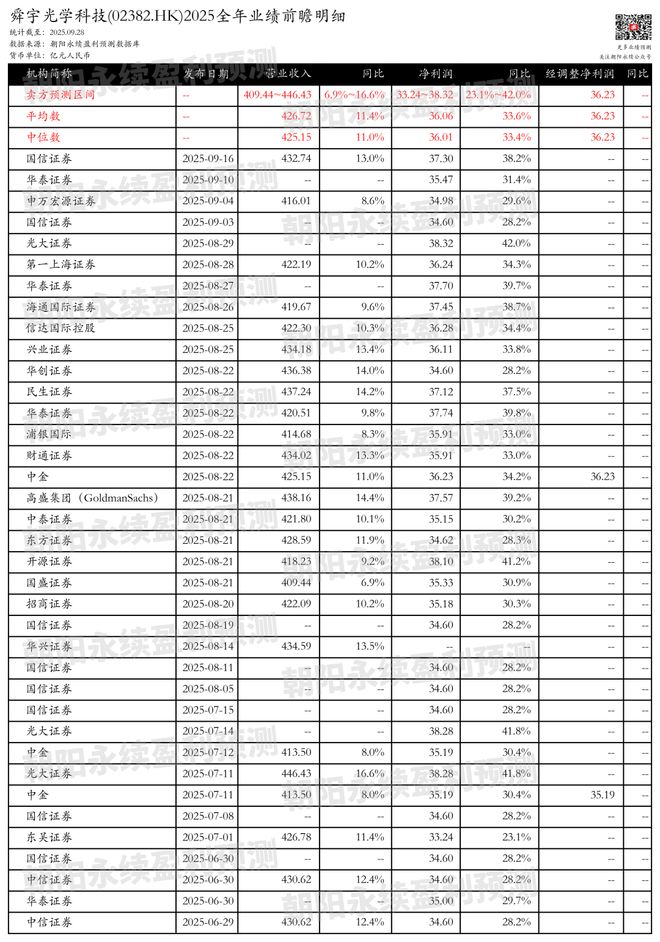
Core Viewpoint - Sunny Optical Technology is expected to achieve a revenue of 40.944 to 44.643 billion RMB for the fiscal year, representing a year-on-year growth of 6.9% to 16.6%, with a net profit forecast of 3.324 to 3.832 billion RMB, indicating a growth of 23.1% to 42.0% [1][2] Financial Performance - The company is projected to report an adjusted net profit of 3.623 billion RMB [1] - The average revenue forecast from various institutions is approximately 42.672 billion RMB, with a median of 42.515 billion RMB [2] - The company achieved a revenue of 19.7 billion RMB in the first half of 2025, aligning with market expectations, and a net profit of 1.65 billion RMB, reflecting a year-on-year increase of 52.6% [3][4] Business Segments - **Mobile Business**: Despite a decline in shipment volume, revenue increased by 1.7%, with a gross margin guidance raised to 25-30%. Revenue growth for 2025 is expected to be between 5-10% due to the adoption of high-end lens modules and advanced optical technologies [4][5] - **Automotive Business**: Revenue from vehicle optics grew by approximately 18%, with the LiDAR business expected to become a future revenue pillar, having secured projects exceeding 1.5 billion RMB [4][5] - **XR and IoT Business**: The XR segment saw a year-on-year growth of 21%, with rapid expansion in smart glasses and AI service robots, anticipating robot business revenue to reach 2 billion RMB [4][5]

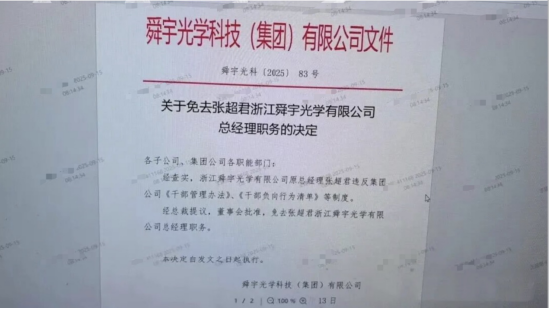
履职八月遭免职?网传舜宇光学科技子公司总经理张超君遭免职,内部公告外泄
Xin Lang Zheng Quan· 2025-09-25 10:47
Core Viewpoint - The internal announcement from Sunny Optical Technology (Group) Co., Ltd. regarding the dismissal of Zhang Chaojun, General Manager of Zhejiang Sunny Optical, has sparked significant market and public attention due to its leak and the circumstances surrounding it [1][11]. Group 1: Dismissal Details - Zhang Chaojun has been dismissed from his position due to violations of the company's management regulations and negative behavior list, as approved by the board of directors [5][9]. - Zhang, aged 55, had been with the company for over 30 years, having joined in 1993 and held various positions before becoming General Manager in January 2025 [6][9]. - The specific reasons for his dismissal have not been disclosed, leading to speculation and discussions in the public domain [11][13]. Group 2: Information Leak and Company Response - The leaked internal announcement included identifiable employee watermarks, raising concerns about information security within the company [1][12]. - The company has acknowledged the leak and emphasized the importance of adhering to information security protocols, stating that it will enhance control and impose stricter penalties for violations [12]. - Sunny Optical Technology, with a market capitalization exceeding HKD 95 billion, is facing dual challenges: the unexpected dismissal of a senior manager and the exposure of its information security vulnerabilities [12].
突破關鍵阻力!舜宇光學輪證策略全解析
Ge Long Hui· 2025-09-24 11:43
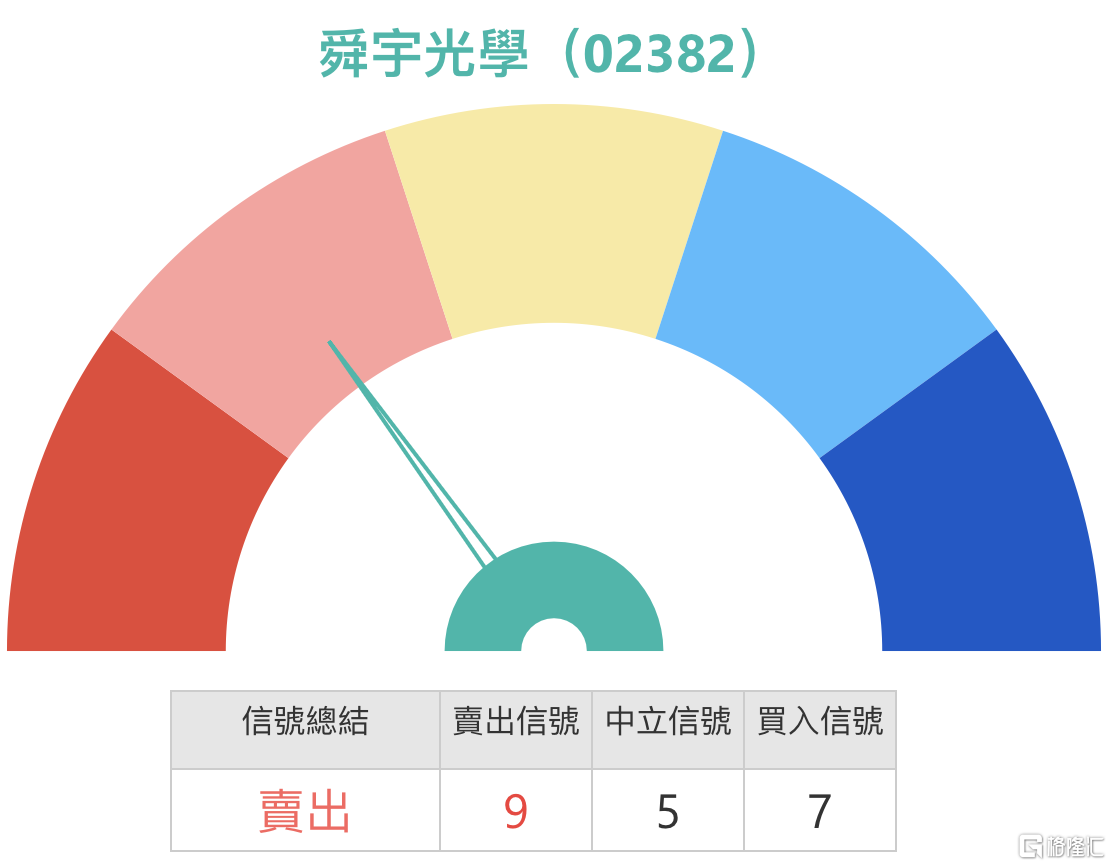
Group 1 - The stock price of Sunny Optical Technology (02382) reached a high of 88.35 HKD, successfully breaking through key resistance levels at 81.79 HKD (10-day moving average) and 80.87 HKD (30-day moving average), indicating a bullish trend [1] - The Relative Strength Index (RSI) is at 61, suggesting it is not yet in the overbought territory, while other indicators like the stochastic oscillator and MACD are signaling buy opportunities [1] - The stock has shown significant volatility with a 5-day price fluctuation of 9.8%, presenting both opportunities and risks for short-term traders [2] Group 2 - Recent market performance of related products has been strong, with UBS warrants (64956) surging 40% in two days due to a 6.29% increase in the underlying stock, indicating investor optimism in the optical sector [4] - Current resistance levels for Sunny Optical are at 92.4 HKD and 93.9 HKD, while support is seen at 81 HKD, with potential downside to 79.2 HKD if the support is breached [2] - Investors are advised to consider various warrant strategies, with UBS call warrants (15320) offering a leverage of 5.6 times and a strike price of 95.93 HKD, suitable for those expecting further price increases [4][6]
贝莱德在舜宇光学科技的持股比例于9月18日从4.61%升至5.13%

Mei Ri Jing Ji Xin Wen· 2025-09-24 09:11
Group 1 - BlackRock's stake in Sunny Optical Technology increased from 4.61% to 5.13% as of September 18 [1]
部分苹果概念股尾盘走高 iPhone 17标准款热度传导至产业链 果链有望受益OpenAI硬件布局
Zhi Tong Cai Jing· 2025-09-24 07:30
Group 1 - Apple concept stocks saw gains in late trading, with notable increases in shares of companies such as Q Technology (up 5.16% to HKD 16.11), Lens Technology (up 4.12% to HKD 30.34), and Sunny Optical (up 1.36% to HKD 86) [1] - Reports indicate that the iPhone 17 standard and Pro Max models are receiving strong demand, with some delivery times extending beyond the pre-order period, suggesting higher-than-expected interest in the standard iPhone 17 [1] - JPMorgan has raised its shipment and profit forecasts for Apple over the next two years, adjusting its target price for Apple to USD 280 based on early signs that the new models may perform better than previously anticipated [1] Group 2 - OpenAI has reportedly signed agreements with Luxshare Precision and other companies to develop a consumer-grade device, indicating collaboration with the domestic supply chain [1] - Analysts from Jefferies noted that OpenAI is also in discussions with Lens Technology and AAC Technologies regarding component supply, highlighting the strategic choice to partner with Apple’s supply chain companies [1] - The collaboration with OpenAI is expected to provide new growth momentum for existing Apple supply chain companies, given that key members of OpenAI's device team have backgrounds at Apple [1]

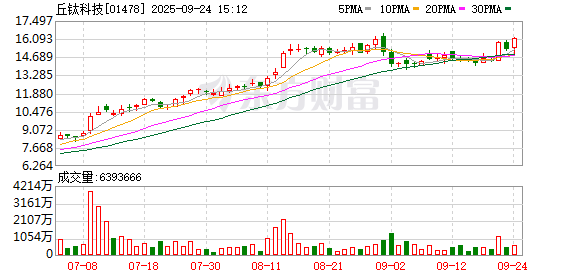
港股苹果概念股有所回升,丘钛科技涨超5%
Mei Ri Jing Ji Xin Wen· 2025-09-24 07:12
Group 1 - Hong Kong's Apple concept stocks experienced a rebound on September 24, with notable increases in share prices [2] - Qiu Tai Technology saw a rise of over 5%, while Lens Technology increased by nearly 4%, and Sunny Optical Technology rose by more than 2% [2]

美银:全球智能眼镜竞赛已加速 中国牢牢占领制造中心地位
智通财经网· 2025-09-23 13:39
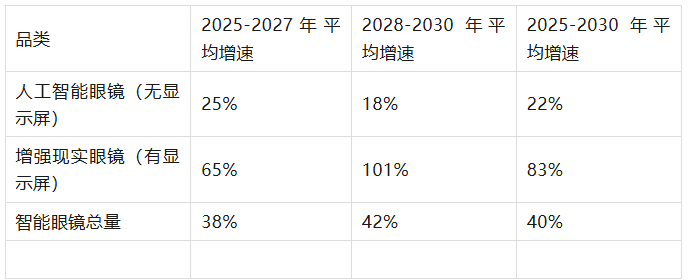
Core Insights - The smart glasses industry is approaching a "critical point of explosion" with major tech companies like Meta launching new smart glasses [1] - Bank of America predicts that AI glasses will dominate growth from 2025 to 2027, while AR glasses are expected to take over as the main growth driver starting in 2028 [1][2] - China is positioned as a key player in the global smart glasses supply chain, controlling over 80% of core components [4] Industry Trends - The smart glasses market is entering a phase of accelerated demand release, characterized by a "two-phase differentiation" growth logic [2] - Phase one (2025-2027): AI glasses, which do not have displays, are expected to lead growth with an average annual shipment growth rate of 25% due to their mature technology and cost-effectiveness [2] - Phase two (2028 onwards): AR glasses are projected to replace AI glasses, with an average annual shipment growth rate of 101% as display technology and optical solutions improve [3] Market Outlook - The global smart glasses shipment volume is expected to have a compound annual growth rate (CAGR) of 40% from 2025 to 2030, with a potential doubling point around 2027 driven by consumer electronics replacement cycles and enterprise applications [3] Supply Chain Dynamics - The global smart glasses supply chain is characterized by "China dominance and regional division of labor," with Chinese suppliers covering key areas such as cameras, optical waveguides, MEMS, and batteries [4] - Major manufacturing bases for smart glasses are concentrated in China, while some non-core assembly processes are gradually moving to Southeast Asia to mitigate supply chain risks [5] Technological Barriers - The core competitive focus in the industry is on two technological directions: drug delivery efficiency and user adaptability, with companies holding key technology patents establishing differentiated barriers [6] Key Company Analysis - **GoerTek (歌尔股份)**: Recognized as a global assembly leader with over 70% of orders from major clients like Meta and Sony, target price set at 42 RMB based on a 34x PE ratio for 2026 [7][8] - **Crystal Optoelectronics (水晶光电)**: Core supplier of AR optical waveguide plates with a target price of 30 RMB based on a 27x PE ratio for 2026, supported by a stable 22% CAGR in earnings from 2024 to 2027 [10] - **Sunny Optical Technology (舜宇光学)**: Major supplier of camera modules with over 60% global market share, target price set at 104 HKD based on a 25x PE ratio for 2026 [12]

大行报告|美银:全球智能眼镜竞赛已加速,中国牢牢占领制造中心地位
智通财经网· 2025-09-23 13:32
Core Viewpoint - The smart glasses industry is approaching a "breakout critical point" with major tech companies like Meta launching new smart glasses, and AI glasses expected to dominate growth from 2025 to 2027, followed by AR glasses from 2028 onwards. China is positioned as a key player in the global supply chain with over 80% supplier representation [1]. Industry Trends - The smart glasses market is entering a phase of accelerated demand release, characterized by a "two-stage differentiation" growth logic: - **First Stage (2025-2027)**: AI glasses will lead growth with an expected annual shipment growth rate of 25%, focusing on lightweight applications such as voice interaction and health monitoring [2]. - **Second Stage (2028 onwards)**: AR glasses will take over with an anticipated annual shipment growth rate of 101%, driven by advancements in display technology and computational power [2]. - The overall global smart glasses shipment compound annual growth rate (CAGR) from 2025 to 2030 is projected to reach 40%, with a doubling point expected around 2027 due to consumer electronics replacement cycles and enterprise applications [2]. Supply Chain Dynamics - The global smart glasses supply chain is characterized by "China dominance and regional division of labor": - **Supply Side**: Chinese companies control over 80% of core components, including cameras, optical waveguides, MEMS, and batteries, with significant market shares in camera modules, optical coatings, and assembly [3]. Manufacturing Landscape - China remains the core manufacturing base for smart glasses, with major production hubs in Shandong and Guangdong. However, electronic manufacturing services (EMS) are gradually shifting some non-core assembly operations to Southeast Asia to mitigate supply chain risks, while retaining core component production in China [4]. Technological Barriers - The industry's core competitive focus is on two main technological directions: - Drug delivery efficiency (e.g., optical transmittance for AR glasses, voice recognition accuracy for AI glasses) - User adaptability (e.g., lightweight design, battery life, and matching usage scenarios for different demographics) [5]. Key Company Analysis - **GoerTek**: Recognized as the global leader in smart glasses assembly, with over 70% of orders from major clients like Meta and Sony. The target price is set at 42 RMB based on a projected PE of 34 times for 2026, reflecting a 30% annual growth expectation in the smart glasses assembly business [6]. - **Crystal Optoelectronics**: A core supplier of optical waveguides for AR glasses, with a target price of 30 RMB based on a PE of 27 times for 2026. The company is expected to achieve a stable 22% CAGR in earnings from 2024 to 2027 [7]. - **Sunny Optical**: A leading supplier of camera modules for smart glasses, with a target price of 104 HKD based on a PE of 25 times for 2026. The company is positioned for growth due to improvements in the optical industry and the potential of smart glasses as a second growth curve [10].

A股、港股突然异动,发生了什么?
Zheng Quan Shi Bao· 2025-09-23 05:39
Market Overview - A-shares and Hong Kong stocks experienced a significant adjustment, with the ChiNext Index initially rising nearly 1.6% before turning negative, and the Shanghai Composite Index dipping below 3,800 points [1][3] - The market saw a high level of selling pressure, with nearly 5,000 stocks declining across the Shanghai and Shenzhen exchanges [3] Investor Behavior - Analysts suggest that the upcoming holiday may lead to increased risk aversion among leveraged funds, prompting a wave of profit-taking [1][3] - The financing balance has reached 2.4 trillion yuan, indicating a substantial scale of leveraged investments, which could trigger market volatility if risk factors arise [3][4] External Market Influences - Recent strong performances in major markets such as the US, Japan, and Europe may attract capital back to those markets, especially since they will remain open during the National Day holiday [4] - The stability of the RMB exchange rate above 7.1 and the USD index around 97 may influence investor sentiment [4] Sector Performance - The banking sector in A-shares showed resilience, with several banks like Nanjing Bank and Qilu Bank seeing gains of nearly 5% and over 3% respectively, while sectors like tourism, real estate, and technology faced significant declines [3][4] - The Hong Kong market also faced declines, with the Hang Seng Index dropping over 1% and the Hang Seng Tech Index falling more than 2% [3] Market Sentiment and Future Outlook - Despite the current market adjustments, the overall risk appetite may not have significantly decreased, as indicated by the performance of long-term government bonds [6] - Analysts believe that there may still be a window of opportunity in the market post-National Day, with potential for a rebound in certain sectors [6][7] - The interplay between domestic fundamentals weakening and improving overseas liquidity could lead to a high-level market fluctuation, with a focus on structural opportunities [6][7]



