GTHT(02611)

Search documents
证券ETF南方(512900)开盘跌0.29%,重仓股东方财富跌0.45%,中信证券跌0.32%
Xin Lang Cai Jing· 2026-03-26 01:32
Group 1 - The Securities ETF Southern (512900) opened down 0.29% at 1.045 yuan on March 26 [2][4] - Major holdings in the ETF include Dongfang Caifu down 0.45%, CITIC Securities down 0.32%, Guotai Junan down 0.23%, Huatai Securities down 0.37%, GF Securities down 0.27%, China Merchants Securities down 0.07%, Dongfang Securities down 0.22%, Dongxing Securities down 0.16%, and Industrial Securities down 0.16%, while Shenwan Hongyuan remained unchanged [2][4] - The performance benchmark for the Securities ETF Southern is the CSI All Share Securities Company Index return, managed by Southern Fund Management Co., Ltd., with a fund manager named Sun Wei [2][4] Group 2 - Since its establishment on March 10, 2017, the ETF has returned 4.70%, but it has seen a decline of 10.11% over the past month [2][4] - A MACD golden cross signal has formed, indicating potential upward momentum for certain stocks [2][4]



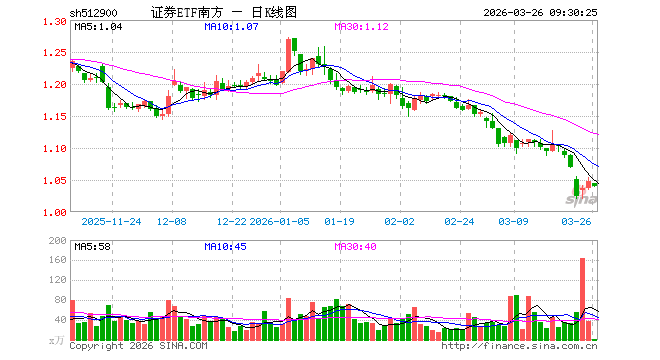
证券ETF鹏华(159993)开盘跌0.18%,重仓股东方财富跌0.45%,中信证券跌0.32%
Xin Lang Cai Jing· 2026-03-26 01:32
Group 1 - The Securities ETF Penghua (159993) opened at a decline of 0.18%, priced at 1.134 yuan [1][2] - Major holdings in the Securities ETF Penghua include Dongfang Caifu, which opened down 0.45%, and other securities firms such as CITIC Securities down 0.32%, Huatai Securities down 0.37%, and GF Securities down 0.27% [1][2] - The performance benchmark for the Securities ETF Penghua is the National Securities Leading Index return, managed by Penghua Fund Management Co., with a return of 13.55% since its establishment on December 26, 2019, and a recent one-month return of -10.12% [1][2] Group 2 - The article mentions the formation of a MACD golden cross signal, indicating potential upward momentum for certain stocks [3]

非银金融行业:加强稳市机制建设,关注板块左侧机遇
GF SECURITIES· 2026-03-23 01:00
Investment Rating - The report provides a "Buy" rating for the non-bank financial sector, indicating an expected performance that will exceed the market by more than 10% over the next 12 months [36]. Core Insights - The report emphasizes the importance of strengthening market stability mechanisms and suggests focusing on left-side opportunities within the sector. It highlights that external risk events may fluctuate, but the market's resilience remains strong, with a trend of incremental capital inflow expected to continue [5]. - The introduction of the Financial Law draft is seen as a significant step towards enhancing regulatory frameworks and promoting high-quality development in the financial sector. This law aims to strengthen supervision, prevent risks, and support long-term growth [16][17]. - The insurance sector is advised to be actively monitored, as it continues to increase its equity investment ratio despite market downturns. The report notes that the solvency ratio of life insurance companies remains robust, providing a buffer against potential market pressures [13][5]. Summary by Sections 1. Market Performance - As of March 21, 2026, the Shanghai Composite Index fell by 3.38%, while the Shenzhen Component Index decreased by 2.90%. The CSI 300 Index dropped by 2.19%, and the ChiNext Index rose by 1.26% [10]. 2. Industry Dynamics and Weekly Commentary (a) Insurance - The report indicates that the insurance sector is guided by the two sessions to pursue high-quality development. The solvency ratio of life insurance companies is at 115%, significantly above the regulatory threshold of 50%, allowing for continued investment in equities [13]. - The proportion of insurance funds allocated to stocks and funds has increased to 14.8%, up by 2.1 percentage points from the previous year. The report suggests that the current valuation of the insurance sector presents a good cost-performance ratio [13]. (b) Securities - The Financial Law draft aims to enhance financial regulation and promote high-quality development. It establishes a comprehensive legal framework for financial activities, emphasizing risk prevention and regulatory clarity [16][17]. - The report notes that the Hong Kong Securities and Futures Commission has reported a significant increase in the virtual asset market, with a daily trading volume increase of 89.5% year-on-year, indicating a growing market and regulatory framework [21][23]. 3. Key Company Valuations and Financial Analysis - The report includes detailed valuations for key companies in the sector, with several companies rated as "Buy," including China Ping An, China Life, and Huatai Securities, among others. The expected earnings per share (EPS) and price-to-earnings (PE) ratios for these companies indicate strong growth potential [6].



加强稳市机制建设,关注板块左侧机遇
GF SECURITIES· 2026-03-22 05:15
Core Insights - The report emphasizes the importance of strengthening market stability mechanisms and highlights potential left-side opportunities in the non-bank financial sector [1][7]. Group 1: Market Performance - As of March 21, 2026, the Shanghai Composite Index was at 3957.05 points, down 3.38%, while the Shenzhen Component Index fell 2.90% to 13866.20 points. The CSI 300 Index decreased by 2.19% to 4567.02 points, and the ChiNext Index rose by 1.26% to 3352.10 points [12]. Group 2: Industry Dynamics and Weekly Commentary Insurance Sector - The report indicates that the insurance sector is guided by the two sessions to develop a high-quality growth blueprint. As of March 20, 2026, the 10-year government bond yield was 1.83%, up 2 basis points from the previous week. The insurance sector is advised to be actively monitored due to its improving fundamentals and increasing equity investment ratio, which reached 14.8% by the end of 2025, up 2.1 percentage points from 2024 [15][18]. - The solvency ratio for life insurance companies was 115%, significantly above the regulatory threshold of 50%, indicating a strong capacity to maintain equity investments despite market fluctuations [15][18]. Securities Sector - The report discusses the introduction of the first financial law draft aimed at enhancing financial governance and promoting high-quality development. This draft, released on March 20, 2026, focuses on strengthening regulation, risk prevention, and facilitating high-quality growth in the financial sector [18][19]. - The draft aims to establish a comprehensive regulatory framework, clarifying responsibilities and enhancing risk management capabilities across financial institutions [19][21]. Group 3: Investment Recommendations - The report suggests focusing on specific stocks within the insurance sector, including China Ping An (A/H), China Life (A/H), and China Pacific Insurance (A/H), due to their favorable valuation and growth potential [15][18]. - In the securities sector, recommended stocks include Guotai Junan (A/H), China Merchants Securities (A/H), and CITIC Securities (A/H), which are expected to benefit from the ongoing market reforms and stability mechanisms [7][15].

国泰海通(02611) - 海外监管公告 - 国泰海通证券股份有限公司关於召开2025年度业绩发佈会...
2026-03-20 11:43
香港交易及結算所有限公司及香港聯合交易所有限公司對本公告之內容概不負責,對其準確性 或完整性亦不發表任何聲明,並明確表示概不對因本公告全部或任何部份內容而產生或因倚賴 該等內容而引致之任何損失承擔任何責任。 國泰海通證券股份有限公司 Guotai Haitong Securities Co., Ltd. (於中華人民共和國註冊成立的股份有限公司) (股份代號:02611) 海外監管公告 本公告乃由國泰海通證券股份有限公司(「本公司」)根據香港聯合交易所有限公司 證券上市規則第13.10B條作出。 茲載列本公司於上海證券交易所網站發佈之《國泰海通證券股份有限公司關於召 開2025年度業績發佈會的公告》,僅供參閱。 承董事會命 國泰海通證券股份有限公司 朱健 董事長 中國上海 2026年3月20日 截至本公告日期,本公司的執行董事為朱健先生、李俊傑先生以及聶小剛先生; 本公司的非執行董事為周杰先生、管蔚女士、鐘茂軍先生、陳航標先生、呂春芳 女士、哈爾曼女士、孫明輝先生以及陳一江先生;本公司的職工董事為吳紅偉先 生;及本公司的獨立非執行董事為李仁傑先生、王國剛先生、浦永灝先生、毛付 根先生、陳方若先生以及江憲先生。 ...
银河期货国债期货持仓日报-20260320
Yin He Qi Huo· 2026-03-20 11:13
1. Report Industry Investment Rating - No relevant information provided 2. Core View of the Report - The report presents a daily summary of Treasury bond futures positions on March 20, 2026, including closing prices, trading volumes, trading amounts, open interest, and margin details for different contract varieties and maturities [3] 3. Summary by Directory 3.1 Treasury Bond Futures Transaction Summary - **T Series Contracts**: The total trading volume of T series contracts was 77,953, a decrease of 9% compared to the previous day; the total trading amount was 84.4 billion, also a decrease of 9%; the total open interest was 305,548, a decrease of 3,521; the total margin for open positions was 6.62 billion [3] - **TF Series Contracts**: The total trading volume of TF series contracts was 78,690, an increase of 7% compared to the previous day; the total trading amount was 83.4 billion, an increase of 7%; the total open interest was 192,513, an increase of 601; the total margin for open positions was 2.45 billion [3] - **TL Series Contracts**: The total trading volume of TL series contracts was 90,333, an increase of 1% compared to the previous day; the total trading amount was 10 billion, an increase of 1%; the total open interest was 159,690, an increase of 5,344; the total margin for open positions was 6.18 billion [3] - **TS Series Contracts**: The total trading volume of TS series contracts was 38,886, a decrease of 13% compared to the previous day; the total trading amount was 7.97 billion, a decrease of 13%; the total open interest was 80,079, an increase of 1,483; the total margin for open positions was 0.82 billion [3] 3.2 Net Position of Treasury Bond Futures - The report provides the net position trends of TS, T, TF, and TL Treasury bond futures from October 9 to March 3, including the net positions of the top five, top ten, and top twenty holders [5][6][7] 3.3 Two - Year Treasury Bond Futures Position - **2606 Contract**: The top five buyers held a total of 34,717 contracts, an increase of 1,442, with a nominal amount change of 2.96 billion and a position share of 45.0%, an increase of 0.7%; the top five sellers held a total of 47,881 contracts, an increase of 429, with a nominal amount change of 0.88 billion and a position share of 62.0%, a decrease of 1.6% [9] - **2609 Contract**: All trading volume, long and short positions of the top twenty holders were 0 [11] 3.4 Five - Year Treasury Bond Futures Position - **2606 Contract**: The top five buyers held a total of 100,076 contracts, an increase of 190, with a nominal amount change of 0.2 billion and a position share of 57.6%, unchanged; the top five sellers held a total of 93,656 contracts, an increase of 368, with a nominal amount change of 0.39 billion and a position share of 53.9%, an increase of 0.1% [13] - **2609 Contract**: The top five buyers held a total of 9,204 contracts, a decrease of 6, with a nominal amount change of - 0.01 billion and a position share of 50.0%, a decrease of 0.3%; the top five sellers held a total of 14,415 contracts, a decrease of 32, with a nominal amount change of - 0.03 billion and a position share of 78.4%, a decrease of 1.2% [15] 3.5 Ten - Year Treasury Bond Futures Position - **Overall**: The top five buyers held a total of 162,333 contracts, a decrease of 3,131, with a nominal amount change of - 3.39 billion and a position share of 56.2%, a decrease of 0.4%; the top five sellers held a total of 146,600 contracts, an increase of 372, with a nominal amount change of 0.4 billion and a position share of 50.7%, an increase of 0.8% [16] - **2606 Contract**: No separate detailed data provided - **2609 Contract**: The top five buyers held a total of 9,577 contracts, with a nominal amount change of 0.02 billion and a position share of 59.1%, a decrease of 0.3%; the top five sellers held a total of 9,873 contracts, an increase of 64, with a nominal amount change of 0.07 billion and a position share of 61.0%, unchanged [19] 3.6 Thirty - Year Treasury Bond Futures Position - **2606 Contract**: The top five buyers held a total of 69,878 contracts, an increase of 439, with a nominal amount change of 0.49 billion and a position share of 52.0%, a decrease of 1.4%; the top five sellers held a total of 71,246 contracts, an increase of 2,086, with a nominal amount change of 2.31 billion and a position share of 53.0%, a decrease of 0.2% [21] - **2609 Contract**: The top five buyers held a total of 15,866 contracts, an increase of 404, with a nominal amount change of 0.45 billion and a position share of 63.5%, a decrease of 0.9%; the top five sellers held a total of 17,613 contracts, an increase of 512, with a nominal amount change of 0.57 billion and a position share of 70.5%, a decrease of 0.7% [23]

国泰海通(601211) - 国泰海通证券股份有限公司关于召开2025年度业绩发布会的公告
2026-03-20 10:15
重要内容提示: 中文+英文:上证路演中心(https://roadshow.sseinfo.com/)、路演中 (https://webcast.roadshowchina.cn/N3LJqE) 证券代码:601211 证券简称:国泰海通 公告编号:2026-009 国泰海通证券股份有限公司 关于召开 2025 年度业绩发布会的公告 本公司董事会及全体董事保证本公告内容不存在任何虚假记载、误导性陈 述或者重大遗漏,并对其内容的真实性、准确性和完整性承担法律责任。 投资者可于 2026 年 3 月 24 日(星期二)至 3 月 30 日(星期一)16:00 前登录上证路演中心网站首页点击"提问预征集"栏目或通过公司邮箱 dshbgs@gtht.com 进行提问。公司将在业绩发布会上对投资者普遍关注的问题进 行回答。 国泰海通证券股份有限公司(以下简称公司)拟于 2026 年 3 月 28 日发布公 司 2025 年年度报告,为便于广大投资者更全面深入地了解公司 2025 年度经营成 果、财务状况,公司计划于 2026 年 3 月 31 日(星期二)10:00-11:00 举行 2025 年度业绩发布会,就投资者 ...
包盘配售、巨额获利,香港近年最大金融监管风暴
阿尔法工场研究院· 2026-03-19 04:06
Core Viewpoint - The ongoing investigation by the Hong Kong Independent Commission Against Corruption (ICAC) and the Securities and Futures Commission (SFC) into bribery and insider trading among brokerage executives may significantly impact the Hong Kong IPO market, potentially leading to a "major earthquake" in the financing market [4][11]. Group 1: Investigation Details - The investigation involves searches at 14 locations and the arrest of 8 individuals, with a specific case of insider trading linked to a hedge fund that generated approximately HKD 315 million in profit [4]. - The implicated brokerage firms include CITIC Securities and Guotai Junan, with high-ranking officials from their equity capital markets (ECM) departments under scrutiny [12]. - The investigation is described as the largest in the financial sector since 2017, raising concerns about the integrity of the Hong Kong financing market [4]. Group 2: Infini Capital's Role - Infini Capital, founded by Tony Chin in June 2015, has gained notoriety for its rapid rise in the market, participating as the sole subscriber in multiple placements totaling over HKD 13.253 billion in the past year [6]. - The fund has also been active in cornerstone investments for IPOs, contributing over HKD 960 million to various projects, with many set to unlock around June 30 [7]. - Allegations suggest that Infini Capital may have engaged in insider trading by obtaining advance information on placements, allowing them to profit from stock price declines [9]. Group 3: Market Reactions and Implications - The investigation has led to increased anxiety among market participants, with expectations that it could lead to a more regulated and cleaner market environment [5][17]. - Concerns have been raised about the potential fallout on numerous IPO projects, particularly those involving the implicated brokerages, as they have been involved in many recent listings [12]. - The phenomenon of "package deals" in IPOs has become more common, with certain funds and brokerages concentrating their subscription shares, raising questions about market practices [14].

英伟达加码260亿美元研发,国泰海通看好模型落地催生全产业链机会
Ge Long Hui· 2026-03-17 02:54
Core Viewpoint - Nvidia plans to invest a total of $26 billion over the next five years to advance the development of open-source AI large models, marking a strategic shift from being a "chip manufacturer" to a "full-stack AI top laboratory" [1] Investment Recommendations Computing Power - Recommended companies include Nvidia (NVDA.O), TSMC (TSM.N), ASML (ASML.O), and Broadcom (AVGO.O) [1] Cloud Providers - Recommended North American cloud providers are Microsoft (MSFT.O), Amazon (AMZN.O), and Google (GOOGL.O) [1] AI Applications - Companies benefiting from AI Agent direction include Apple (AAPL.O), Qualcomm (QCOM.O), Lenovo Group (0992.HK), and Xiaomi Group (1810.HK). Tesla (TSLA.O) is highlighted for its benefits in the Physical AI direction [1] AI Social - Recommended social network giants empowered by AI include Tencent Holdings (0700.HK), Meta (META.O), and Google (GOOGL.O) [1]
中信证券及国泰海通卷入3亿港元内幕交易案 员工平均年薪超70万远超同行敲合规警钟
Chang Jiang Shang Bao· 2026-03-15 23:18
Core Viewpoint - The recent investigation into two major securities firms, CITIC Securities and Guotai Junan, by the Hong Kong Independent Commission Against Corruption (ICAC) and the Securities and Futures Commission (SFC) highlights significant compliance risks in the booming Hong Kong IPO market, revealing potential insider trading and corruption issues [2][4][9]. Group 1: Investigation Details - CITIC Securities and Guotai Junan disclosed that their Hong Kong branches were searched by the ICAC and SFC as part of a joint operation targeting insider trading and corruption [2][4]. - The investigation, codenamed "Fuse," involved the arrest of eight individuals, including senior executives from the two securities firms and a hedge fund management company, for allegedly accepting over HKD 4 million in bribes [5][6]. - The hedge fund reportedly profited approximately HKD 315 million by short-selling stocks based on leaked information about upcoming share placements from multiple Hong Kong-listed companies [2][5]. Group 2: Market Context and Compliance Concerns - The Hong Kong IPO market has seen explosive growth, with 119 companies raising over HKD 280 billion in 2025, making it the largest globally [9]. - In the first two months of 2026, 24 companies completed IPOs, a year-on-year increase of nearly 167%, with total financing reaching HKD 892.26 million, a tenfold increase [9]. - The rapid growth in IPOs and related activities has raised compliance concerns, as the lack of pre-approval for placements in the Hong Kong market creates opportunities for insider trading and conflicts of interest [9]. Group 3: Financial Performance and Employee Compensation - In 2024, the average salaries for employees at CITIC Securities and Guotai Junan were HKD 779,800 and HKD 709,700, respectively, ranking them first and second in the industry [4][10]. - The profitability of the securities firms is closely tied to their performance in high-yield areas such as IPOs and placements, which directly impacts employee performance and compensation [3][9].