Zijin Mining(02899)

Search documents
8大固态电池项目开工/上马
DT新材料· 2026-03-01 16:05
Core Viewpoint - The domestic solid-state battery industry is entering a new wave of construction and production starting in early 2026, with multiple projects across various provinces including Guangdong, Hubei, Jiangsu, Fujian, Inner Mongolia, and Hunan, covering the entire industry chain from core electrolyte material research to the production of power and energy storage batteries [1] Group 1: Project Launches - Ganfeng Lithium's Dongguan project has commenced, with an annual production capacity of 10GWh for new lithium batteries and energy storage, involving a total investment of 5 billion yuan and covering approximately 325.5 acres [2] - Guangdong Electric General Storage Technology has started the expansion of its solid-state battery production base for low-altitude economy applications, with a total investment of 1.6 billion yuan and an expected annual output value of about 1 billion yuan [3] - Chunan New Energy has registered two projects in Hubei, with a total investment of 27.5 billion yuan for each project, aiming for an annual production capacity of 100GWh for power and energy storage batteries [4][5] - Kunshan Guochuang's solid-state battery project has officially started, with a total investment of approximately 693 million yuan [6] - Zijin Mining's solid-state battery lithium new material construction project has officially broken ground in Fujian, focusing on core raw materials for solid-state batteries [7][8] - Wuhai Qingtai has publicized a 5GWh solid-state battery project and a 500-ton solid-state electrolyte material project, with total investments of 1 billion yuan and 15 million yuan respectively [9] - Xiangxiang Fuqi New Materials has launched a project for producing 1,000 tons of high-performance solid electrolyte materials, with a total investment of 60 million yuan [10] - Sichuan Chuanhong New Energy's new solid-state lithium-ion battery production base is under construction, with an expected annual output value of 3.5 billion yuan and a total investment of 1.5 billion yuan [11] Group 2: Industry Trends - The solid-state battery industry is experiencing significant growth, with multiple projects indicating a strong investment trend and a focus on advanced manufacturing capabilities [1][4][5] - The projects span various applications, including low-altitude economy, energy storage, and high-performance materials, reflecting the industry's diversification and innovation [3][10] - The total investments in these projects highlight the increasing confidence in solid-state battery technology and its potential to meet future energy demands [2][9]


资金转向新赛道 涨价线索受青睐
Zhong Guo Zheng Quan Bao· 2026-02-27 20:43
Core Insights - The prices of various commodities, including precious metals, minor metals, storage chips, and electronic fabrics, have significantly increased this year, leading to a surge in related stock prices [1][2][3] - Analysts indicate that macro liquidity easing supports commodity prices, with the metal sector expected to have higher upward elasticity, making price increases a key investment theme for the first quarter [1][5] Price Increases Across Various Commodities - Multiple commodities have seen price hikes this year, driven by strong AI demand for storage chips and electronic fabrics, as well as increases in resource-based products like gold and silver [1][2] - As of February 27, 2023, spot gold has risen nearly 20%, spot silver over 25%, and LME tin contracts have increased by over 40% [2] - Chemical giants like BASF and Wanhua Chemical have announced price increases for their products [2] Stock Performance - The surge in commodity prices has positively impacted related stocks, with the Wind storage chip index up over 27%, the Wind glass fiber index up over 46%, and the Wind minor metals index up over 42% this year [3] - Specific stocks such as Xianglu Tungsten and Zhangyuan Tungsten have seen increases of over 180%, while Zhongtung High-tech has risen over 130% [3] Positive Impact on Company Performance - Price increases are expected to have a positive effect on the performance of related listed companies, with companies like Zinc Industry Co. indicating that rising indium prices will benefit their earnings [4] - Zhangyuan Tungsten has forecasted significant revenue and net profit growth due to tight supply and increased demand for tungsten raw materials [4] Investment Trends - The trend of price increases is seen as a core investment theme, with significant capital inflows into price-sensitive stocks [4][5] - As of February 26, 2023, Zijin Mining has seen a net capital inflow of over 4.6 billion yuan, with several other companies also experiencing substantial net purchases [4] Broader Market Implications - Price increases are becoming a critical trading theme across various sectors, not limited to specific industries, with 25 out of the top 30 concept indices related to price increases [5] - The expansion of price increases from non-ferrous metals to oil, chemicals, construction materials, and technology is anticipated to be a significant market driver this year [5]


智通港股空仓持单统计|2月27日
智通财经网· 2026-02-27 11:42
Core Insights - The top three companies with the highest short positions as of February 20 are China COSCO Shipping (01919) at 18.86%, CATL (03750) at 16.68%, and Ping An Insurance (02318) at 15.48% [1][2] Group 1: Top Short Positions - China COSCO Shipping (01919) has a short position of 520 million shares, representing a short ratio of 18.86% [2] - CATL (03750) has a short position of 26.0064 million shares, with a short ratio of 16.68% [2] - Ping An Insurance (02318) has a short position of 1.153 billion shares, with a short ratio of 15.48% [2] - Sunny Optical Technology (02382) has a short ratio of 15.24% [2] - Dongfang Electric (01072) has a short ratio of 15.12% [2] - ZTE Corporation (00763) has a short ratio of 14.53% [2] - Vanke (02202) has a short ratio of 14.16% [2] - Zijin Mining (02899) has a short ratio of 13.50% [2] - Hansoh Pharmaceutical (01276) has a short ratio of 13.32% [2] - WuXi AppTec (02359) has a short ratio of 12.50% [2] Group 2: Largest Increases in Short Positions - Weimob (02013) saw an increase of 0.27% in its short ratio, now at 12.43% [2] - China Duty Free Group (01880) increased by 0.25%, now at 8.92% [2] - Midea Group (00300) increased by 0.23%, now at 4.26% [2] - Meitu (01357) increased by 0.22%, now at 8.21% [2] - Xinjiang Xinxin Mining (03833) increased by 0.20%, now at 0.51% [2] - Hua Hong Semiconductor (01347) increased by 0.20%, now at 3.59% [2] - Minmetals Development (00425) increased by 0.19%, now at 2.59% [2] - China COSCO Energy (01138) increased by 0.18%, now at 6.61% [2] - Jiaxin International Resources (03858) increased by 0.17%, now at 0.25% [2] - China Railway (00390) increased by 0.17%, now at 4.61% [2] Group 3: Largest Decreases in Short Positions - Pacific Basin Shipping (02343) decreased by 0.83%, now at 4.66% [3] - Tianqi Lithium (09696) decreased by 0.66%, now at 2.25% [3] - Tiangong International (00826) decreased by 0.51%, now at 3.46% [3] - Huiju Technology (01729) decreased by 0.50%, now at 3.08% [3] - Shengye (06069) decreased by 0.44%, now at 1.63% [3] - Ganfeng Lithium (01772) decreased by 0.29%, now at 8.52% [3] - China Galaxy (06881) decreased by 0.25%, now at 3.19% [4] - Jiangxi Copper (00358) decreased by 0.22%, now at 2.32% [4] - China COSCO Shipping (01919) decreased by 0.21%, now at 18.86% [4] - Cafe de Coral (00341) decreased by 0.19%, now at 5.43% [4]

2月净流入约905亿元 频现单日百亿流入逆势抄底科网股
Xin Lang Cai Jing· 2026-02-27 11:10
Core Viewpoint - In February, southbound capital inflow into Hong Kong stocks reached approximately 90.575 billion HKD, marking a three-month high despite a volatile market, indicating strong investor interest in certain sectors [2][4]. Group 1: Capital Inflow Data - Southbound capital recorded a net inflow of about 90.575 billion HKD in February, with an average daily inflow of 6.469 billion HKD, a nearly 90% increase compared to January [2]. - There were five trading days where the net buying exceeded 10 billion HKD, setting new records [4]. - The technology sector attracted the most capital, with a net inflow of 39.372 billion HKD, while the non-essential consumer sector saw 21.196 billion HKD [5][6]. Group 2: Sector Performance - The technology sector has seen a cumulative inflow of over 66 billion HKD in the first two months of the year, despite the Hang Seng Technology Index declining nearly 7% [6]. - Non-essential consumer goods also received significant attention, with a total inflow exceeding 38 billion HKD in the first two months [6]. - The materials sector, particularly non-ferrous resources, faced continuous selling pressure, with a cumulative outflow of nearly 20 billion HKD over the past two months [6]. Group 3: Individual Stock Performance - Tencent Holdings (0700.HK) was the top net buyer with 24.453 billion HKD, followed by Xiaomi Group (1810.HK) with 7.337 billion HKD and Alibaba (9988.HK) with 3.473 billion HKD [7][9]. - Conversely, Zijin Mining (2899.HK) experienced the largest net sell-off at 3.520 billion HKD, followed by SMIC (981.HK) at 2.867 billion HKD [8][9]. - Notable trends include continued inflows into Meituan (3690.HK) and Xiaomi Group despite their respective declines of 16.51% and 1.69% in February [9].







春季行情正当时!供给密集扰动下,碳酸锂剑指20万元大关?
Hua Er Jie Jian Wen· 2026-02-27 09:10
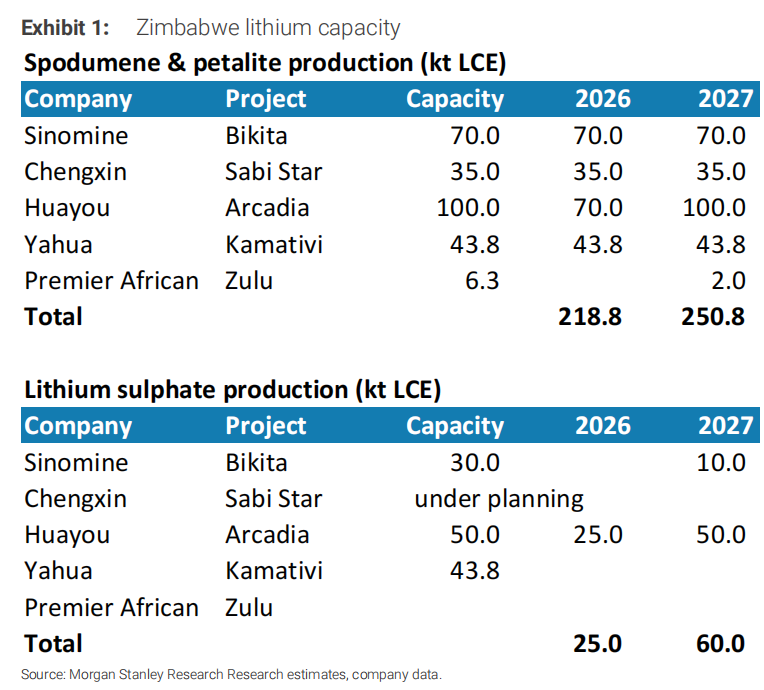
Core Viewpoint - Zimbabwe's sudden ban on all raw mineral and lithium concentrate exports has triggered a significant market reaction, with lithium carbonate futures surging over 11% to exceed 160,000 yuan/ton, indicating a potential new cycle in the lithium market driven by supply disruptions and surging demand from energy storage batteries [1][2][3]. Supply Side - The ban from Zimbabwe is expected to have a short-term impact, with current compliant export capacity limited to 25,000 tons of lithium carbonate equivalent (LCE) in 2026, increasing to 60,000 tons in 2027 [3][5]. - The global lithium supply is projected to be approximately 202,000 tons of LCE in 2026, with demand expected to reach around 201.7 million tons, indicating a tight supply-demand balance [22]. - The recovery of lithium production in Australia is anticipated to take at least a quarter, with many projects still in the planning stages, which limits immediate supply response to rising prices [8][12]. Demand Side - The demand for lithium is increasingly driven by energy storage, with global shipments of storage batteries expected to reach 900 GWh in 2026, translating to a demand for approximately 540,000 tons of LCE, a 50% year-on-year increase [16][18]. - Despite a temporary slowdown in demand for power batteries due to policy changes, the overall demand for lithium is expected to rebound significantly in 2026, with projections of 1.9 million electric vehicles sold in China, a 15.2% increase year-on-year [16][18]. Pricing Dynamics - The current low inventory levels, with social stocks of lithium carbonate dropping to around 10,300 tons, have significantly amplified price elasticity, leading to a market that is trading on "shortage driven by restocking" rather than waiting for supply-demand equilibrium [18][24]. - The pricing logic in the lithium market is shifting from "current period looseness" to "future period tightness," as financial attributes of lithium are becoming more pronounced, with market participants pricing in future scarcity [25][26]. Geopolitical Factors - The emergence of a "Lithium OPEC" in South America, involving Argentina, Bolivia, and Chile, aims to regain pricing power over lithium resources, which could further complicate supply dynamics [6][7]. - Geopolitical and policy variables, such as nationalization efforts in Chile and Mexico's strategic designation of lithium, are expected to layer additional pricing options that could influence market dynamics over time [6][7]. Future Outlook - Analysts predict that lithium carbonate prices could exceed 200,000 yuan/ton in the short term, supported by low inventory, concentrated supply disruptions, and the upcoming demand peak [26]. - The long-term outlook remains uncertain, with differing views on whether prices above 200,000 yuan/ton will be sustainable or if they represent a temporary window before supply increases catch up [26].




供需错配支撑铜价持续上行 对产业链上下游影响几何?
Zheng Quan Ri Bao Zhi Sheng· 2026-02-27 06:36
产业上下游影响分化 本报记者 冯雨瑶 2026年开年以来,铜价持续高位运行。生意社数据显示,截至2月26日,现货铜价最新为10.20万元/ 吨,同比增长32.51%。 供需错配支撑铜价上行 对于驱动铜价上涨的因素,上海钢联铜事业部分析师曾健辉告诉记者:"其一是供应的扰动为铜价提供 了上涨的逻辑支撑,铜精矿供应偏紧;其二是需求导向,传统领域需求不减,另外新能源、AI智能电 气化等对于铜消费又存在强预期;其三地缘政治冲突使得市场避险情绪升温,贵金属大幅上涨,带动铜 的避险属性。" 摩根大通最新预测,2026年全球铜市场将出现13万吨供应缺口,工业金属供需格局迎来关键转向。作为 新能源、电网、AI算力与高端制造的核心原材料,铜的短缺将直接抬升价格中枢,重塑产业链利润分 配,国内具备资源与产能优势的铜业龙头将显著受益。 供给端刚性约束是缺口形成的核心原因。据了解,全球铜矿勘探开发周期长达5年至8年,过去十年矿企 资本开支偏低,新增产能释放缓慢;主力矿山品位持续下滑、产区地缘扰动频发,进一步压制供给弹 性。国金证券报告指出,2025年铜矿产量指引多次下调,2026年预计增量有限。 而反观需求端,AI数据中心等正成为拉动 ...
有色ETF华安(512940)开盘跌0.78%,重仓股紫金矿业跌0.43%,洛阳钼业跌0.35%
Xin Lang Cai Jing· 2026-02-27 01:42
Group 1 - The core point of the article highlights the performance of the Huazhong Nonferrous ETF (512940), which opened with a decline of 0.78% at 1.022 yuan [1] - Major holdings in the ETF include Zijin Mining, which fell by 0.43%, and Ganfeng Lithium, which dropped by 2.00% [1] - The ETF's performance benchmark is the CSI Nonferrous Metals Mining Theme Index, with a return of 3.32% since its establishment on February 4, 2026 [1] Group 2 - The fund is managed by Huazhong Fund Management Co., Ltd., with Xu Zhiyan as the fund manager [1] - Other notable stock performances include Luoyang Molybdenum down 0.35%, Northern Rare Earth up 0.05%, and China Aluminum down 0.82% [1] - The article provides a snapshot of the ETF's performance and its key holdings, reflecting the current market conditions in the nonferrous metals sector [1]

智通港股通持股解析|2月27日
智通财经网· 2026-02-27 00:33
Core Insights - The top three companies by Hong Kong Stock Connect holding ratios are Haotian International Investment (01341) at 72.06%, China Telecom (00728) at 71.36%, and Southern Hengsheng Technology (03033) at 70.17% [1] - The largest increases in holdings over the last five trading days were seen in the Yingfu Fund (02800) with an increase of 3.892 billion, Southern Hengsheng Technology (03033) with 3.036 billion, and Tencent Holdings (00700) with 2.099 billion [1] - The largest decreases in holdings over the last five trading days were recorded by Zijin Mining (02899) with a decrease of 706 million, China Pacific Insurance (02601) with 381 million, and Jiangxi Copper (00358) with 361 million [2] Group 1: Hong Kong Stock Connect Holding Ratios - Haotian International Investment (01341) holds 7.997 billion shares, representing 72.06% [1] - China Telecom (00728) holds 9.905 billion shares, representing 71.36% [1] - Southern Hengsheng Technology (03033) holds 10.714 billion shares, representing 70.17% [1] Group 2: Recent Increases in Holdings - Yingfu Fund (02800) saw an increase of 3.892 billion, with a change of 14.644 million shares [1] - Southern Hengsheng Technology (03033) increased by 3.036 billion, with a change of 60.727 million shares [1] - Tencent Holdings (00700) increased by 2.099 billion, with a change of 4.100 million shares [1] Group 3: Recent Decreases in Holdings - Zijin Mining (02899) experienced a decrease of 706 million, with a change of 15.867 million shares [2] - China Pacific Insurance (02601) decreased by 381 million, with a change of 10.720 million shares [2] - Jiangxi Copper (00358) saw a decrease of 361 million, with a change of 8.007 million shares [2]


智通港股沽空统计|2月27日
智通财经网· 2026-02-27 00:28
Group 1 - BYD Company Limited (81211), Anta Sports Products Limited (82020), and Great Wall Motor Company Limited (82333) have the highest short-selling ratios at 100.00% each [1][2] - Alibaba Group Holding Limited (09988), Ping An Insurance (Group) Company of China, Ltd. (02318), and Tencent Holdings Limited (00700) lead in short-selling amounts, with 1.503 billion, 1.32 billion, and 892 million respectively [1][2] - The highest deviation values are recorded for BYD Company Limited (43.16%), Geely Automobile Holdings Limited (80175) (40.22%), and Standard Chartered PLC (02888) (36.96%) [1][2] Group 2 - The top ten short-selling ratios include BYD Company Limited (100.00%), Anta Sports Products Limited (100.00%), and Great Wall Motor Company Limited (100.00%) [2] - The top ten short-selling amounts show Alibaba Group Holding Limited leading with 1.503 billion, followed by Ping An Insurance with 1.32 billion, and Tencent Holdings with 892 million [2] - The top ten deviation values highlight BYD Company Limited (43.16%), Geely Automobile Holdings Limited (40.22%), and Standard Chartered PLC (36.96%) [2][3]


智通港股通资金流向统计(T+2)|2月27日
智通财经网· 2026-02-26 23:38
Core Insights - The article highlights the net inflow and outflow of capital in the Hong Kong stock market, with specific focus on the top companies experiencing significant changes in capital flow [1][2]. Net Inflow Summary - The top three companies with the highest net inflow of capital are: - Southern Hang Seng Technology (03033) with a net inflow of 1.556 billion, representing a 21.87% increase in capital [2]. - Meituan-W (03690) with a net inflow of 448 million, showing a 13.77% increase [2]. - Xiaomi Group-W (01810) with a net inflow of 436 million, reflecting a 10.02% increase [2]. - Other notable companies with significant net inflows include: - UBTECH (09880) with 362 million and a 28.57% increase [2]. - Techtronic Industries (00669) with 276 million and a 30.43% increase [2]. Net Outflow Summary - The top three companies with the highest net outflow of capital are: - Zijin Mining (02899) with a net outflow of -592 million, indicating a -24.54% decrease [2]. - Jiangxi Copper (00358) with a net outflow of -262 million, reflecting a -32.21% decrease [2]. - China Life (02628) with a net outflow of -251 million, showing a -10.30% decrease [2]. - Other companies with significant net outflows include: - Minmetals Resources (01208) with -243 million and a -43.98% decrease [2]. - PetroChina (00857) with -223 million and a -24.59% decrease [2]. Net Inflow Ratio Summary - The companies with the highest net inflow ratios are: - Midea Real Estate (03990) with a net inflow ratio of 434.41% [2]. - MIRXES-B (02629) with a net inflow ratio of 137.09% [2]. - Southern East Selection (03441) with a net inflow ratio of 125.93% [2]. - Additional companies with notable net inflow ratios include: - Maoyan Entertainment (01896) with 108.12% [3]. Net Outflow Ratio Summary - The companies with the highest net outflow ratios are: - CRRC Corporation (01766) with a net outflow ratio of -137.15% [3]. - China Communications Construction (03969) with a net outflow ratio of -131.76% [3]. - Jiuxing Holdings (01836) with a net outflow ratio of -117.95% [3]. - Other companies with significant net outflow ratios include: - Xianjian Technology (01302) with -104.69% [3].