GCL TECH(03800)

Search documents
“平台黄了”传言震动光伏板块 晶澳科技、光伏协会紧急发文辟谣
Zhong Guo Jing Ying Bao· 2025-11-13 03:23
Group 1 - The core viewpoint of the articles revolves around the recent rumors regarding the photovoltaic industry, which led to a significant decline in stock prices of major companies in the sector, with some experiencing a drop of over 5% in a single day [1] - The rumors included claims about a company secretary stating that certain industry self-regulation initiatives were failing, raising concerns about the progress of self-regulatory mechanisms within the photovoltaic industry [1] - In response to the rumors, major companies like JA Solar issued urgent clarifications, denying the statements attributed to them and emphasizing the importance of relying on official channels for accurate information [1] Group 2 - The photovoltaic industry has faced significant losses over the past two years due to supply-demand mismatches and low-price competition, prompting a "anti-involution" initiative that began in the second half of 2024 [2] - The initiative includes measures such as production cuts and price controls to ensure that prices do not fall below production costs, with a focus on the upstream polysilicon segment, which is critical for the overall supply-demand balance [2] - Despite some leading polysilicon companies like GCL-Poly and Daqo Energy achieving profitability by Q3 2025, many downstream companies in the silicon wafer, cell, and module sectors continue to report losses [2]






港股光伏股今日回暖 新特能源涨4.4%
Mei Ri Jing Ji Xin Wen· 2025-11-13 02:59
Core Viewpoint - The Hong Kong solar stocks have shown a rebound today, with notable increases in share prices for several companies in the sector [1] Company Summaries - New Energy (01799.HK) has seen a rise of 4.4%, reaching a price of 8.78 HKD [1] - Flat Glass (06865.HK) increased by 2.86%, with its stock priced at 12.96 HKD [1] - Xinyi Solar (00968.HK) experienced a 2.41% gain, bringing its share price to 3.82 HKD [1] - GCL-Poly Energy (03800.HK) rose by 2.27%, with shares priced at 1.35 HKD [1]

港股异动 | 光伏股今日回暖 晶澳科技澄清不实传闻 光伏行业协会发声反内卷
智通财经网· 2025-11-13 02:49
Core Viewpoint - The photovoltaic (PV) stocks have rebounded today, with notable increases in share prices for several companies, amidst rumors regarding the multi-crystalline silicon storage platform being "failed" which were dismissed by the China Photovoltaic Industry Association as false information [1] Group 1: Stock Performance - New Energy (01799) increased by 4.4%, reaching HKD 8.78 [1] - Flat Glass (06865) rose by 2.86%, reaching HKD 12.96 [1] - Xinyi Solar (00968) saw a rise of 2.41%, reaching HKD 3.82 [1] - GCL-Poly Energy (03800) increased by 2.27%, reaching HKD 1.35 [1] Group 2: Industry Response - The China Photovoltaic Industry Association issued a statement on the 12th, labeling the circulating rumors as false and indicating that such malicious actions aim to undermine the PV industry for profit [1] - Liu Yiyang, the Executive Secretary of the Association, emphasized the determination of policies and the industry's commitment to avoid destructive competition [1] - JA Solar Technology clarified that its board secretary did not make any statements in internal or external meetings regarding the rumors, labeling the information as serious misinformation [1]
光伏行业协会称稳步推进“反内卷”,强调“不要低估政策决心”
Huan Qiu Wang· 2025-11-13 01:13
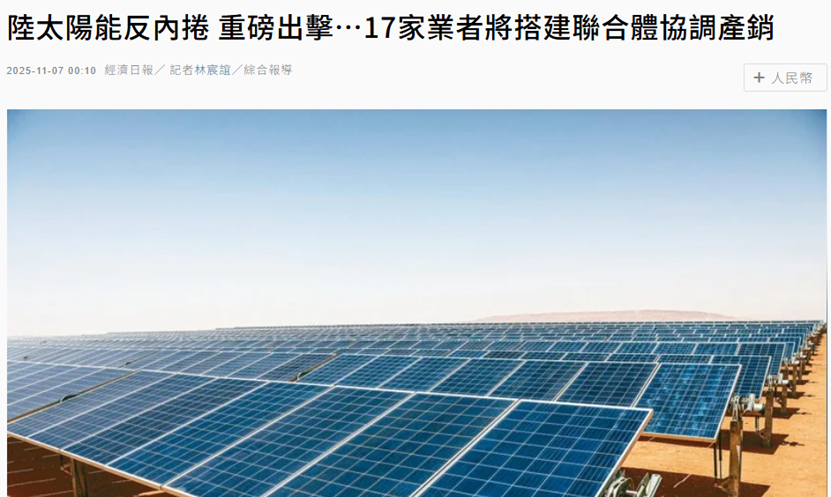
联合新闻网近日发文称,中国内地太阳能反内卷有重大进展,硅料龙头企业协鑫集团董事长朱共山透露,17家硅料企 业已基本同意搭建联合体,预计于2025年底前完成。 【环球网财经综合报道】针对昨日市场中关于光伏产业链的传言,中国光伏行业协会紧急发布声明称,网络流传消息 均不实,协会和行业内各企业正一道努力,稳步推进"反内卷"相关工作。 中国光伏行业协会执行秘书长刘译阳指出,不要低估政策决心,光伏行业不走出"反内卷"恶性竞争誓不罢休。 据中信建投统计,2022年至2024年,中国内地太阳能硅料产业合计新增产能234万吨,到2024年年底累计总产能306.5 万吨;预计到2025年年底,太阳能硅料累计产能将达到333.8万吨。目前终端需求为120万到150万吨左右,过剩产能在 200万吨左右。 报道还提到,2022年以来投产的硅料产线成本约每吨人民币7万到8万元。联合体平台公司如果要收购100万吨的硅料 产能,所需资金要人民币500亿元到700亿元。 ...

11月12日南向资金净买入42.86亿港元
Zheng Quan Shi Bao Wang· 2025-11-13 00:39
Core Viewpoint - The Hang Seng Index rose by 0.85% to close at 26,922.73 points on November 12, with a net inflow of HKD 4.286 billion through the southbound trading channel [1] Group 1: Market Activity - The total trading volume for the southbound trading on November 12 was HKD 105.405 billion, with a net buy of HKD 4.286 billion [1] - The Shanghai Stock Exchange's southbound trading accounted for HKD 66.456 billion in trading volume and a net buy of HKD 3.397 billion, while the Shenzhen Stock Exchange had HKD 38.949 billion in trading volume and a net buy of HKD 0.889 billion [1] Group 2: Active Stocks - Alibaba-W was the most actively traded stock on the Shanghai Stock Exchange with a trading volume of HKD 70.00 billion, but it experienced a net sell of HKD 23.26 billion, closing down by 2.24% [1][2] - Xiaomi Group-W followed with a trading volume of HKD 36.36 billion and a net buy of HKD 9.41 billion, closing up by 1.68% [1][2] - On the Shenzhen Stock Exchange, Alibaba-W also led with a trading volume of HKD 42.72 billion and a net sell of HKD 11.07 billion, closing down by 2.24% [2] - Other notable stocks included Tencent Holdings with a trading volume of HKD 27.24 billion and a net buy of HKD 6.18 billion, and SMIC with a trading volume of HKD 16.61 billion [2]





南向资金今日成交活跃股名单(11月12日)
Zheng Quan Shi Bao Wang· 2025-11-13 00:32
Group 1 - The Hang Seng Index rose by 0.85% on November 12, with a total southbound trading volume of HKD 105.4 billion, including HKD 54.8 billion in buy transactions and HKD 50.6 billion in sell transactions, resulting in a net inflow of HKD 4.3 billion [1] - The southbound trading through Stock Connect (Shenzhen) totaled HKD 38.9 billion, with buy transactions of HKD 19.9 billion and sell transactions of HKD 19.0 billion, leading to a net inflow of HKD 0.9 billion; while Stock Connect (Shanghai) had a total of HKD 66.5 billion, with buy transactions of HKD 34.9 billion and sell transactions of HKD 31.5 billion, resulting in a net inflow of HKD 3.4 billion [1] - Alibaba-W had the highest trading volume among southbound stocks, totaling HKD 112.72 billion, followed by Xiaomi Group-W and SMIC with HKD 54.04 billion and HKD 43.22 billion respectively [1] Group 2 - Xiaomi Group-W recorded the highest net inflow among stocks, with a net buy of HKD 15.92 billion, closing up by 1.68%; followed by XPeng Motors with a net buy of HKD 7.18 billion, and Pop Mart with a net buy of HKD 6.31 billion [1] - Conversely, Alibaba-W experienced the largest net outflow of HKD 34.34 billion, closing down by 2.24%; Huahong Semiconductor and SMIC also faced significant net outflows of HKD 9.85 billion and HKD 4.28 billion respectively [1] - Over a continuous period, Xiaomi Group-W saw a net inflow for 11 consecutive days, totaling HKD 81.36 billion, while China National Offshore Oil Corporation and Pop Mart had net inflows of HKD 28.21 billion and HKD 14.55 billion respectively [2]


智通港股沽空统计|11月13日
智通财经网· 2025-11-13 00:21
Core Insights - The article highlights the top short-selling ratios and amounts for various companies, indicating significant market sentiment against these stocks [1][2]. Short-Selling Ratios - The top three companies with the highest short-selling ratios are Hang Seng Bank-R (80011) and BYD Company-R (81211), both at 100.00%, followed by Kuaishou-WR (81024) at 90.79% [1][2]. - The short-selling ratio for Shengjing Bank (02066) is 83.46%, while Meituan-WR (83690) has a ratio of 77.62% [2]. Short-Selling Amounts - The companies with the highest short-selling amounts are Xiaomi Group-W (01810) at 2.038 billion, Tencent Holdings (00700) at 1.705 billion, and Pop Mart (09992) at 1.689 billion [1][2]. - Other notable companies include Alibaba-SW (09988) with 1.451 billion and Ping An Insurance (02318) with 1.368 billion [2]. Short-Selling Deviation Values - The top three companies with the highest deviation values are Shengjing Bank (02066) at 71.47%, Hang Seng Bank-R (80011) at 60.71%, and BYD Company-R (81211) at 49.79% [1][2]. - Kuaishou-WR (81024) has a deviation value of 40.46%, indicating a significant difference from its historical short-selling average [2].
公募基金港股持仓 聚焦高成长性资产
Zheng Quan Ri Bao· 2025-11-12 23:12
Group 1 - Public funds have significantly increased their allocation to Hong Kong stocks, with the investment market value reaching 1.362211 trillion yuan by the end of Q3 2025, a 43.09% increase from 951.985 billion yuan at the end of Q2 2025 [1] - The market value of equity and index funds in Hong Kong stocks reached 1.231653 trillion yuan and 701.284 billion yuan, reflecting increases of 45.02% and 73.07% respectively [1] - The surge in public fund holdings in Hong Kong stocks indicates a structural transformation in asset allocation, driven by the attractiveness of technology and value stocks [1] Group 2 - The influx of funds into Hong Kong ETFs is attributed to three main reasons: valuation advantages compared to A-shares, the convenience and low cost of ETF trading, and risk diversification benefits [2] - The top Hong Kong stocks that public funds increased their holdings in include SenseTime-W, Alibaba Health, China Biologic Products, and others, primarily in the information technology and healthcare sectors [2] - A total of 38 cross-border ETFs attracted a net inflow of 49.561 billion yuan in Q3, with a year-to-date net inflow of 72.642 billion yuan as of November 12 [2]


公募基金港股持仓聚焦高成长性资产
Zheng Quan Ri Bao· 2025-11-12 16:15
Group 1 - Public funds have significantly increased their allocation to Hong Kong stocks, with the investment market value reaching 1.362211 trillion yuan by the end of Q3 2025, a 43.09% increase from the end of Q2 2025 [1] - The market value of equity and index funds in Hong Kong stocks reached 1.231653 trillion yuan and 701.284 billion yuan, reflecting increases of 45.02% and 73.07% respectively [1] - The surge in public fund holdings indicates a structural transformation in asset allocation, driven by the enhanced attractiveness of Hong Kong stocks, particularly in the technology and banking sectors [1][2] Group 2 - The influx of funds into Hong Kong ETFs is attributed to three main factors: valuation advantages compared to A-shares, trading convenience and low fees of ETFs, and risk diversification benefits [2] - The most favored Hong Kong stocks by public funds include SenseTime-W, Alibaba Health, China Biologic Products, and others, primarily in the information technology and healthcare sectors, aligning with the constituents of the Hang Seng Technology Index and the Hong Kong Pharmaceutical Index [2] - A total of 38 cross-border ETFs attracted a net inflow of 49.561 billion yuan in Q3, with a year-to-date net inflow of 72.642 billion yuan as of November 12 [3] Group 3 - The acceleration of fund flows into ETFs is expected to enhance market liquidity and pricing efficiency, supporting the stable development of the Hong Kong stock market [4]
光伏“反内卷”遇到了“鬼故事”
虎嗅APP· 2025-11-12 13:33
Core Viewpoint - The article discusses the recent turmoil in the photovoltaic (PV) industry due to rumors about the failure of anti-involution policies, which led to significant stock declines. However, the industry association's clarification has stabilized the market, highlighting the determination to combat unhealthy competition and restore value in the sector [3][4][17]. Group 1: Industry Context - The term "involution" has become synonymous with the PV industry in 2023, characterized by homogenized expansion, price wars, and inefficient competition amid slowing installation demand [7]. - The capital market's reaction is evident, with the PV ETF experiencing a dramatic decline of 68.39%, reflecting the industry's struggles and the negative sentiment surrounding it [8]. - The anti-involution initiative began planning in May 2024, officially launching in October 2024, with policies aimed at curbing unhealthy competition and restoring market balance [9][10]. Group 2: Policy Measures - Current policies focus on "price protection" and "volume control," aiming to eliminate below-cost sales and facilitate the exit of outdated production capacities [10]. - Initial results of the price protection measures show significant price increases in key materials: silicon materials up 33.33%, silicon wafers up 17.39%, batteries up 8.92%, and modules up 2.45% [11]. - The silicon material segment is crucial for reversing the industry's overcapacity, as it has the least production elasticity and is capital-intensive, making it difficult to restart production once halted [12][13]. Group 3: Market Recovery - The anti-involution actions have led to expectations of rapid capacity reduction in the silicon material sector, which is essential for improving the overall PV industry landscape [17]. - The establishment of a joint storage platform for silicon material by multiple companies is anticipated to facilitate the exit of smaller players and further stabilize the market [16]. Group 4: Asset Revaluation - The article posits that the anti-involution policies will drive a revaluation of PV assets, transitioning the industry from scale expansion to quality competition [20]. - Companies like Tongwei, TCL Zhonghuan, and Longi Green Energy are showing signs of recovery, with some reporting improved quarterly performance despite still being in the red [22]. - The focus on technological advancements, such as perovskite solar cells, is seen as a pathway for companies to differentiate themselves and enhance their market value [24][25].