
GCL TECH(03800)

Search documents
光伏“反内卷”遇到了“鬼故事”
Hu Xiu· 2025-11-12 12:49
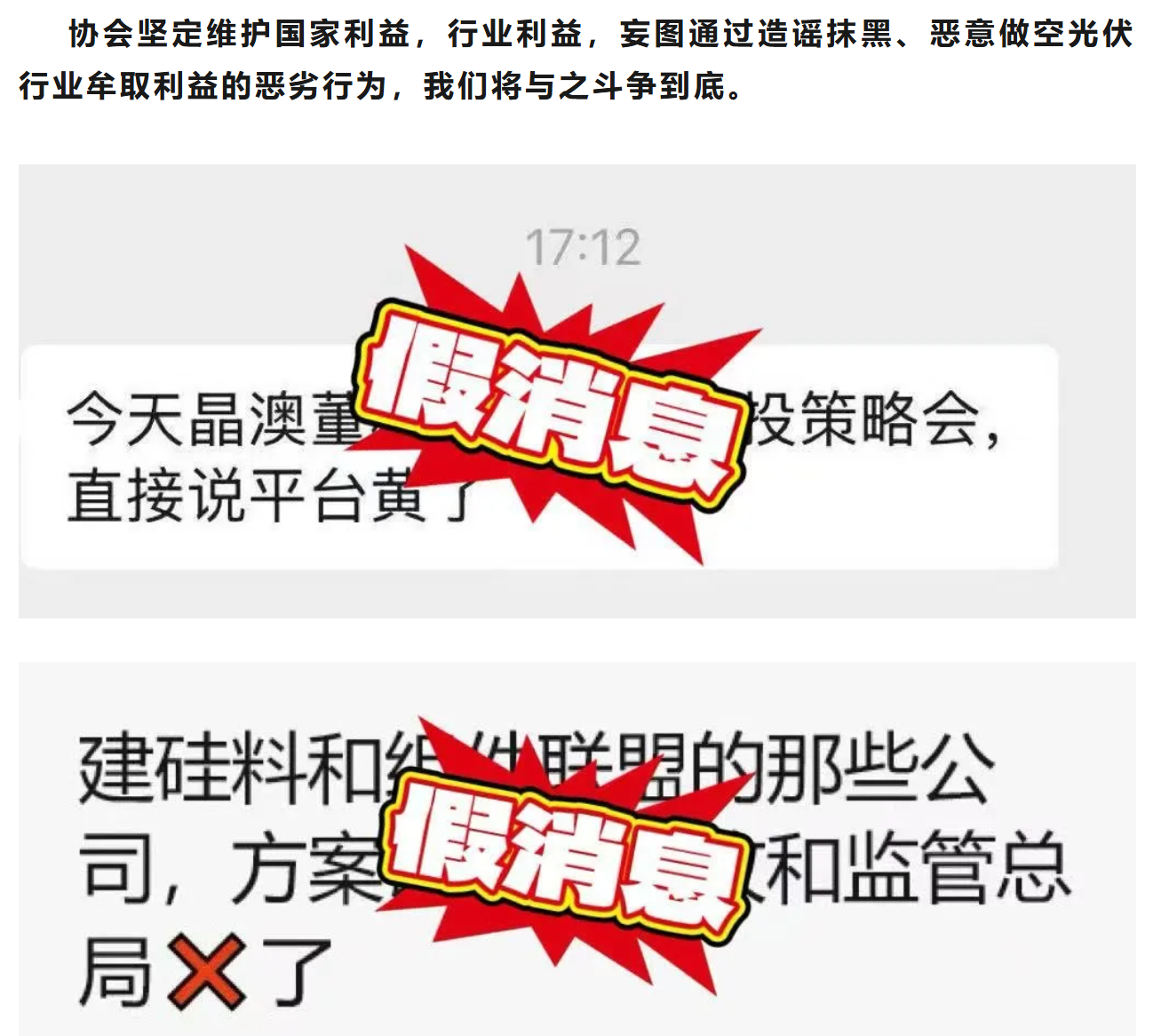
Core Viewpoint - The recent rumors regarding the failure of the "anti-involution" policy in the photovoltaic industry led to significant stock declines, but subsequent clarifications from industry associations helped stabilize the market, indicating a strong commitment to reversing negative competition in the sector [1][5][18]. Group 1: Market Reaction - Following the spread of rumors, the photovoltaic sector experienced a sharp decline, with companies like Jingao Technology and Tongwei Co. seeing drops of 6.84% and 6.06% respectively [5]. - The China Photovoltaic Industry Association issued a statement to refute the rumors, emphasizing the importance of maintaining industry integrity and combating malicious market manipulation [1][5]. Group 2: Anti-Involution Policy - The term "involution" has become synonymous with the photovoltaic industry since 2023, characterized by homogenized expansion and price wars amid slowing installation demand [7]. - The core of the current policy focuses on "price protection" and "volume control," aiming to eliminate below-cost sales and facilitate the exit of outdated production capacities to restore market balance [9][10]. Group 3: Price Recovery - Initial results from the price protection measures show positive trends, with significant price increases in key materials: silicon materials up 33.33%, silicon wafers up 17.39%, and battery cells up 8.92% [10]. - The recovery of prices is expected to improve profitability for companies, laying a solid foundation for valuation increases [20]. Group 4: Capacity Control - The silicon material segment is crucial for addressing overcapacity issues, as it has the least production flexibility and is capital-intensive [11][12]. - Companies are beginning to implement production and sales controls, with expectations to limit annual output to 1.4 million tons, aligning with earlier targets [14]. Group 5: Asset Revaluation - The anti-involution policies are transitioning from expectation to substantial implementation, driving the revaluation of assets in the photovoltaic sector [18][19]. - Companies like Tongwei Co., GCL-Poly Energy, and Daqo New Energy are expected to attract market attention as they benefit from reduced silicon material production and subsequent price increases [22]. Group 6: Technological Advancements - The Ministry of Industry and Information Technology has initiated efforts to accelerate the development of advanced photovoltaic technologies, such as perovskite solar cells, which have the potential for higher efficiency compared to traditional silicon cells [23]. - Recent announcements from companies like GCL-Poly regarding the commercialization of perovskite technology indicate a shift towards innovative production methods, which could lead to significant market opportunities [24].







资金动向 | 北水净买入港股近43亿港元,减持阿里巴巴、华虹半导体
Xin Lang Cai Jing· 2025-11-12 11:57
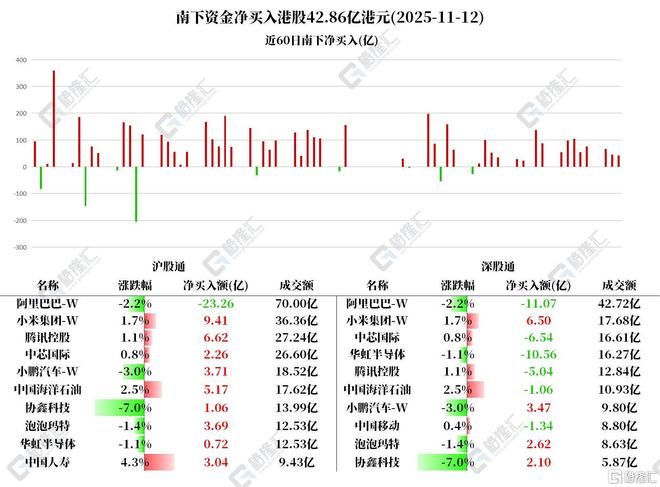
Group 1: Market Activity - Southbound funds net bought Hong Kong stocks worth 4.286 billion HKD on November 12, with notable purchases including Xiaomi Group (1.592 billion HKD), Xpeng Motors (717 million HKD), and China National Offshore Oil Corporation (411 million HKD) [1] - Continuous net buying trends were observed for Xiaomi (81.3635 billion HKD over 11 days), CNOOC (28.2105 billion HKD over 4 days), and Pop Mart (14.5466 billion HKD over 3 days) [3] Group 2: Company Insights - Xiaomi reported a cumulative payment amount exceeding 29 billion HKD as of November 11, with Goldman Sachs maintaining a "Buy" rating and a 12-month target price of 56.5 HKD, citing its strong balance sheet and competitive advantages in the electric vehicle sector [4] - Morgan Stanley raised the target price for Xpeng Motors to 131 HKD, reflecting growth potential from new AI products and expected market sentiment improvement starting mid-2026 [4] - CNOOC's production cost is projected to be 29.56 USD per barrel in 2024, the lowest among major Chinese oil companies, indicating strong international competitiveness [4] Group 3: Company Developments - Alibaba is set to launch its first self-developed flagship AI glasses, Quark AI Glasses, on November 27, with pre-sales performing strongly during the "Double 11" shopping festival [5] - GCL-Poly Energy responded to market rumors regarding its storage platform, asserting that such claims are unfounded, while the China Photovoltaic Industry Association emphasized the importance of policy support in the solar industry [5]



南向资金追踪|净流入约43亿港元 加仓小米和多家中字头并减持阿里
Xin Lang Cai Jing· 2025-11-12 10:33
Core Insights - Southbound funds recorded a transaction volume of approximately HKD 105.4 billion, an increase of about HKD 15.6 billion compared to the previous day, accounting for 44.59% of the total turnover of the Hang Seng Index today [1] - The Hang Seng Index continued its short-term upward trend, with net inflows from southbound funds amounting to approximately HKD 4.286 billion, marking 16 consecutive trading days of net inflows totaling HKD 101.525 billion [1] Individual Stock Performance - Xiaomi Group-W saw a significant net inflow of HKD 1.592 billion, with a short-term increase of 1.68% and an additional 7.608 million shares acquired over the past five days [2][3] - Pop Mart International fell by 1.43%, with a net outflow of HKD 631 million and a reduction of 202,000 shares in the last five days [2] - XPeng Inc. experienced a decline of 3.04%, but short-term funds accelerated inflow, acquiring 1.944 million shares in the past five days [2] - China National Offshore Oil Corporation rose by 2.50%, with a net inflow of HKD 411 million and an increase of 13.3 million shares acquired over the past five days [2] - GCL-Poly Energy Holdings saw a drop of 7.04%, with a net outflow of HKD 316 million and a reduction of 11.6 million shares in the last five days [2] - China Life Insurance gained 4.30%, with a net inflow of HKD 304 million and an increase of 1.692 million shares acquired over the past five days [2] - Alibaba Group Holding experienced a significant net outflow of HKD 3.434 billion, with a decline of 2.24% and a reduction of 402,000 shares in the last five days [2][3] - Hua Hong Semiconductor saw a decrease of 1.06%, with a net outflow of HKD 985 million but an increase of 1.536 million shares acquired over the past five days [2][3] - Semiconductor Manufacturing International Corporation rose by 0.83%, with a net outflow of HKD 428 million and a reduction of 400,000 shares in the last five days [2][3]



中国南方电网投资成立数智能源科技公司,含AI业务
Zheng Quan Shi Bao Wang· 2025-11-12 07:49
Core Insights - Beijing Shuzhijian Technology Co., Ltd. has been established with a registered capital of 50 million yuan [1] - The company is fully owned by Southern Power Grid Co., Ltd. through its subsidiary, Southern Power Grid New Power System (Beijing) Research Institute Co., Ltd. [1] Company Overview - The business scope of the new company includes the development of artificial intelligence basic software and application software [1] - It also involves the manufacturing, sales, and design services of integrated circuit chips and products [1]
港股电力设备股持续走低,协鑫科技跌超9%
Xin Lang Cai Jing· 2025-11-12 03:21
Core Viewpoint - The Hong Kong stock market for power equipment stocks is experiencing a decline, with significant drops in share prices for several companies, indicating a bearish trend in the sector [1] Group 1: Company Performance - GCL-Poly Energy Holdings has seen its stock price drop by over 9% [1] - Other companies affected include Flat Glass Group, Xinyi Solar, and Goldwind, which also experienced declines in their stock prices [1]
协鑫科技-行业整合基金将削减更多多晶硅产能
2025-11-10 03:34
Summary of GCL Technology Conference Call Company Overview - **Company**: GCL Technology (3800.HK) - **Industry**: Polysilicon production within the China solar sector Key Points and Arguments 1. **Polysilicon Capacity Reduction**: GCL expects that no more than 1.5 million metric tons (MT) of polysilicon capacity will remain operational post-consolidation, significantly lower than the previous estimate of 2.0-2.5 million MT. Approximately 2.0 million MT of excessive capacity will be acquired by the industry consolidation fund [1][2] 2. **Cost Efficiency**: GCL's unit production cost is reported to be lower than most peers by more than RMB 10/kg, with a unit cash production cost of RMB 24.16/kg in 3Q25, reflecting a year-over-year decrease of 27.2% and a quarter-over-quarter decrease of 4.5% [7][1] 3. **Earnings Guidance**: Management has guided for an improvement in earnings, with EBITDA expected to rise quarter-over-quarter in 4Q25E, supported by increased sales prices due to anti-involution measures in the solar sector [8][1] 4. **Industry Consolidation Fund**: The consolidation fund is expected to acquire and shut down approximately 2.0 million MT of low-efficiency capacity, aligning operational capacity with annual demand. The acquisition cost is estimated between RMB 600 million to RMB 800 million per 10,000 MT [2][1] 5. **Cash Reserves**: GCL has sufficient cash reserves, bolstered by a share placement that is expected to yield net proceeds of HK$5.4 billion, allowing the company to participate in the consolidation fund [9][1] 6. **Valuation and Target Price**: The 12-month target price for GCL is set at HK$1.72, based on a discounted cash flow (DCF) valuation, indicating a potential return of 24.6% from the current price of HK$1.38 [3][10] 7. **Earnings Summary**: - 2023A: Net Profit of RMB 2,510 million, EPS of RMB 0.095 - 2024A: Net Loss of RMB 4,750 million, EPS of RMB -0.180 - 2025E: Net Loss of RMB 2,043 million, EPS of RMB -0.076 - 2026E: Net Profit of RMB 282 million, EPS of RMB 0.010 - 2027E: Net Profit of RMB 2,526 million, EPS of RMB 0.089 [5][1] Additional Important Information 1. **Risks**: The stock is assigned a high-risk rating due to potential volatility. Risks include slower-than-expected capacity reductions, lower demand for polysilicon, and higher power costs [11][1] 2. **Management Statements**: The Chairman of GCL Group, Mr. Zhu Gongshan, indicated that 17 leading polysilicon companies have largely agreed to form the consolidation consortium, with completion expected by the end of 2025 [2][1] 3. **Production Cost Reduction Goals**: GCL aims to further reduce its unit cash cost by 5-10% year-over-year in 2026, alongside a target to lower selling, general, and administrative (SG&A) expenses [7][1] This summary encapsulates the critical insights from the conference call regarding GCL Technology's operational strategies, financial outlook, and market positioning within the polysilicon industry.
研判2025!中国硅外延片行业产业链全景、发展现状、细分市场及未来发展趋势分析:大尺寸引领技术跃迁,新兴应用开辟增长空间【图】
Chan Ye Xin Xi Wang· 2025-11-10 00:54
Core Insights - The silicon epitaxial wafer industry is experiencing significant growth driven by strong demand in downstream applications, particularly in integrated circuits and power devices [1][7][10] - The market for silicon epitaxial wafers in China is projected to reach 12.44 billion yuan in 2024, with a year-on-year growth of 10.58% [10][11] - The industry is transitioning towards high-end, autonomous, and diversified development, focusing on technological upgrades and industry chain collaboration [13][14][15] Industry Overview - Silicon epitaxial wafers are core semiconductor materials formed by growing a single-crystal semiconductor film on a silicon substrate, allowing precise control of key parameters [2][3] - The classification of silicon epitaxial wafers includes sizes of 300mm (12 inches), 200mm (8 inches), and 150mm (6 inches and below), catering to various semiconductor device requirements [3][4] Market Dynamics - The integrated circuit sector is the most significant application market for silicon epitaxial wafers, with production expected to reach 451.42 billion units in 2024, a 14.38% increase year-on-year [7][8] - The power semiconductor market in China is projected to grow to 175.255 billion yuan in 2024, driven by sectors such as new energy vehicles and photovoltaics [8][10] Industry Development - The Chinese silicon epitaxial wafer industry has evolved from technology dependence to achieving self-sufficiency, with significant advancements in 8-inch core processes and a shift towards 12-inch high-end products [5][10] - The industry is currently in a phase of simultaneous scale expansion and quality upgrade, with increasing competitiveness and a focus on high-end applications [10][11] Competitive Landscape - The industry is characterized by a competitive landscape where international giants dominate the high-end market, while domestic companies are rapidly catching up through technological collaboration and industry chain integration [12][13] - Key players include Hu Silicon Industry, TCL Zhonghuan, and Lian Microelectronics, focusing on breakthroughs in 12-inch technology and establishing advantages in the 8-inch power device sector [12][13] Future Trends - The silicon epitaxial wafer industry is expected to accelerate towards high-end, autonomous, and diversified development, with a focus on large-size and low-defect density technologies [14][15] - There will be a stronger emphasis on upstream and downstream collaboration to enhance self-sufficiency and build a secure and controllable industrial ecosystem [14] - Emerging application scenarios, such as new energy vehicles and artificial intelligence, will drive product diversification and innovation in the industry [15][16]


协鑫科技 3800.HK
Zhong Guo Zheng Quan Bao - Zhong Zheng Wang· 2025-11-09 23:00
Core Insights - The article discusses the recent developments and performance of GCL-Poly Energy Holdings Limited, highlighting its strategic initiatives and market positioning [1] Group 1: Company Performance - GCL-Poly reported a significant increase in revenue, reaching approximately 50 billion yuan, representing a year-on-year growth of 25% [1] - The company's net profit for the last fiscal year was approximately 5 billion yuan, showing a 15% increase compared to the previous year [1] Group 2: Strategic Initiatives - GCL-Poly is focusing on expanding its production capacity for solar cells and modules, aiming to increase output by 30% in the next year [1] - The company is also investing in research and development to enhance the efficiency of its solar products, with a target to improve efficiency rates by 2% over the next two years [1] Group 3: Market Positioning - GCL-Poly has strengthened its position in the global solar market, capturing a market share of approximately 15% in the last quarter [1] - The company is actively exploring international markets, with plans to enter at least three new countries by the end of the fiscal year [1]

协鑫科技完成7亿美元募资,助力推动钙钛矿技术生产和商业化
Xin Lang Cai Jing· 2025-11-09 07:09
Core Insights - GCL-Poly Energy Holdings Limited has secured a strategic financing agreement with Infini Capital, raising approximately HKD 54.46 billion (around RMB 5 billion) through a private placement of about 4.736 billion shares [1][3] - The completion of this financing is a pivotal moment for GCL-Poly, strengthening its financial position [1] Use of Proceeds - HKD 18 billion will be allocated for optimizing polysilicon production capacity [3] - HKD 9 billion is designated for the expansion of the silane gas new business [3] - HKD 8 billion will be used to optimize the capital structure [3] - HKD 4 billion is earmarked for general working capital [3] - HKD 14.87 billion will be utilized to repay bank loans, with HKD 8.8 billion to be repaid by the end of 2025 [3] Technological Advancements - The new funding will support GCL-Poly in advancing its perovskite technology for production and commercialization [3] - Perovskite is recognized for its high efficiency and low cost, with potential applications beyond traditional solar energy, including sensors and optical displays [3] - Success in the perovskite sector could open new revenue streams for GCL-Poly [3] Supply Chain Strategy - By investing in local raw material production, GCL-Poly aims to enhance the reliability of high-tech manufacturing and reduce dependence on imports [3] - Increased R&D funding will accelerate the mass production of perovskite photovoltaic products, paving the way for new opportunities in renewable energy and advanced technologies [3]
协鑫科技(03800):25Q3光伏材料业务扭亏,颗粒硅受益产能出清
Tianfeng Securities· 2025-11-08 12:39
Investment Rating - The report maintains a "Buy" rating for the company, expecting a relative return of over 20% within the next six months [6][15]. Core Insights - The company's photovoltaic materials segment achieved an unaudited profit of approximately RMB 9.6 billion in Q3 2025, compared to an unaudited loss of RMB 18.1 billion in the same period last year, marking a significant turnaround [1]. - The average external selling price of granular silicon in Q3 2025 was RMB 42.12 per kg, reflecting a 27.9% increase from Q2 2025, while the average production cash cost decreased by 4.5% to RMB 24.16 per kg [2]. - The tightening of energy consumption standards for polysilicon production is expected to facilitate capacity clearance and industry upgrades, with the company’s granular silicon production meeting the new standards [3][4]. Summary by Sections Financial Performance - The photovoltaic materials business reported an adjusted EBITDA of approximately RMB 14.1 billion in Q3 2025, a recovery from an adjusted EBITDA loss of RMB 5.71 billion in the same quarter last year [1][2]. - Revenue forecasts for 2025 to 2027 have been adjusted to RMB 123.9 billion, RMB 169.5 billion, and RMB 214.2 billion respectively, with net profits projected at RMB -9.9 billion, RMB 13.8 billion, and RMB 25.6 billion [5]. Market Position - The company’s market share for granular silicon reached 24.32% in the first half of 2025, a significant increase from 14.58% in 2024, driven by continuous improvements in product quality and customer adhesion [4]. - The company is positioned to benefit from the expected price recovery in the granular silicon market, with further improvements anticipated in Q4 2025 [5]. Industry Trends - The new energy consumption standards for polysilicon production are expected to significantly tighten industry regulations, promoting the exit of less efficient producers and benefiting companies like this one that meet the new criteria [3][4].