
CICC(03908)

Search documents
汇金系整合大幕拉开 中金“三合一”并购重塑券业格局
2 1 Shi Ji Jing Ji Bao Dao· 2025-11-20 23:01
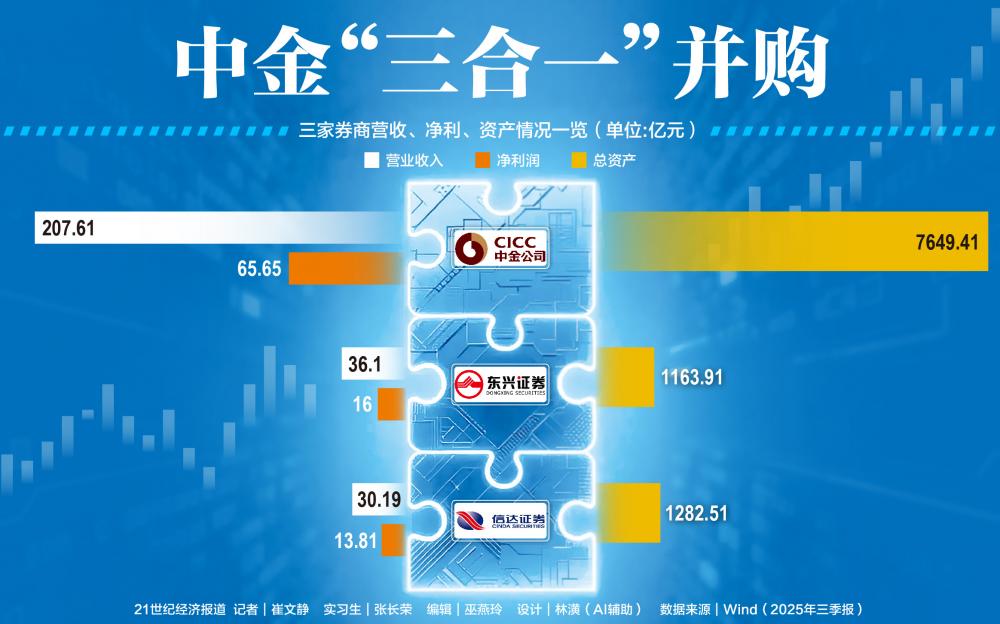
Core Viewpoint - The merger of China International Capital Corporation (CICC) with Dongxing Securities and Xinda Securities marks a significant reshaping of the brokerage industry, with implications for market competition and resource integration [1][2][3]. Group 1: Merger Details - The merger involves CICC absorbing Dongxing Securities and Xinda Securities through a share exchange, with trading suspension starting from November 20 for up to 25 trading days [1][5]. - Post-merger, the combined entity is expected to surpass Huatai Securities in revenue, becoming the third-largest brokerage by revenue and fourth by total assets [2][7]. Group 2: Strategic Implications - This merger is seen as the first step in the integration of "Hui Jin" system brokerages, aiming for resource optimization and strategic complementarity [3][9]. - CICC will enhance its retail network significantly by acquiring nearly 200 branches from Dongxing and Xinda, improving its coverage and service capabilities for high-net-worth and retail clients [5][10]. Group 3: Market Position and Financials - The combined revenue of CICC, Dongxing, and Xinda is projected to reach 27.39 billion yuan, surpassing Huatai Securities' 27.12 billion yuan, while total assets will be approximately 1,009.58 billion yuan, closely trailing Huatai Securities [7][12]. - The net profit post-merger is expected to be 9.546 billion yuan, ranking sixth in the industry, indicating that while CICC will not disrupt the top two positions held by CITIC Securities and Guotai Junan, it may affect the rankings of other leading brokerages [7][11]. Group 4: Broader Industry Trends - The merger is part of a broader trend of consolidation in the brokerage industry, driven by regulatory policies aimed at creating a few leading investment banks with international competitiveness [12][15]. - Other recent mergers include Guotai Junan with Haitong Securities and Guolian Securities with Minsheng Securities, indicating a wave of strategic partnerships aimed at enhancing market positioning and operational efficiency [13][14].



争抢“3+10”入场券 中金公司重组将加剧券商头部晋级战
Zheng Quan Shi Bao· 2025-11-20 22:23
Core Viewpoint - The announcement of China International Capital Corporation (CICC) planning to merge with Dongxing Securities and Xinda Securities has sparked significant industry discussion, indicating a new phase of consolidation in the securities sector [1][8]. Group 1: Impact on CICC - The merger will significantly enhance CICC's performance metrics, pushing total assets beyond 1 trillion yuan, and improving its rankings in various financial metrics [1][4]. - Post-merger, CICC's industry ranking will rise from sixth to fourth in total assets, from ninth to fourth in net assets, from sixth to third in revenue, and from tenth to sixth in net profit attributable to shareholders [4]. - The merger is expected to improve CICC's capital adequacy and operational capacity, allowing for long-term growth and expansion of business space [4][5]. Group 2: Strategic Significance - The merger is seen as a strategic move to optimize resources within the Central Huijin-controlled securities firms, enhancing the competitive landscape among the top ten securities firms [2][3]. - Analysts suggest that this consolidation reflects a broader trend of mergers and acquisitions in the securities industry, driven by regulatory changes and the need for firms to strengthen their market positions [7][8]. - The "3+10" framework proposed by the China Securities Regulatory Commission aims to establish around ten leading institutions in the industry, with CICC's merger positioning it favorably in this competitive environment [7]. Group 3: Business and Regional Synergies - The merger will create synergies in business operations, with CICC benefiting from Dongxing's asset management strengths and Xinda's investment banking capabilities, enhancing its service offerings [5][6]. - The regional presence of Dongxing and Xinda in areas like Liaoning and Fujian will help CICC expand its market reach, complementing its existing operations concentrated in economically developed regions [6]. - The integration of fund management licenses between CICC, Xinda, and Dongxing is anticipated to streamline operations and enhance compliance with regulatory requirements [6].
资本市场增强吸引力包容性
Jing Ji Ri Bao· 2025-11-20 22:16
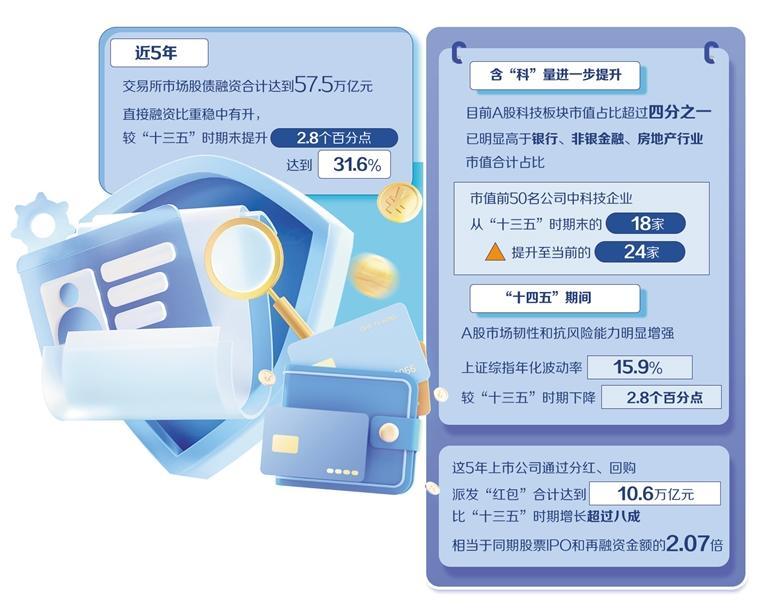
Group 1: Market Outlook - The A-share market is expected to establish a "low volatility slow bull" foundation by 2026, supported by a more stable macroeconomic environment, clearer industrial directions, and a friendlier regulatory framework [2][3] - International investment banks like UBS and Goldman Sachs have updated their outlooks, indicating a significant increase in the weight of A-shares in global asset allocation [2] Group 2: Macroeconomic Context - Citic Securities predicts a macroeconomic growth rate of around 5% in 2025 and approximately 4.9% in 2026, with a fiscal deficit rate likely maintained at 4% [4] - The economic recovery is characterized by moderate demand-side support and a balanced fiscal and monetary policy approach [4] Group 3: New Economic Drivers - The term "new quality productivity" is frequently mentioned, highlighting sectors like AI, biotechnology, and aerospace as key drivers of market transformation [6][7] - The integration of AI with advanced manufacturing is seen as a crucial growth lever, with significant implications for various sectors [11] Group 4: Globalization and Market Structure - Chinese companies are increasingly shifting from a domestic demand-driven model to a global demand-oriented approach, exporting capital goods and solutions to emerging markets [8] - The market structure is evolving, with new economy sectors like semiconductors and renewable energy gaining market share, while traditional industries are undergoing digital transformation [7] Group 5: Investment Trends - There is an anticipated flow of up to 6 trillion RMB from real estate and deposits into the stock market, marking a transition from stock market competition based on existing assets to new incremental allocations [10] - The focus on long-term investment strategies is expected to grow, with reforms aimed at enhancing the supply of quality financial products and increasing dividend payouts from listed companies [9][12]


争抢“3+10”入场券中金公司重组将加剧券商头部晋级战
Zheng Quan Shi Bao· 2025-11-20 18:29
Core Viewpoint - The announcement of China International Capital Corporation (CICC) planning to merge with Dongxing Securities and Xinda Securities has sparked significant industry discussion, indicating a strategic move towards resource integration within the Central Huijin group, aiming to enhance CICC's performance metrics and establish it as a leading international investment bank [1][2]. Group 1: Impact on CICC - The merger will elevate CICC's total assets beyond 1 trillion yuan, improving its industry ranking from sixth to fourth, net assets from ninth to fourth, revenue from sixth to third, and net profit from tenth to sixth [4][5]. - The merger is expected to enhance CICC's operational capacity by improving capital adequacy and expanding business opportunities, particularly in asset management and investment banking [4][5]. Group 2: Industry Dynamics - The merger is seen as a significant step in reshaping the competitive landscape among the top ten securities firms, with expectations of intensified consolidation efforts among mid-sized and large securities firms aiming for the "3+10" market entry slots [7][8]. - Analysts predict that the ongoing trend of mergers and acquisitions in the securities industry will continue, with potential for further restructuring within the Central Huijin group [8][9].
券商航母整合加速度
Bei Jing Shang Bao· 2025-11-20 16:16
Core Viewpoint - The integration of securities firms, specifically the merger of CICC with Xinda Securities and Dongxing Securities, is seen as a significant trend in the industry, leading to the emergence of large-scale brokerage firms with enhanced risk resistance and operational efficiency [1][2][3] Group 1: Industry Trends - The consolidation of securities firms is an inevitable trend in the industry, allowing for resource sharing, improved research outcomes, and enhanced customer service [1][2] - Larger brokerages resulting from mergers will have greater capital strength and broader business layouts, enabling them to better meet client needs and expand service offerings [1][2] Group 2: Competitive Landscape - The integration will enhance the overall competitiveness of the brokerage industry, particularly in the face of increasing international competition [2][3] - Merged firms are expected to have improved compliance and risk management systems, contributing to the overall regulatory development of the industry [2] Group 3: Investment Implications - Long-term investors may benefit from the increased valuation of the newly formed brokerage firms, although there may be short-term speculative risks due to increased market capitalization and potential sell-offs [2] - The merger process may create opportunities for value investors to acquire shares at favorable prices during any short-term price corrections [2]
中金拟合并信达东兴证券,万亿级券商航母加速整合
Bei Jing Shang Bao· 2025-11-20 13:51
#又一万亿级券商航母呼之欲出# 【#券商航母整合加速度# 】券商整合又出新案例,中金公司拟吸收合 并信达证券和东兴证券,又一个万亿级别的券商航母呼之欲出。券商规模越大,抗风险能力就越强,服 务客户的能力也越强,同时运营成本也会更低,这对于券商降本增效很有好处。未来超大券商的整合还 会增加,参与整合的券商竞争力将明显高于未参与整合的券商。 券商整合是行业发展的必然趋势。通过整合,券商可以通过资源共享实现研究成果的互通、交易渠道的 整合、客户服务的提升,从而提升自身的竞争力。对于券商竞争格局来说,整合能够扩大券商的规模, 增强抗风险能力,在面对各项市场风险的时候,大型券商更有能力抵御风险,保障日常经营的稳定开 展。 此次整合对于三家券商来说,无疑是一次重要的发展机遇。整合后的券商将拥有更强大的资本实力和更 广泛的业务布局。在资本实力方面,合并后的新券商将拥有更多的资金用于业务拓展和创新,能够更好 地满足客户的需求。在业务布局上,不同券商可能在不同领域具有优势,通过整合可以实现优势互补, 拓展业务范围,提升服务客户的能力。例如,一家券商在投行业务方面具有较强的实力,而另一家在财 富管理领域表现出色,整合后可以为客户 ...

国泰海通|非银:一流投行建设加速推进,看好板块估值修复——关于中金公司筹划吸收合并东兴证券、信达证券的点评
国泰海通证券研究· 2025-11-20 12:46
Core Viewpoint - The merger is expected to significantly enhance the overall strength of the companies involved, with synergies anticipated mainly in expanding the customer base and improving asset efficiency [1][3]. Summary by Sections Event Overview - On November 19, China International Capital Corporation (CICC) announced plans for a major asset restructuring, intending to merge with Dongxing Securities and Xinda Securities, with a suspension period not exceeding 25 trading days. This integration is driven by the need to improve the management of state-owned financial capital and the goal of building a top-tier investment bank [2]. Expected Outcomes of the Merger - The merger is projected to elevate the combined strength of CICC, Dongxing Securities, and Xinda Securities from their current industry rankings of 8th, 25th, and 26th to potentially 3rd or 4th. Post-merger, net revenue, net profit attributable to shareholders, total assets, and net assets are expected to rank 3rd, 6th, 4th, and 4th in the industry, respectively [3]. - In terms of specific business segments, self-operated income is anticipated to rise to 3rd place, with improved capital utilization efficiency post-merger (CICC's leverage ratio at 5.4x compared to Dongxing Securities at 3.2x and Xinda Securities at 3.8x). The brokerage business is expected to enhance the customer base, particularly in regions like Fujian and Liaoning [3]. Investment Recommendations - The supply-side reform remains a significant long-term change in the industry. The current valuation of the brokerage sector is seen as undervalued relative to fundamentals (currently at 1.40x PB, with 5/10 year PB percentiles at 57%/40%). It is anticipated that the event will catalyze a recovery in sector valuations, leading to a continued recommendation for investment [3].

ETF日报:银行板块P/B估值仍处于较低水平,尚有提升空间,可关注金融ETF
Xin Lang Ji Jin· 2025-11-20 12:35
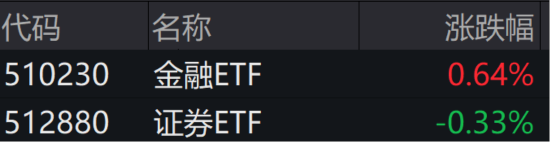
Market Overview - A-shares continued to show volatility, with major indices opening high and closing low. The Shanghai Composite Index fell by 0.4% to 3931.05 points, while the Shenzhen Component Index dropped by 0.76%, and the ChiNext Index decreased by 1.12% [1] - The total trading volume in the A-share market was 1.72 trillion yuan, slightly down from 1.74 trillion yuan the previous day, indicating a reduction in market activity [1] - Over 3800 stocks in the market declined, reflecting a fast rotation of sector performance and an ongoing consolidation pattern [1] Banking Sector - As of November 20, 2025, 26 out of 42 listed banks announced mid-term or third-quarter dividends, with a total proposed payout of approximately 264.6 billion yuan, marking an increase from 258.3 billion yuan last year [3] - The banking sector's net interest margin is under pressure but is expected to stabilize gradually, maintaining a solid fundamental outlook [3] - High dividend yields in a low-interest environment make bank stocks attractive for long-term investment, with the banking sector's P/B valuation still at a low level, indicating potential for improvement [3] Securities Industry - China International Capital Corporation (CICC), Xinda Securities, and Dongxing Securities announced plans for a major asset restructuring, with CICC set to absorb the other two through a share swap [2] - The combined total assets of the three firms post-merger are expected to exceed 1 trillion yuan, positioning them as the fourth largest in the industry [2] - The merger aims to enhance CICC's capabilities across various business lines and improve regional coverage in Liaoning and Fujian [2] Technology Sector - NVIDIA reported Q3 FY26 revenue of $57 billion, a year-over-year increase of 62% and a quarter-over-quarter increase of 22%, exceeding market expectations [4] - The data center segment generated $51.2 billion in revenue, also surpassing forecasts, with Q4 revenue guidance suggesting a new record high [4] - The introduction of Google's Gemini 3 Pro AI model has shown significant performance improvements over its predecessor, indicating strong competition in the AI space [6] Semiconductor and Memory Market - Flash wafer prices remained stable, while DDR memory prices have seen significant increases, with DDR4 memory prices doubling in some cases due to rising costs [7] - NVIDIA's decision to switch server memory from DDR5 to LPDDR5X to reduce power consumption may lead to price increases for older generation products [7] - The semiconductor industry is expected to see continued growth in capital expenditures, particularly in high-end products like optical modules [11]
万亿级“新中金”呼之欲出,“汇金系”券商整合加速
第一财经· 2025-11-20 12:26
Core Viewpoint - The article discusses the planned merger of China International Capital Corporation (CICC) with two smaller securities firms, Xinda Securities and Dongxing Securities, as part of a broader trend of consolidation among "Hui Jin" system securities firms in China [3][5]. Group 1: Merger Details - CICC announced a major asset restructuring plan to absorb and merge Xinda Securities and Dongxing Securities, with agreements signed on November 19 [3][7]. - The merger will involve a stock swap, with estimated exchange ratios of 0.33:1 for CICC and Dongxing Securities, and 0.51:1 for CICC and Xinda Securities based on their average stock prices over the previous 60 trading days [7]. - The combined asset scale of the three firms post-merger is projected to reach approximately 1.01 trillion yuan, with total revenue of 273.89 billion yuan and net profit of 95.2 billion yuan [8]. Group 2: Strategic Implications - The merger aims to streamline operations by addressing issues of excessive licenses and complex management structures, particularly as CICC is a leading player compared to the smaller firms [4][9]. - The integration is expected to enhance CICC's capabilities in investment banking, leveraging the strengths of Xinda and Dongxing in retail brokerage and asset management [9][10]. - Analysts suggest that this merger represents a strategic restructuring rather than mere scale expansion, aiming for complementary business strengths [9]. Group 3: Industry Context - The consolidation of "Hui Jin" system securities firms is anticipated to accelerate, with other firms like China Galaxy and Changcheng Guorui potentially following suit [5][11]. - The restructuring aligns with a broader trend in the securities industry towards increased concentration, with expectations of forming a few large-scale "carrier" brokerages while smaller firms focus on niche markets [15]. - The article highlights the potential for further integration among securities firms under the "Hui Jin" umbrella, especially following recent changes in shareholding structures of major asset management companies [12][14].
万亿级“新中金”呼之欲出,“汇金系”券商整合加速
Di Yi Cai Jing· 2025-11-20 11:25
Core Viewpoint - The merger of China International Capital Corporation (CICC) with Xinda Securities and Dongxing Securities is aimed at addressing the complexities of managing multiple licenses and enhancing operational efficiency in the brokerage sector [1][2]. Group 1: Merger Details - CICC is planning a major asset restructuring involving a stock swap to absorb Xinda Securities and Dongxing Securities, with agreements signed on the evening of the 19th [1]. - The stocks of all three companies will be suspended from trading starting on the 20th, with an expected suspension period of no more than 25 trading days [1]. - This merger is not CICC's first; it previously acquired CITIC Securities in 2017, which was renamed CICC Wealth Securities [1]. Group 2: Shareholder Background - All three companies involved in the merger are part of the "Hui Jin" system, with Central Huijin being the controlling shareholder of CICC, holding 40.11% of its shares [1]. - Central Huijin indirectly holds shares in Xinda Securities and Dongxing Securities through China Xinda and Dongfang Assets, with ownership stakes of 78.67% and 45%, respectively [1]. Group 3: Financial Performance - For the first nine months, CICC reported revenues of 20.761 billion yuan, a year-on-year increase of 54.36%, and a net profit of 6.567 billion yuan, up 129.75% [3]. - Dongxing Securities and Xinda Securities reported revenues of 3.61 billion yuan and 3.02 billion yuan, respectively, with net profits of 1.599 billion yuan and 1.354 billion yuan, reflecting year-on-year growth of 69.56% and 52.89% [3]. - Post-merger, the combined asset scale of the three companies is expected to reach approximately 1.01 trillion yuan, with total revenues of 27.389 billion yuan and net profits of 9.52 billion yuan [3]. Group 4: Business Integration - CICC's traditional strength lies in investment banking, with a net income from investment banking fees of 2.94 billion yuan, a 42.55% increase year-on-year [4]. - Xinda Securities and Dongxing Securities excel in retail brokerage and proprietary trading, with Xinda having a strong position in special asset investment banking [4]. - The merger is seen as a strategic restructuring that optimizes resources within the "Hui Jin" system, enhancing the combined entity's capabilities in investment banking and asset management [4]. Group 5: Market Implications - The merger has raised expectations for further consolidations among "Hui Jin" affiliated brokerages, as the restructuring of major asset management companies (AMCs) has recently occurred [6]. - Following the transfer of shares from the Ministry of Finance to Central Huijin, the number of brokerages under Central Huijin is expected to increase, potentially leading to more mergers [6]. - Analysts suggest that the ongoing consolidation in the brokerage industry is accelerating, with a trend towards creating a few large-scale brokerages while smaller firms focus on niche markets [10].