
CALB(03931)

Search documents
渗透率持续提升 新能源车成产业链企业“核心引擎”
Shang Hai Zheng Quan Bao· 2025-08-29 19:52
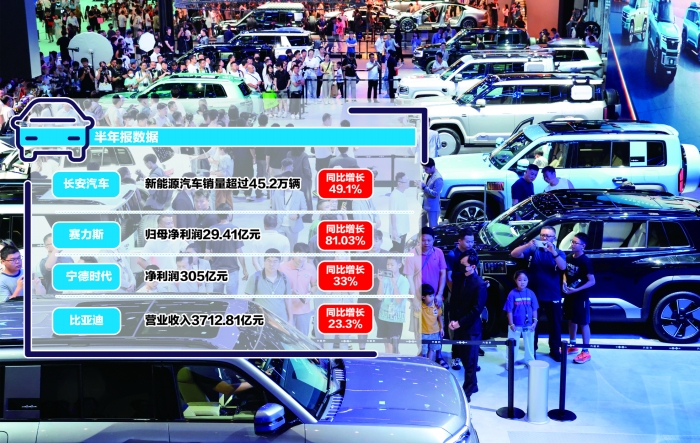
Industry Overview - The Chinese automotive industry is experiencing significant growth in the new energy vehicle (NEV) sector, with NEV sales accounting for over 44% of total vehicle sales in the first half of 2025, marking a new phase in the industry's electrification transformation [6] - The export of Chinese NEVs also saw impressive growth, with a 75.2% year-on-year increase, reaching 1.06 million units, highlighting the global competitiveness of Chinese manufacturing [6] Company Performance - Changan Automobile reported a revenue of 72.69 billion yuan in the first half of 2025, a decline of 5.25% year-on-year, with a net profit of 2.29 billion yuan, down 19.09% [3] - Despite the overall decline in revenue and profit, Changan's NEV sales exceeded 452,000 units, showing a remarkable growth of 49.1% year-on-year, significantly outperforming the industry average [3] - Changan's NEV penetration rate increased to 33%, reaching 50% in the second quarter, indicating a successful transition towards electrification [3] Strategic Collaborations - Seres reported a revenue of 62.40 billion yuan in the first half of 2025, with a net profit of 2.94 billion yuan, reflecting an 81.03% increase year-on-year, largely attributed to its partnership with Huawei for the AITO brand [4] - The AITO series, including models M5, M7, M8, and M9, has gained significant market traction, with over 700,000 users and M9 leading the sales in the 500,000 yuan market segment [4] - BAIC Blue Valley also benefited from its collaboration with Huawei, achieving a revenue of 9.52 billion yuan, a 154.38% increase year-on-year, despite a net loss of 2.31 billion yuan, which was a 10.23% improvement [4] Battery Industry Impact - CATL reported a revenue of 178.9 billion yuan in the first half of 2025, a year-on-year increase of over 7.2%, with a net profit of 30.5 billion yuan, up over 33% [5] - CATL's battery installation volume reached 128.6 GWh, with a market share of 86.3% in the domestic electric bus sector, indicating strong demand for its products [5] - The anticipated net profit for China Innovation Aviation is projected to be between 709 million and 793 million yuan, representing a 70% to 90% increase year-on-year, driven by the scaling of its advanced battery technologies [5]





18家电池企业H1业绩出炉:头部稳进,二三线挣扎
高工锂电· 2025-08-29 11:51
Core Viewpoint - The lithium battery industry is experiencing significant growth and competitive restructuring in the first half of 2025, with energy storage batteries emerging as a new growth engine, outpacing the growth of power batteries [2][4]. Overall Performance - The overall performance of battery companies shows improvement, but with notable differentiation. More than half of the 18 surveyed battery companies achieved both revenue and profit growth, including major players like CATL and A123 Systems [5][6]. - CATL, A123 Systems, and other first-tier companies reported revenue growth rates exceeding 30%, driven by continuous technological breakthroughs and successful product launches [5][6]. Market Dynamics - The total shipment of lithium batteries reached 776 GWh in the first half of 2025, a year-on-year increase of 68%. Power batteries accounted for 477 GWh (up 49%), while energy storage batteries surged to 265 GWh (up 128%) [7][8]. - In the power sector, lithium iron phosphate batteries dominated with a market share of 78%, reflecting a year-on-year growth of 68% [8]. Structural Growth and Competition - The industry is characterized by structural growth and differentiated competition, with leading companies maintaining high production capacity utilization rates above 90%, while many second and third-tier companies struggle with utilization rates below 60% [4][10]. - Leading companies are investing heavily in R&D to build technological barriers, with CATL's R&D expenditure exceeding 10 billion yuan [10]. Differentiated Strategies - Smaller companies are focusing on emerging markets like humanoid robots, leveraging their flexibility to meet niche demands and avoid direct competition with larger firms [11]. - Major companies are innovating business models, such as CATL's battery swapping and V2G technologies, to enhance their market position and explore new revenue streams [12]. Capital Movements - Several battery companies, including CATL and A123 Systems, have initiated plans for IPOs in Hong Kong to support their technological development and global expansion [13].


中创新航涨超6% 上半年净利同比增超八成 海外储能业务迎来突破
Zhi Tong Cai Jing· 2025-08-29 02:50
Core Viewpoint - Zhongxin Innovation's stock rose over 6% following the release of its 1H25 financial results, indicating strong growth in both revenue and net profit, particularly in the energy storage segment [1][2]. Group 1: Financial Performance - In 1H25, Zhongxin Innovation reported a revenue increase of 31.7% year-on-year to 16.42 billion RMB, with power battery revenue growing by 9.7% to 10.66 billion RMB and energy storage battery revenue surging by 109.7% to 5.76 billion RMB [1]. - The gross profit margin for the period reached 17.5%, reflecting an increase of 1.9 percentage points year-on-year and 1.4 percentage points quarter-on-quarter [1]. - Net profit for 1H25 rose by 80.4% year-on-year to 750 million RMB, with a net profit margin of 4.6%, up 1.3 percentage points year-on-year and 1.8 percentage points quarter-on-quarter [1]. Group 2: Market Position and Growth - The company achieved a power battery installation volume of 21.8 GWh in 1H25, representing a year-on-year increase of 22.7%, with the commercial vehicle sector identified as a significant growth area [1]. - According to data from the China Power Battery Alliance, Zhongxin Innovation's cumulative delivery of commercial vehicle batteries exceeded 3.7 GWh in 1H25, up from 0.9 GWh in 1H24, increasing its market share by 2.8 percentage points to 6.7% [1]. - The company launched over 230 new vehicle models during the period, marking a 33% year-on-year increase [1]. Group 3: Energy Storage Business - Since 2H24, Zhongxin Innovation has secured energy storage orders, leading to significant shipment growth in 1H25, including successful projects in Latin America and South Africa [2]. - In 1H25, the global energy storage market saw a cumulative shipment of 240.2 GWh, reflecting a year-on-year increase of 106.1%, with an annual forecast of 460.0 GWh [2]. - The company's overseas energy storage business is expected to maintain strong growth momentum throughout the year [2].
港股异动 | 中创新航(03931)涨超6% 上半年净利同比增超八成 海外储能业务迎来突破
智通财经网· 2025-08-29 02:47
Group 1 - The core viewpoint of the news is that Zhongxin Innovation (03931) has shown significant growth in its financial performance for the first half of 2025, with a notable increase in revenue and net profit [1] - In 1H25, the company's revenue increased by 31.7% year-on-year to 16.42 billion RMB, driven by a 9.7% increase in power battery revenue to 10.66 billion RMB and a substantial 109.7% increase in energy storage battery revenue to 5.76 billion RMB [1] - The gross profit margin for the period reached 17.5%, reflecting an increase of 1.9 percentage points year-on-year and 1.4 percentage points quarter-on-quarter [1] Group 2 - The net profit for 1H25 rose by 80.4% year-on-year to 750 million RMB, with a net profit margin of 4.6%, up 1.3 percentage points year-on-year and 1.8 percentage points quarter-on-quarter [1] - The company’s power battery installation volume reached 21.8 GWh in 1H25, representing a year-on-year increase of 22.7%, with the commercial vehicle sector identified as a key growth area [1] - In the energy storage segment, the company has seen a significant increase in shipments due to new orders received since 2H24, successfully supporting projects in Latin America and South Africa [2]
中创新航_2025 年上半年业绩因销量强劲超出预期;维持中性评级,目标价上调
2025-08-29 02:19
Summary of CALB Co. (3931.HK) Earnings Call Company Overview - **Company**: CALB Co. (3931.HK) - **Industry**: Battery manufacturing, specifically for electric vehicles (EVs) Key Financial Results - **1H25 Performance**: - **Net Profit**: Rmb 466 million, up 87% year-over-year (yoy) and 36% half-over-half (hoh), beating Goldman Sachs estimates (GSe) by 23% [1] - **Revenue**: Rmb 16.4 billion, up 32% yoy and 7% hoh, exceeding GSe by 12% [1] - **Sales Volume**: Estimated at 45 GWh, up 80% yoy and 7% hoh, also beating GSe by 7% [1] Profitability Metrics - **Unit Gross Profit (GP)**: Rmb 64/kWh in 1H25, an increase from Rmb 59/kWh in 2H24 but down from Rmb 78/kWh in 1H24 [2] - **Operating Expenses (OPEX)**: Declined to approximately Rmb 38/kWh from Rmb 50/kWh in 2023-2024, indicating strong operating leverage improvement [2] - **Unit EBIT**: Expanded from approximately Rmb 17/kWh in 2024 to Rmb 26/kWh in 1H25 [2] Earnings Forecast Adjustments - **EPS Estimates**: Raised by 36% and 10% for 2025 and 2026 respectively, reflecting more positive volume assumptions of 110 GWh and 130 GWh [3] - **Unit GP Assumptions**: Trimmed by Rmb 1/kWh for 2025-2027E to Rmb 66/kWh, Rmb 73/kWh, and Rmb 74/kWh [3] - **2027E EPS Forecast**: Lowered by 14% due to a more cautious view on Total Addressable Market (TAM) [3] Valuation and Price Target - **Target Price (TP)**: Maintained at HK$19.60, derived from a near- and long-term valuation approach [4] - **Valuation Method**: Utilizes a 3-month average P/E of 16.9x for 2025-26E average EPS and a long-term P/E of 15.0x for 2030E, discounted back to 2025E at an 11.3% cost of equity (COE) [4][36] Market Position and Customer Diversification - **Customer Contribution**: The contribution from CALB's largest customer declined from 44% in 2023 to 11% in 1H25, indicating a more diversified customer base [19] - **Market Share**: CALB has become a major supplier to selective OEMs, achieving a market share of 7% in June 2025 [23] Risks and Considerations - **Upside Risks**: Include slower-than-expected industry capacity expansion, new long-term contracts with major OEMs, and the launch of advanced battery products [37] - **Downside Risks**: Include slower-than-expected overseas project progress, stronger domestic price competition, and financial risks from aggressive capacity expansion [37] Conclusion - **Investment Rating**: Neutral, as the risk-reward is viewed as balanced [18][39] - **Market Context**: CALB is the 3rd-largest battery maker in China by installed capacity and ranked 4th globally among EV battery suppliers [38]
中创新航、欣旺达相继发布2025年上半年财报
Xin Lang Cai Jing· 2025-08-28 18:38
Core Insights - Both XINWANDA and CALB released their performance reports for the first half of 2025, showcasing significant revenue and profit growth. Group 1: XINWANDA Performance - XINWANDA achieved total revenue of approximately 26.985 billion yuan, representing a year-on-year increase of 12.82% [3] - The net profit attributable to shareholders was about 855.85 million yuan, reflecting a growth of 3.88% compared to the previous year [3] - Revenue from energy storage system products reached 1.004 billion yuan, with a remarkable year-on-year growth of 68.85% [4] - The shipment volume of energy storage systems was 8.91 GWh, marking a significant increase of 133.25% year-on-year [4] - The company has submitted a listing application to the Hong Kong Stock Exchange on July 30, 2025 [5] Group 2: CALB Performance - CALB reported total revenue of approximately 16.419 billion yuan, with a year-on-year growth of 31.7% [5] - The net profit for the first half of 2025 was around 750 million yuan, showing an impressive increase of 80.4% compared to the same period last year [5] - CALB plans to mass-produce its 588Ah energy storage cell product by the end of Q4 2025, along with a new generation 600Ah+ energy storage cell [7] - The company has launched a 261KWh liquid-cooled outdoor energy storage cabinet, supporting flexible configurations from 100KWh to 2MWh, with series products already in mass production [7]

中创新航(03931):1H25 盈利能力稳步提升,海外储能和商用车业务迎来突破;维持买入
BOCOM International· 2025-08-28 12:39
Investment Rating - The report maintains a "Buy" rating for the company 中创新航 (3931 HK) [3][2] Core Views - The report highlights steady improvement in profitability for 1H25, with breakthroughs in overseas energy storage and commercial vehicle businesses driving battery shipment growth. The target price is set at HKD 24.77, indicating a potential upside of 14.7% from the current price of HKD 21.60 [2][8] Financial Performance Summary - Revenue for 1H25 increased by 31.7% year-on-year to RMB 16.42 billion, with energy storage battery revenue soaring by 109.7% to RMB 5.76 billion. The gross margin reached 17.5%, up 1.9 percentage points year-on-year [7][12] - Net profit for 1H25 rose by 80.4% year-on-year to RMB 750 million, with a net profit margin of 4.6% [7][12] - The company expects to maintain its annual shipment forecast, with adjustments to battery price expectations leading to a revenue forecast reduction of 8%-10% for 2025-2027 [7][8] Earnings Forecast Changes - The report provides updated earnings forecasts for 2025E, 2026E, and 2027E, with revenue estimates of RMB 37.698 billion, RMB 45.33 billion, and RMB 51.518 billion respectively, reflecting a decrease of 8%-10% from previous estimates [6][12] - The net profit forecast for 2025E is adjusted to RMB 1.79 billion, with a net profit margin of 4.7% [6][12] Market Position and Growth Potential - The company has seen significant growth in its commercial vehicle battery segment, with a year-on-year increase in delivery volume of 22.7% to 21.8 GWh, and a market share increase of 2.8 percentage points to 6.7% [7][12] - The overseas energy storage business is expected to maintain strong growth, with successful project completions in Latin America and South Africa [7][8]
美银证券:降中创新航目标价至24港元 上半年收入胜预期 重申“买入”评级
Zhi Tong Cai Jing· 2025-08-28 08:43
美银证券发布研报称,结合上半年业绩,下调中创新航(03931)2025年、2026年及2027年每股盈利预 测,分别下调21%、15%及7%,反映更高的销售和毛利率预期,但同时上调了所得税费用和非控股股东 权益的预期。目标价从25港元下调至24港元,重申"买入"评级,理由包括2025年电动车和储能系统电池 出货量稳健增长;规模经济改善和优质产品组合推动盈利能力提升;逐步推进的海外产能扩张计划。 中创新航上半年总收入为164亿元人民币(下同),同比增长32%,较上年底增长7%,超出该行预期4%。 毛利率为17.5%,同比提升1.9个百分点,较上年底提升1.4个百分点,高于该行预估的15.8%。营业利润 为11亿元,同比增长73%,较上年底增长237%,超出该行预期21%。净利润为4.66亿元,同比增长 87%,较上年底增长36%,较该行预期低38%,主要由于财务成本、所得税费用高于预期,以及少数股 东权益分配增加。 ...
美银证券:降中创新航(03931)目标价至24港元 上半年收入胜预期 重申“买入”评级
智通财经网· 2025-08-28 08:39
Group 1 - The core viewpoint of the report is that Bank of America Securities has downgraded the earnings per share forecasts for China Innovation Aviation (03931) for 2025, 2026, and 2027 by 21%, 15%, and 7% respectively, reflecting higher sales and gross margin expectations, while also increasing the forecasts for income tax expenses and non-controlling interests [1] - The target price for China Innovation Aviation has been reduced from HKD 25 to HKD 24, while maintaining a "Buy" rating due to expected steady growth in electric vehicle and energy storage system battery shipments in 2025, improved economies of scale, and a strong product mix driving profitability [1] - For the first half of the year, China Innovation Aviation reported total revenue of RMB 16.4 billion, a year-on-year increase of 32%, and a 7% increase compared to the end of last year, exceeding the bank's expectations by 4% [1] Group 2 - The gross margin for the company was 17.5%, an increase of 1.9 percentage points year-on-year and 1.4 percentage points compared to the end of last year, which is higher than the bank's estimate of 15.8% [1] - Operating profit reached RMB 1.1 billion, a year-on-year increase of 73% and a 237% increase compared to the end of last year, exceeding the bank's expectations by 21% [1] - Net profit was RMB 466 million, a year-on-year increase of 87% and a 36% increase compared to the end of last year, but 38% lower than the bank's expectations, primarily due to higher financial costs, income tax expenses, and increased distribution to minority shareholders [1]
中创新航2025年上半年营收净利润双增长 规模效应与技术红利持续释放
Zheng Quan Ri Bao Wang· 2025-08-28 06:45
Core Insights - The company, Zhongchuang Innovation Technology Group Co., Ltd., reported a significant increase in revenue and profit for the first half of 2025, achieving revenue of 16.419 billion yuan, a year-on-year growth of 31.7%, and a profit of 753 million yuan, a substantial increase of 80.4% [1] - The company has reached historical highs in both power and energy storage shipments, with a power battery installation volume of 21.8 GWh, a year-on-year increase of 22.7%, ranking fourth globally and third domestically [1] Business Performance - In the passenger vehicle market, the company has successfully entered partnerships with major global automakers and is advancing battery mass production for multiple models, laying a solid foundation for sales in the second half of the year [2] - The commercial vehicle market has seen a remarkable year-on-year growth of 310% in installation volume, with the company ranking among the top three in monthly installation volume [1][2] - The energy storage market has positioned the company as the fourth largest globally in cell shipments, with successful entries into major projects in Latin America and South Africa [2] Technological Advancements - The company is advancing its high-energy solid-liquid hybrid battery and has made breakthroughs in solid-state battery research, with production lines now operational [2] - As the first company in the industry to pass compliance checks for eVTOL power battery manufacturing, Zhongchuang Innovation is exploring emerging markets, achieving scale deliveries in the low-altitude flight market [2] Strategic Goals - The company aims to build a cross-domain, cross-scenario energy storage product matrix, continuously expanding into new markets such as rail transportation, mining, low-altitude flight, and humanoid robots, while providing high safety, reliability, and performance product solutions [2]