
BANK OF CHINA(03988)

Search documents
新刊速读 | 银行资产配置对债券市场影响的动态传导
Xin Hua Cai Jing· 2025-10-24 09:01
Core Insights - The article emphasizes the significant role of banks in the bond market, highlighting that their asset allocation behavior not only determines their own profit models and risk preferences but also profoundly influences bond market trends and pricing mechanisms [1][9] - It identifies a need for more granular analysis of banks' asset-liability management and how their allocation behaviors evolve dynamically with economic cycles, regulatory constraints, and risk management strategies [2][9] Group 1: Static Relationship Between Bank Balance Sheets and Bond Markets - The logic of bank asset allocation is embedded within the framework of their balance sheets, where the liability side determines funding costs and stability, while the asset side reflects the trade-off between credit issuance and financial investments [3] - An increase in deposit growth and a decrease in funding costs lead banks to favor long-term government and local bonds, while weak deposit growth or rising interest rates push banks towards higher volatility, shorter-term assets [3][4] Group 2: Dynamic Transmission of Credit Issuance to Bond Markets - Empirical analysis from 2016 to 2025 using VAR models reveals that household short-term loans have a leading effect on bond markets, with their growth leading to rising ten-year government bond yields within four months [5] - In contrast, household medium- to long-term loans, primarily reflecting real estate demand, influence bond yields with a lag of 8 to 12 months, while corporate loans have a less significant and sustained impact on bond yields [6] Group 3: Heterogeneous Impact of Bond Investment Categories - The study categorizes bond investments into three types based on accounting treatment and finds that different types of banks exhibit varying impacts on government bond yields [7] - State-owned banks' investments in FVOCI accounts tend to lower government bond yields, while smaller banks, facing higher funding costs, often engage in strategies that increase market volatility [7] Group 4: Comprehensive Conclusions and Policy Implications - The research reveals that credit issuance is pro-cyclical while bond investment is counter-cyclical, reflecting the macro-regulatory function of bank asset allocation [8] - It suggests optimizing bond asset allocation, improving internal fund transfer pricing mechanisms, and strengthening risk management frameworks to enhance the sustainability of smaller banks [8][9]
中银集团深度赋能山东滨州企业“出海”
Zhong Guo Jin Rong Xin Xi Wang· 2025-10-24 08:50
Group 1 - The event "New Opportunities for Global Layout of Binzhou Enterprises" was successfully held in Binzhou, aimed at connecting local enterprises with Hong Kong and international capital, optimizing the global competitive landscape [1] - The event was organized by the United Front Work Department of the Binzhou Municipal Committee, with participation from Bank of China Hong Kong, Bank of China International, and local branches of Bank of China [1] - The seminar gathered representatives from local government departments, key enterprises, and financial institutions to inject "financial momentum" into the global development of Binzhou enterprises [1] Group 2 - Bank of China Hong Kong and Bank of China International provided four customized financial support solutions focusing on the full-cycle needs of enterprises going abroad [2] - The "Bank of China Hong Kong · Safeguarding Going Abroad" comprehensive financial service plan was introduced, covering cross-border settlement, financing support, and risk hedging [2] - Trade products were detailed to facilitate efficient settlement tools for import and export scenarios, helping to break down international market barriers [2] - Cash management services were introduced to enhance cross-border fund utilization efficiency through global fund collection and liquidity management [2] - The seminar also covered policies and exclusive financial services related to listing in Hong Kong, establishing a bridge for enterprises to connect with international capital markets [2] Group 3 - In recent years, Bank of China Binzhou Branch has actively facilitated domestic and foreign enterprises, providing comprehensive financial service solutions for enterprises "going out" and attracting investments [3] - The branch supported projects like the Weiqiao Group's alumina project in Indonesia and provided financing solutions for local enterprises going abroad [3] - Since 2025, the branch has completed the first offshore financing CCS hedging transaction in Binzhou amounting to 42.29 million USD, expanded the number of clients for exchange rate hedging, and increased the volume of trade foreign exchange facilitation [3] - The Bank of China Shandong Branch plans to deepen cooperation with local enterprises, leveraging its global service network and expertise to provide high-quality financial support for international market expansion [3]

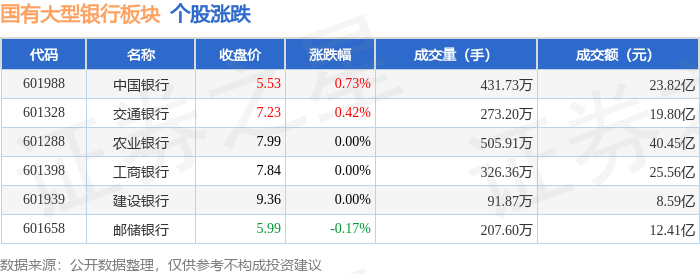
国有大型银行板块10月24日涨0.13%,中国银行领涨,主力资金净流出8504.6万元
Zheng Xing Xing Ye Ri Bao· 2025-10-24 08:27
Market Performance - On October 24, the state-owned large bank sector increased by 0.13% compared to the previous trading day, with Bank of China leading the gains [1] - The Shanghai Composite Index closed at 3950.31, up 0.71%, while the Shenzhen Component Index closed at 13289.18, up 2.02% [1] Individual Bank Performance - Bank of China (601988) closed at 5.53 with a gain of 0.73%, trading volume of 4.3173 million shares, and a transaction value of 2.382 billion [1] - Agricultural Bank of China (601288) remained unchanged at 7.99, with a trading volume of 5.0591 million shares [1] - Industrial and Commercial Bank of China (601398) also remained unchanged at 7.84, with a trading volume of 3.2636 million shares [1] - Postal Savings Bank of China (601658) saw a slight decline of 0.17% to close at 5.99, with a trading volume of 2.0760 million shares [1] Fund Flow Analysis - The state-owned large bank sector experienced a net outflow of 85.046 million from institutional investors and 51.2904 million from retail investors, while retail investors saw a net inflow of 136 million [1] - Bank of China had a net inflow of 13 million from institutional investors but a net outflow of 132 million from speculative funds [2] - Agricultural Bank of China had a net inflow of approximately 19.87 million from institutional investors, while it faced a net outflow of 37 million from retail investors [2] - Postal Savings Bank of China experienced a significant net outflow of 137 million from institutional investors, despite a net inflow of 77.09 million from retail investors [2]





多家银行发布公告:这些账户将被清理
Xin Lang Cai Jing· 2025-10-24 05:28
Core Viewpoint - Multiple banks are initiating the cleanup of long-dormant accounts, which include both personal and corporate accounts, to mitigate risks associated with fraud and money laundering [1][3]. Group 1: Bank Actions - Several banks, including Industrial Bank and Bank of China, have announced measures to restrict transactions on accounts identified as long-dormant starting from October 15 [2]. - Industrial Bank has adjusted its criteria for identifying long-dormant accounts, changing the balance threshold from 100 yuan to 10 yuan and extending the inactivity period from 180 days to 365 days [2]. - Other local banks, such as Fengtai Rural Commercial Bank and Huludao Bank, have also issued warnings regarding the cleanup of long-dormant accounts [2]. Group 2: Reasons for Cleanup - The cleanup of long-dormant accounts is driven by regulatory requirements and aims to prevent risks related to telecom fraud and money laundering [3]. - Long-dormant accounts, often referred to as "sleeping accounts," can lead to wasted financial resources and expose consumers to increased risks of fraud [3]. Group 3: Consumer Recommendations - Industry experts recommend that consumers regularly monitor and manage their bank accounts, including closing any accounts that are no longer in use [4]. - Consumers are advised to use services like the "one-click card check" feature in the Cloud Flash Payment app to track their bank accounts [4]. - If an account is identified as long-dormant but still needed, consumers should conduct at least one transaction before the bank's restrictions take effect to avoid complications [4]. Group 4: Account Recovery Process - If a bank account is frozen due to being classified as long-dormant, account holders can visit bank branches with their identification and bank card to reactivate their accounts [5]. - Banks emphasize that they will not request sensitive information such as passwords or verification codes through phone calls or messages during the cleanup process [5].

银行发力双11!24期免息+满减返现 国有行城商行齐放大招
Bei Ke Cai Jing· 2025-10-24 03:16
Group 1 - Major state-owned banks and city commercial banks are launching various promotional offers such as card binding discounts, interest-free installments, and cashback in collaboration with e-commerce platforms ahead of the "Double 11" shopping festival [1][2][10] - The promotional activities are designed to attract consumers and stimulate consumption growth, with consumer loans and installment products being key tools due to their small amounts and convenience [1][15] - China Bank has partnered with Alipay to offer a consumption discount activity for users who bind their savings cards, providing random discounts for purchases during the promotional period [3][4] Group 2 - Various banks, including China Bank and Ping An Bank, are offering credit card payment discounts, with China Bank's "Installment Enjoy Discount" program providing up to 300 yuan in discounts and interest-free installments for up to 24 months [5][8] - City commercial banks like Suzhou Bank and Guiyang Bank are also participating in the promotional activities, offering discounts for credit card users and collaborating with Alipay for additional benefits [9][10] - Alipay has introduced a "Daily Discount for Bank Cards" program, allowing users to enjoy discounts for a specified number of days after registration, with participation from several major banks [10][14] Group 3 - The competitive landscape includes traditional banks facing off against popular payment options like Huabei and JD Pay, with banks leveraging their lower financing costs and broader customer base as competitive advantages [17] - However, banks face challenges in convenience and user data accumulation compared to online payment platforms, which offer quicker approval processes and targeted marketing [18] - The banking sector is experiencing pressure on net interest margins, with the average net interest margin reported at 1.42% as of the second quarter, indicating ongoing challenges in profitability [19]



银行App掀起关停潮
吴晓波频道· 2025-10-24 00:30
Core Viewpoint - The digital finance industry in China is experiencing a "retreat tide," marked by the closure and integration of various banking apps and payment licenses, indicating the end of an era characterized by rapid expansion and imitation of internet strategies without understanding the underlying ecosystem [2][5][28]. Group 1: Industry Trends - The number of credit cards and loan cards has decreased to 715 million, down 6 million from the previous quarter and 12 million from the end of last year, marking a continuous decline for 11 consecutive quarters [8]. - The total loan balance for credit cards among 14 listed banks fell by 2.56% in the first half of the year, while transaction volumes dropped by 11.1% year-on-year [9]. - The number of direct banks has significantly decreased, with 21 banks ceasing operations of their direct banking apps in 2023, reflecting a shift in strategy among banks [11][12]. Group 2: Market Dynamics - The mobile banking app user base has stagnated between 650 million and 700 million over the past three years, with daily usage time dropping from 4.9 minutes to 2.7 minutes, a decline of over 40% [11]. - The third-party payment industry is undergoing significant consolidation, with 107 payment licenses revoked, leaving only 164 licensed institutions, as many smaller players exit the market [14][25]. - Major state-owned banks are increasingly dominating the market, with their apps consistently ranking among the top ten in monthly active users, while smaller banks struggle to maintain user engagement [22][24]. Group 3: Challenges Faced - The industry faces issues of homogenization, with many banking apps offering similar services that overlap significantly with their parent bank's main app, leading to redundancy [21]. - High operational costs associated with maintaining multiple apps have resulted in unsustainable business models, particularly for smaller banks and direct banks [21]. - Regulatory scrutiny is increasing, with the government mandating the integration or shutdown of apps with low user engagement and poor functionality [26]. Group 4: Future Opportunities - The focus of competition is shifting from quantity to quality, emphasizing compliance and ecosystem collaboration over mere user acquisition [30]. - Banks are expected to concentrate resources on core services, transitioning from product-oriented strategies to user-centric approaches, leveraging data to meet diverse customer needs [30]. - The rise of digital currencies and advancements in payment technologies present new opportunities for growth in the financial sector, particularly in cross-border payments [31][32].


银行“双十一”火力全开 信用卡满减、储蓄卡返现
2 1 Shi Ji Jing Ji Bao Dao· 2025-10-23 23:41
Core Viewpoint - The annual "Double Eleven" shopping festival has prompted banks to actively participate by launching various promotional activities to boost consumer spending and capture market share during this peak consumption period [1][11]. Group 1: Bank Promotions - Banks are offering diverse credit card promotions, including "full reduction" discounts on specified e-commerce platforms, allowing users to save hundreds of yuan when meeting spending thresholds [2]. - China Bank has introduced a "Installment Enjoy Discount" campaign in collaboration with over ten platforms, providing discounts based on spending thresholds, with potential savings of up to 200 yuan for orders over 5000 yuan [2][3]. - Huishang Bank is offering a "full reduction" promotion on Taobao with discounts up to 400 yuan, while China Bank's savings card users can participate in a "daily discount" event with varying reductions based on spending [3]. Group 2: Consumer Finance Companies - Consumer finance companies are also enhancing their offerings, with Jianxin Consumer Finance focusing on home appliances and green consumption, providing interest-free benefits on selected products [4]. - Zhaolian Consumer Finance has partnered with China Unicom to offer "zero interest" installment plans for mobile purchases, allowing consumers to benefit from multiple discounts, potentially saving up to 1100 yuan [4]. Group 3: Market Trends - The banking sector's aggressive push into consumer loans is driven by the sluggish recovery of the real estate market, leading banks to seek alternative revenue streams [5][6]. - Continuous interest rate cuts, with the one-year LPR at 3% and five-year LPR at 3.5%, have created favorable conditions for consumer lending, reducing borrowing costs for consumers [7][8]. Group 4: Policy Support - The Ministry of Commerce and other departments have issued policies to stimulate service consumption, emphasizing financial support for consumer loans and encouraging banks to innovate financial products tailored to service consumption [10]. - The banks' promotional activities during the "Double Eleven" season align with these policy measures, aiming to lower consumer costs and stimulate spending [11].
为了双11,银行纷纷放大招
21世纪经济报道· 2025-10-23 16:55
Group 1 - The annual "Double Eleven" shopping festival has prompted banks to actively participate in consumer promotions, launching various exclusive activities for credit and debit cardholders to capture market share and stimulate business growth [1][3][4] - Banks are offering diverse credit card promotions, including direct discounts and interest-free installment plans for large purchases, effectively alleviating short-term payment pressures for consumers [3][4] - China Bank has introduced a "Installment Enjoy Discount" campaign, providing discounts for credit card users on multiple e-commerce platforms, with specific reductions based on purchase amounts [3][4] Group 2 - On the debit card front, China Bank has partnered with Alipay to launch the "11.11 Daily Discount" campaign, which includes a pre-sale and promotional period with varying discount thresholds [4] - China Merchants Bank has initiated a "Daily Cashback" activity for debit card users, offering cashback opportunities and additional benefits for new cardholders [4] - The consumer finance sector is also active, with companies like Jianxin Consumer Finance providing multiple subsidies for green and smart home appliances, enhancing consumer incentives [5] Group 3 - Analysts indicate that banks are focusing on consumer loans to compensate for the decline in housing loans, as the real estate market is still recovering and consumer confidence in housing purchases remains low [7] - The continuous reduction in interest rates, with the LPR at historical lows, is seen as a catalyst for stimulating consumer loans and enhancing market activity [7][8] - Recent government policies aimed at boosting service consumption have encouraged financial institutions to expand credit offerings in the consumer sector, aligning with the banks' promotional efforts during the "Double Eleven" season [9][10]

中国银行业_市场反馈_板块轮动是投资者关注的关键-China Banks_ Marketing feedback_ sector rotation a key investor watch
2025-10-23 13:28
Summary of Conference Call Notes on China Banks Industry Overview - **Sector**: China Banks - **Investor Sentiment**: There is decent investor interest in China banks amid market consolidation, with approximately 80% of institutions met being long-only funds [2][3] Key Points and Arguments Investor Positioning and Market Dynamics - Many long-only investors have trimmed their positions in China banks due to a sector rally before July, considering the resurgence of geopolitical risks [2] - Investors are more focused on sector rotation rather than fundamentals, with potential buying flows expected from insurers [2] - A 6% dividend yield in the H-share banks universe is viewed as a good entry point by some investors [2] Macro Sentiment - Overall sentiment among investors is not bearish, with a consensus that macro trends are stabilizing despite previous downturns in property and local government financing vehicle (LGFV) debt risks [3] - Discussions during investor meetings have shifted towards potential upside cases, including government initiatives and positive effects from strong stock markets [3] Bank Fundamentals - Investors are less concerned about dividend yield sustainability following asymmetric rate cuts in May, which positively impacted net interest margins (NIM) [4] - Concerns regarding asset quality have eased, particularly related to developer loans and LGFV debt [4] - The performance of state-owned enterprises (SOE) banks in Q2 exceeded expectations, driven by bond trading [4] Specific Bank Insights - There is a divided opinion on China Merchants Bank (CMB), with some investors optimistic about the rebound of retail deposit CASA ratios, while others are concerned about its earnings growth being on par with SOE banks [4] - Other banks of interest include Bank of China (BOC), CITIC, Bank of Chengdu, and Bank of Ningbo [4] Stock Recommendations - The report remains constructive on defensive names due to soft domestic macro conditions and trade uncertainties [5] - Expected positive year-over-year growth in revenue and earnings for SOE banks in the upcoming Q3 [5] - Preferred stocks include CITIC-H, CCB-H, BOC-H, and ICBC-H [5] Risks Identified - Major risks to China banks include: 1. Deterioration in asset quality due to a soft macro environment and property market activity [8] 2. Risks related to capital adequacy and potential dilution from refinancing [8] 3. Downside in interest rates affecting bank profitability [8] Additional Insights - The upcoming 4th Plenary Session and interest rate outlook were frequently discussed, although overall policy expectations remain low [3] - The report indicates a shift in investor focus towards potential positive developments rather than solely on risks [3] This summary encapsulates the key insights and dynamics discussed in the conference call regarding the China banking sector, highlighting investor sentiment, macroeconomic conditions, specific bank performance, and associated risks.
中国银行业_2025 年三季度预览_大型国有银行同比增长势头可能延续-China Banks_ Q325 preview_ Positive YoY growth momentum for large SOE banks likely to continue
2025-10-23 13:28
Summary of Key Points from the Conference Call Industry Overview - **Industry**: Chinese Banking Sector - **Context**: The conference call discusses the upcoming Q3 earnings results for large state-owned enterprises (SOE) banks, joint stock banks (JSBs), and regional banks in China, highlighting expected performance trends and key metrics. Core Insights and Arguments - **Positive Growth Momentum**: Large SOE banks are expected to continue showing positive year-over-year (YoY) growth in revenue, profit before provisions (PPOP), and net profit, driven by strong non-interest income, particularly from investment and trading activities. However, net interest income (NII) may decline on average YoY [2][3][4] - **Joint Stock Banks Performance**: Select JSBs are anticipated to report positive net profit growth, aided by reduced impairment charges, although revenue and PPOP growth may remain subdued [2][3] - **Regional Banks Challenges**: Most regional banks are likely to experience a slowdown in both revenue and net profit growth, attributed to weakened investment and trading income [2][3] - **Key Operating Metrics**: - NIM (Net Interest Margin) is projected to decline slightly by 2 basis points (bps) on average across all bank types. - Loan growth YoY is expected to remain stable for large SOE and regional banks, while select JSBs may see a slight increase of 3.6% YoY. - Credit costs are expected to decline YoY, with large SOE banks, JSBs, and regional banks recording reductions of 8, 11, and 6 bps respectively [2][3] Investment Sentiment - **Market Performance**: MSCI China Banks and MSCI China Banks-A have gained 21.3% and 12.4% year-to-date as of October 17, 2025, but have underperformed the broader MSCI China index, which rose by 32.7% [3] - **Investor Preferences**: Investors are likely to favor banks with sustained positive YoY net profit growth and improving NIM and asset quality trends. The performance of investment and trading income, along with credit costs, will be critical differentiators in the upcoming earnings season [3][4] Bank-Specific Expectations - **ICBC**: Expected to show the largest improvement in net profit growth, with a YoY increase of 2.5% in Q3 compared to 1.4% in Q2. It is highlighted as a preferred stock with a dividend yield of 5.8% for 2025E [4] - **ABC**: Anticipated to have the highest YoY net profit after tax (NPAT) growth among large SOE banks at 3.6% in Q3, outperforming the average of 2.1% [4] - **CITIC**: Expected to lead JSBs with a YoY NPAT growth of 6.6% in Q3, significantly above the average of 2.1% for select JSBs [4] - **Regional Banks**: BONJ is flagged for robust growth, while BOCD may face notable deceleration [4] Defensive Investment Strategy - **Defensive Names**: Given the soft macro conditions and trade uncertainties, there is a constructive outlook on defensive bank stocks. Dividend yields have become attractive, exceeding 5% for H-shares and 4% for A-shares [6] Financial Forecasts - **Q325E Forecasts**: - Core earnings for major banks show varied performance, with ICBC expected to decline by 2.7%, CCB increasing by 2.1%, and ABC decreasing by 1.5% YoY. - NII is projected to decline for most banks, with ICBC at -4.5% and ABC at -3.7% YoY. - Non-interest income is expected to see significant growth for some banks, with estimates of 110% for certain institutions [7] Additional Insights - **Credit Cost Trends**: The average credit cost across banks is expected to decline, with ICBC at 0.43% and CCB at 0.56% for 2025E, indicating improved asset quality [9] - **NIM Trends**: The quarterly NIM for major banks is projected to decline, with ICBC at 1.24% and CCB at 1.36% for Q325E, reflecting ongoing pressure on interest margins [8] This summary encapsulates the key points discussed in the conference call, providing insights into the performance expectations and investment sentiment within the Chinese banking sector.

