BANK OF CHINA(03988)

Search documents
中国银行个人金融2025年4季度资产配置策略-中国银行
Sou Hu Cai Jing· 2025-10-21 08:17
Core Insights - The report from the Bank of China outlines the global asset allocation strategy for Q4 2025, emphasizing the contrasting trends of a "cold economy" and "hot assets" observed in the first three quarters of the year [1][10][12]. Market Performance Overview - The global economy has shown signs of weakness, while equity markets have performed strongly, particularly in China and Germany, with notable gains in the ChiNext Index, Hang Seng Tech Index, and DAX Index [1][10][20]. - The A-share market has entered a technical bull market, while Hong Kong stocks have consistently outperformed [1][10][23]. - In the bond market, U.S. Treasuries have shown strength, while Chinese bonds have exhibited a mixed performance, with long-term bonds declining and short-term bonds rising [1][36][39]. - The U.S. dollar has depreciated significantly, while the Chinese yuan has remained stable, with gold prices continuing to rise, reaching historical highs [1][10][54]. Economic Outlook - The global economic environment remains uncertain despite a loose monetary and fiscal policy backdrop. The Federal Reserve is expected to lower interest rates twice in Q4, while concerns about "stagflation" are rising due to the U.S. government's fiscal challenges [1][12][44]. - China's economy grew by 5.2% in the first three quarters, but the momentum from the "three drivers" is expected to slow down in Q4, although policy support remains strong [1][12][44]. Asset Class Perspectives - The report indicates a clear asset allocation strategy, favoring Chinese stocks (both A-shares and Hong Kong stocks), gold, and U.S. Treasuries, while suggesting a lower allocation to oil [2][36][57]. - The report highlights the importance of diversifying investments to mitigate risks associated with high valuations in popular assets, particularly in the AI sector [2][12][57]. Investment Recommendations - Q4 is identified as a window for increasing positions in high-dividend sectors and emerging technologies such as AI and robotics, while cautioning against zero allocation to Chinese equities and gold [2][12][57]. - The report suggests that investors with higher risk tolerance can increase their equity exposure to as much as 68% [2][12][57].



中国银行发布2025Q4《个人金融全球资产配置策略季报》
Di Yi Cai Jing· 2025-10-21 07:57
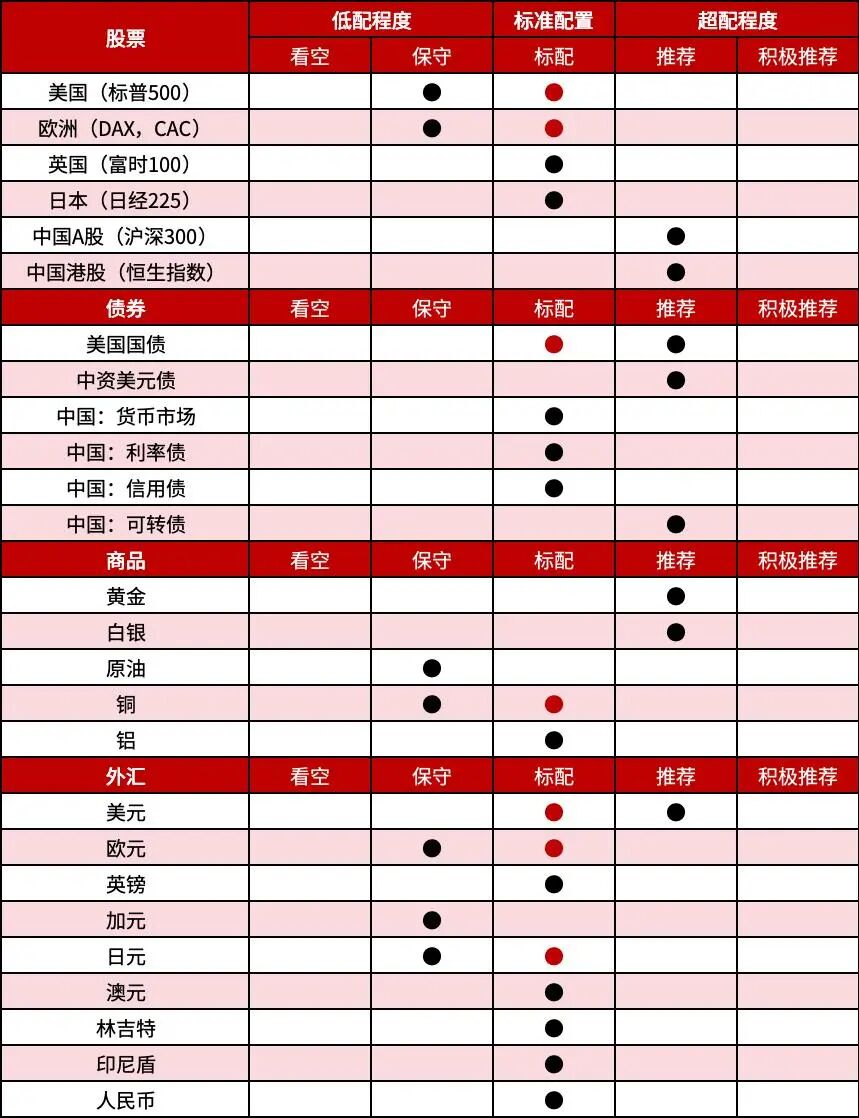
Core Insights - The report by the Bank of China outlines the global asset allocation strategy for personal finance in Q4 2025, focusing on economic and financial trends both domestically and internationally [1] Review Section - In Q3, the phenomenon of "cold economy, hot assets" persisted, with global equity markets benefiting from liquidity during the interest rate cut cycle and the evolution of AI narratives. The US tariff policy has become less impactful, leading to a bullish trend in the Chinese A-shares and Hong Kong stocks [2] - The global economic momentum remains weak, with a divergence in the US and China bond markets, where US bonds are performing better while Chinese bonds are weaker. The US dollar is experiencing weakness, while the Renminbi shows resilience and a steady increase. Gold has been on a significant upward trend, reaching historical highs, while commodity performance is mixed, with copper and aluminum strong and oil weak [2] Economic Outlook Section - In Q4, the global economy will continue to face uncertainties despite a loose monetary and fiscal environment. The Federal Reserve may continue to cut interest rates amid challenges related to employment and inflation, while the fiscal issues behind the US government shutdown raise concerns about stagflation. The European Central Bank is nearing the end of its rate cuts, with debt pressures in major economies acting as a barrier to growth [3] - China's economy achieved a cumulative year-on-year growth rate of 5.2% in the first three quarters, but the three main drivers of growth are under pressure. Policies will focus on implementation and detail, with the potential for support in response to unexpected events. Over the longer term, the "14th Five-Year Plan" will emphasize high-quality development, focusing on themes such as technological innovation, domestic demand, and investment in human capital [3] Major Asset Analysis Section - In Q4, both the US and China may experience synchronized liquidity easing. There are early signs of bubble formation in US AI capital investments, which should be approached with caution. A bullish atmosphere has formed in the Chinese equity market, entering a critical phase of a slow bull market, while Hong Kong stocks are expected to continue a volatile upward trend [4] - In the bond market, the upward trend in US bonds is likely to continue, while domestic easing policies support a bullish tail in the bond market, although the bond market remains weak due to the stock-bond seesaw effect. In foreign exchange, the US dollar is expected to remain weak, with fluctuations in non-US currencies, while the Renminbi may continue to rise steadily. Gold is in a major upward trend but may enter a consolidation phase after reaching a peak, and the commodity market is expected to maintain its mixed performance [4] Opportunities and Risks Section - In Q4, the market presents both opportunities and risks. Opportunities include the potential for a "long bull slow bull" in the Chinese stock market, making it a good time for "buying the dip" and "winter sowing" strategies, particularly in high-dividend sectors and mainstream strong sectors during pullbacks [5] - Risks include the recommendation against zero allocation in Chinese equity assets and gold, which could lead to missing historical strategic asset allocation opportunities and a lack of long-term growth momentum. Additionally, there is a short-term risk of chasing high-priced assets or sectors, particularly in gold and leading indices in A-shares and US stocks, which may affect investor confidence [5] Global Asset Allocation Strategy Overview - The report provides a detailed table of global asset allocation strategies, indicating varying degrees of allocation recommendations across different asset classes, including equities, bonds, commodities, and foreign exchange [6][7]
“丰”沃辽沈 “收”获振兴
Jin Rong Shi Bao· 2025-10-21 06:37
Core Insights - The Bank of China Liaoning Branch has implemented a series of inclusive financial services to support agricultural development in Liaoning Province, achieving a significant increase in agricultural loans [1][2] - The bank's focus on tailored financial products, such as "Grain Loan" and "Peanut Loan," has effectively addressed the financing challenges faced by local farmers and agricultural enterprises [1][2] Group 1: Agricultural Loan Growth - As of September 2023, the agricultural loan balance of the Bank of China Liaoning Branch exceeded 39.5 billion yuan, with an annual increase of approximately 11 billion yuan, marking a historical high with a growth rate of 38.43% [1] - The "Grain Loan" product has a current balance of 3.094 billion yuan, benefiting 2,294 clients and supporting the stable development of Liaoning's grain and oil industry [1] Group 2: Specialized Financial Products - The "Peanut Loan" product, promoted during the local Peanut Festival, has reached a loan balance of 1.178 billion yuan, serving 774 clients and contributing to the development of the local peanut industry [2] - The "Aquaculture Loan" service has provided 168 million yuan in loans to nearly 300 clients in the river crab industry, enhancing financial support for local aquaculture and contributing to community food supply [2] Group 3: Community Engagement and Support - The bank actively engages with local communities by providing on-site financial services and policy promotion during agricultural festivals, ensuring that financial support reaches farmers directly [1][2] - The collaboration with local governments to implement financial support policies demonstrates the bank's commitment to fostering agricultural growth and improving farmers' livelihoods [2]
中国银行在伦敦举办人民币国际化路演
人民网-国际频道 原创稿· 2025-10-21 05:42
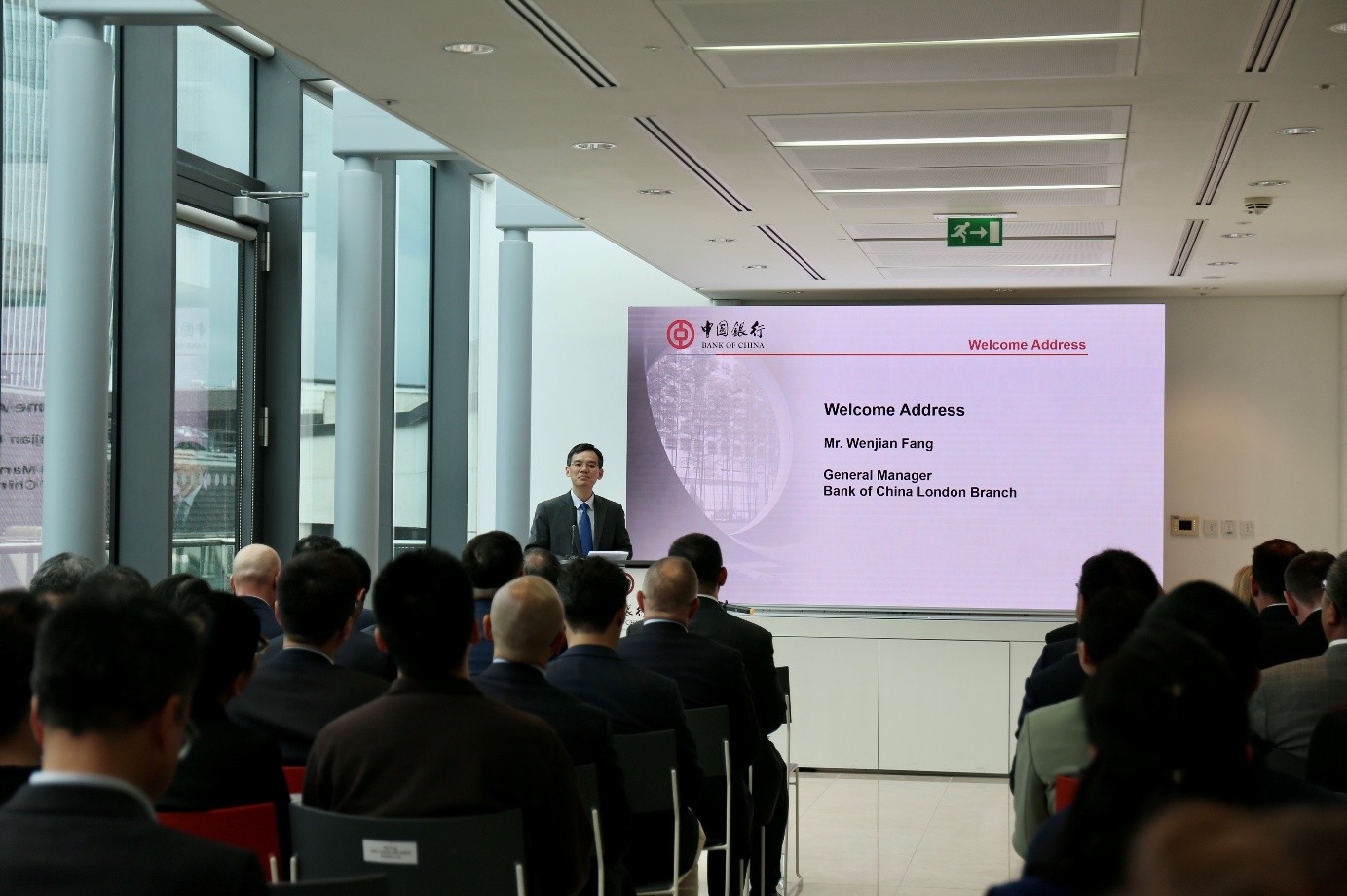
人民网伦敦10月20日电(徐量)中国银行于20号在伦敦举办"人民币国际化路演(伦敦站)"活动,吸引了来自中国人民银行、英国政府机构、伦敦金融 城、国际金融同业、跨国企业及智库代表等近百位嘉宾出席,共同探讨人民币国际化进程与跨境金融合作新机遇。 中国银行伦敦分行行长方文建致欢迎辞。主办方供图 本次活动是中国银行2025年人民币国际化全球系列推广活动的重要一站,旨在进一步推动人民币在跨境贸易与国际投融资中的使用,深化中英及欧洲地 区金融合作。活动现场,与会代表围绕人民币在跨境支付清算、贸易结算、投融资服务、外汇交易与风险管理、债券融资等领域的应用展开深入交流,并分 享人民币市场发展趋势、金融基础设施合作与产品创新最新进展。 与会嘉宾围绕人民币国际化进程与跨境金融合作展开热烈讨论。主办方供图 活动当天还举行了"人民币产品与项目奖"颁奖仪式,对在跨境人民币业务创新、服务推广及市场培育方面表现突出的八家合作机构给予表彰,进一步凝 聚市场合力,推动构建开放协同的人民币生态圈。 据了解,作为中国现代金融业在国际金融中心设立的第一家分支机构,中国银行伦敦分行自2011年在伦敦启动建设离岸人民币市场以来,稳步推进人民 币相关业 ...
从“落子”到“生根”:中国银行以稳健之策深耕土耳其市场
Xin Hua Cai Jing· 2025-10-21 05:12
新华财经伊斯坦布尔10月21日电(记者许万虎)中国银行(土耳其)股份有限公司安卡拉分行20日开启 试营业。这是土耳其中行在该国设立的首家二级机构,标志着中土两国金融合作迈上新台阶。 具有国际竞争力的金融机构是金融强国建设战略不可或缺的关键要素,更是支撑金融体系稳健运行、推 动经济高质量发展的重要力量。 中国银行作为我国金融业国际化布局的关键支柱,近年来,在集团全球化发展进程中,积极践行国家战 略,其下的土耳其中国银行在动荡的新兴市场环境中稳健运营,展现出国有金融机构在"稳"与"进"方面 的积极探索。 国家战略的金融支点:全球化布局中的土耳其落子 土耳其作为连接欧亚的关键节点,其"中间走廊"计划与中国"一带一路"倡议高度契合,成为中资金融机 构重点布局的新兴市场。中国银行的海外拓展既是其自身发展的战略需要,也是服务"一带一路"倡议与 人民币国际化战略的关键环节。 中国银行有关负责人介绍,2018年,中国银行在伊斯坦布尔设立土耳其中国银行,初步构建起本土化服 务平台。随着安卡拉分行试营业,中行在土耳其形成"伊斯坦布尔+安卡拉"的双核心布局,进一步提升 了在土耳其的金融服务覆盖面,将有效助力两国在基础设施建设、工业 ...
面对新时代,拓展新方向 中国银行(欧洲)有限公司切实推动高质量发展和高水平对外开放
Di Yi Cai Jing· 2025-10-21 02:44
Core Viewpoint - Bank of China established its first overseas branch in Luxembourg in 1979, marking a significant achievement of China's reform and opening-up policy [1] Group 1: Historical Development - In 1991, Bank of China obtained its first subsidiary license in Europe, leading to the establishment of Bank of China (Luxembourg) Limited [1] - In 2022, the bank was renamed Bank of China (Europe) Limited, becoming the European regional headquarters and an important support for global development [1] Group 2: Services and Future Outlook - Bank of China (Europe) is committed to providing high-quality financial services such as project financing, syndicate loans, trade financing, bond underwriting, and fund management for Chinese and European corporate clients [1] - The bank plans to enhance its comprehensive platform to offer more diversified and comprehensive financial services to overseas clients [1] - The focus will be on commercial banking, with cross-border services as the engine, and new business expansion directions including light capital operations in financial markets, financial institutions, custody, bond underwriting, and asset management [1]
四季度买银行股?大摩:首次无大规模刺激的“自然周期性触底” 中国银行业进入新时代
Zhi Tong Cai Jing· 2025-10-21 02:42
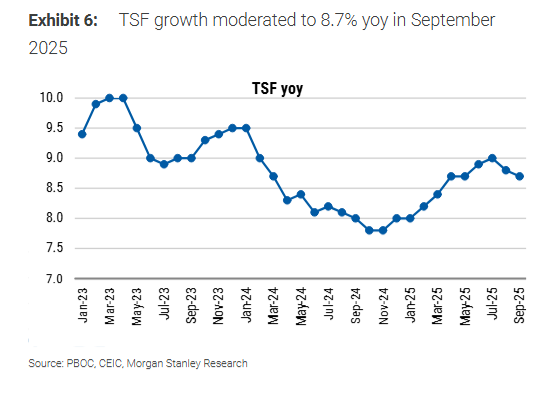
Core Viewpoint - Morgan Stanley believes that domestic bank stocks will present good investment opportunities in the fourth quarter and the first quarter of next year after experiencing seasonal adjustments in the third quarter [1] Group 1: Market Conditions - The Chinese financial system is undergoing an unprecedented change, achieving a "natural cycle bottom" without large-scale stimulus or further monetary easing [3] - The current credit growth is more aligned with economic growth, with social financing growth slowing to 8.7% and loan growth to 6.4% as of September 2025, which stabilizes bank asset returns [4][6] - M1 and corporate current deposit growth have accelerated since early 2025, indicating improved corporate liquidity and confidence, suggesting that risks are easing [6][8] Group 2: Industry Transition - The banking sector is transitioning from a risk control model to a development model, with high-risk asset ratios expected to decline from 9.2% in 2024 to around 3% in the coming years, significantly reducing risk premiums for financial stocks [11][13] - The demand for credit is expected to grow steadily at 5-6% annually, slightly above the projected nominal GDP growth of about 4%, supporting reasonable asset returns and stable net interest margins for banks [13] Group 3: Investment Drivers - Four key factors are expected to support bank stock performance in the fourth quarter: - Dividend-driven capital inflow as banks typically pay mid-term dividends at the end of December and early January, attracting strong demand from institutional investors [14] - Improvement in bank fundamentals, with expected mild pressure on net interest margins and a rebound in fee income due to active capital markets [15] - Supportive policies, including a newly introduced 500 billion RMB structural financial policy tool aimed at supplementing project capital and supporting credit demand without pressuring loan yields [15] - A stable interest rate environment, with minimal adjustments to the loan market quotation rate (LPR) in 2025, which alleviates concerns about sustained pressure on interest spreads [17] Group 4: Investment Opportunities - Banks exhibiting superior profit rebound potential and robust dividend capabilities in the current environment are seen as quality choices to capture opportunities in this "new era" [20]
中国银行业-市场反馈:板块轮动是投资者关注的关键-China Banks-Marketing feedback sector rotation a key investor watch
2025-10-21 01:52
Summary of Key Points from the Conference Call Industry Overview - **Industry**: China Banks - **Investor Sentiment**: There is decent investor interest in China banks amid market consolidation, with approximately 80% of institutions met being long-only funds [2][3] Core Insights and Arguments - **Sector Rotation**: Investors are more focused on sector rotation rather than fundamentals, with potential buying flows expected from insurers. The sustainability of dividend payouts (DPS) is a key concern [2][3] - **Dividend Yield**: A 6% dividend yield in the H-share banks universe is viewed as a good entry point for investors [2] - **Macro Trends**: Overall sentiment is stabilizing, with less concern about the property downturn and local government financing vehicle (LGFV) debt risk. The upcoming 4th Plenary Session and interest rate outlook are frequently discussed, although policy expectations remain low [3] - **Positive Upside Cases**: Investors are looking for potential upside cases, including government initiatives to combat economic stagnation, migration of retail deposits to stock markets, and positive wealth effects from strong stock markets [3] Bank-Specific Insights - **Fundamentals**: Investors are less bearish on banks following asymmetric rate cuts in May, which positively impacted net interest margins (NIM). Concerns over asset quality related to developer loans and LGFV debt have eased [4] - **China Merchants Bank (CMB)**: Investor opinions are divided; some are optimistic about the rebound of retail deposit CASA ratios, while others are concerned about earnings growth being on par with state-owned enterprises (SOEs) and the lack of an increase in payout ratios [4] - **Preferred Banks**: Analysts remain constructive on defensive names, expecting SOE banks to report positive year-over-year growth in revenue and earnings in Q3. Preferred banks include CITIC-H, CCB-H, BOC-H, and ICBC-H [5] Risks Identified - **Asset Quality**: Deterioration in asset quality remains a significant risk, influenced by a soft macro environment and domestic property market activity [8] - **Capital Adequacy**: Risks related to capital adequacy and potential dilution from refinancing are highlighted [8] - **Interest Rate Pressure**: Downside risks in interest rates could pressure bank profitability [8] Additional Important Points - **Investor Focus**: There is a notable shift in investor focus towards defensive names due to ongoing macro uncertainties and trade tensions [5] - **Market Dynamics**: The report indicates that the market is currently in a phase where banks are being evaluated based on their dividend yields and potential for growth, rather than solely on traditional financial metrics [4][5] This summary encapsulates the key points discussed in the conference call regarding the China banking sector, highlighting investor sentiment, macroeconomic factors, bank-specific insights, and identified risks.


手机银行App加速“瘦身”
Jin Rong Shi Bao· 2025-10-21 01:24
Core Insights - A wave of bank app closures is occurring in China, with over 10 banks participating in this "streamlining" process, including major state-owned banks and city commercial banks [1][2] - The closures are part of a broader trend where banks are integrating their services into fewer apps to enhance user experience and operational efficiency [2][3] Group 1: Bank App Closures - China Bank's credit card app "Binfeng Life" will gradually shut down, with all functions migrating to the China Bank app [1] - Zhuhai Huaren Bank announced that its "Run Wallet" app will cease operations by October 15, 2025, with features moving to the Huaren Bank app [1] - Beijing Rural Commercial Bank closed its "Phoenix Credit Card" app on March 31 this year, transferring functionalities to its main mobile banking app [1] Group 2: Industry Trends - The number of direct banking apps has significantly decreased, with only about 10 remaining, down from peak levels [2] - The integration trend reflects banks' shift away from "digital anxiety" towards a more rational approach to app management [2][3] - The Financial Regulatory Authority's guidelines have accelerated the consolidation process, urging banks to optimize or terminate low-activity apps [3] Group 3: Expert Opinions - Experts suggest that the focus should be on improving app operation and customer experience rather than merely increasing the number of apps [2][3] - Recommendations include prioritizing technology development, enhancing active user engagement, and improving customer experience over mere product deployment [3]
金价狂飙!银行密集提示市场风险,专家建议投资者考虑战略配置而非押注涨跌
Xin Lang Cai Jing· 2025-10-21 00:46
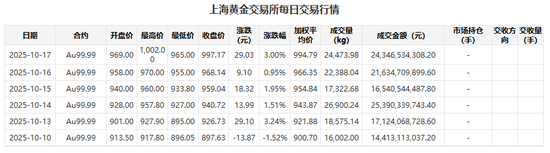
Core Insights - The precious metals market is experiencing increased volatility, prompting banks and exchanges to issue risk warnings [1][7][8] - Gold prices recently hit a historical peak, with spot gold reaching $4380.79 per ounce on October 17, marking a year-to-date increase of over 60% [3][2] - Financial institutions are raising thresholds for gold accumulation and adjusting margin requirements due to market fluctuations [10][6] Group 1: Market Performance - On October 20, gold prices fell below $4230 per ounce, a drop of over $45 from the day's high, yet remained at historically high levels [1] - The price of gold in the Shanghai Gold Exchange reached a record high of 997.17 yuan per gram on October 17 [3] - Brand gold jewelry prices have also surged, with Chow Tai Fook's gold jewelry priced at 1279 yuan per gram, an increase of 32 yuan from the previous day [4][5] Group 2: Institutional Responses - Major banks, including China Construction Bank and China Merchants Bank, have issued multiple risk warnings regarding precious metals trading [8][10] - The Shanghai Gold Exchange and Shanghai Futures Exchange have advised members to enhance risk management practices due to market instability [7] - Several banks have raised the minimum purchase amounts for gold accumulation products, with China Bank adjusting its minimum from 850 yuan to 950 yuan [10] Group 3: Investment Strategies - Bridgewater Associates founder Ray Dalio suggests that gold should be viewed from a strategic allocation perspective rather than a speculative one, recommending a portfolio allocation of 10% to 15% in gold [14][11] - Despite warnings from financial institutions, there is a growing trend of investors engaging in risky behaviors, such as using loans to purchase gold [12][13] - Experts caution that while gold has strong liquidity, extreme market conditions could lead to liquidity issues, and using borrowed funds for investment purposes may violate regulations [12][13]