BANK OF CHINA(03988)

Search documents
中银欧洲董事长刘坚东:发挥金融纽带作用,为体育文化交流提供高质量金融服务保障
Zhong Guo Jin Rong Xin Xi Wang· 2026-02-28 01:56
新华财经瑞士洛桑2月28日电(记者 尹亮)"尽管受到地缘政治和逆全球化浪潮的冲击,中欧双边经贸 合作仍然展现出强大的韧性与活力。"2月25日,在瑞士洛桑奥林匹克博物馆举行的"体育事业和城市发 展"学术研讨会上,欧盟中国商会会长、中银欧洲董事长刘坚东表示,作为全球唯一"双奥银行",中国 银行将持续发挥金融纽带作用,通过支持体育文化交流,促进中欧民心相通,助力"一带一路"建设与欧 洲绿色转型。 在当日的学术研讨会上,《国际赛事名城影响力指数报告2025》首次发布。来自中、美、英、法、德等 国的专家学者就体育赛事与城市发展的共生关系、推动"赛事营城"发展模式等主题进行了深入探讨。 编辑:谈瑞 刘坚东介绍,随着中欧经贸和文化交流的日益密切,欧盟中国商会于2019年在比利时布鲁塞尔揭牌成 立。欧盟中国商会拥有120余家会员单位,代表超1000家在欧中企利益,下设金融、绿色、数字、汽车 四个工作组,覆盖能源、通信、金融、制造等核心领域。欧盟中国商会通过组织高峰论坛、定期发布 《中国企业在欧盟发展报告》以促进中欧企业相互了解、合作,并为中企在欧长期持续稳健经营营造良 好环境。同时,还积极与欧盟政策制定者保持联系、反馈企业意 ...
智通ADR统计 | 2月28日





智通财经网· 2026-02-27 23:41
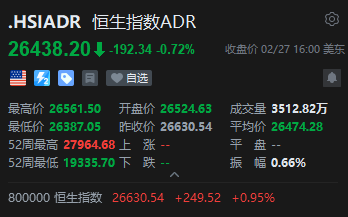
Market Overview - US stock indices experienced a decline on Friday, with the Hang Seng Index ADR closing at 26,438.20 points, down 192.34 points or 0.72% from the Hong Kong close [1] - The highest price for the ADR was 26,561.50, while the lowest was 26,387.05, with a trading volume of 35.1282 million [1] Major Blue-Chip Stocks - Most large-cap stocks fell, with HSBC Holdings closing at HKD 145.765, down 1.04% from the Hong Kong close [2] - Tencent Holdings closed at HKD 513.995, down 0.77% from the Hong Kong close [2] Stock Performance Summary - Tencent Holdings (00700) latest price: HKD 518.000, up 1.17% with an ADR price of USD 65.700, down 0.77% [3] - Alibaba Group (09988) latest price: HKD 142.900, down 0.07% with an ADR price of USD 144.110, down 1.38% [3] - HSBC Holdings (00005) latest price: HKD 147.300, up 1.59% with an ADR price of USD 93.160, down 1.04% [3] - Other notable stocks include AIA Group (01299) up 2.48%, and NetEase (099999) up 2.40% [3]

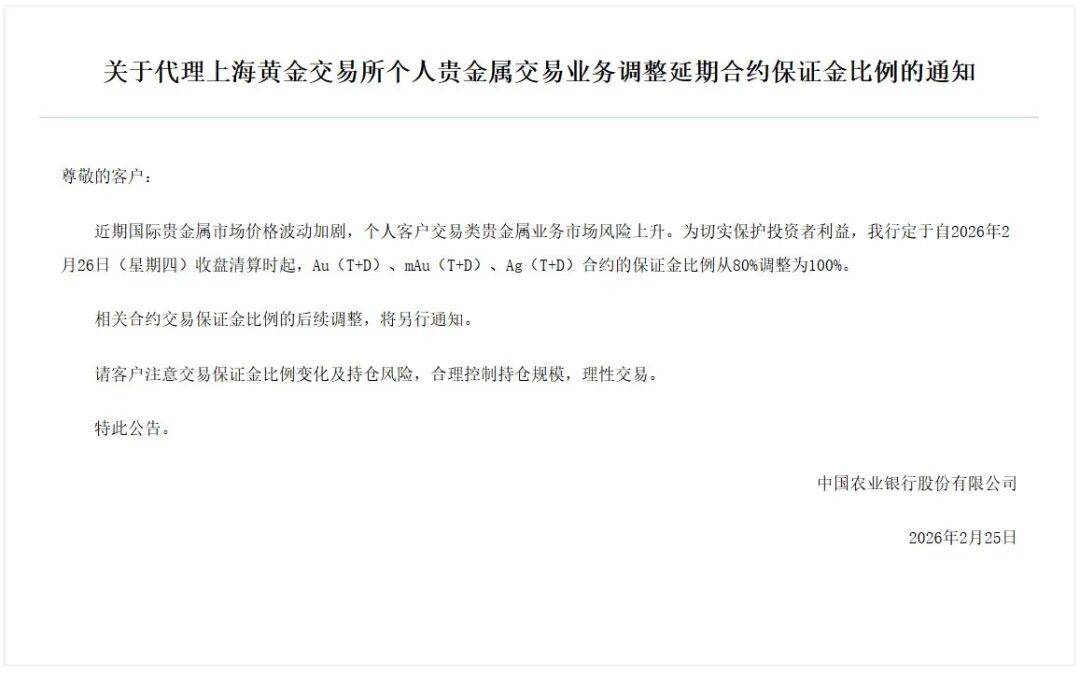
多家银行上调个人客户上金所延期合约保证金比例
Zheng Quan Ri Bao· 2026-02-27 16:37
Core Viewpoint - The recent increase in risk within the precious metals market has led several major state-owned banks in China to adjust the margin requirements for personal clients trading on the Shanghai Gold Exchange [1][2]. Group 1: Margin Requirement Adjustments - On February 24, the Bank of China announced adjustments to the margin requirements and price fluctuation limits for personal clients trading gold and silver deferred contracts [1]. - Agricultural Bank of China stated that starting from February 26, 2026, the margin requirement for Au (T+D), mAu (T+D), and Ag (T+D) contracts will be increased from 80% to 100% [1]. - Industrial and Commercial Bank of China (ICBC) also announced that from February 27, 2026, the margin requirement for various gold and silver contracts will be raised to 100% [1]. Group 2: Rationale Behind Adjustments - ICBC's customer service indicated that the adjustment to a 100% margin requirement is a response to significant price volatility in the domestic and international precious metals markets, aimed at mitigating market risk and protecting investors [2]. - The increase in margin requirements effectively reduces the leverage available to traders, meaning that for a contract valued at 1 million yuan, the required margin will increase from 800,000 yuan to 1 million yuan [2]. - Financial expert Tian Lihui noted that the current international gold prices are at historically high levels, influenced by global "reflation" expectations, geopolitical risk premiums, and the reassessment of U.S. dollar credit, with banks raising margins to create necessary risk buffers and curb potential speculative bubbles [2].

折扣叠加财政贴息 银行信用卡账单分期成本下降
Zheng Quan Ri Bao· 2026-02-27 16:10
Core Viewpoint - The implementation of the personal consumption loan interest subsidy policy by the Ministry of Finance and other departments aims to stimulate consumer spending by reducing the cost of credit card installment payments through combined financial incentives from banks and government subsidies [1][2]. Group 1: Policy Implementation - The personal consumption loan interest subsidy policy has been extended until the end of 2026, allowing banks to include credit card installment payments in the subsidy scope, which directly lowers their funding costs [2][3]. - Banks have responded by lowering installment fees and offering discounts, which, combined with the subsidy, significantly reduces the financial burden on consumers [2][3]. Group 2: Bank Initiatives - Several banks, including Bank of China and Nanjing Bank, have launched promotional activities that offer substantial discounts on installment interest rates, with some rates dropping to as low as 2% [3][4]. - For instance, Nanjing Bank offers a special rate of 4.4% to 4.57% for certain installment plans, down from an original annual rate of around 14% [3]. Group 3: Consumer Impact - The dual incentives from the subsidy and bank promotions have effectively lowered the actual cost of consumer spending, thereby enhancing consumer confidence and willingness to spend [4]. - Consumers have reported significant savings on their installment payments, with some experiencing reductions in annualized interest rates from 3.06% to below 2% due to the combined effects of bank discounts and the subsidy [3][4]. Group 4: Market Dynamics - The policy is expected to stimulate the growth of consumer credit, contributing to increased domestic demand and a positive cycle of credit and consumption [4][5]. - The rapid growth in consumer credit activity has been observed, with banks reporting increases in customer numbers, transaction volumes, and lending scales [4].


中国银行山东省分行助力小微企业喜迎新春
Zhong Guo Jin Rong Xin Xi Wang· 2026-02-27 12:07
Core Insights - The article highlights the significant role of the Bank of China Shandong Branch in supporting local businesses during the Chinese New Year, particularly through quick and efficient loan services that enhance the festive consumption atmosphere [1][4]. Group 1: Financial Support for Local Businesses - The Bank of China provided 10 million yuan in credit support to a local ecological agriculture company producing "Jiaodong flower steamed buns," helping to stabilize employment for nearly 100 local farmers and boost production and sales during the festive season [1]. - A transportation company in Binzhou received 900,000 yuan in emergency loans within two days, allowing them to secure raw materials and meet increased demand during the holiday [2]. - The Bank of China tailored a 30 million yuan loan for a flour company in Zaozhuang, ensuring a steady supply of quality wheat and supporting local food production [2]. Group 2: Timely Assistance to Small Enterprises - A dumpling shop in Jining received 500,000 yuan in a no-repayment loan extension, enabling them to stock up on ingredients and maintain operations during the peak season [3]. - A seafood merchant in Weihai was granted 1 million yuan in credit within 48 hours, allowing them to dispatch 1,500 boxes of fish and generate over 1.2 million yuan in sales, while also creating jobs for local fishermen's families [3]. - The Bank of China has disbursed over 10 million yuan in loans to more than 20 seafood businesses, ensuring a stable supply of festive products for families [3].
中国银行党委召开扩大会议暨党建工作领导小组会议 部署开展树立和践行正确政绩观学习教育工作
Xin Lang Cai Jing· 2026-02-27 11:51
来源:中国银行 2月27日,中国银行党委召开扩大会议暨党建工作领导小组会议,认真学习贯彻习近平总书记关于树立 和践行正确政绩观学习教育的重要讲话和重要指示精神,传达学习中央党的建设工作领导小组会议部 署、中共中央办公厅《关于在全党开展树立和践行正确政绩观学习教育的通知》精神,审议《关于在全 行开展树立和践行正确政绩观学习教育的实施方案》,对全行学习教育工作进行动员部署。中国银行党 委书记、党建工作领导小组组长葛海蛟主持会议并讲话。 会议认为,在"十五五"开局之年,党中央决定开展树立和践行正确政绩观学习教育,充分彰显了立党为 公、执政为民的价值追求,具有重大意义。党的十八大以来,习近平总书记反复强调要树立和践行正确 政绩观,近期又在多次重要讲话中特别加以强调,为全行准确把握正确政绩观的科学内涵、精神实质、 实践要义,开展学习教育指明了方向、提供了重要遵循。各级党组织和广大党员干部要深入学习领会, 进一步提高政治站位,深刻认识开展这次学习教育是坚定拥护"两个确立"、坚决做到"两个维护"的实际 行动,是贯彻落实党的二十届四中全会战略部署、以实干担当推动高质量发展的有力保障,是始终站稳 人民立场、深入践行金融为民理念 ...
港股27日涨0.95% 收报26630.54点
Xin Hua She· 2026-02-27 11:03
Core Viewpoint - The Hong Kong stock market showed positive performance on February 27, with the Hang Seng Index rising by 249.52 points, or 0.95%, closing at 26,630.54 points. The total turnover for the day was HKD 288.42 billion [1]. Market Indices - The Hang Seng Index increased by 249.52 points, closing at 26,630.54 points, with a gain of 0.95% [1]. - The National Enterprises Index rose by 45.2 points, closing at 8,859.49 points, reflecting a gain of 0.51% [1]. - The Hang Seng Technology Index gained 28.51 points, closing at 5,137.84 points, with an increase of 0.56% [1]. Blue-Chip Stocks - Tencent Holdings rose by 1.17%, closing at HKD 518 [1]. - Hong Kong Exchanges and Clearing increased by 0.87%, closing at HKD 419 [1]. - China Mobile saw a rise of 0.89%, closing at HKD 79.3 [1]. - HSBC Holdings increased by 1.59%, closing at HKD 147.3 [1]. Local Hong Kong Stocks - Cheung Kong Holdings increased by 3.58%, closing at HKD 49.78 [1]. - Sun Hung Kai Properties rose by 7.12%, closing at HKD 146 [1]. - Henderson Land Development gained 2.9%, closing at HKD 35.44 [1]. Chinese Financial Stocks - Bank of China decreased by 0.22%, closing at HKD 4.64 [1]. - China Construction Bank fell by 0.12%, closing at HKD 7.99 [1]. - Industrial and Commercial Bank of China rose by 0.47%, closing at HKD 6.45 [1]. - Ping An Insurance increased by 0.22%, closing at HKD 68 [1]. - China Life Insurance rose by 0.64%, closing at HKD 31.58 [1]. Oil and Petrochemical Stocks - China Petroleum & Chemical Corporation increased by 0.37%, closing at HKD 5.45 [1]. - China National Petroleum Corporation rose by 0.85%, closing at HKD 9.54 [1]. - CNOOC Limited saw an increase of 2.68%, closing at HKD 25.32 [1].




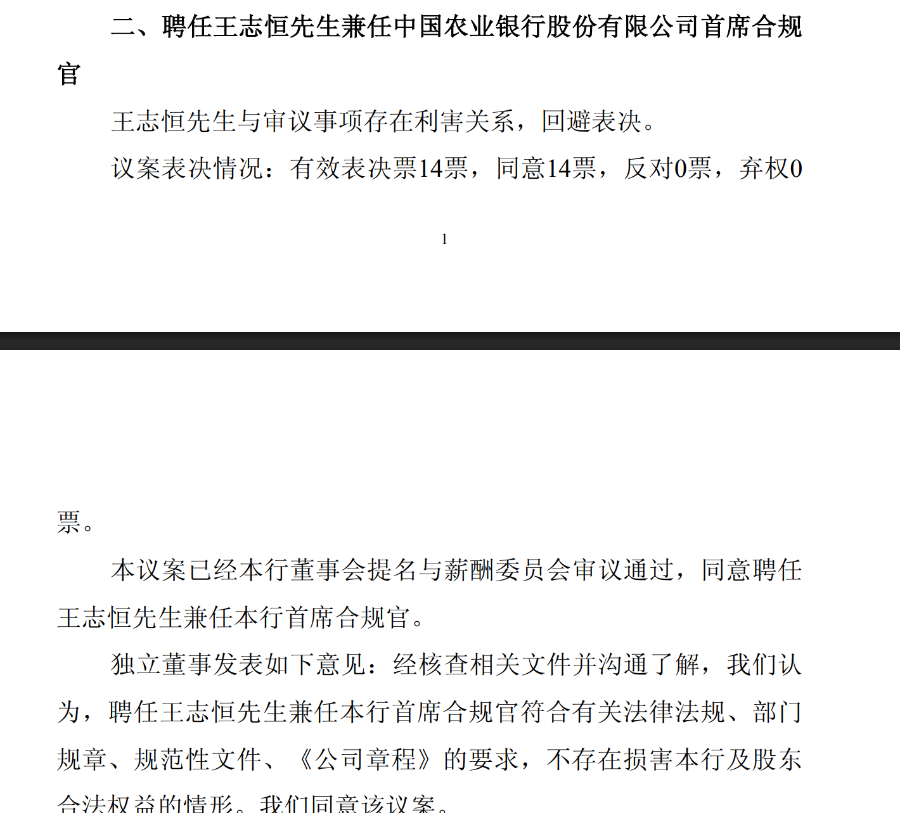
凸显合规治理 农行、中行“高配”首席合规官
2 1 Shi Ji Jing Ji Bao Dao· 2026-02-27 09:12
Group 1 - The core viewpoint of the articles is the establishment of the Chief Compliance Officer (CCO) position by major Chinese banks, reflecting a heightened emphasis on compliance and internal control within the banking sector [1][2][6] - Agricultural Bank of China and Bank of China have appointed their respective presidents as CCOs, marking the first time these banks have created this position [1][2] - The appointments are in response to the regulatory requirements set forth by the National Financial Regulatory Administration's "Compliance Management Measures for Financial Institutions," which mandates the establishment of a CCO at the headquarters of financial institutions [2][6] Group 2 - The "Compliance Measures" came into effect on March 1, 2025, with a one-year transition period, leading to a wave of CCO appointments across various banking institutions [2][6] - Other banks, such as Industrial Bank and Ping An Bank, have also appointed CCOs, indicating a broader trend in the industry [2] - The role of the CCO is distinct from that of the Chief Risk Officer (CRO), with the CCO focusing on compliance with laws and regulations, while the CRO manages substantive risks [4][5] Group 3 - The CCO position is expected to enhance compliance governance and integrate compliance requirements into business processes and decision-making, thereby influencing the corporate culture and sustainable development of the banking industry [6] - The qualifications for the CCO include a bachelor's degree and significant experience in finance and compliance, reflecting the importance of expertise in this role [5][6] - The establishment of the CCO role is seen as a significant restructuring of internal governance and risk management within banks, driven by regulatory changes and the evolving risk environment [6]

艺术品抵押贷款,唤醒沉睡资产
Sou Hu Cai Jing· 2026-02-27 03:45
Core Viewpoint - The Chinese cultural industry has surpassed a trillion yuan in scale, but financing challenges persist for collectors, artists, and cultural enterprises. The recent approval of the "Bank Support for Cultural Industry Development Report" marks a significant step towards integrating art and finance, enabling collectors to leverage their assets, artists to focus on creation, and cultural enterprises to accelerate expansion, thus making art collateral loans mainstream and enhancing the value of collections [1][2]. Group 1: Market Demand and Growth - The total estimated value of private collections in China exceeds 12 trillion yuan, yet the legal circulation rate remains below 1%, highlighting a significant market demand for art collateral loans [2]. - By 2025, the scale of art collateral loans in China is projected to exceed 1.2 trillion yuan, indicating rapid growth and a vast potential market in art finance [1]. Group 2: Banking Sector Involvement - Major state-owned banks dominate the art collateral loan market, with specific strategies: China Construction Bank focuses on traditional cultural items with a maximum collateral ratio of 70% and a loan cap of 5 million yuan; Industrial and Commercial Bank of China covers various art forms with a 60% collateral ratio; Bank of China targets antiques and ceramics with a similar collateral ratio but a lower loan cap of 3 million yuan [2]. - Joint-stock banks adopt a more cautious approach, with banks like Bank of Communications and China Merchants Bank only accepting renowned artworks, maintaining a uniform collateral ratio of 50% and a loan cap of 2 million yuan [2]. Group 3: Innovative Financing Models - Weifang Bank has pioneered a pre-purchase model for art, successfully lending 1.1 billion yuan with zero bad debts, demonstrating the feasibility of innovative financing methods [2][4]. - A new "four-step" service model for copyright pledge loans has been established in Feicheng, focusing on copyright assessment, pledge registration, financing credit, and loan issuance, creating a closed-loop system for financing [6]. Group 4: Technology Integration - Technologies such as blockchain and AI are being utilized to address trust issues in art financing, providing a permanent, traceable digital record for artworks, which helps solve problems related to authenticity, valuation, and ownership [8]. - The global art collateral loan market is maturing, with Deloitte reporting that global loan balances are expected to exceed $36 billion by 2024, indicating strong growth potential [8]. Group 5: Changing Perceptions of Art - 73% of clients use art financing to release liquidity for other business activities rather than solely purchasing more art, indicating a shift in perception of art from mere aesthetic objects to active capital [9]. - Art is increasingly recognized as a liquid asset that can address funding gaps for startups, provide operational cash flow for businesses, and serve as a tool for family wealth transfer [9].

上调至100%!金价迅猛上涨,国有大行紧急出手
Sou Hu Cai Jing· 2026-02-27 00:39
Core Viewpoint - The recent adjustments in margin requirements for personal precious metals trading by several banks reflect increased market volatility and risk in the international precious metals market, particularly gold and silver. Group 1: Price Movements - London spot gold rebounded to over $5200 per ounce on February 26, following a period of price fluctuations [1] - Major jewelry brands in China, such as Chow Tai Fook, reported an increase in gold prices, with the latest price for 24K gold jewelry at 1576 RMB per gram, up from 1570 RMB per gram [1] Group 2: Margin Requirement Adjustments - Agricultural Bank of China announced an increase in the margin requirement for personal precious metals trading from 80% to 100% effective February 26, 2026, due to heightened market risks [2] - Industrial and Commercial Bank of China also confirmed a similar adjustment, effective February 27, 2026, for various gold and silver contracts [4][5] - Other banks, including China Construction Bank and Bank of China, have also made similar margin adjustments in response to market conditions [8] Group 3: Price Increase Announcements - Multiple jewelry brands are expected to raise prices, with Chow Tai Fook planning a price adjustment for gold products around March 10, with anticipated increases of 15% to 30% [11] - Lao Pu Gold announced a price increase starting February 28, 2026, following previous adjustments in 2025 [11] Group 4: Market Outlook - Deutsche Bank maintains a bullish outlook on gold prices, predicting a target of $6000 per ounce, supported by strong demand for gold and other precious metals [12] - JPMorgan has raised its long-term gold price forecast to $4500 per ounce, while maintaining a year-end target of $6300 per ounce for 2026 [12] - Bank of America anticipates gold prices could reach $6000 per ounce within the next 12 months, despite potential short-term declines in silver prices [12]