INTEL(04335)

Search documents
道指、标普500创新高,英特尔涨超10%,美联储1月降息可能性几乎为零
2 1 Shi Ji Jing Ji Bao Dao· 2026-01-09 23:48
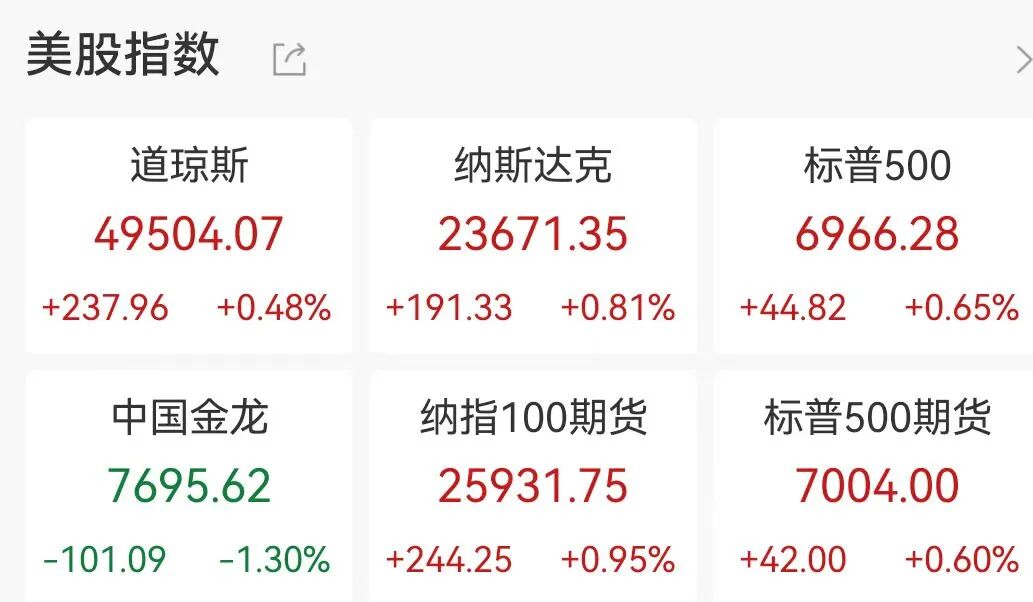
Group 1 - US stock markets experienced a broad rally, with all three major indices closing higher on January 9, 2025. The Dow Jones rose by 0.48% to 49,504.07 points, the S&P 500 increased by 0.65% to 6,966.28 points, and the Nasdaq gained 0.81% to 23,671.35 points. Both the Dow and S&P 500 reached all-time closing highs [1] - The non-farm payroll data released on January 9 indicated an increase of 50,000 jobs in December 2025, falling short of the market expectation of 73,000 jobs. The unemployment rate decreased to 4.4% from 4.6% in November 2025, suggesting a slowdown in the labor market [3][4] - Major technology stocks mostly rose, with the US Technology Seven Index increasing by 0.48%. Notable movements included Tesla rising over 2% and Facebook gaining more than 1%, while Nvidia saw a slight decline of 0.12% [1] Group 2 - The Philadelphia Semiconductor Index surged by 2.73%, with Intel experiencing a significant increase of over 10%, marking its largest single-day gain since September. Other notable performers included Lam Research up over 8% and Applied Materials up over 6% [1] - The energy sector showed mixed results, with ExxonMobil rising over 1% and Chevron nearly 2%, while ConocoPhillips fell over 1%. This reflects the volatility in the energy market [2] - In the commodities market, precious metals and base metals saw an overall increase, with COMEX gold futures rising by 1.29% to $4,518.4 per ounce and silver futures increasing by over 6% to $79.79 per ounce [2]
道指、标普500创新高 英特尔涨超10% 美联储1月降息可能性几乎为零
2 1 Shi Ji Jing Ji Bao Dao· 2026-01-09 23:44
Market Performance - US stock indices all closed higher on January 9, with the Dow Jones up 0.48% at 49,504.07 points, the S&P 500 up 0.65% at 6,966.28 points, and the Nasdaq up 0.81% at 23,671.35 points, marking historical closing highs for both the Dow and S&P 500 [1][2] - For the week, the Dow rose 2.32%, the S&P 500 increased by 1.57%, and the Nasdaq gained 1.88% [1] Employment Data - The latest non-farm payroll data released on January 9 indicated an increase of 50,000 jobs in December 2025, which was below the market expectation of 73,000 jobs; the unemployment rate fell to 4.4% [1][8] - Following the data release, the swap market assessed the probability of a Federal Reserve rate cut in January to be zero, with a 2.8% chance of a 25 basis point cut and a 97.2% chance of maintaining the current rate [8] Technology Sector - Major technology stocks mostly rose, with the Philadelphia Semiconductor Index increasing by 2.73%; Intel surged over 10%, marking its largest single-day gain since September [2] - Other notable gains included Lam Research up over 8%, Applied Materials up over 6%, and ASML up over 6% [2][4] Commodity Market - International oil prices collectively rose, with WTI crude oil up 1.77% at $58.78 per barrel and Brent crude up 1.66% at $63.02 per barrel [8] - In the precious metals market, COMEX gold futures rose by 1.29% to $4,518.4 per ounce, with a weekly increase of 4.34%, while COMEX silver futures surged over 6% to $79.79 per ounce, with a weekly increase of 12.07% [5][6] Chinese Stocks - The Nasdaq Golden Dragon China Index fell by 1.3%, with notable declines in popular Chinese stocks such as Atour down over 5% and Huya down over 4% [2][4]

芯片股领涨英特尔涨近11% 金龙指数跌1.3% 12月非农仅增5万 标普道指齐创收盘新高
Di Yi Cai Jing· 2026-01-09 23:37
Market Performance - The US stock market reached new historical highs driven by strong performance in chip stocks and a rotation into value sectors, with the S&P 500 index rising 0.65% to 6966.28 points, the Nasdaq composite up 0.81% to 23671.35 points, and the Dow Jones Industrial Average increasing 0.48% to 49504.07 points [1] - The S&P 500 index saw a weekly increase of 1.6%, the Dow Jones up over 2.3%, and the Nasdaq rising 1.9%, indicating a continued recovery in risk appetite [1] Sector Performance - The semiconductor sector led the market, with the Philadelphia Semiconductor Index rising 2.7% to a record high, and notable gains in storage and equipment stocks, such as Lam Research up 8.7% and Intel rising nearly 11% [2] - Value sectors showed signs of recovery, with the S&P 500 value index up approximately 3% year-to-date, outperforming the S&P 500 growth index which rose about 1% [5] Economic Data - The US labor market showed moderate growth with 50,000 new non-farm jobs added in December, below the expected 73,000, while the unemployment rate fell to 4.4%, better than the anticipated 4.5% [3] - Market expectations for a rate cut by the Federal Reserve have shifted, with the probability of a cut in January dropping to 4.8% from 11.6% prior to the data release [3] Notable Company Movements - Major tech companies saw varied stock performance, with Broadcom up 3.79%, Tesla up 2.11%, and Meta Platforms rising 1.08%, while Nvidia experienced a slight decline of 0.08% [2] - Vistra Energy surged 10.5% following Meta Platforms' agreement to purchase its nuclear power plant electricity [2] Commodity Market - International oil prices increased, with light crude oil futures rising by $1.36 to $59.12 per barrel, a 2.35% increase [7] - Gold prices remained strong, with spot gold rising to $4496.09 per ounce, up 0.5%, and silver prices also increased significantly [7]

芯片股领涨英特尔涨近11%,金龙指数跌1.3%,12月非农仅增5万,标普道指齐创收盘新高
Di Yi Cai Jing· 2026-01-09 23:29
Market Overview - The U.S. stock market reached new historical closing highs driven by strong performance in chip stocks and a rotation into value sectors, alleviating investor concerns about a sharp economic slowdown [1][3] - The S&P 500 index rose by 0.65% to close at 6966.28 points, while the Nasdaq Composite increased by 0.81% to 23671.35 points, and the Dow Jones Industrial Average climbed 0.48% to 49504.07 points [1] - The labor market showed signs of stability with a slight decrease in the unemployment rate to 4.4%, despite non-farm payrolls adding only 50,000 jobs in December, below the expected 73,000 [3] Sector Performance - The semiconductor sector led the market, with the Philadelphia Semiconductor Index rising by 2.7%, reaching a record high [2] - Notable individual stock performances included Broadcom up 3.79%, Tesla up 2.11%, and Intel rising nearly 11% following positive comments from President Trump [2] - Value sectors showed signs of recovery, with the S&P 500 Value Index up approximately 3% year-to-date, outperforming the S&P 500 Growth Index which rose about 1% [4] Economic Indicators - The Federal Reserve's interest rate expectations shifted, with traders now estimating only a 4.8% chance of a rate cut at the upcoming January meeting, down from 11.6% prior to the employment data release [3] - The two-year U.S. Treasury yield rose by 4.6 basis points to 3.534%, while the ten-year yield fell slightly by 1.4 basis points to 4.183% [3] Corporate Developments - Meta Platforms agreed to purchase power from Vistra Energy's nuclear power plant, leading to a significant 10.5% increase in Vistra's stock price [2] - General Motors announced a charge of approximately $6 billion to terminate or withdraw from certain electric vehicle investment projects, resulting in a decline of over 2% in its stock [5] Commodity Market - Crude oil prices increased by 2.35%, closing at $59.12 per barrel, while gold prices rose by 0.5% to $4496.09 per ounce, reflecting a weekly gain of about 3.9% [6] - Silver prices saw a notable increase, with spot silver rising by 3.81% to $79.93 per ounce, and COMEX silver futures up 5.92% [6]
道指创新高 英特尔涨超10%;美最高法院暂缓对关税案裁决;反内卷 外卖平台表态丨每经早参
Mei Ri Jing Ji Xin Wen· 2026-01-09 23:26
Group 1 - The Chinese government is implementing a package of fiscal and financial policies to boost domestic demand, as discussed in a State Council meeting chaired by Premier Li Qiang [5] - The U.S. stock market saw all three major indices rise, with the Dow Jones and S&P 500 reaching all-time closing highs, while Intel experienced a significant increase of over 10% [5] - International oil prices rose, with West Texas Intermediate (WTI) crude oil increasing by 1.77% to $58.78 per barrel [5] Group 2 - The Chinese government is investigating the competitive landscape of the food delivery industry, with major platforms like Meituan and Taobao Shanguo expressing support for the investigation [8] - The Ministry of Finance and the State Taxation Administration announced the cancellation of VAT export tax rebates for photovoltaic products starting April 1, 2026 [10] - The China Securities Regulatory Commission has increased the reward for whistleblowers reporting securities and futures violations, raising the maximum reward from 100,000 yuan to 1 million yuan [11] Group 3 - The Ministry of Commerce has issued a plan to expand service industry trials in nine cities, including Dalian and Shenzhen, with a focus on telecommunications, healthcare, and finance [12] - Beijing has launched a free HPV vaccination program for girls aged 13 and above, aiming to provide two doses of the vaccine [13] - Shanghai aims to add 100 manufacturing enterprises with an annual output value exceeding 1 billion yuan by 2028, contributing to the growth of the industrial chain [14] Group 4 - Apple is reportedly accelerating the search for a successor to CEO Tim Cook, with John Ternus emerging as a leading candidate [18] - The passing of Liu Hui, a prominent fund manager at Yinhua Fund, may impact investor confidence and the fund management team [20] - Tianpu Co. is under investigation by the China Securities Regulatory Commission for significant omissions in its stock trading announcements following a 1600% price increase in 2025 [21] Group 5 - Meta Platforms has signed agreements to extend and expand the operation of three nuclear power plants, positioning itself as a major corporate buyer of nuclear energy in the U.S. [23] - The sale of assets, including real estate and vehicles, by Honghui New Materials has raised over 17 million yuan, indicating a significant financial maneuver [26] - The recent surge in demand for a Sam's Club down jacket priced at 499 yuan reflects consumer trends and brand influence in the retail market [28]


标普500指数创历史新高 英特尔(INTC.US)涨10.8%
Zhi Tong Cai Jing· 2026-01-09 23:18
Market Performance - The three major U.S. stock indices recorded gains, with the S&P 500 index reaching a new all-time high, up 1.57% for the week [2] - The Dow Jones Industrial Average rose by 0.48% to close at 49,504.07 points, while the Nasdaq increased by 0.81% to 23,671.35 points [2] - Notable gains were seen in chip stocks, with Oracle up 4.95%, Broadcom up 3.76%, and Intel up 10.8% [2] Employment Data - U.S. non-farm payrolls increased by 50,000 in December, which was below expectations, while the unemployment rate fell to 4.4% [4] - The labor market is described as being in a "no hiring, no firing" mode, indicating a slowdown in job growth due to cautious hiring practices related to import tariffs and AI investments [4] - The report suggests that the economy is in a state of no employment expansion, with significant impacts from previous trade and immigration policies [4] Housing Market - U.S. homebuilder confidence remains low, with new housing starts in October dropping to the lowest level since the pandemic began, down 4.6% to an annualized rate of 1.25 million units [5] - The NAHB/Wells Fargo Housing Market Index remains at a weak level of 39, indicating that most builders view market conditions negatively [5] - Builders are tightening policies to shorten construction times and improve efficiency while waiting for customer demand to recover [5] Federal Reserve Insights - The Federal Reserve is closely monitoring the employment report, which indicates a low recruitment environment, with a focus on the balance between moderate job growth and labor supply [7] - The average rate for a 30-year fixed mortgage fell below 6% for the first time in years, settling at 5.99%, marking a significant decrease over the past year [7] Company Developments - Amazon plans to open a large supermarket in the Chicago area, emulating the models of Walmart and Target, with a store size of 229,000 square feet [8] - Chevron may see an annual revenue increase of $700 million from oil production in Venezuela, as it is currently the only U.S. oil giant operating there [8]
隔夜美股 | 标普500指数创历史新高 英特尔(INTC.US)涨10.8%
智通财经网· 2026-01-09 23:16
Market Overview - The three major U.S. stock indices recorded gains, with the S&P 500 index reaching a new all-time high, closing up 1.57% for the week [2] - On Friday, the S&P 500 index rose by 44.82 points, or 0.65%, closing at 6966.28 points, with an intraday high of 6978.36 points [2] - The Dow Jones increased by 237.96 points, or 0.48%, closing at 49504.07 points, while the Nasdaq rose by 191.33 points, or 0.81%, closing at 23671.35 points [2] Employment Data - In December, U.S. non-farm payrolls increased by 50,000, which was below expectations, while the unemployment rate fell to 4.4% [4] - The labor market is described as being in a "no hiring, no firing" mode, indicating a cautious approach from employers due to concerns over import tariffs and AI investments [4] - The report suggests that the labor market has lost significant momentum, attributed to aggressive trade and immigration policies from the previous administration [4] Construction Industry - U.S. homebuilders are experiencing low confidence, with new housing starts in October dropping to the lowest level since the pandemic began, down 4.6% to an annualized rate of 1.25 million units [5] - The National Association of Home Builders (NAHB) reported a builder confidence index of 39, indicating a pessimistic outlook as it remains below the neutral level of 50 [5] Federal Reserve Insights - The Federal Reserve is expected to maintain interest rates, as indicated by the latest employment report showing moderate job growth and a low recruitment environment [7] - The average 30-year fixed mortgage rate fell below 6% for the first time in years, settling at 5.99%, which is the lowest since February 2023 [7] Individual Company News - Amazon plans to open a large supermarket in the Chicago area, covering 229,000 square feet, marking its entry into the physical retail space [8] - Chevron may see an annual revenue increase of $700 million from oil production in Venezuela, as it is currently the only U.S. oil giant operating there [8]


道指创新高,英特尔涨超10%;美最高法院暂缓对关税案裁决;最高100万!证券期货违法行为“吹哨人”奖金提高;反内卷,外卖平台表态丨每经早参
Mei Ri Jing Ji Xin Wen· 2026-01-09 23:04
Group 1 - The State Council of China, led by Premier Li Qiang, is implementing a package of policies to promote domestic demand through fiscal and financial collaboration [3] - The U.S. stock market saw all three major indices rise, with the Dow Jones and S&P 500 reaching historical closing highs, while Intel experienced a significant increase of over 10% [3] - International oil prices rose, with WTI crude oil increasing by 1.77% to $58.78 per barrel, and Brent crude oil rising by 1.66% to $63.02 per barrel [4] Group 2 - The European stock indices closed higher, with Germany's DAX up by 0.58%, France's CAC40 up by 1.44%, and the UK's FTSE 100 up by 0.8% [5] - The Chinese food delivery industry is facing intensified competition, prompting the State Council's antitrust office to investigate the market conditions of delivery platforms [6][7] - The Chinese Ministry of Finance and the State Taxation Administration announced the cancellation of VAT export tax rebates for photovoltaic products starting April 1, 2026 [8] Group 3 - The China Securities Regulatory Commission has increased the reward for whistleblowers reporting securities and futures violations, raising the maximum reward from 10,000 yuan to 100,000 yuan for significant cases [9] - The Ministry of Commerce has issued a plan to expand service industry openings in nine cities, including Dalian and Shenzhen, with 159 pilot tasks aimed at enhancing service sector development [10] - Beijing has launched a free HPV vaccination program for girls aged 13 and above, aiming to improve public health [11] Group 4 - Shanghai aims to add 100 manufacturing enterprises with an annual output value exceeding 1 billion yuan by 2028, contributing to the growth of the industrial chain [12] - The passing of a new regulation by the U.S. Supreme Court regarding tariffs imposed by the Trump administration has been delayed [13] - Meta Platforms has signed agreements to extend and expand operations at three nuclear power plants, positioning itself as a significant corporate buyer of nuclear energy in the U.S. [22]


1月10日隔夜要闻:美股收高 金价上涨 英特尔涨超10% 特朗普泄露就业数据 委称与美启动探索性外交
Xin Lang Cai Jing· 2026-01-09 22:32
Company - Nvidia is recruiting executives from Google Cloud to strengthen its position in the market [8] - Chevron could see an annual revenue increase of up to $700 million due to its operations in Venezuela [8] - Stellantis has canceled its sales plan for plug-in hybrid vehicles in the U.S. due to weak demand [8] - Glencore and Rio Tinto are in negotiations to potentially create the world's largest mining company [8] - xAI plans to invest $20 billion in building a data center in Mississippi [8] - Hyundai will fully deploy humanoid robots starting in 2028 [8] - Paramount reiterated its all-cash offer of $30 per share for WBD [8] - General Motors will account for $7.1 billion in expenses in the fourth quarter [8] - Johnson & Johnson is lowering drug prices in the U.S. in exchange for tariff reductions, but experts say savings for insured individuals will be limited [8] Industry - The U.S. added 584,000 jobs in 2025, marking the lowest growth rate in a non-recession period since 2003 [8] - U.S. household wealth has reached a record high, benefiting from the rise in the stock market [8] - The EU is expected to sign a historic trade agreement with South America despite opposition from France [8] - The WTI crude oil price has risen for the third consecutive week [9] - The U.S. debt market shows mixed results, with a flattening yield curve and mixed non-farm payroll data [9] - The dollar is rising alongside U.S. Treasury yields as traders reduce bets on Federal Reserve rate cuts [9]


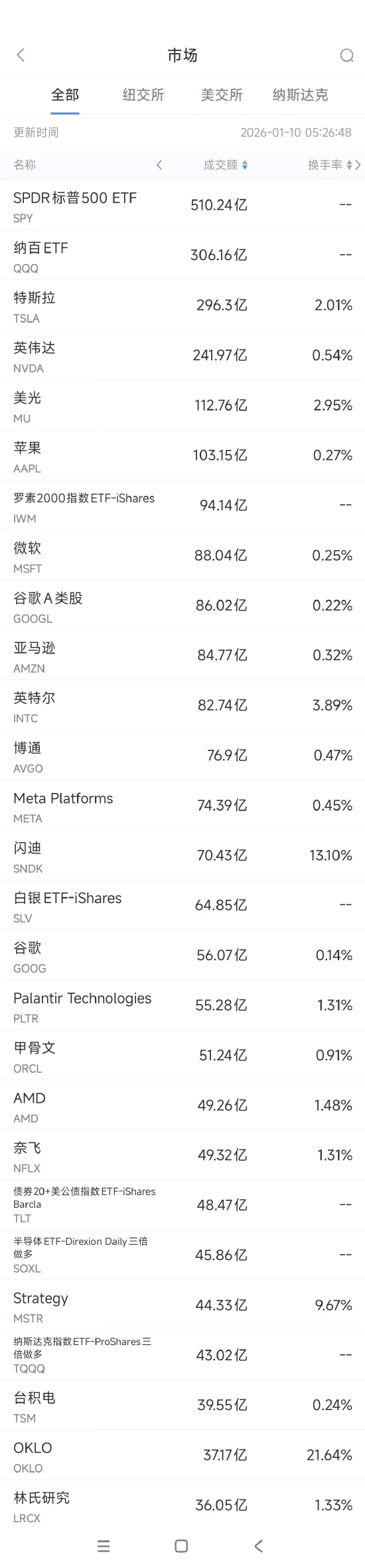
1月10日美股成交额前20:英特尔本周上涨逾15%
Xin Lang Cai Jing· 2026-01-09 21:54
Core Insights - Tesla has lost its position as the global leader in electric vehicle sales for 2025, facing significant challenges in key overseas markets, particularly in Europe [1][10] - Nvidia is appointing Alison Wagonfeld from Google Cloud as its Chief Marketing Officer, indicating a strategy to enhance brand influence [2][10] - Micron Technology is experiencing supply constraints, only meeting 50% to 66% of key customer mid-term demand, despite plans for a new wafer fab to begin production in mid-2027 [3][11] Tesla - Tesla's projected sales in Europe for 2025 are expected to drop from approximately 326,000 units in 2024 to over 235,000 units, representing a year-on-year decline of 27.8% [1][10] - In Germany, Tesla's sales are projected to fall nearly 50% to about 19,000 units, while in the UK, sales are expected to decrease by 10% to 50,300 units [1][10] Nvidia - Nvidia's stock decreased by 0.10%, with a trading volume of $24.197 billion [1][10] - The appointment of Alison Wagonfeld is seen as a move to initiate a new growth phase for Nvidia [2][10] Micron Technology - Micron's stock increased by 5.53%, with a trading volume of $11.276 billion [1][10] - The company has indicated that even with the new Idaho 1 wafer fab coming online in mid-2027, the supply-demand imbalance for DRAM and HBM will remain unresolved [3][11] - Mizuho Securities raised Micron's target stock price from $290 to $390 [3][12] Apple - Apple's stock rose by 0.13%, with a trading volume of $10.315 billion, after experiencing a decline over the previous seven trading days [1][10] Intel - Intel's stock increased by 10.80%, with a trading volume of $8.274 billion, marking a cumulative increase of 15.67% for the week [1][10] - Discussions between President Trump and Intel's CEO focused on the company's new processor developments, with the U.S. government having acquired approximately 5.5% of Intel's shares [1][10] SanDisk - SanDisk's stock surged by 12.81%, with a trading volume of $7.043 billion, and has seen a cumulative increase of over 37% for the week [1][10] - Analysts predict that SanDisk may double the prices of its enterprise-level SSD NAND flash in the upcoming quarter due to strong demand [1][14] Oracle - Oracle's stock rose by 4.95%, with a trading volume of $5.124 billion [1][10] - HSBC Global Research maintained a "buy" rating for Oracle, highlighting potential challenges and opportunities in the AI industry chain for 2026 [1][14]