
INTEL(04335)

Search documents
斥资50亿美元,英伟达“驰援”英特尔
Huan Qiu Lao Hu Cai Jing· 2025-09-19 03:36
Core Insights - Nvidia will acquire approximately 5% of Intel's common stock for $5 billion at a price of $23.28 per share, alongside a collaboration agreement to develop data center and PC chips [1] - Intel's stock surged over 22% following the announcement, indicating strong market confidence in the partnership [1] - The collaboration will focus on custom chips, with Intel providing x86 CPUs for Nvidia's AI infrastructure and Nvidia integrating its RTX GPU chips into Intel's x86 system-on-chip (SoC) offerings [1][2] Group 1 - The partnership aims to tightly integrate Nvidia's AI and accelerated computing stack with Intel's CPU and x86 ecosystem, potentially transforming the traditional separation of CPU and GPU in PCs and data centers [2] - The market opportunity for this collaboration is estimated to be between $25 billion and $50 billion, highlighting the significant potential for growth in AI PCs and data center solutions [2] - Intel has recently attracted external investments, including an $8.3 billion stake from the U.S. government and a $2 billion investment from SoftBank, indicating a strategic move to stabilize its financial position amid ongoing operational challenges [3] Group 2 - Intel's net profit has declined sharply, from $8 billion in fiscal year 2022 to a projected loss of $18.756 billion in fiscal year 2024, with the company reporting a revenue of $12.9 billion and a net loss of $2.9 billion in the latest quarter [3] - The partnership with Nvidia is seen as a potential game-changer for Intel, providing much-needed capital and positioning the company more favorably in the AI market [3]


英伟达50亿美元注资英特尔;华为亮出昇腾AI芯片规划
2 1 Shi Ji Jing Ji Bao Dao· 2025-09-19 03:27
Group 1: Major Corporate Developments - Nvidia announced a partnership with Intel, involving a $5 billion investment to acquire Intel shares at $23.28 per share, with Intel customizing x86 CPUs for Nvidia's AI infrastructure [2] - Huawei revealed its Ascend AI chip iteration plan, with new chips expected to launch in 2026 and 2027, emphasizing the trend of self-controlled domestic computing power [3] - Microsoft is set to complete a $3.3 billion AI data center in Wisconsin by early 2026 and plans to invest an additional $4 billion for a second data center, bringing total investment in the state to over $7 billion [5] Group 2: Financial Activities and Market Trends - Major internet companies, including Tencent and Alibaba, are increasing bond financing to support AI investments, with Tencent's stock reaching a new high since March 2021 [4] - Nvidia plans to invest £2 billion in the UK AI startup ecosystem to enhance AI's impact across various industries [10] Group 3: Product Innovations and Launches - Meta Platforms launched its first consumer smart glasses with a digital display, priced at $799, highlighting the role of wearable devices in AI [11] - Kuaishou's Keling AI introduced a new digital human feature that generates 1080p videos based on images, text, or audio, with a low cost of 0.12 yuan per second [12] - Xpeng's P7 electric vehicle now supports Apple iPhone shortcut control features, enhancing user convenience [13] Group 4: Financial Performance and Forecasts - Shentong Express reported an increase in express service revenue by 14.47% year-on-year for August, with a total revenue of 4.434 billion yuan [8] - Hyundai Motor revised its 2025 operating profit margin forecast down to 6%-7% while increasing revenue growth expectations to 5%-6% [9]
英伟达50亿美元联姻英特尔的背后逻辑
3 6 Ke· 2025-09-19 03:26
Core Insights - Nvidia is investing $5 billion in Intel at a price of $23.28 per share, with plans to co-develop new chips for PCs and data centers [1] - Intel's stock surged over 30% in pre-market trading, marking a significant shift in power dynamics within the semiconductor industry [1] - The collaboration will involve Intel designing custom x86 processors for Nvidia's AI infrastructure, integrating Intel CPU cores with Nvidia RTX GPU chips [1][4] Financial Implications - The investment from Nvidia, along with previous investments from the U.S. government and SoftBank, provides Intel with approximately $16 billion in new funding, alleviating debt concerns [3] - Nvidia's $5 billion investment represents only about 2% of its market value, allowing it to gain strategic options without manufacturing risks [3] Competitive Landscape - The partnership is expected to strengthen Nvidia's position against competitors like AMD, particularly in the data center and gaming laptop markets [8] - Intel's x86 RTX chips could challenge AMD's foothold in the gaming laptop APU sector, creating dual pressure on AMD [8] Historical Context - This collaboration is not the first attempt to merge chips; previous efforts, such as Intel's Kaby Lake-G, faced execution challenges [9] - The current partnership benefits from clearer architecture and incentives, with Nvidia controlling GPU drivers and utilizing NVLink for tighter integration [9] Geopolitical Considerations - The U.S. government's stake in Intel (9.9%) reflects a strategic interest in bolstering domestic semiconductor capabilities, aligning with Nvidia's partnership [9] Execution Challenges - Successful integration of tightly coupled CPU-GPU systems requires custom silicon, coherent memory semantics, and effective thermal management, with many potential failure points [10] - Nvidia's own CPU roadmap complicates the situation, as it promotes ARM architecture for specific workloads, indicating a heterogeneous approach [10] Industry Trends - The transaction signifies a shift towards tightly integrated accelerator-first systems, moving away from traditional PCIe-based architectures [11] - The collaboration highlights the increasing importance of companies that control the entire stack, from silicon to software [11] Final Summary - Nvidia has solidified its dominant position in the industry, with Intel now relying on Nvidia's ecosystem to remain competitive in AI-related markets [13] - The partnership marks a permanent shift in system architecture towards tightly coupled designs centered around NVLink [13]

英伟达豪掷50亿美元入股英特尔!定制芯片成合作核心,产业链影响几何
Hua Er Jie Jian Wen· 2025-09-19 03:21
Core Insights - NVIDIA and Intel have reached a "historic" agreement focused on the development of custom chips, which will open new markets for NVIDIA in the laptop sector and make it a major customer for Intel's server CPUs [1][2] - The collaboration is expected to address a market opportunity valued between $25 billion to $50 billion [1] - NVIDIA plans to invest $5 billion in Intel's common stock at a price of $23.28 per share, which is at a discount compared to the previous trading day's closing price [3] Group 1: Collaboration Details - The partnership will leverage both companies' core strengths, aiming to create a new generation of integrated laptop chips that combine CPU and GPU processing [2] - NVIDIA will gain the rights to use the x86 architecture, enhancing its flexibility in scaling supercomputers [2] - Intel will develop custom x86 CPUs for NVIDIA, which will be integrated into AI infrastructure platforms [3] Group 2: Market Reactions - Following the announcement, Intel's stock surged, opening 27.6% higher and reaching a potential maximum single-day increase since October 1987 [1] - NVIDIA's stock also saw a rebound, rising approximately 3.9% during the day, while AMD's stock fell by over 5.8% initially [10] Group 3: Analyst Perspectives - Analyst Ming-Chi Kuo noted that the collaboration poses manageable risks for TSMC, which is expected to maintain its advanced process technology advantage for at least five more years [5][6] - The partnership is seen as potentially defining and accelerating the AI PC ecosystem, with significant synergy in the x86/mid-range/inference AI server market [5] Group 4: Political Context - There are speculations regarding the political implications of NVIDIA's investment in Intel, especially in light of recent comments from the Trump administration [3] - Analysts are questioning whether this collaboration is a symbolic gesture or the beginning of a broader partnership that could significantly benefit Intel [3]

英伟达和英特尔,“改变游戏规则”
Di Yi Cai Jing· 2025-09-19 03:15
Core Insights - Nvidia has announced a significant investment in Intel, acquiring shares at $23.28 per share for a total of $5 billion, pending regulatory approval [3][4] - Following the announcement, Nvidia's stock rose by 3.49%, while Intel's surged by 22.77%, indicating strong market reaction [3] - The partnership aims to integrate Intel's x86 CPUs with Nvidia's AI and accelerated computing architecture, potentially reshaping the competitive landscape in data centers and personal computing [4][5] Investment and Market Opportunities - Nvidia will customize x86 processors for Intel, which will be integrated into Nvidia's AI infrastructure, enhancing capabilities in data centers [4][6] - The collaboration is expected to create a new type of system-on-chip (SoC) that combines Intel's x86 CPUs with Nvidia's RTX GPUs, targeting the growing market for laptops and PCs [6][7] - Nvidia anticipates a market opportunity of $25 billion to $50 billion annually from this partnership, with Intel becoming a key supplier of server CPUs [7][8] Strategic Collaboration - The partnership is built on the strengths of both companies, with Nvidia leading in AI acceleration and Intel in data center and PC CPUs [5][6] - Nvidia's CEO highlighted the integration of Intel's x86 CPUs into the NVLink ecosystem, which will facilitate the construction of AI supercomputers [6][7] - Both companies are committed to exploring diverse collaboration opportunities while maintaining their existing relationships with TSMC as a foundry partner [9][10]
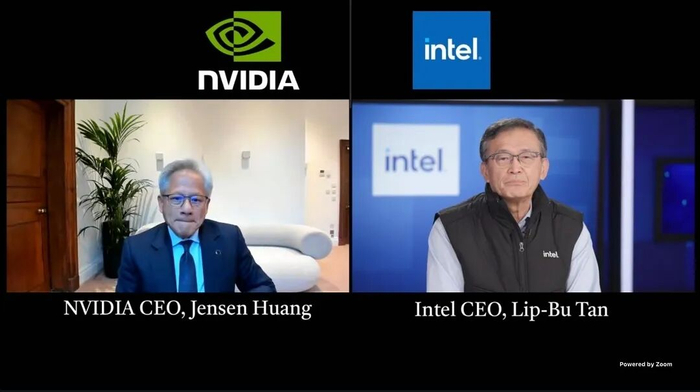
英伟达宣布与英特尔开展联合合作及股权投资 -对我们覆盖标的的影响_ Semiconductors_ Nvidia announces Intel joint collaboration and equity investment - Implications for our coverage
2025-09-19 03:15
Summary of Conference Call Notes Industry and Company Involved - **Industry**: Semiconductors - **Companies**: Nvidia and Intel Core Points and Arguments - **Joint Collaboration Announcement**: Nvidia and Intel announced a collaboration to develop custom datacenter and PC products, with Nvidia investing $5 billion in Intel at a price of $23.28 per share, representing approximately 5% ownership [1] - **Positive Implications for Nvidia**: The collaboration is seen as a modest positive for Nvidia, likely enhancing its position among enterprise customers with custom x86 and ARM-based solutions [2] - **Impact on Synopsys**: The announcement is viewed positively for Synopsys, as it may restore confidence in Intel's health following its muted FY26 IP guidance [2] - **Negative Implications for AMD**: The collaboration is expected to negatively impact AMD, potentially weakening its position in the enterprise server CPU market and slowing its desktop share gains [3] - **Negative Implications for ARM**: The collaboration could dampen investor sentiment regarding ARM's market share gains in the datacenter sector [3] Additional Important Content - **Product Development Focus**: Intel will create custom x86 CPUs for Nvidia's AI infrastructure and x86 system-on-chips (SOCs) that integrate Nvidia's RTX GPU chiplets for PCs. The collaboration is primarily focused on product design without commitments related to Intel's foundry business [6] - **Price Target for Nvidia**: The 12-month target price for Nvidia is set at $200, based on a 35X P/E multiple [4] - **Key Risks Identified**: Potential risks include a slowdown in AI infrastructure spending, increased competitive intensity, margin erosion, and supply constraints [7]
芯片“三分天下”终焉?英伟达牵手英特尔共同开发产品,AMD又该如何应对
Mei Ri Jing Ji Xin Wen· 2025-09-19 03:08
Core Viewpoint - The collaboration between Nvidia and Intel is seen as a potential game-changer in the semiconductor industry, combining Nvidia's AI chip dominance with Intel's extensive user base and patents [2][4]. Group 1: Collaboration Announcement - Nvidia and Intel announced their partnership on September 18, focusing on creating innovative solutions for the next computing era, targeting a combined market exceeding $50 billion [2][4]. - The partnership includes joint development of customized data center and PC products, with Intel customizing x86 processors for Nvidia and launching SoCs integrated with Nvidia's RTX GPUs [4][5]. - Nvidia plans to purchase Intel shares at $23.28 per share, marking a significant investment in Intel [4][5]. Group 2: Market Impact - The collaboration is expected to disrupt the current market dynamics, potentially ending the existing three-way competition among Nvidia, Intel, and AMD [2][10]. - Analysts suggest that the partnership could create substantial opportunities, with estimates of addressing market opportunities ranging from $2.5 billion to $50 billion annually [8][10]. Group 3: Strategic Context - The collaboration arises amid challenges faced by both companies, with Nvidia struggling in key markets and Intel experiencing setbacks with its 3nm chips and political pressures [2][13]. - The partnership is viewed as a strategic move to enhance the U.S. semiconductor industry's global advantage and alleviate concerns about Intel's potential government acquisition [13][14]. Group 4: Future Considerations - The collaboration's success hinges on the extent of technological integration and cooperation between the two companies, with some experts viewing it as a tentative partnership rather than a full merger of capabilities [11][14]. - Intel's extensive patent portfolio may provide long-term advantages, but the current collaboration is primarily led by Nvidia due to its recent market positioning [14].
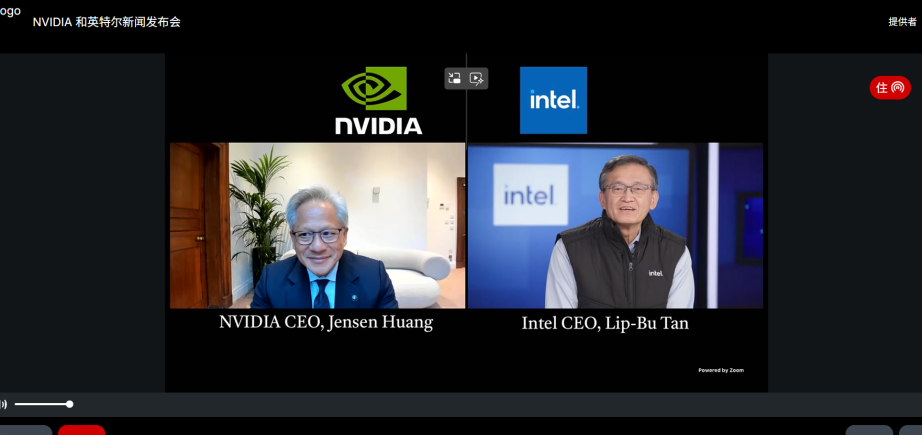
NVIDIA 向英特尔投资 50 亿美元 共同开发 AI 基础设施和个人计算产品
Jing Ji Guan Cha Wang· 2025-09-19 03:00
Core Insights - NVIDIA and Intel have announced a partnership to invest $5 billion in Intel to jointly develop AI infrastructure and personal computing products [1][2] - NVIDIA will purchase Intel common stock at $23.28 per share, leveraging NVIDIA NVLink technology to integrate NVIDIA's AI capabilities with Intel's advanced CPU technology [1][2] - The collaboration aims to create customized data center and client CPUs, enhancing applications for large-scale, enterprise, and consumer markets [1][2] Company Performance - Intel reported Q2 2025 revenue of $12.9 billion, slightly up from $12.8 billion year-over-year, with client computing group revenue down 3% to $7.9 billion, while Data Center and AI revenue increased by 4% to $3.9 billion [2] - NVIDIA's market capitalization has surpassed $4 trillion, with Q2 revenue reaching $46.7 billion, a 6% increase quarter-over-quarter and a 56% increase year-over-year [3]
黄仁勋掏出50亿,不是为了救英特尔,而是为了250亿美元的新市场
3 6 Ke· 2025-09-19 02:57
Core Viewpoint - Nvidia announced a $5 billion investment in Intel, providing significant support to the struggling chip manufacturer and opening new development opportunities for Intel [1][8]. Group 1: Investment and Strategic Implications - The collaboration will enable Intel to secure substantial funding to improve its manufacturing and chip design capabilities, while also enhancing its position in the growing data center business [1]. - Nvidia's investment allows it to penetrate the PC market more deeply and transition seamlessly into the "edge computing" sector [1]. - Nvidia CEO Jensen Huang emphasized that this move is not a strategic shift away from Arm architecture, which remains a focus for the company [1]. Group 2: Market Competition - The partnership aims to compete against AMD, which has a unique advantage by integrating both CPU and GPU capabilities in its products [3][6]. - Nvidia is targeting the lucrative notebook market, which has an annual sales volume of 150 million units, rather than just the high-end segment with discrete GPUs [6][8]. - AMD's Strix Halo product, which combines powerful CPUs with integrated graphics, poses a challenge in the same market segment that Nvidia and Intel are looking to exploit [6]. Group 3: Server Market Dynamics - Nvidia plans to become a major customer of Intel's server CPUs, which is notable given Nvidia's previous focus on developing its own Arm-based server CPUs [7]. - AMD has gained significant market share in the server CPU market, nearing 40% this summer, which highlights the competitive landscape [7]. Group 4: Future Outlook for Intel - Analysts view Nvidia's investment as a critical turning point for Intel after years of decline, potentially solidifying its position in the AI race [8]. - There are concerns that Intel may need structural changes beyond this investment to regain its former glory, as it has lost technological advantages to TSMC [9][10]. - The possibility of Intel splitting its chip design and manufacturing operations is discussed as a way to enhance collaboration with companies like Nvidia and improve operational efficiency [11][12].


芯片股延续近期涨势 英伟达斥巨资入股英特尔 中美半导体行情实现共振
Zhi Tong Cai Jing· 2025-09-19 02:53
Core Viewpoint - Semiconductor stocks continue to rise, driven by significant investments and optimistic market outlooks in the industry [1] Group 1: Stock Performance - Huahong Semiconductor (01347) increased by 7.25%, reaching HKD 62.15 - SMIC (00981) rose by 3.96%, reaching HKD 72.25 - Jingmen Semiconductor (02878) gained 3.85%, reaching HKD 0.54 - Hongguang Semiconductor (06908) increased by 3.39%, reaching HKD 0.61 - ASMPT (00522) rose by 2.68%, reaching HKD 78.5 [1] Group 2: Major Investments - Nvidia plans to invest USD 5 billion in Intel at a price of USD 23.28 per share - Post-transaction, Nvidia will become one of Intel's largest shareholders, potentially holding 4% or more [1] Group 3: Strategic Collaborations - Intel will customize x86 CPUs for Nvidia in the data center sector - Nvidia will integrate these CPUs into its AI infrastructure platform for market deployment - In personal computing, Intel will produce x86 system-on-chip solutions that integrate Nvidia's RTX GPU chips [1] Group 4: Market Outlook - Guosen Securities reports a rapid increase in the semiconductor sector, following strong performance in North America's computing power industry - TSMC has raised its annual performance guidance, while SMIC and Huahong Semiconductor have optimistic forecasts for future orders [1] - The Ministry of Commerce has initiated anti-dumping investigations on US-produced analog chips, highlighting a focus on domestic chip production and wafer foundry sectors [1] - Alibaba and Baidu are developing their own computing power chips, indicating a gradual decoupling from overseas models for domestic training [1]