
MICROSOFT(04338)

Search documents
微软“Maia 200”强化ASIC崛起叙事 高速铜缆、DCI与光互连站上自研AI芯片风口
智通财经网· 2026-01-28 07:23
Core Insights - The report from BNP Paribas highlights the launch of Microsoft's second-generation self-developed AI chip, "Maia 200," which is expected to trigger a new wave of investment in the AI computing power industry, particularly benefiting leaders in custom AI ASIC chips like Marvell and Broadcom [1][6] - Analysts predict that the market share of ASICs compared to NVIDIA's AI GPU clusters could significantly increase from the current ratio of 1:9/2:8 to nearly equal [1] - The ongoing AI infrastructure investment wave is projected to reach between $3 trillion and $4 trillion globally by 2030, driven by unprecedented demand for AI computing power [4] Group 1: AI Chip Market Dynamics - The trend of self-developed AI chips by cloud computing giants like Microsoft, Google, and Amazon is reshaping the AI ASIC and GPU landscape, with significant implications for data center interconnects and high-speed cabling [2][3] - Google’s TPU AI chip production is expected to surge, with projections of 5 million and 7 million units in 2027 and 2028, respectively, indicating a potential shift towards external sales of TPU chips [7] - The demand for AI ASICs is anticipated to triple by 2027, surpassing GPU shipments, driven by the expansion of Google’s TPU infrastructure and AWS Trainium clusters [7] Group 2: Infrastructure and Connectivity - The report identifies potential beneficiaries in the data center connectivity space, including Amphenol for high-speed copper cables and Lumentum for optical interconnects, as the demand for AI infrastructure grows [8] - The integration of high-performance networking solutions, such as NVIDIA's InfiniBand and Google's Optical Circuit Switching, is crucial for the efficiency of AI data centers, emphasizing the role of both copper and optical interconnects [9][10] - The Maia 200 AI infrastructure is expected to be deployed in a specific topology designed for AI inference workloads, with large-scale deployment anticipated to accelerate in the second half of 2026 [11]

微软发布第二代AI芯片Maia 200,AI人工智能ETF(512930)红盘向上
Xin Lang Cai Jing· 2026-01-28 05:25
Group 1 - The core viewpoint of the news highlights the performance of the AI sector, particularly the rise of the Zhongzheng AI Theme Index and its constituent stocks, indicating a positive trend in the market [1] - The Zhongzheng AI Theme Index (930713) increased by 0.25%, with notable gains from stocks such as Beijing Junzheng (up 7.93%), Guanghuan Xinnet (up 4.95%), and others [1] - The AI Artificial Intelligence ETF (512930) also saw an increase of 0.38%, with the latest price reported at 2.4 yuan [1] Group 2 - Microsoft has launched its second-generation AI chip, Maia 200, aiming to reduce reliance on Nvidia, with production handled by TSMC and deployment in data centers in Iowa and Phoenix [1] - The chip's control software is now available for developers, although the timeline for Azure cloud service users to access servers based on this chip remains unclear [1] - Microsoft has alternative options for chip designs through its partnership with OpenAI, should internal development face challenges [1] Group 3 - According to GF Securities, the demand for high-frequency random access in vector databases driven by AI agents is significantly increasing, leading to a rise in eSSD capacity requirements for GPUs [2] - The NAND demand growth rate is projected to reach 21% by 2026, while supply constraints due to capital expenditure shifts towards HBM/DRAM are expected to limit capacity expansion [2] - TrendForce forecasts a substantial increase in NAND contract prices, with an annual rise of 105%-110% and a quarterly increase of 55%-60% in Q1 [2] Group 4 - The Zhongzheng AI Theme Index consists of 50 listed companies involved in providing resources, technology, and application support for AI, reflecting the overall performance of AI-related securities [2] - As of December 31, 2025, the top ten weighted stocks in the Zhongzheng AI Theme Index include companies like Zhongji Xuchuang and New Yisheng, accounting for 58.08% of the index [2]
微软官方邮箱地址遭黑客滥用,向民众发送钓鱼诈骗邮件
Xin Lang Cai Jing· 2026-01-27 23:07
IT之家 1 月 28 日消息,据外媒 arstechnica 报道,微软官方邮箱地址 no-reply-powerbi@microsoft.com 遭 黑客滥用,用于向用户发送钓鱼诈骗邮件。 炒股就看金麒麟分析师研报,权威,专业,及时,全面,助您挖掘潜力主题机会! (来源:IT之家) 对此,微软发言人回应外媒称公司已关注到平台邮箱地址遭滥用情况,正在对此进行调查,暂时没有更 多信息。而网络安全公司 Proofpoint 的威胁研究员 Sarah Sabotka 指出,黑客很有可能滥用了 Power BI 的一项"将外部邮箱地址添加为订阅者"的功能,从该功能允许调用微软官方邮箱地址向指定用户群发内 容。 根据微软官方文档,这一"no-reply-powerbi@microsoft.com"邮箱地址与微软 Power BI 服务相关联,用于 向启用邮件功能的安全组发送订阅通知,为了避免被垃圾邮件过滤器拦截,微软还建议用户将相应地址 加入邮件白名单。 然而,有用户报告称,她在昨天收到来自上述邮件地址的诈骗邮件,声称她被扣除了 399 美元(IT之家 注:现汇率约合 2779 元人民币)费用,并附上一个电话号码,要 ...
美股异动丨微软盘前续涨1% 发布第二代AI芯片Maia 200
Ge Long Hui· 2026-01-27 09:54
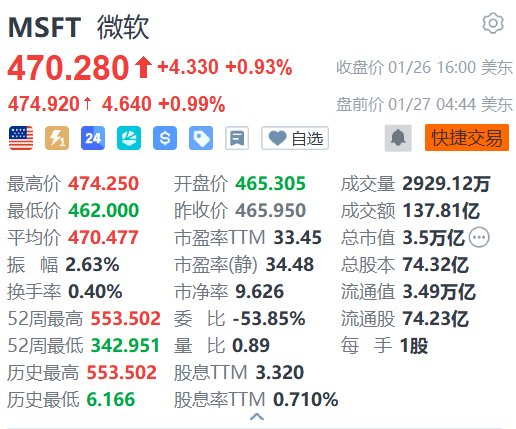
| MSFT 微软 | | | | --- | --- | --- | | 470.280 ↑ +4.330 +0.93% | | 收盘价 01/26 16:00 美东 | | 474.920 + 4.640 +0.99% | | 盘前价 01/27 04:44 美东 | | 二 24 4 3 8 0 日 | | ● 快捷交易 | | 最高价 474.250 | 开盘价 465.305 | 成交量 2929.12万 | | 最低价 462.000 | 昨收价 465.950 | 成交额 137.81亿 | | 平均价 470.477 | 市盈率 33.45 | 总市值 3.5万亿 (... | | 振 幅 2.63% | 市盈率(静) 34.48 | 总股本 74.32亿 | | 换手率 0.40% 市净率 9.626 | | 流通值 3.49万亿 | | 52周最高 553.502 委 比 -53.85% | | 流通股 74.23亿 | | 52周最低 342.951 量 比 0.89 | | 色 手 1股 | | 历史最高 553.502 股息TTM 3.320 | | | | 历史最低 6.166 股 ...

AI风口的超级爆点! 微软(MSFT.US)引领“AI+网络安全”风潮 Palo(PANW.US)等网安巨头紧随其后
智通财经网· 2026-01-27 07:21
Core Insights - The migration of enterprise-scale data workloads to the cloud is expected to enhance the market share of hyperscalers like Microsoft in the cybersecurity market, driven by strong demand for "AI + cloud cybersecurity service systems" [1][2][4] - Morgan Stanley's analysts view hyperscalers as the largest group of cybersecurity suppliers, collectively holding about 14% of the cybersecurity software market, with Microsoft alone accounting for approximately 11% [2][4] - The cybersecurity market is experiencing robust growth, with significant investments from major tech companies, particularly in AI-driven cybersecurity solutions [3][4] Group 1: Market Dynamics - The share of cloud workloads has increased from approximately 25% three years ago to about 47% currently, indicating a significant shift towards cloud-based solutions [5][6] - The total addressable market (TAM) for cybersecurity is estimated to be as high as $270 billion, making it a key focus area for hyperscalers [4][5] - Major cybersecurity platforms like Palo Alto Networks and CrowdStrike are well-positioned to compete with hyperscalers due to their cost efficiency and reputation [4][5] Group 2: Competitive Landscape - Smaller cybersecurity firms like Okta and Varonis Systems may face increased pressure as market share is likely to be further absorbed by larger players [1][2] - Morgan Stanley downgraded Varonis' stock rating from "Overweight" to "Equal-weight" due to the competitive landscape [1] - The acquisition of cybersecurity firms by hyperscalers, such as Google's acquisition of Wiz, is expected to enhance their capabilities in the cybersecurity domain [4][5] Group 3: AI Integration - The integration of AI into cybersecurity is becoming a new investment theme, with AI both expanding risks and creating new demands for cybersecurity solutions [3][4] - AI-driven cybersecurity services are appealing due to their low technical barriers and significant efficiency improvements [3] - The embedded security budget advantage of hyperscalers like Microsoft and Google makes it challenging for traditional cybersecurity vendors to compete [5][6]
微软(MSFT.US)“跑赢大盘“评级背后的博弈:云与AI势头强劲 但市场开始为“颠覆性”风险打折
智通财经网· 2026-01-27 07:06
另一方面,花旗集团也在1月21日将微软的目标价从690美元下调至660美元,同时维持"买入"评级。 花旗分析师表示,其分销商调查和合作伙伴核查显示,在微软2026财年第二季度业绩发布前,市场环境 呈现更为复杂的局面。该行预计Azure云服务在第二财季的表现将超出预期,但由于个人电脑(PC)市场 预测疲软,微软非Azure业务的业绩预估已被下调。 值得注意的是,此次调整是瑞穗在对大型软件股群体进行2025财年第四季度业绩预览时作出的。该行分 析师指出,渠道调研整体保持强劲,公共云数据依旧稳健,人工智能(AI)的采用势头非常强劲。 尽管基本面积极,但该行补充称,投资者对AI颠覆性影响的担忧日益加剧,已开始影响软件公司的估 值倍数。瑞穗表示,行业出现了多重估值压缩,这是其下调目标价的主要原因。 智通财经APP获悉,微软公司(MSFT.US)被分析师列为值得长期持有的最佳科技股之一。近日,瑞穗证 券将其对微软股票的目标价从640美元下调至620美元,但维持"跑赢大盘"评级。花旗也下调了目标价, 但仍维持"买入"评级。 ...
独家供货微软AI旗舰芯片 SK海力士股价飙涨逼近历史新高
Zhi Tong Cai Jing· 2026-01-27 06:49
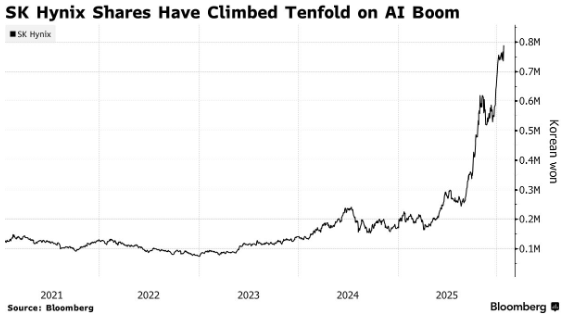
SK海力士公司股价大幅跃升,正迈向历史最高收盘水平。据此前报道,该公司是微软(MSFT.US)新型 人工智能芯片先进内存的独家供应商。 Fibonacci Asset Management Global的首席执行官Jung In Yun表示,周二的股价上涨得到了"逢低买盘和 不断增长的HBM(高带宽内存)盈利预期的支撑"。他补充道:"我们很可能会再次看到SK海力士的业绩 符合预期。" 另一利好因素来自花旗集团,该机构将SK海力士的目标股价大幅上调56%,至市场最高的140万韩元。 花旗维持对该股的"买入"评级,并开启了为期30天的正面催化剂观察。 分析师Peter Lee在周一的一份报告中写道:"内存市场正转向半定制化,内存客户需要在产品实际交付 前一年签订合同。我们预计,2026年全球DRAM/NAND的价格增长将显著超出预期。" 该公司在韩国交易所的股价早盘一度上涨7.7%,抹去了此前因美国总统特朗普最新关税威胁而出现的 跌幅。今年以来,SK海力士股价持续攀升,延续了由人工智能热潮推动的涨势,这家韩国公司的市值 已接近4000亿美元。 据悉,微软于周一发布的每颗Maia 200加速器都将使用六颗SK海力士 ...
微软甩出3nm自研AI芯片,算力超10PFLOPS,干翻AWS谷歌
3 6 Ke· 2026-01-27 05:29
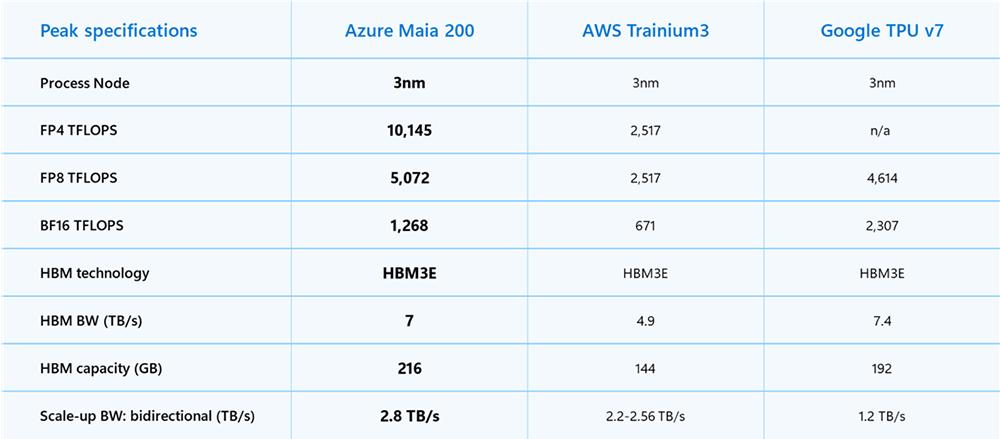
芯东西1月27日报道,今日,微软宣布推出自研AI推理芯片Maia 200,并称该芯片是"目前所有超大规模数据中心中性能最高的自研芯片",旨 在显著提升AI token生成的经济效益。 Maia 200采用台积电3nm工艺制造,拥有超过1400亿颗晶体管,配备原生FP8/FP4张量核心,重新设计的内存子系统包含216GB HBM3e(读写 速度高达7TB/s)和272MB片上SRAM,以及能确保海量模型快速高效运行的数据传输引擎。 Maia 200专为使用低精度计算的最新模型而设计,每块芯片在FP4精度下可提供超过10PFLOPS的性能,在FP8精度下可提供超过5PFLOPS的 性能,所有这些都控制在750W的SoC TDP范围内。 其FP4性能是亚马逊自研AI芯片AWS Trainium3的3倍多,FP8性能超过了谷歌TPU v7。 | Peak specifications | Azure Maia 200 | AWS Trainium3 | Google TPU v7 | | --- | --- | --- | --- | | Process Node | 3nm | 3nm | 3nm | | FP4 ...
微软发布新一代AI加速器Maia 200,科创芯片设计ETF天弘(589070)上市两日净流入额超3600万元
2 1 Shi Ji Jing Ji Bao Dao· 2026-01-27 03:37
Group 1 - The Shanghai Stock Exchange Sci-Tech Innovation Board Chip Design Theme Index (950162.SH) increased by 1.97%, with notable gains from Dongxin Co., Ltd. reaching the daily limit, and Puran Co., Ltd. rising over 14% [1] - The Tianhong Sci-Tech Chip Design ETF (589070) recorded a trading volume exceeding 65 million yuan, with a net inflow of 26.31 million yuan on January 26 [1] - The Tianhong ETF has a 20% price fluctuation limit and closely tracks the Sci-Tech Innovation Board Chip Design Theme Index, focusing on the core segment of chip design with a high industry concentration of nearly 95% [1] Group 2 - Microsoft has launched its next-generation AI accelerator, Maia 200, which reportedly outperforms Amazon's third-generation Trainium and Google's seventh-generation TPU, positioning it as the strongest self-developed chip among major cloud service providers [2] - The domestic AI chip market in China, including products from Huawei and Cambrian, is projected to reach 99.67 billion yuan in 2024 and potentially exceed 100 billion yuan by 2029, driven by technological breakthroughs in ASIC/DSA architecture [2] - Foundries like SMIC are operating at over 95% capacity utilization, supporting the expansion of local design companies in the AI chip sector [2]
微软:2QFY 业绩前瞻及 AI 巡展要点
2026-01-27 03:13
MSFT 12m Price Target: $655.00 Price: $465.95 Upside: 40.6% Microsoft reports 2QFY results on 1/28. We believe risk/reward is skewed positive into the print. Since 1Q EPS in October, the stock is down 13% vs. the NASDAQ down 2%, in part due to broader concerns around the OpenAI ecosystem and app software disintermediation (productivity and business processes is 43% of Microsoft revenue), as well as specific concerns around Azure competitive positioning. We recognize the heightened focus on Azure revenue gro ...