MICROSOFT(04338)

Search documents
微软或将与Kimi进行Agent级合作!科创人工智能ETF华夏(589010) 红盘震荡,软件股逆势活跃
Mei Ri Jing Ji Xin Wen· 2025-12-19 02:27
Core Viewpoint - The Sci-Tech Innovation Artificial Intelligence ETF (589010) demonstrates resilience, rising by 0.23% while managing to maintain positive performance despite some pressure from weight stocks [1] Group 1: Market Performance - The ETF shows strong performance with a rise of 0.23%, indicating resilience in the face of market fluctuations [1] - Internal rotation within the sector is orderly, with notable gains from stocks such as AsiaInfo Technology rising over 3%, and others like Yuke and Jingchen both increasing over 2% [1] - The trading volume surpassed 20 million yuan during the session, reflecting active market participation and a search for structural opportunities [1] Group 2: Company Developments - Microsoft Azure's collaboration with Kimi on the Kimi k2 model is expected to enhance application-level integration, with a new Agent feature set to launch this month [1] - This partnership aims to leverage AI capabilities to automate Office products, addressing competition from local firms [1] - According to Guosheng Securities, China has a significant advantage in AI application deployment due to its large pool of engineers, data resources, and a well-established application ecosystem, exemplified by Alibaba's rapid AI integration across its applications [1] Group 3: ETF Characteristics - The Sci-Tech Innovation Artificial Intelligence ETF closely tracks the Shanghai Stock Exchange Sci-Tech Innovation Board AI Index, covering high-quality enterprises across the entire industry chain [1] - The ETF benefits from high R&D investment and policy support, with a 20% price fluctuation range and small-cap elasticity aiding in capturing the "singularity moment" of the AI industry [1]

微软、英伟达等24家公司加入,美国能源部拟为AI“创世使命”投资超3.2亿美元
Xin Lang Cai Jing· 2025-12-19 02:07
Group 1 - 24 leading AI companies have signed on to the U.S. government's "Genesis Mission" AI initiative, including OpenAI, Microsoft, NVIDIA, Amazon Web Services, and Alphabet [1] - The U.S. Department of Energy announced an investment of over $320 million to create a comprehensive AI experimental platform that integrates supercomputing clusters from 17 national laboratories and numerous federal scientific data assets [1] - The initiative aims to transform scientific research and accelerate scientific discovery by leveraging AI technologies [1] Group 2 - The investment signifies a major strategic shift for the U.S. government, focusing on integrating government computing power, data resources, and private sector technological advantages to address cost, energy, and supply chain bottlenecks in high-performance computing infrastructure [2] - The rapid development of AI is increasingly dependent on energy, with data centers consuming 4.4% of the nation's total electricity, projected to rise to 22% of household electricity consumption by 2028 [2] - The initiative is viewed by the Trump administration as equally important as the Manhattan Project and the space race, with collaboration between government, academia, and private sector innovators [2]
AI校园争夺战升级:OpenAI以“批发价”抢占百万用户,微软谷歌如何破局?
Zhi Tong Cai Jing· 2025-12-19 00:14
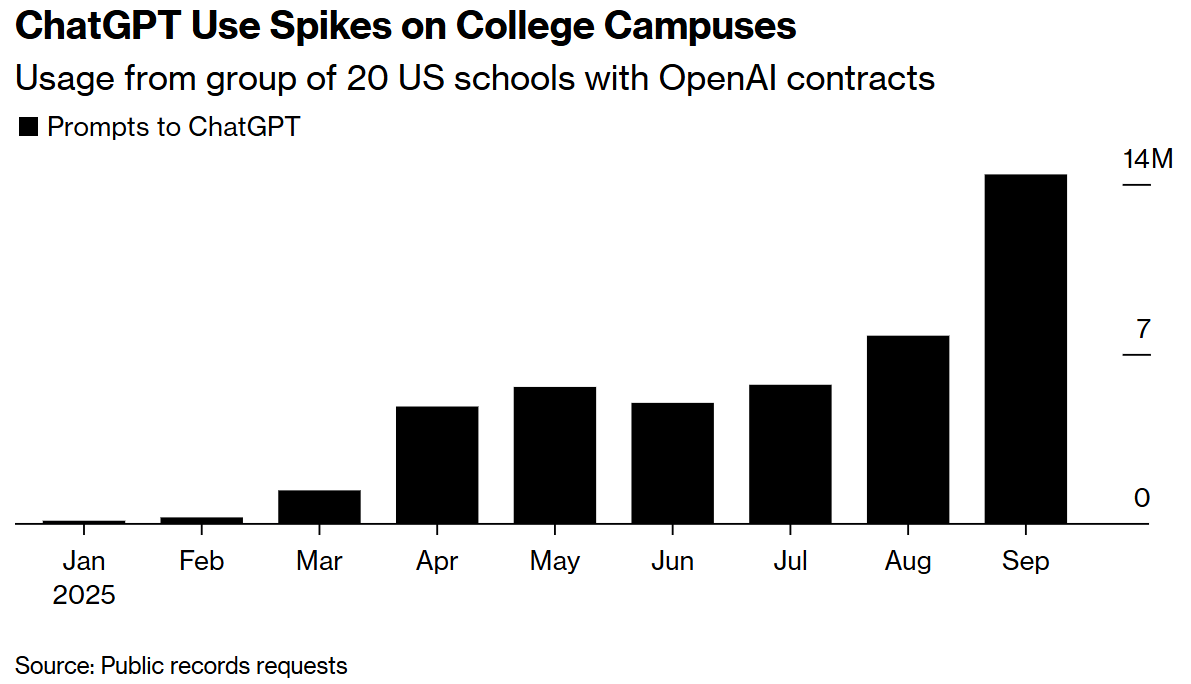
智通财经APP注意到,根据采购订单显示,OpenAI 已向约 35 所公立大学售出超过 70 万份 ChatGPT 许 可证,供学生和教职员工使用。相比之下,通常将 Copilot 助手与现有软件捆绑销售的微软 (MSFT.US),其 AI 工具在这些学校的普及速度则较为缓慢,且教职员工的使用比例往往高于学生。 ChatGPT 在美国校园内的普及非常迅速。根据 20 所与 OpenAI 签署合同的校方数据,学生和教职员工 在 9 月份的使用次数超过 1400 万次。平均而言,每位用户当月调用 ChatGPT 达 176 次,用于寻求写 作、研究和数据分析等任务的帮助。 私立学校不受公共记录法的约束,因此其 AI 许可证的购买情况无法轻易获知,这意味着大学合同的实 际数量可能要高得多。OpenAI 的一位发言人表示,在全球范围内,公司已向高校售出"远超百万"份许 可证。微软发言人则表示,许多大学正在使用该公司的系列 AI 产品。 科技行业长期以来一直向学生推销低价软件和硬件,希望将他们培养成终身客户。苹果(AAPL.US)每年 都会提供教育优惠并推出返校季活动,以进一步吸引购买者。谷歌(GOOGL.US)的 C ...

AI校园争夺战升级:OpenAI以“批发价”抢占百万用户,微软(MSFT.US)谷歌(GOOGL.US)如何破局?
智通财经网· 2025-12-18 23:24
Core Insights - OpenAI has sold over 700,000 ChatGPT licenses to approximately 35 public universities for use by students and faculty, significantly outpacing Microsoft's AI tools in adoption rates within these institutions [1][12] - The rapid adoption of ChatGPT in U.S. campuses is evidenced by over 14 million uses in September alone, with an average of 176 uses per user [1] - OpenAI's pricing strategy, offering bulk licenses at a few dollars per user per month, contrasts sharply with Microsoft's higher pricing for its Copilot tool, making ChatGPT more attractive to educational institutions [2][6] Group 1: Adoption and Usage - Arizona State University has purchased ChatGPT access for nearly 10,000 students and 6,400 staff, while California State University plans to provide access to about 500,000 students and faculty, paying $15 million annually [6][8] - Many universities are now embracing AI tools, with educators recognizing the potential benefits of ChatGPT for research and writing, despite initial skepticism [7][9] - A survey at the University of Nebraska Omaha found that 92% of respondents would recommend ChatGPT, with many reporting time savings of 1 to 5 hours per week [9] Group 2: Competitive Landscape - OpenAI's ChatGPT is currently leading in the education sector, but competition from Google and Microsoft is intensifying, with Google offering free trials of its Gemini AI assistant to students [13][14] - Despite Microsoft's strong presence in corporate environments, its educational adoption of Copilot remains limited compared to ChatGPT, with many universities only purchasing a small number of licenses for faculty use [13][14] - OpenAI's confidence in maintaining its lead is bolstered by the popularity of ChatGPT among students, even in institutions that have access to other AI tools [15]

微软或与Kimi合作上线Agent功能,阿里云Qwen下载量超7亿
3 6 Ke· 2025-12-18 09:54
Group 1 - Microsoft is expected to collaborate with Kimi to launch new Agent features for Office products, aiming for automation to compete with local firms [1] - Kimi's k2 model has been integrated with Microsoft Azure, indicating a strategic partnership to enhance application capabilities [1] - Alibaba Cloud has taken a different approach by fully open-sourcing its Qwen model, positioning itself as a significant player in the global AI landscape [1] Group 2 - The number of Qwen derivative models has surpassed 180,000, significantly exceeding Meta's Llama series [2] - Qwen has achieved over 700 million downloads globally, making it the leading open-source AI model [2] - Alibaba Cloud aims for Qwen to become an industry standard, similar to Linux for servers and MySQL/Hadoop for data [2] - AWS and Microsoft are accelerating their self-developed model efforts, indicating a critical self-correction phase to enhance their competitive edge [2]

AI云的“半程路标”:谷歌云和阿里云的逆袭,AWS、微软云的再审视
Tai Mei Ti A P P· 2025-12-18 08:26
Core Insights - The emergence of large models in AI presents a unique opportunity for cloud providers, allowing latecomers to challenge established leaders like Google, Alibaba Cloud, AWS, and Microsoft [1][20] - The AI cloud landscape is evolving, with major players struggling to reach a consensus on how to effectively implement AI solutions [1] Group 1: AI Cloud Dynamics - Microsoft initially gained an advantage in AI cloud through its investment in OpenAI, but the relationship has become strained as OpenAI seeks alternatives and competes with Microsoft [3][4] - Amazon's cloud strategy emphasizes a variety of model choices, believing that no single model can excel in all scenarios, which has led to significant investments in competitors like Anthropic [3][4] - Alibaba Cloud has taken a bold approach by fully open-sourcing its Qwen model, aiming to establish it as a standard in the industry, similar to Linux for servers [5][6] Group 2: Competitive Landscape - Google Cloud is seen as a rising contender with its Gemini 3 series models and advanced TPU technology, which have been recognized for their performance and efficiency [6][10] - Gartner's recent reports categorize major cloud providers, with Microsoft, Google, AWS, and Alibaba Cloud identified as leaders in GenAI cloud infrastructure [10][13] - The competition among cloud providers is shifting from isolated capabilities to a comprehensive system-level competition, where success depends on integrating models, cloud platforms, and chip technology [19][20] Group 3: Future Outlook - The traditional cloud business model is transitioning from selling cloud resources to delivering AI as the primary product, with cloud infrastructure becoming a supporting element [20][21] - New entrants in the cloud market are attempting to carve out niches, but they face challenges in disrupting the dominance of established players [21] - The competition in AI cloud is still in its early stages, with the potential for significant shifts as companies refine their strategies and capabilities [22]



大摩:AI云业务利润增长空间广阔 重申微软(MSFT.US)“增持”评级
智通财经网· 2025-12-18 07:04
Core Viewpoint - Morgan Stanley analyst Keith Weiss believes that Microsoft's Azure division has significant upside potential following a meeting with Microsoft executives, particularly due to a recent $250 billion deal with OpenAI [1] Group 1: Azure Growth Potential - Weiss has raised expectations for Azure, estimating that the gross margin for Azure AI (excluding revenue sharing with OpenAI) may have reached around 20% [1] - He projects that the gross margin for Azure AI could reach 30% or higher by fiscal year 2029, indicating substantial growth potential [1] - Weiss anticipates that Azure AI's profit margins could exceed 40%, suggesting significant growth opportunities in the coming years [1] Group 2: Demand Trends and Financial Projections - Conversations with Microsoft management have bolstered confidence in demand trends, which are expected to support accelerated revenue growth and expanded operating margins in the first fiscal quarter [1] - Demand signals in terms of bookings, remaining performance obligations (RPO), and product usage are outpacing previous expectations [1] - Despite Microsoft's current stock price being 23 times the projected GAAP earnings per share of approximately $20.65 for fiscal year 2027, the strong demand and potential for margin improvement are seen as undervalued [1] Group 3: OpenAI Deal Impact - The growth forecast for Azure is considered to be far less than the potential contribution from the OpenAI deal, which could provide an additional growth point if the remaining performance obligations can be fully recognized as revenue [1]
西门子公布CES 2026演讲阵容:黄仁勋领衔,微软百事高管助阵
Feng Huang Wang· 2025-12-17 22:32
Core Insights - Siemens will focus on the industrial AI revolution during its keynote at CES 2026, exploring how AI reshapes various operational aspects from design to execution [1] - A significant highlight will be the dialogue between Siemens CEO Roland Busch and NVIDIA CEO Jensen Huang, discussing the next phase of industrial AI development and the responsible scaling of smart technologies [1] Group 1 - The keynote will feature discussions with various industry leaders, including Microsoft and PepsiCo executives, on the integration of AI technologies and operational transformations [2] - The event is scheduled for January 6, 2026, at 8:30 AM PST at the Venetian Hotel [2] - Siemens will collaborate with Amazon Web Services (AWS) to set up a joint live broadcast space at the Las Vegas Convention Center, inviting industry leaders to share insights on the implementation of industrial AI [2]


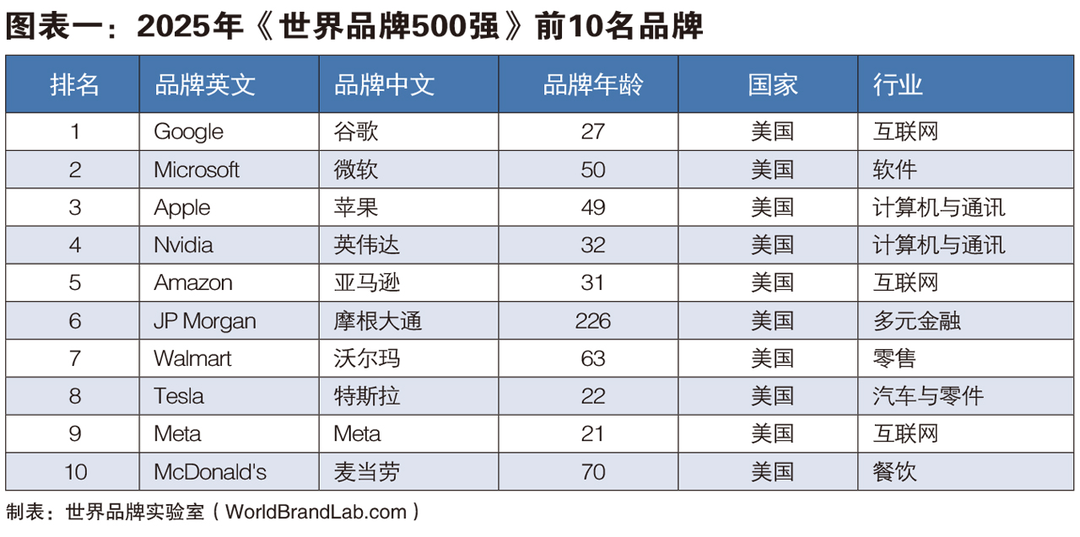
最新“世界品牌500强”:谷歌、微软和苹果居前三 中国50个品牌上榜
Zhong Guo Xin Wen Wang· 2025-12-17 08:37
Group 1 - The core finding of the "World Brand 500" list for 2025 is that Google has surpassed Apple to take the top position, with Microsoft remaining in second place and Apple dropping to third [1] - A total of 50 Chinese brands made the list, maintaining China's position as the third-largest country in terms of brand representation [1] - The United States leads with 184 brands, followed by France with 51, China with 50, Japan with 40, and the United Kingdom with 34 [1] Group 2 - This year, 23 new brands were added to the list, including three from China: CATL, China Unicom, and Tongding [2] - The average age of the brands on the list is 98.46 years, which has decreased compared to last year due to the rapid growth of younger brands in the technology sector [2] - A discussion at the Hong Kong launch focused on the impact of artificial intelligence on branding and marketing, highlighting its mixed contributions to growth and revenue [2]


世界品牌实验室发布2025年世界品牌500强,谷歌、微软、苹果排前三
Qi Lu Wan Bao· 2025-12-17 07:19
Core Insights - The 2025 World's 500 Most Influential Brands list was released on December 17, with Google ranking first, followed by Microsoft and Apple [1][3] - The United States leads with 184 brands in the list, while China ranks third with 50 brands, surpassing Japan's 40 [1][4] - The report highlights the impact of artificial intelligence on brand creativity and the dual-edged sword effect it presents [1][12] Brand Rankings - Google (27 years, USA, Internet) is ranked first, followed by Microsoft (50 years, USA, Software) and Apple (49 years, USA, Computer & Communications) [2] - Other notable brands in the top 10 include Nvidia, Amazon, JP Morgan, Walmart, Tesla, Meta, and McDonald's [2] Brand Influence Criteria - The ranking is based on brand influence, which includes market share, brand loyalty, and global leadership [3][14] - The evaluation involved approximately 8,000 well-known brands, with metrics from iTrust Rating and ESG databases [3] Brand Representation by Country - The United States has 184 brands, France 51, China 50, Japan 40, and the UK 34 [5] - Germany, Switzerland, and Italy represent the third tier of brand countries [4] Industry Representation - The automotive sector leads with 33 brands, followed by energy and food & beverage sectors with 30 brands each [6] - The banking sector has 29 brands, while retail and computer & communications each have 27 brands [6] New Entrants - A total of 23 new brands made the list, with Elevance Health (173rd) being the highest-ranked newcomer [6][7] - Notable new entrants from China include CATL, China Unicom, and Tongding, reflecting advancements in new energy and telecommunications [6] Brand Age Insights - The average age of brands in the list is 98.46 years, with 221 brands over 100 years old [7] - The oldest brand is Saint-Gobain (360 years), followed by Aviva and Moutai [8] AI and Brand Strategy - The report emphasizes the need for brands to adapt to AI-driven changes in marketing and decision-making [10][11] - AI is seen as a transformative tool that can enhance brand performance but also poses challenges in management and evaluation [10][12]