
MICROSOFT(04338)

Search documents
科技巨头南亚AI竞赛升级:继微软175亿后,亚马逊宣布在印投资350亿美元
Hua Er Jie Jian Wen· 2025-12-10 06:49
Group 1 - The core point of the article highlights the intensifying AI arms race among global tech giants in the South Asian market, with Amazon committing to invest over $35 billion in India's cloud and AI sectors by 2030 [1][2] - Amazon's investment aligns with India's national priorities, focusing on expanding AI capabilities, enhancing logistics infrastructure, supporting small businesses, and creating job opportunities [1][2] - The investment is expected to create 1 million additional jobs, quadruple export value to $80 billion, and benefit 15 million small businesses through AI technology [1][2] Group 2 - Amazon's new investment builds on nearly $40 billion previously invested in India, including a $26 billion plan announced in 2023, aimed at developing fulfillment centers, data centers, and payment infrastructure [2] - The company aims to significantly increase the cumulative export value of Indian sellers from over $20 billion in the past decade to $80 billion by 2030, with the new jobs encompassing direct, indirect, and seasonal employment [2] - The competition in the Indian market is fierce, with Amazon facing challenges from local players like Flipkart and Reliance Industries, as well as global competitors like Microsoft and Google [3]

美国将允许英伟达向中国出售H200芯片;微软宣布公司史上最大亚洲投资计划;SK海力士考虑在纽约上市
Sou Hu Cai Jing· 2025-12-10 05:05
Group 1 - The U.S. will allow Nvidia to sell H200 chips to China, with the government receiving a 25% cut from the sales [2][4] - Microsoft announced a historic $23 billion investment plan in AI, primarily targeting India with $17.5 billion allocated for building AI infrastructure [4] - SK Hynix is considering a potential listing in New York to narrow the valuation gap with U.S. peers, with its stock rising approximately 240% this year due to strong demand for high-bandwidth memory chips [5] Group 2 - Google's TPU has helped its Gemini 3 AI model outperform OpenAI's GPT-5, prompting investors to reassess Nvidia's market dominance [6] - The European Commission has launched an antitrust investigation into Google regarding its use of online content for AI without compensating creators [7] - Meta has formed a strategic content partnership with People Inc., allowing it to provide real-time lifestyle content to its AI users [9] Group 3 - Chinese smartphone manufacturers are promoting applications to help users transition from iPhones, intensifying competition in the domestic market [10] - Apple has issued a new round of cybersecurity threat notifications to users across 84 countries, aiming to protect them from surveillance threats [11] - Alibaba's Qianwen has surpassed 30 million monthly active users just 23 days after its public beta launch, introducing new AI features [13] Group 4 - Haiguang Information and Zhongke Shuguang have announced the termination of a major asset restructuring, stating it will not adversely affect their operations [14] - Xiaomi has announced personnel adjustments in its China operations, affecting multiple departments [15] - Zhang Yutong has been appointed as the president of Kimi, focusing on the company's strategy and commercialization [16] Group 5 - OpenAI is collaborating with Deutsche Telekom to launch AI services starting in 2026, integrating ChatGPT Enterprise across the company [18] - Ericsson has acquired a minority stake in software development company LotusFlare, enhancing its strategic partnership in the telecom sector [19] - Australia has become the first country to ban social media access for children under 16, facing criticism from tech companies but support from parents [21]





微软承诺在加拿大和印度投入超300亿美元,用于建设“主权AI”
3 6 Ke· 2025-12-10 04:43
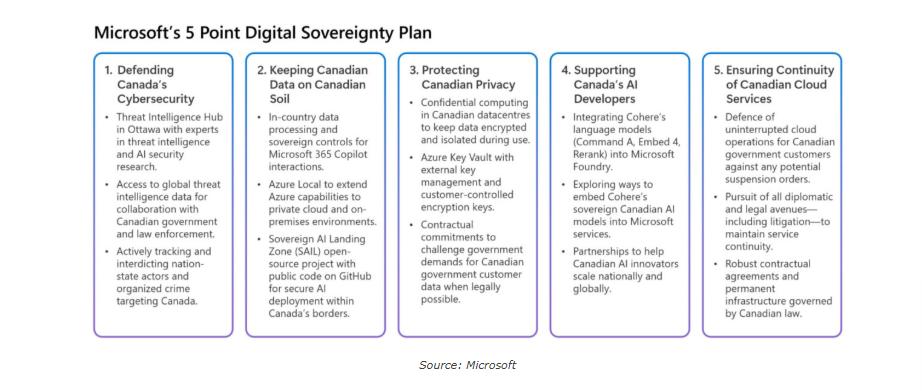
Core Insights - Microsoft has committed to invest over $30 billion in Canada and India to establish large-scale infrastructure, aiming to control the global data ecosystem [1] - The investment in Canada includes CAD 19 billion (approximately $13.4 billion) for local cloud expansion, with a legal commitment to resist foreign judicial requests for data stored in Canada [1] - In India, the investment has surged to $17.5 billion, nearly six times the initial target set for January 2025, integrating Azure AI services into the Indian government welfare portal to cover approximately 310 million workers [1][6] Group 1: Investment and Infrastructure - Microsoft plans to invest CAD 19 billion in Canada by 2027 for local cloud expansion, with a focus on legal protections against foreign data requests [1] - The investment in India has increased to $17.5 billion, significantly enhancing Microsoft's strategic presence in the region [1][6] - The company is shifting its focus from centralized "super factories" in the U.S. to distributed, nation-level infrastructure [1] Group 2: Technology and Compliance - Microsoft is implementing three key technological pillars to strengthen data sovereignty: enhanced data residency commitments, expansion of Azure Local services, and the introduction of Sovereign AI Landing Zone (SAIL) [3][5] - Azure Local will support cloud operations in fully offline, physically isolated environments, addressing stringent regulatory requirements [5] - Microsoft has made a legal commitment to use all available legal and diplomatic avenues to protect access to critical infrastructure in Canada [5] Group 3: User Engagement and Skills Development - The investment strategy includes deep integration with India's e-Shram labor welfare portal, providing job matching for over 310 million informal workers [6] - Microsoft aims to train 20 million people in India by 2030, while a smaller initiative in Canada targets training 250,000 workers, focusing on Indigenous and remote communities [8] - The strategy emphasizes building a complete ecosystem rather than merely capital investment, with a focus on large-scale infrastructure to support AI workloads [7] Group 4: Competitive Landscape - Microsoft's investments come amid a global race for computing power and market share, with other companies like OpenAI, Amazon, and Oracle also enhancing their sovereign cloud services [9] - The demand for computing resources is distorting supply chains, as seen with Micron Technology's shift away from consumer memory markets [9] - Microsoft's distributed strategy contrasts with competitors' centralized approaches, focusing on building sovereign computing capabilities within national borders [9]
微软祭出在亚洲最大投资,175亿美元豪赌印度AI
Tai Mei Ti A P P· 2025-12-10 03:26
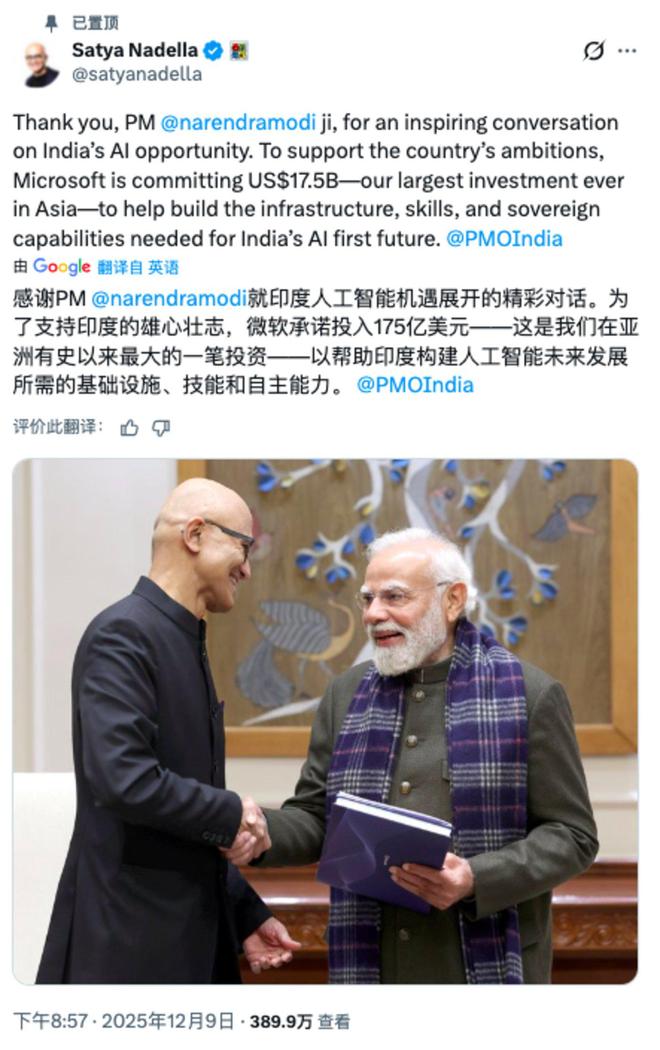
Group 1 - Microsoft CEO Satya Nadella announced a commitment to invest $17.5 billion in India to build AI infrastructure, skills training, and self-sufficiency [1][3] - This investment is the largest ever by Microsoft in Asia and will be implemented gradually from 2026 to 2029, focusing on AI infrastructure centered around large-scale data centers [1][3] - The investment aims to provide AI skills to 20 million Indians by 2030 and create job opportunities while supporting the development of digital governance platforms in India [3][4] Group 2 - Microsoft has been active in India for over 30 years, employing more than 22,000 people, and is leveraging India's policy advantages, labor cost benefits, and IT infrastructure [4][5] - The recent investment comes amid a strategic reevaluation by Microsoft, with Nadella hiring Rolf Harms as an AI economics advisor to rethink the company's business model in the AI era [5][6] - Microsoft’s Copilot AI platform has a high usage rate of 76%, indicating its strategic significance in the AI software service market [6] Group 3 - Other tech giants like Google and Nvidia are also interested in the Indian AI market, with Google planning to invest $15 billion in India over the next five years [7][9] - The Indian government is actively seeking foreign investment in AI and digital infrastructure, viewing AI as a critical area for future development [10] - Predictions indicate that India's data center market could triple in size within five years, with the AI market expected to reach $17 billion by 2027 [10]
微软宣布230亿美元AI投资计划,175亿加码印度
Xin Lang Cai Jing· 2025-12-10 02:31
Group 1 - Microsoft announced a global AI investment plan worth $23 billion, with $17.5 billion allocated to India for AI infrastructure and talent development from 2026 to 2029 [1] - The investment in India will bring Microsoft's total investment in the country to $20.5 billion, following an earlier commitment of $3 billion for cloud computing and AI infrastructure [1] - India's market potential is significant, with a population of 1.4 billion and around 1 billion internet users, making it an attractive destination for global tech companies seeking to expand their AI footprint [1] Group 2 - Other tech giants are also investing in India, with Google announcing a $15 billion investment to build the world's largest AI data center in Andhra Pradesh, and Nvidia planning to invest $1 billion in expanding its R&D center [2] - Microsoft has been operating in India for over 30 years, employing 22,000 people and developing AI products such as Copilot Studio and Azure AI [2] - Microsoft plans to double its cloud service capacity in India by 2029 to support high-performance computing needs for AI model training and digital transformation [4]
微软和谷歌疯了?2300亿元投资砸向印度
Sou Hu Cai Jing· 2025-12-10 01:45
Group 1 - Microsoft announced a $23 billion AI investment plan, with $17.5 billion allocated to India, aimed at building AI infrastructure in the country [1] - Google also made a significant investment in India, committing $15 billion to establish one of the largest AI hubs globally [1] - Nvidia announced a $2 billion investment in India, further emphasizing the interest of major tech companies in the Indian market [1] Group 2 - India's rapid economic growth provides a strong foundation for the development of the digital economy, with significant investments from major global tech firms [3] - The CEOs of Microsoft and Google, both of Indian origin, have strong ties to India, which influences their companies' investment decisions in the country [5][7] - India aims to become a global leader in semiconductor manufacturing and AI, supported by various incentive policies to attract large tech companies [10]
微软计划新增约230亿美元的AI投资
Zheng Quan Shi Bao Wang· 2025-12-10 01:00
微软计划新增约230亿美元的AI投资。175亿美元将用于印度AI基础设施建设,这是微软在亚洲规模最 大的一笔投资,旨在帮助印度建设面向AI未来的基础设施、技能体系和主权能力。 此项印度投资是在微软今年早些时候宣布的30亿美元云计算和AI基础设施投资基础上的进一步加码, 首座新数据中心预计于2026年年中投入使用。 微软还宣布在未来两年向加拿大新增投资超过75亿加元,使其2023年至2027年在加拿大的AI总投资规 模达到190亿加元。加拿大新增产能预计从2026年下半年开始上线,投资包括扩展Azure Local云服务、 与AI初创公司Cohere合作,以及设立专门的"威胁情报中心",以增强网络安全和AI安全研究。 ...
美满电子CEO否认失去亚马逊和微软业务的报道
Xin Lang Cai Jing· 2025-12-10 00:32
Core Viewpoint - Marvell Technology's CEO Matt Murphy denied reports of losing major clients, emphasizing the company's strong relationships with key players in the data center sector and reaffirming a positive outlook for the current quarter [1][2][3] Financial Performance - Marvell Technology reported earnings that exceeded expectations, indicating strong demand for data center products in the coming year [1][2] - The company announced plans to acquire Celestial AI for at least $3.35 billion, aimed at expanding its chip business, which positively impacted its stock price [1][2] Market Reaction - Following reports of losing business with Amazon and Microsoft, Marvell's stock experienced a decline, dropping 3.37% on Tuesday [1][2] - Despite the stock's recent dip, Murphy highlighted that the current stock price presents a significant buying opportunity, as it is trading below average multiples compared to the semiconductor index [2][3] Business Relationships - Murphy stated that Marvell maintains strong, critical relationships with all major U.S. hyperscale companies, reinforcing the stability of its data center business [1][3]

微软急了,紧急腰斩AI产品销售指标,内部拉响红色警告
3 6 Ke· 2025-12-09 23:49
Core Insights - Microsoft's AI products are facing significant challenges in the market, with declining user interest and sales performance [1][11][21] - The company has lowered its sales KPIs for AI products, a rare move indicating internal concerns about product performance and market demand [3][7][12] Sales Performance - Microsoft has adjusted its sales targets for AI products, particularly for Azure AI, due to poor sales performance [7][9] - A specific Azure sales team aimed for a 50% growth in sales but only achieved less than 20%, leading to a revised target of 25% [9][11] - Overall, both enterprise and consumer-facing AI services are experiencing weak demand, falling short of expectations [11][12] Strategic Issues - Microsoft's AI strategy has been criticized for poor execution and lack of user engagement, with products failing to meet user needs [12][16] - The integration of OpenAI technologies into Microsoft's products has not translated into user interest, despite OpenAI's popularity [14][17] - The company's reliance on OpenAI and NVIDIA for AI capabilities has created vulnerabilities, as these partners face their own challenges [19][21] Competitive Landscape - Google's AI products, particularly the Gemini model, are gaining traction and threatening Microsoft's market position [21][22] - Google has established a stronger product ecosystem, allowing for quicker adoption of AI technologies compared to Microsoft [21][22] - Other companies, including OpenAI and AWS, are also experiencing a slowdown in AI product growth, indicating a broader trend in the industry [24][26] Financial Outlook - Despite the challenges in AI product sales, Microsoft is expected to earn approximately $15 billion from OpenAI's cloud server rentals, indicating that the overall AI business remains profitable [22][24] - The company is navigating a complex landscape where it must balance its investments in AI with the performance of its products and partnerships [19][22]

微软宣布230亿美元AI投资计划 175亿美元将投向印度
Xin Lang Cai Jing· 2025-12-09 20:45
Core Viewpoint - Microsoft announced a $23 billion investment plan in artificial intelligence to challenge Amazon and Google [1][2] Group 1: Investment Details - The company plans to invest approximately $23 billion in the AI sector, with a significant portion directed towards India [1][2] - As part of this initiative, Microsoft will invest $17.5 billion in India, marking its largest investment in Asia aimed at building AI infrastructure [1][2] - This investment builds on Microsoft's earlier $3 billion investment plan announced earlier this year [1][2]