ZA ONLINE(06060)

Search documents
港股保险股集体走强,新华保险(01336.HK)、中国人寿(02628.HK)、中国太平(00966.HK)涨超3%,中国太保(02601.HK)、阳光...
Jin Rong Jie· 2026-01-05 02:22
Group 1 - Hong Kong insurance stocks experienced a collective surge, with New China Life Insurance (01336.HK), China Life Insurance (02628.HK), and China Pacific Insurance (00966.HK) rising over 3% [1] - China Taiping Insurance (02601.HK), Sunshine Insurance (06963.HK), and ZhongAn Online (06060.HK) saw increases of more than 2% [1]



保险延伸健康管理服务
Jing Ji Ri Bao· 2026-01-05 01:40
Core Insights - ZhongAn Insurance has launched the upgraded "Zunxiang eSheng 2026" million medical insurance product, focusing on "treatment + rehabilitation" to extend coverage to critical post-operative recovery stages, promoting a shift towards "full-process health services" [1] - The demand for health insurance has been increasing among the public, highlighting its importance as a key product in connecting the healthcare industry and reinforcing the social security network [1] - The National Financial Regulatory Administration has issued guidelines to promote high-quality development in health insurance, advocating for a new health service guarantee system that integrates prevention, management, and post-coverage [1] Health Management Services - Post-operative rehabilitation costs can be as high as acute treatment costs, creating a financial burden for families, which underscores the need for comprehensive health management services [2] - Health management services provided by insurance companies include pre-consultation, in-treatment assistance, and post-treatment support, creating a closed-loop management system from acute treatment to rehabilitation [2] - The "Zunxiang eSheng 2026" product has implemented direct payment for rehabilitation medical expenses in several designated hospitals, enhancing accessibility and convenience for patients [2] Market Trends - In the first half of 2025, national health insurance premium income exceeded 620 billion yuan, indicating significant growth in the sector [3] - Health management services are expanding to include various offerings for chronic disease patients, such as appointment scheduling, remote consultations, and rehabilitation guidance [3] - The integration of health management with health insurance is driving a shift from traditional reimbursement models to managed care approaches [3] Industry Insights - Health management services are seen as a win-win for insurance companies and policyholders, allowing insurers to either purchase third-party services or develop their own systems [4] - By enhancing health management capabilities, insurance companies can provide a comprehensive service model that includes medical, pharmaceutical, rehabilitation, and insurance elements, while also leveraging data for product innovation [4]
中国保险行业"十四五"大盘点系列⑨|从体育保险,看众安产品创新再进化
Ge Long Hui· 2026-01-04 11:32
Core Insights - The increasing popularity of sports as a lifestyle has led to the growth of the sports industry, which is becoming a significant force in the fashion sector [1] - A recent report indicates that nearly 60% of respondents have experienced sports injuries in the past three years, highlighting the risks associated with sports participation [3][6] - Despite the high awareness of the importance of sports insurance, actual spending on it remains low, with annual premium income below 1.5 billion yuan, indicating a mismatch between the growth of the sports industry and the insurance market [4][9] Market Overview - The sports insurance market in China is currently valued at only 1.419 billion yuan, representing just 0.3% of the overall insurance market, which is significantly lower than in mature markets like Europe and the U.S. [9] - The potential market size for sports insurance could reach nearly 50 billion yuan if the majority of the 300 million individuals at risk were to purchase insurance at an average premium of 300 yuan [7][9] Consumer Behavior - While 72% of respondents express a desire for insurance products that include professional guidance, and 68% want coverage for emerging sports risks, actual spending on sports insurance remains low [17] - A significant portion of consumers (54%) is only willing to pay an annual premium of 300 yuan or less, with 24% accepting only 100 yuan or less [7] Supply-Side Challenges - The current sports insurance offerings are primarily focused on professional events and do not adequately cover everyday sports activities or emerging sports, leading to a gap in the market [10][22] - Traditional sports insurance products are often limited to post-incident compensation and lack comprehensive services that include prevention and rehabilitation [10][22] Future Growth Potential - With the projected increase in GDP per capita in China, the demand for sports insurance is expected to grow significantly, as higher income levels correlate with increased awareness and need for insurance [15][16] - The sports insurance market is anticipated to benefit from the normalization of sports participation and the awakening of risk awareness among consumers [20] Strategic Recommendations - Companies should focus on understanding the specific risks associated with various sports activities and tailor their products accordingly to meet the actual needs of consumers [22] - There is a need for innovative insurance products that cover both professional and everyday sports activities, as well as preventive and rehabilitative services [10][18]
保险行业2026年策略:资负两端全面改善,估值修复正当其时
SINOLINK SECURITIES· 2025-12-31 15:27
Investment Rating - The report indicates a positive outlook for the insurance industry, with expectations of double-digit growth in new premiums and net profit value (NBV) driven by the migration of deposits and improved margins [2][22]. Core Insights - The insurance sector is expected to benefit from strong household savings demand, with insurance products becoming increasingly attractive as low-risk savings options amid declining bank deposit rates [2][22]. - The transition towards participating insurance products is anticipated to enhance market share for leading insurance companies, as they leverage their stronger investment capabilities and distribution channels [2][3]. - The report highlights a favorable market environment for insurance stocks, driven by high demand for new policies and a stable investment return outlook, which is expected to support valuation recovery [4][8]. Summary by Sections Liability Side Outlook - New business and NBV are projected to grow at double-digit rates, supported by strong household savings and a shift towards insurance products due to declining bank deposit rates [2][22]. - The insurance sector is expected to maintain stable margins despite the downward adjustment of preset interest rates and the transition to participating insurance [2][22]. Asset Side Outlook - Insurance funds are expected to actively enter the market, with a significant portion of new premiums allocated to equities, particularly in A-shares [3][16]. - The report anticipates a diversified approach to asset allocation, with a focus on high-dividend stocks and sectors such as technology and advanced manufacturing [3][19]. Market Performance Review - The insurance sector has outperformed the broader market, with significant gains in both A-shares and H-shares, indicating strong investor confidence [8][4]. - The report notes that the insurance index has increased by 27.0%, outperforming the CSI 300 index, which rose by 18.2% [8]. Premium Income and Profitability - New premium income is expected to achieve double-digit growth, with specific companies like China Life and Ping An showing substantial increases in their new business premiums [14][32]. - The report highlights the importance of maintaining a favorable cost structure and investment returns to support profitability in the insurance sector [4][11].



众安在线申请文本处理方法专利,提高文本处理的处理效率
Jin Rong Jie· 2025-12-31 12:47
Group 1 - The core point of the article is that ZhongAn Online P&C Insurance Co., Ltd. has applied for a patent for a text processing method, device, electronic equipment, and storage medium, aimed at improving the efficiency of information extraction from diverse materials [1] Group 2 - ZhongAn Online P&C Insurance Co., Ltd. was established in 2013 and is located in Shanghai, primarily engaged in the insurance industry [2] - The company has a registered capital of 1,469.81 million RMB [2] - ZhongAn has invested in 5 companies, participated in 90 bidding projects, and holds 447 trademark records and 110 patent records [2]
上市潮未歇,AI成保险科技叙事新逻辑
Xin Lang Cai Jing· 2025-12-29 13:45
Core Insights - The insurance technology sector is experiencing a significant transformation, moving from a "traffic-driven" narrative to an "AI-driven" approach, reflecting a fundamental shift in growth paths and capital market valuations [3][24][30] Group 1: Market Developments - On December 23, 2025, Easy Health was listed and saw a first-day surge of 158%, reaching a market capitalization of over HKD 12 billion, marking it as a standout in the Hong Kong insurance technology sector [23] - White Dove Online has also passed the Hong Kong Stock Exchange's listing hearing, aiming to become the "first AI stock in the domestic insurance industry" [3][24] - The insurance technology industry is witnessing a new wave of listings, with various companies like Yuanbao and iCloud Insurance entering the market, indicating a robust trend towards public offerings [3][24][25] Group 2: AI Integration and Investment - In 2025, the Chinese insurance industry is projected to invest over CNY 67 billion in technology, with a focus on big data, cloud computing, and artificial intelligence [25] - McKinsey's research indicates that leading insurance companies utilizing AI have seen shareholder returns 6.1 times greater than those lagging behind, highlighting AI as a core competitive advantage [25] - Major insurance firms are evolving their strategies from "ALL in AI" to "AI in ALL," integrating AI across the entire value chain, including product design and risk management [25][26] Group 3: Competitive Landscape - Traditional insurance companies are enhancing their internal capabilities while new tech-driven firms are rapidly exploring boundaries, validating AI's value creation potential [26][28] - Companies like Easy Health and White Dove Online are leveraging AI technologies to transform traditional processes, focusing on areas such as health data structuring and scenario adaptation [26][28] - The competition is intensifying, with a clear divide in market valuations based on the effectiveness of AI implementation among different firms [4][25] Group 4: Narrative Reconstruction - The narrative surrounding insurance technology is shifting from acquiring large user bases to emphasizing AI technology barriers and digital solutions [30][31] - This transition is driven by market saturation, regulatory pressures, and changing consumer expectations for more precise and transparent services [32][33] - The new narrative emphasizes the importance of technology-driven value creation, moving away from the previous reliance on external traffic growth [34][39] Group 5: Challenges and Risks - The rise of AI in insurance also brings challenges related to data security and algorithm fairness, as companies must navigate the complexities of handling sensitive personal information [36][37] - There are significant risks associated with the interpretability of AI models, which can lead to unfair treatment of certain demographic groups if historical biases are present in training data [36][37] - Companies are urged to build resilience in technology and governance to address these challenges and ensure compliance with regulatory standards [36][38]


格隆汇港股聚焦(01.14)︱招商银行2020年净利同比增4.82%;中国平安2020年原保费收入达7973.4亿元



Ge Long Hui· 2025-12-26 13:32
Financial Data - China Merchants Bank (03968.HK) reported a net profit of 97.342 billion yuan, an increase of 4.82% year-on-year [1] - Fast Retailing (06288.HK) saw a 0.7% decline in first-quarter net profit to 70.3 billion yen, with trading resuming tomorrow [1] - Highgate Group (08412.HK) narrowed its mid-term loss by 62.47% to 4.094 million Hong Kong dollars [1] - Dongjun Holdings (08383.HK) reported a first-quarter net profit of 3.92 million ringgit, a year-on-year increase of 113% [1] - Qian Sheng Group Holdings (08475.HK) narrowed its first-quarter loss by 55.37% to 216,000 Singapore dollars [1] Earnings Forecast - Jia Hong Logistics (02130.HK) expects a significant increase in annual net profit attributable to shareholders [1] - Zhongdi Dairy (01492.HK) anticipates a substantial increase in net profit for the ten months ending in October [1] - Guonong Financial Investment (08120.HK) expects a significant reduction in annual losses [1] - PIK Far East (00752.HK) forecasts a decrease of over 80% in annual profit attributable to shareholders [1] - Weiyali (00854.HK) expects to turn a profit of 59.3 million Hong Kong dollars in the first three quarters [1] - Jiuxing Holdings (01836.HK) anticipates annual net profit between 0 and 5 million US dollars [1] Operational Data - Ping An Insurance (02318.HK) reported original premium income of 797.34 billion yuan for 2020 [1] - Zhong An Online (06060.HK) achieved original premium income of 16.703 billion yuan in 2020, a year-on-year increase of 14.13% [1] - Luk Fook Holdings (00590.HK) reported a same-store sales decline of 29% in the third quarter [1] - Chalco International (02068.HK) signed new contracts worth 15.965 billion yuan in the fourth quarter, a year-on-year increase of 12.61% [1] - Yongjia Group (03322.HK) reported an 11% decrease in same-store sales for its high-end fashion retail business in the fourth quarter [1] - Delta Electronics Holdings (00179.HK) reported revenue of 2.242 billion US dollars for the first three fiscal quarters, a year-on-year decline of 4% [1] - Beijing Energy International (00686.HK) achieved a total power generation of 2.7567 million megawatt-hours in 2020 [1] - TRUE PARTNER (08657.HK) reported an asset management scale of approximately 1.59 billion US dollars by the end of December [1] Shareholding Changes - Minsheng Education (01569.HK) saw its chairman and controlling shareholder Li Xuechun increase his stake by 1.95 million shares [2] Mergers and Acquisitions - Non-Fan China (08032.HK) announced that LionRock intends to acquire a majority stake in Clark for £51 million [3] - Tan Carpenter (00837.HK) plans to acquire the remaining 9.09% stake in Jiangsu Tan Carpenter for 15.873 million yuan [3] - Guan Hua International Holdings (00539.HK) subsidiary sold a Hong Kong office property for 33 million Hong Kong dollars [3] Capital Restructuring - China Dredging Environmental Protection (00871.HK) plans a "2-for-1" share consolidation and will place 508 million shares to Chairman Liu Kaijin [2] Share Buybacks - Shisi Pharmaceutical Group (02005.HK) repurchased 2.71 million shares for 11.365 million Hong Kong dollars on January 14 [3] - Hengdeli (03389.HK) repurchased 16.7 million shares for 4.9681 million Hong Kong dollars on January 14 [3] - China Star Group (00326.HK) repurchased 555,000 shares for 0.8325 million Hong Kong dollars on January 14 [3]
众安在线(06060) - 修订物业框架协议的年度上限
2025-12-24 10:26
香港交易及結算所有限公司及香港聯合交易所有限公司對本公告的內容概不負責,對其準確性或完 整性亦不發表任何聲明,並明確表示,概不對因本公告全部或任何部份內容而產生或因倚賴該等內 容而引致的任何損失承擔任何責任。 眾安在綫財產保險股份有限公司 ZHONGAN ONLINE P & C INSURANCE CO., LTD.* (於中華人民共和國註冊成立的股份有限公司,並以「ZA Online Fintech P & C」在香港經營業務) (股份代號:6060) 修訂物業框架協議的年度上限 茲提述本公司日期為2025年1月17日的公告,內容有關物業框架協議項下擬進行 的持續關連交易。 基於本公告所述理由,預計本公司截至2026年及2027年12月31日止年度根據物 業框架協議應付的物業管理服務費總額將超過現有年度上限。因此,董事會建議 修訂截至2026年及2027年12月31日止年度的現有年度上限。 上市規則的涵義 於本公告日期,洛克菲勒集團外灘源為RGAP的附屬公司,而RGAP為Z Fin的全 資附屬公司。本公司非執行董事歐亞平先生於Z Fin已發行股份中持有約64.61% 的權益。因此,根據上市規則第14A章, ...
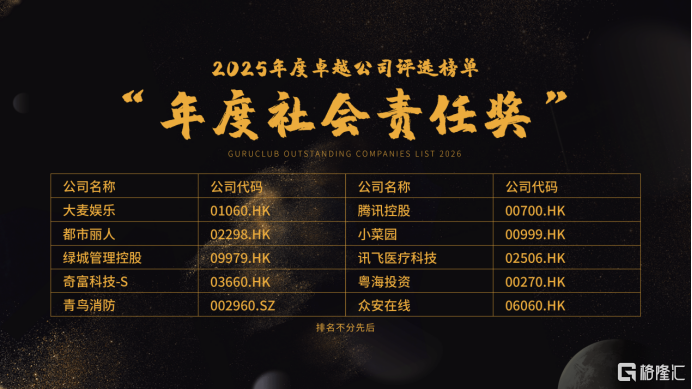
众安在线荣获“格隆汇金格奖·年度社会责任奖”
Ge Long Hui· 2025-12-23 09:50
格隆汇昨日线上举办"科技赋能·资本破局"分享会。备受瞩目的卓越公司评选榜单隆重揭晓。其中,格 隆汇"金格奖"年度卓越公司评选中,众安在线(6060.HK)荣获"年度社会责任奖"奖项。 "年度社会责任奖"奖项是对公司多年来积极履行社会责任的认可和肯定,是对公司管理水平和人员素质 的嘉奖。具备社会责任感是企业可持续发展的必要条件,作为经济主体,只有认识并积极承担社会责任 才能使自己更具竞争力。 ...
格隆汇“科技赋能·资本破局”线上分享会暨“金格奖”——“年度社会责任奖”奖项揭晓:大麦娱乐(01060.HK)、都市丽人(02298.HK)、绿城管理控股(09979.HK)等10家企业上榜
Ge Long Hui· 2025-12-22 13:04
Core Viewpoint - The "Golden Award" annual excellence company selection by Gelonghui recognizes companies for their social responsibility and management quality, highlighting the importance of corporate social responsibility for sustainable development [1][2]. Group 1: Award Winners - Ten companies received the "Annual Social Responsibility Award," including: - Damai Entertainment (01060.HK) - Urban Beauty (02298.HK) - Greentown Management Holdings (09979.HK) - Qifu Technology-S (03660.HK) - Qingniao Fire Protection (002960.SZ) - Tencent Holdings (00700.HK) - Xiaocai Garden (00999.HK) - iFlytek Medical Technology (02506.HK) - Yuehai Investment (00270.HK) - ZhongAn Online (06060.HK) The ranking is in alphabetical order and does not indicate priority [1]. Group 2: Evaluation Process - The selection process for the awards involved quantitative data analysis and an expert review panel to determine the final results [1]. - The aim of the "Golden Award" is to create a valuable reference for investors regarding listed companies and unicorns across various stock exchanges, including the Hong Kong Stock Exchange, Shanghai Stock Exchange, Shenzhen Stock Exchange, New York Stock Exchange, and NASDAQ [2].