
SUNART RETAIL(06808)

Search documents
什么都卖的大超市,正在被挤出市中心?
Hu Xiu· 2025-06-06 03:46
Core Viewpoint - Traditional supermarkets in China, once thriving, are now struggling to adapt to changing consumer preferences and competition from new retail formats, leading to a significant decline in their market position [5][12][13]. Group 1: Traditional Supermarkets' Decline - Traditional supermarkets like RT-Mart have faced unprecedented operational pressures, leading to a sale at a significant loss to Dehong Capital [7]. - RT-Mart's parent company, Gaoxin Retail, reported a slight revenue decline of 1.4% year-on-year for the fiscal year 2025, despite achieving a net profit of 386 million yuan, indicating ongoing challenges in its transformation journey [9]. - Other traditional supermarkets such as Wumart, Carrefour, and Yonghui are also experiencing downturns and are attempting to regain growth through store upgrades and operational adjustments [10]. Group 2: Shift in Consumer Preferences - New retail formats like Pinduoduo, Hema, Sam's Club, and Costco are attracting younger consumers by offering not just products but also lifestyle experiences [11][12]. - The rise of "instant retail" and membership warehouse models has created a stark contrast to traditional supermarkets, which are losing relevance as consumer preferences shift towards convenience and unique shopping experiences [30][31]. - The market for instant retail in China has surpassed 650 billion yuan in 2023, with a compound annual growth rate of 56%, while traditional supermarkets face declining revenues and store closures [32]. Group 3: Evolution of Retail Formats - The traditional supermarket model is being challenged by a trend towards smaller, more efficient retail formats that cater to urban consumers' fast-paced lifestyles [35][36]. - New retail models focus on a limited selection of high-quality products, enhancing shopping efficiency and brand loyalty, contrasting with the overwhelming variety offered by traditional supermarkets [37][38]. - The emergence of private label brands and exclusive products in new retail formats has shifted consumer expectations, making traditional supermarkets' offerings seem less appealing [39][40]. Group 4: Future Directions for Traditional Supermarkets - Traditional supermarkets are beginning to recognize the need for transformation, inspired by successful models like Pinduoduo, which emphasize customer experience and emotional engagement [54][55]. - RT-Mart is exploring partnerships and pilot projects to enhance its fresh food processing capabilities and reposition stores as community commercial centers [59]. - The evolution of consumer preferences necessitates a fundamental rethinking of how traditional supermarkets operate, focusing on understanding and meeting modern consumer needs [61].

商超渠道财报透视:靠即时零售突围线上,“调改”热词继续提效存量
Cai Jing Wang· 2025-05-30 09:21
Group 1 - Traditional supermarkets are increasingly adopting an "online + offline" model to enhance revenue and improve customer engagement through instant retail and social e-commerce [1][2] - High Xin Retail reported a significant turnaround in profitability for the fiscal year ending March 31, 2025, with a profit of 386 million and a revenue of 71.552 billion, despite a slight revenue decline of 1.4% [2] - The same-store sales for High Xin Retail grew from 0.3% in the first half of the fiscal year to 0.6% for the full year, driven by improved pricing competitiveness and product optimization [2] Group 2 - The online business of Da Run Fa covers over 20,000 SKUs, offering delivery services within 5 kilometers, with innovations like satellite warehouses to meet consumer demand [3] - Yonghui Supermarket reported online revenue of 14.6 billion, accounting for 21.7% of total revenue, with a gross margin improvement attributed to better product structure [4] - Red Flag Chain has increased collaboration with social e-commerce platforms, achieving over 1 billion in sales through frequent operations on platforms like Douyin [5] Group 3 - The supermarket industry is undergoing a transformation, with 48.9% of supermarkets reporting online sales growth, particularly in second and third-tier markets [5] - Experts suggest that instant retail is a key area for supermarkets to focus on, emphasizing the importance of product and brand integration [5][8] - The trend of closing underperforming stores is prevalent, with High Xin Retail closing 8 large stores and Yonghui closing 232 stores in 2024 [7][8] Group 4 - The restructuring of store formats is gaining momentum, with 86% of categories seeing positive growth post-restructuring, and fresh produce playing a crucial role in driving sales [9] - Yonghui plans to expand its restructuring efforts, targeting 150 stores by the end of July 2025, while other companies like Wumart are also focusing on store upgrades [10] - The industry is seeing a diversification of store formats, with companies like High Xin Retail and Wumart exploring new community store models to cater to local needs [11][12]


否认大润发裁撤东北大区 德弘资本接手3个月:高鑫零售的“变”与“不变”
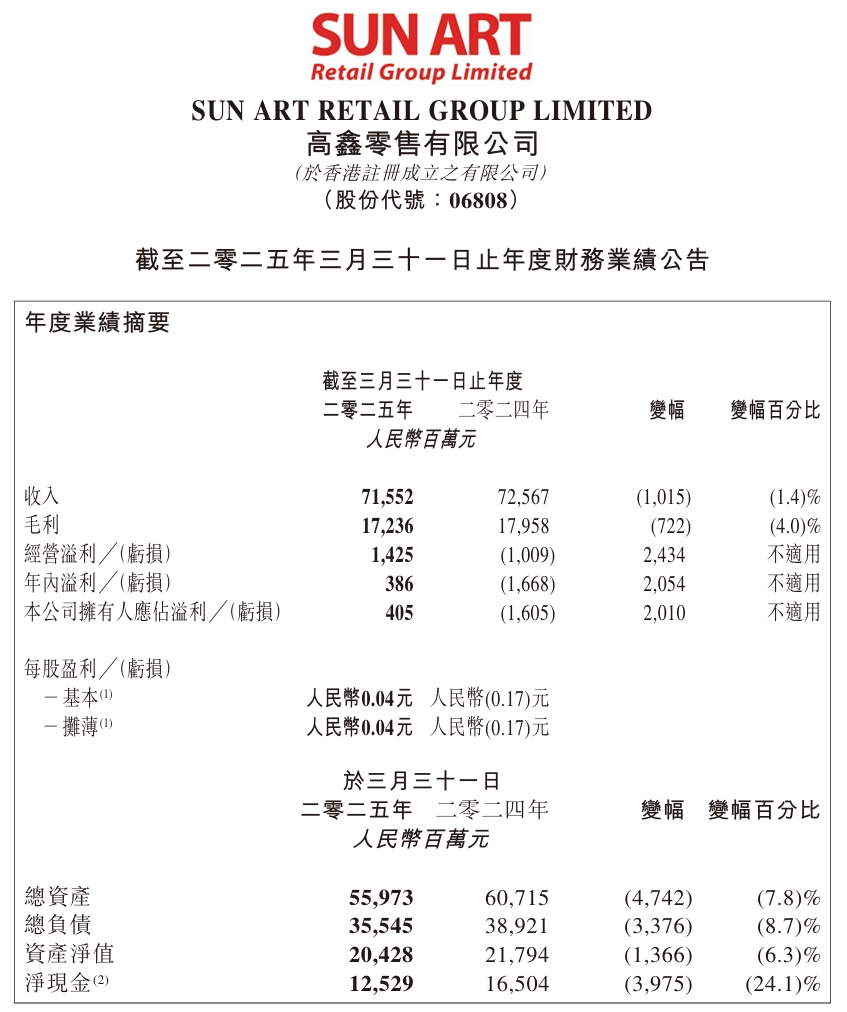
Mei Ri Jing Ji Xin Wen· 2025-05-29 14:33
Core Viewpoint - Recent news regarding the restructuring of Gao Xin Retail's (HK06808) operations, particularly the adjustment of its Da Run Fa stores, has sparked significant discussion in the market. The company has clarified that it is not closing its Northeast region but rather reorganizing its operational zones to enhance efficiency and customer service [1][2]. Financial Performance - Gao Xin Retail reported a revenue of RMB 71.55 billion and a net profit of RMB 386 million for the fiscal year ending March 31, 2025, marking a turnaround from previous losses [3][4]. - The company achieved a gross profit of RMB 17.24 billion, although this represented a 4% decrease compared to the previous year [4]. - The total assets decreased by 7.8% to RMB 55.97 billion, while total liabilities fell by 8.7% to RMB 35.55 billion [4]. Strategic Changes - The company has transitioned ownership from Alibaba to DeHeng Capital, which has led to a renewed focus on a "low-price" strategy and a commitment to restructuring its market approach [5][6]. - Gao Xin Retail aims to enhance its competitive edge by emphasizing price competitiveness and customer experience through its "everyday low price + community life center" model [8][14]. Operational Adjustments - The restructuring of operational zones from five to four is intended to streamline management and improve service delivery [1][10]. - The company has closed a total of 9 stores, including 8 large hypermarkets and 1 medium-sized supermarket, as part of its cost-cutting measures [10]. Market Position and Competition - Gao Xin Retail continues to face intense competition, particularly in non-first-tier cities, where new entrants like Sam's Club and ALDI are expanding their presence [15][16]. - The company has acknowledged the need to attract more customers to its stores, emphasizing the importance of foot traffic for its growth [14]. Future Outlook - The company plans to focus on various aspects such as product offerings, pricing strategies, operational efficiency, store planning, talent development, and membership operations to strengthen its market position [14].
扭亏为盈后 大润发调整运营架构 被指或为进一步降本增效
Nan Fang Du Shi Bao· 2025-05-28 15:00
Group 1 - Dazhonghua has adjusted its operational regions from five to four, consolidating the Central China region into the East China region and reallocating stores accordingly [2] - The restructuring aims to enhance efficiency and better serve customers, with a focus on cost reduction [2][3] - Senior retail analyst Wang Guoping noted that the previous organizational structure was less compatible with the current defensive market stance, indicating a need for cost-cutting measures [2] Group 2 - Gao Xin Retail, Dazhonghua's parent company, reported a turnaround in its fiscal year 2025, achieving a net profit of 386 million yuan after a loss of 1.605 billion yuan in the previous fiscal year [3] - Despite a 1.4% decline in revenue to 71.552 billion yuan, significant reductions in sales and administrative expenses contributed to the profitability [3] - The company optimized its employee structure, leading to a decrease in personnel costs and other operational expenses [3] Group 3 - This fiscal report is Gao Xin Retail's first since its separation from Alibaba, which sold its 78.7% stake in the company [4] - Gao Xin Retail operates three store formats, including hypermarkets, and has closed several locations while opening new ones, resulting in a total of 465 hypermarkets as of March 31, 2025 [4][5] - The company has experienced a gradual decline in the number of hypermarkets over the past few fiscal years, indicating a strategic shift in its business model [5] Group 4 - The proportion of Gao Xin Retail's stores in first-tier cities has been decreasing, with only 6.4% of its total stores located in these areas as of March 31, 2025 [6] - The company aims to maintain its competitive edge through a "low price and good quality" strategy, while also adapting to market changes [6] - There is uncertainty regarding Dazhonghua's future direction, as it has not yet established a clear reform strategy [6]
撤销华中区,大润发易主后调整组织架构
Jing Ji Guan Cha Wang· 2025-05-28 09:50
Group 1 - The core viewpoint of the articles is that after the acquisition by Dihon Capital, Gao Xin Retail has restructured its operational regions from five to four, aiming for organizational efficiency and effectiveness [1][2] - Gao Xin Retail's adjustment includes merging the original Central China region into other operational areas, resulting in a total store count reduction from 117 to 97 in Central China over three years [1] - The company has experienced significant revenue fluctuations, with a peak revenue of 102.3 billion in 2017, followed by a net loss of 8.26 billion in 2022 and an expanded loss of 16.68 billion in 2024, before returning to profitability with a net profit of 386 million in 2025 [1][2] Group 2 - A key factor in Gao Xin Retail's return to profitability in the 2025 fiscal year was a reduction in store and labor costs, with sales and marketing expenses decreasing by 16.2% compared to 2024 [2] - The company attributed the decrease in sales and marketing expenses to three main reasons: optimization of employee structure, reduction in impairment losses from cash flow negative stores, and management's focus on cost reduction [2] - The restructuring of operational regions is part of a broader trend in the industry, as evidenced by Yonghui Supermarket's recent shift to a flatter management structure, reducing layers from four to three [3]
400+大卖场转型是关键!高鑫零售大区合并,关店“瘦身”能否见效考验刚开始
Hua Xia Shi Bao· 2025-05-28 08:49
Core Viewpoint - Gao Xin Retail is undergoing significant strategic adjustments following Alibaba's exit and a major management overhaul, focusing on operational efficiency and shifting its business model towards medium-sized supermarkets amidst a challenging retail environment [2][3][4]. Group 1: Strategic Adjustments - Gao Xin Retail has restructured its operational regions from five to four, integrating the Huazhong region into other areas to enhance efficiency and customer service [4]. - The company has experienced a leadership change, with Alibaba officially exiting and Dehong Capital taking control, leading to a reshuffle in the board of directors [4][5]. - The CEO, Shen Hui, remains in position, having been with the company since 1999 and previously managing the Auchan brand in China [5]. Group 2: Financial Performance - In the fiscal year 2024, Gao Xin Retail reported a revenue decline of 13.3% to 72.567 billion yuan, with a net loss of 1.605 billion yuan, compared to a profit of 109 million yuan in the previous year [6]. - The company has implemented a "store closure" strategy, closing 20 hypermarkets in fiscal year 2024, with a net reduction of 14 stores, and further reducing the number by 7 in fiscal year 2025 [6][7]. - Despite revenue decreases, Gao Xin Retail achieved profitability in fiscal year 2025, reporting a net profit of 405 million yuan, although total revenue fell to 71.552 billion yuan [7]. Group 3: Industry Trends - The traditional supermarket sector is facing significant challenges, prompting companies like Gao Xin Retail to explore new business models, including membership and discount stores [8][9]. - The shift towards medium-sized supermarkets is seen as a necessary adjustment, as the retail market structure in China evolves, with larger hypermarkets becoming less relevant [9]. - Gao Xin Retail is focusing on expanding its medium-sized supermarket format, which has shown growth, with 33 stores and an average area of 7,084 square meters per store [8][9].
高鑫零售(06808.HK):FY25扭亏为盈 聚焦商品力与效率升级
Ge Long Hui· 2025-05-23 18:24
Core Viewpoint - The company reported better-than-expected financial performance for FY2025, with a revenue of 71.55 billion, a slight decline of 1.4%, but a 1.6% increase when excluding the impact of supply chain business contraction and store closures [1] Financial Performance - Revenue for FY2025 was 71.55 billion, down 1.4%, but up 1.6% when excluding supply chain impacts [1] - Operating profit reached 1.425 billion, compared to a net loss of 1.009 billion in the previous year [1] - Net profit was 0.405 billion, recovering from a net loss of 1.605 billion last year, exceeding expectations due to ongoing store optimization and significant cost reduction efforts [1] - The interim dividend announced was 0.17 HKD per share, yielding approximately 17.5% based on the closing price, surpassing market expectations [1] Development Trends - Same-store sales improved by 0.6%, driven by enhanced price competitiveness and stable growth in customer spending across channels [1] - Online B2C revenue increased by 6%, contributing to higher average transaction values [1] - Membership fee revenue surged by 125% to 0.36 billion, indicating strong growth in membership-related income [1] - The company closed 7 hypermarket stores, reducing the total to 465, while increasing the number of convenience stores by 1 to 33, with same-store sales growth of 5.9% [1] Cost Management and Profitability - Gross margin slightly decreased by 0.6 percentage points to 24.1%, with product gross margin also down by 0.6 percentage points to 20.7% [2] - The company focused on cost reduction through optimizing personnel costs, reducing headquarters expenses, and lowering rental costs, leading to a decrease in selling and administrative expense ratios [2] - Net profit margin improved by 2.8 percentage points to 0.6% due to these cost management efforts [2] Strategic Focus - The company is advancing a low-price, high-quality strategy, enhancing operational efficiency and competitiveness through better pricing strategies and product quality [2] - Efforts are being made to improve supply chain efficiency and digitalization to enhance overall operational effectiveness [2] Earnings Forecast and Valuation - The earnings forecast for FY2026 was raised from 0.38 billion to 0.67 billion, with a new forecast for FY2027 at 0.94 billion [2] - The current stock price corresponds to a price-to-earnings ratio of 29/21 for FY2026/FY2027, with a target price increase of 22% to 2.8 HKD, indicating a potential upside of 27% [2]
高鑫零售(6808.HK):FY25盈利改善明显 股东回报优化
Ge Long Hui· 2025-05-23 18:24
Core Viewpoint - High-end retail company Gao Xin Retail reported a revenue of 71.55 billion (down 1.4% year-on-year) and a net profit of 410 million, marking a turnaround from a loss of 1.605 billion in the same period last year, aligning with expectations [1] Group 1: Financial Performance - Revenue for FY25 was 71.55 billion, a decrease of 1.4% year-on-year, primarily due to a contraction in supply chain business and closure of underperforming stores [1] - The company declared a total dividend of 0.34 HKD per share, resulting in a dividend yield of approximately 16.6% [1] - Gross margin slightly declined by 0.6 percentage points to 24.1%, attributed to enhanced cost-effective strategies [2] Group 2: Operational Adjustments - The company implemented refined management strategies under new leadership, focusing on detailed adjustments in frontline stores and more efficient cost control, leading to a return to profitability [1] - Same-store sales saw a slight increase of 0.6%, driven by higher average transaction values due to a focus on high-cost performance products and improved quality control [1] - Membership fees generated revenue of 40 million, reflecting a year-on-year increase of 125% [1] Group 3: Future Outlook - The company plans to continue its "one store, one policy" transformation strategy, aiming for steady improvement in profitability through refined operations [1] - The operational focus will be on enhancing efficiency, reducing costs, and expanding new revenue sources, particularly through the development of membership stores [2] - The forecast for net profit for FY26 and FY27 is set at 500 million and 660 million respectively, with an introduction of an 850 million forecast for FY28 [2] Group 4: Valuation and Market Position - The average PE ratio for comparable companies in FY25 is 43x, down from 74x, primarily due to a valuation adjustment for Yonghui Supermarket [3] - The target price for FY26 has been adjusted down by 9.6% to 2.35 HKD, maintaining a "buy" rating [3]
大润发被阿里抛弃后,全年盈利!
Sou Hu Cai Jing· 2025-05-23 15:46
Core Viewpoint - Gao Xin Retail, the parent company of RT-Mart, reported impressive financial results for the fiscal year 2025, with revenue of 71.5 billion and a net profit of 386 million, marking a turnaround from losses [2] Group 1: Online Business Performance - The online business, particularly instant retail, has been a key pillar in Gao Xin Retail's turnaround, with B2C revenue growing by 6% year-on-year and online business accounting for 36.5% of total revenue [4][5] - The self-owned app "RT-Mart Youxian" significantly contributed to this growth, offering a "1-hour home delivery service" within a 5-kilometer radius of stores, catering to consumer demand for instant shopping [4] - The integration with multiple platforms like TaoXianDa and Ele.me has expanded online order sources, attracting diverse consumer shopping habits [4] - The intelligent "warehouse picking and distribution" system improved order picking efficiency by 30% and reduced costs by 15% [4] Group 2: Store Format and Community Engagement - The "RT-Mart Super" format has become a highlight, with 4 new stores opened in fiscal year 2025, totaling 33 stores, and same-store sales growth of 5.9% [6] - The community can enjoy affordable meals at the community canteen, addressing dining needs for busy residents, thus increasing in-store dwell time and purchase frequency [6] - The self-owned brands "Chao Sheng" and "Run Fa Zhen Xuan" have increased their share to 15%, with a 10% reduction in procurement costs through direct sourcing [7] Group 3: Capital Changes and Strategic Challenges - Alibaba's exit from Gao Xin Retail, selling a 78.7% stake for 12.3 billion, marks the beginning of a "post-Alibaba" era, introducing uncertainties and testing strategic continuity [9][10] - The company has taken decisive actions, such as closing unprofitable stores and laying off 16,000 employees, resulting in a 12.06% reduction in sales expenses to 7.667 billion [10] - Future strategies include optimizing product structure, focusing on major products, enhancing self-owned brand capabilities, and improving customer experience [10] Group 4: Conclusion - Gao Xin Retail's fiscal year 2025 report demonstrates the feasibility of traditional supermarket transformation, yet raises concerns about sustainable growth amid market challenges [12] - The CEO emphasizes that the essence of retail is customer value creation, suggesting that a return to this principle is crucial for navigating future changes [12]
高鑫零售:FY25盈利改善明显,股东回报优化-20250522
HTSC· 2025-05-22 07:25
Investment Rating - The report maintains a "Buy" rating for the company with a target price of HKD 2.35 [8][9]. Core Insights - The company reported a significant improvement in profitability for FY25, with revenue of HKD 71.55 billion (down 1.4% year-on-year) and a net profit of HKD 405 million, marking a turnaround from a loss of HKD 1.605 billion in the previous year [1][5]. - The new management has focused on fine-tuning operations at frontline stores and implementing more efficient cost control measures, leading to a return to profitability [1][4]. - The company plans to continue its strategy of tailored store operations and aims for steady improvement in profitability through enhanced operational efficiency [1][4]. Revenue and Business Segments - The company's merchandise sales revenue was HKD 68.48 billion, also down 1.4% year-on-year, primarily due to a contraction in supply chain operations and the closure of underperforming stores. However, the average transaction value increased, resulting in a same-store sales growth of 0.6% [2]. - Rental income slightly decreased to HKD 3.03 billion, down 2.8% year-on-year, attributed to store closures and tenant restructuring, with an overall vacancy rate of approximately 4.7% [2]. - Membership fees generated revenue of HKD 40 million, reflecting a substantial year-on-year growth of 125% [2]. Profitability and Cost Control - The gross margin slightly declined by 0.6 percentage points to 24.1%, mainly due to the enhanced focus on cost-effective product strategies [3]. - Cost control measures were effective, with total expenses (excluding impairment impacts) decreasing by HKD 2.2 billion, driven by reductions in personnel costs and rent [3]. - The net profit margin improved by 2.8 percentage points to 0.6%, with adjusted net profit reaching HKD 690 million, corresponding to a profit margin of 1.0% [3]. Future Outlook and Strategy - The company’s future operational plans will focus on three main areas: enhancing efficiency through a "daily low price + community life center" model, continuing cost-saving measures, and expanding revenue sources through improved store formats and membership offerings [4]. - The medium-sized supermarket segment is expected to see same-store sales growth of 8%, with positive cash flow anticipated as the business model stabilizes [4]. Earnings Forecast and Valuation - The report maintains net profit forecasts of HKD 500 million for FY26 and HKD 660 million for FY27, with an introduction of an FY28 forecast of HKD 850 million [5]. - The average PE ratio for comparable companies is projected at 43x for FY25, with a target price adjustment of 9.6% down to HKD 2.35, while maintaining the "Buy" rating [5].