
HTSC(06886)

Search documents
港股异动 | 中资券商股涨幅居前 证监会主席提拓宽券商资本空间 优质券商ROE天花板有望打开
智通财经网· 2025-12-08 01:49
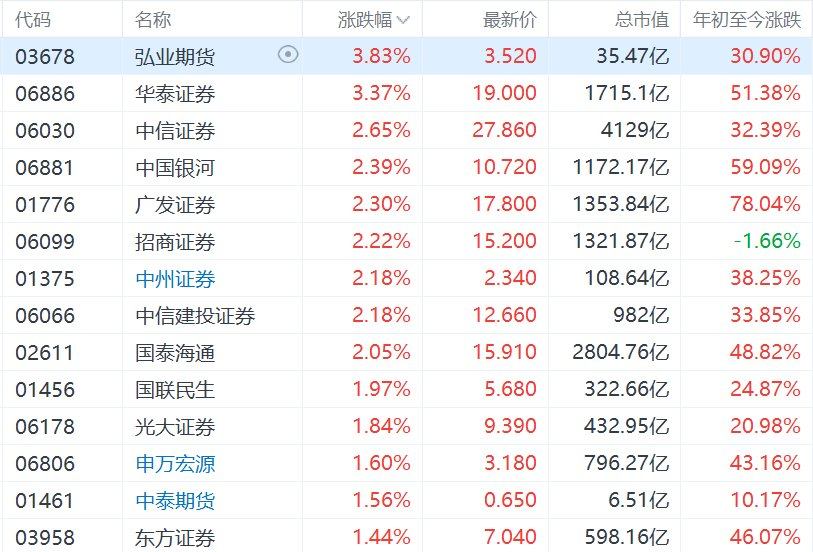
方正证券认为,在监管支持方面,吴清主席提及"对优质机构适当松绑,进一步优化风控指标、适度打 开资本空间和杠杆限制……对中小券商、外资券商在分类评价、业务准入等方面探索实施差异化监 管",这是继24年9月证监会修订《证券公司风险控制指标计算标准规定》以来监管又一次明确优化风控 指标、打开杠杆限制,预计后续相关政策落地、优质券商ROE天花板有望打开。 智通财经APP获悉,中资券商股涨幅居前,截至发稿,弘业期货(03678)涨10.91%,报3.76港元;华泰证 券(06886)涨7.56%,报19.77港元;国泰海通(02611)涨6.74%,报16.64港元;中信证券(06030)涨5.38%, 报28.6港元;中国银河(06881)涨5.16%,报11.01港元。 消息面上,12月6日,证监会主席吴清在中国证券业协会第八次会员大会上提出投资银行差异化特色化 发展要做到新突破,监管政策将"扶优限劣",对优质机构适当"松绑"。吴清特别强调,一流投行不是头 部机构的"专属"、"专利",中小机构也要把握优势、错位发展,在细分领域、特色客群、重点区域等方 面集中资源、深耕细作,努力打造"小而美"的精品投行、特色投行和特 ...
港股异动丨行业迎重磅利好!中资券商股集体高开,华泰证券涨超3%
Ge Long Hui· 2025-12-08 01:48
Group 1 - The core viewpoint of the news is that Chinese brokerage stocks in the Hong Kong market opened higher, with notable gains from several major firms following regulatory announcements aimed at optimizing capital utilization and implementing differentiated supervision [1][2] Group 2 - On December 6, the Chairman of the China Securities Regulatory Commission, Wu Qing, emphasized the need to strengthen classified regulation, focusing on "supporting the strong and limiting the weak" [1] - The regulatory approach will involve easing restrictions for high-quality institutions, optimizing risk control indicators, and appropriately increasing capital space and leverage limits [1] - There will be differentiated supervision for small and medium-sized brokerages and foreign brokerages, promoting specialized development [1] - Strict regulation will be enforced on a few problematic brokerages, with severe penalties for violations [1] Group 3 - Major brokerage stocks saw significant price increases, with Huatai Securities rising over 3%, and other firms like CITIC Securities, China Galaxy, and GF Securities increasing by over 2% [1] - Specific stock performance includes Huatai Securities at a price of 19.000 with a market cap of 171.51 billion and a year-to-date increase of 51.38% [2] - CITIC Securities reached a price of 27.860 with a market cap of 412.9 billion and a year-to-date increase of 32.39% [2] - China Galaxy's stock price was 10.720 with a market cap of 117.217 billion, reflecting a year-to-date increase of 59.09% [2] - GF Securities showed a price of 17.800 with a market cap of 135.384 billion and a year-to-date increase of 78.04% [2]


大金融板块继续走强,瑞达期货2连板
Mei Ri Jing Ji Xin Wen· 2025-12-08 01:43
Group 1 - The financial sector continues to strengthen, with notable gains in stocks such as Ruida Futures, which has achieved two consecutive trading limits [1] - Other securities firms, including Industrial Securities, Guosen Securities, Huatai Securities, Xiangcai Securities, and Guotai Junan, opened higher [1]




券商股拉升,创业板指涨超1%
Hua Er Jie Jian Wen· 2025-12-08 01:41
Group 1 - The ChiNext Index rose over 1%, indicating a positive market sentiment in the A-share market [1] - Brokerage stocks in A-shares experienced significant gains, with Industrial Securities hitting the daily limit, Northeast Securities rising over 7%, and other major firms like Bank of China Securities, Huatai Securities, Guotai Junan, CITIC Securities, and GF Securities also seeing increases [1] - The Chairman of the China Securities Regulatory Commission, Wu Qing, announced on December 6 that regulatory measures will be strengthened, focusing on differentiated supervision, optimizing evaluation indicators for quality institutions, and appropriately expanding capital space and leverage limits to enhance capital utilization efficiency [1]



金融股继续走强 兴业证券涨停
2 1 Shi Ji Jing Ji Bao Dao· 2025-12-08 01:40
Group 1 - Financial stocks continue to strengthen, with notable performances from companies such as Industrial Securities, which saw a significant increase and reached the upper limit of trading [1] - Ruida Futures achieved a second consecutive trading limit increase, indicating strong market momentum [1] - Other companies like Northeast Securities, Bank of China Securities, Huatai Securities, Yingshi Sheng, and Chuangshi Technology also experienced upward movements in their stock prices [1]
华泰证券12月5日获融资买入2.06亿元,融资余额63.25亿元
Xin Lang Cai Jing· 2025-12-08 01:21
Group 1 - On December 5, Huatai Securities experienced a stock price increase of 2.78% with a trading volume of 2.097 billion yuan, while the margin trading data indicated a net margin buy of -86.82 million yuan for the day [1] - As of December 5, the total margin trading balance for Huatai Securities was 6.336 billion yuan, with the financing balance at 6.325 billion yuan, representing 3.97% of the circulating market value, which is below the 10th percentile level over the past year [1] - In terms of securities lending, on December 5, Huatai Securities had a securities lending repayment of 62,600 shares and a securities lending sell of 109,300 shares, with a sell amount of 2.3827 million yuan, while the securities lending balance was 10.2329 million yuan, exceeding the 90th percentile level over the past year [1] Group 2 - As of September 30, Huatai Securities had 195,500 shareholders, a decrease of 6.96% from the previous period, with an average of 38,566 circulating shares per person, an increase of 7.62% [2] - For the period from January to September 2025, Huatai Securities reported an operating income of 0.00 yuan and a net profit attributable to shareholders of 12.733 billion yuan, reflecting a year-on-year growth of 1.69% [2] - Since its A-share listing, Huatai Securities has distributed a total of 42.893 billion yuan in dividends, with 13.994 billion yuan distributed over the past three years [3] Group 3 - As of September 30, 2025, among the top ten circulating shareholders of Huatai Securities, Hong Kong Central Clearing Limited held 442 million shares, a decrease of 108 million shares from the previous period, while China Securities Finance Corporation held 153 million shares, unchanged from the previous period [3] - The Guotai CSI All-Share Securities Company ETF (512880) entered as a new shareholder, holding 131 million shares [3]
华泰证券:春季躁动提前的能见度上升
Xin Lang Cai Jing· 2025-12-08 01:01
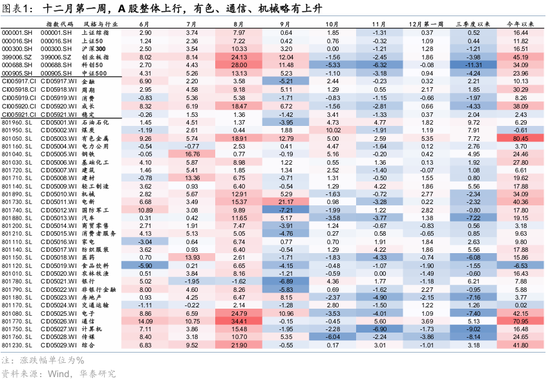
Core Viewpoint - The A-share market continues to rebound with reduced trading volume, supported by improved liquidity conditions and expectations of policy easing ahead of the Central Economic Work Conference [1][16]. Group 1: Funding Observation - Recent improvements in the funding environment include a slight recovery in margin trading balances and a decrease in the scale of net outflows from foreign capital [2][17]. - New equity funds have seen a slight decrease in shares, but the estimated positions of ordinary stock and mixed equity funds have increased [2][19]. - The number of newly issued ETFs has significantly increased, with 22 currently being issued, 10 awaiting issuance, and 11 pending approval [2][19]. Group 2: Economic Tracking - The overall industry prosperity index continued to decline in November, influenced by holiday effects on October production data [3][19]. - Key sectors showing improvement include TMT, upstream resources, and public industries, with notable recovery in AI applications, commodity prices, and consumer goods [3][19]. - Specific areas of focus include the AI chain, price increase chain, capital goods, consumer goods, and infrastructure chains [3][19]. Group 3: Policy Outlook - Expectations for policy changes are rising ahead of the December Political Bureau meeting and the Central Economic Work Conference, with anticipated focuses on proactive macro policies and expanding domestic demand [4][19]. - Historical data suggests a higher probability of market increases in the week leading up to the Central Economic Work Conference, particularly in sectors like consumer services and home appliances [4][19]. Group 4: Investment Strategy - The market is currently in a phase of recovery, with potential for a "spring surge" starting in mid-December [5][20]. - A balanced allocation between growth and cyclical sectors is recommended, with a focus on high-value consumption and financial sectors as long-term investment choices [5][20]. - Key sectors to watch include aviation equipment, AI chains, and power equipment for growth, while non-ferrous metals and certain chemicals are highlighted for cyclical investments [5][20].
再CALL非银板块 - 政策松绑吹响新一轮反攻号角
2025-12-08 00:41
Summary of Conference Call on Non-Banking Sector Industry Overview - The conference call focused on the non-banking sector, particularly the insurance and brokerage industries in China for the year 2025 [1][2][3]. Key Points and Arguments 1. **Market Activity and Performance**: The non-banking sector's performance in 2025 is driven by market trading activity, benefiting brokerage businesses, proprietary trading, and insurance companies' equity investment returns. The sector is expected to see a significant inflow of approximately 1,000 billion CNY due to new policies encouraging long-term holdings [1][2][8]. 2. **Regulatory Changes**: The China Securities Regulatory Commission (CSRC) has optimized the equity allocation coefficient for insurance funds, potentially releasing around 108.6 billion CNY into the market. This policy encourages long-term stock holdings, particularly benefiting the CSI 300 and the CSI Dividend Low Volatility Index [1][4][10]. 3. **Insurance Companies' Position**: China Life is highlighted as having a high capital ratio for domestic equity price risk, suggesting significant potential for benefit from policy adjustments. China Ping An and New China Life, which have actively acquired bank shares, are also expected to gain from the optimized equity allocation [1][5][10]. 4. **Brokerage Recommendations**: The call recommends several brokerage firms, including Huatai Securities, Tonghuashun, and Dongfang Caifu, as they are well-positioned to perform well in the current market environment [1][6][12]. 5. **Challenges in the Insurance Sector**: The insurance industry faces a triangular dilemma involving solvency, equity allocation, and a low-interest-rate environment. Solutions include regulatory adjustments or capital increases. It is anticipated that insurance companies will increase capital in 2026 primarily due to regulatory encouragement to boost stock allocations [1][9][10]. 6. **Market Trends**: The performance of the non-banking sector can be divided into two phases in 2025. The first phase saw low trading volumes and declining long-term interest rates, leading to weaker performance in insurance and brokerage sectors. The second phase, particularly from May to August, experienced a rebound driven by strong mid-year reports from insurance companies and increased trading volumes [2][3][11]. 7. **Future Outlook**: The non-banking sector's future development will continue to be influenced by policy optimization and increased market trading activity. The focus will remain on long-term holdings, with specific recommendations for China Life, China Ping An, Huatai Securities, Tonghuashun, and Dongfang Caifu [1][8][12]. Additional Important Insights - The CSRC's recent policy changes signal a stronger commitment to supporting the A-share market, particularly for the CSI 300 and CSI Dividend Low Volatility Index components [4][10]. - The insurance sector's increasing involvement in the stock market is expected to enhance their market influence and performance metrics, particularly for China Life and China Ping An [10][11]. - The brokerage sector's performance has lagged behind expectations, with opportunities arising from regulatory easing and potential mergers and acquisitions among leading firms [3][11][12].


看好证券保险岁末年初行情!
2025-12-08 00:41
Summary of Key Points from Conference Call Records Industry Overview - The conference call discusses the securities and insurance sectors, highlighting regulatory encouragement for broker consolidation and mergers to enhance industry concentration and competitiveness [1][2][4][7]. Core Insights and Arguments - Regulatory bodies are promoting a shift from price competition to value competition, emphasizing high-quality service to attract clients and stabilize fees, which is expected to foster healthy industry development [1][6][7]. - The new solvency regulations for insurance companies have adjusted risk factors, reducing the risk weights for certain stocks, which supports long-term capital market entry and alleviates capital pressure on smaller insurance firms [1][10][13]. - As of September 2025, the equity allocation scale of insurance funds in the secondary market reached 5.59 trillion yuan, an increase of 1.49 trillion yuan from the end of 2024, with a configuration ratio nearing 15%, reflecting an accelerated entry of insurance capital into the market [1][14]. Specific Regulatory Changes - The adjustments in risk factors for insurance companies include: - Risk factor for stocks held over three years in the CSI 300 index reduced from 0.3 to 0.27 - Risk factor for stocks held over two years in the STAR Market reduced from 0.4 to 0.36 - Risk factor for export credit insurance business reduced from 0.467 to 0.42 [10]. Market Performance and Future Expectations - Recent market movements in the securities and insurance sectors were influenced by the reduction of stock investment risk factors, which injected confidence into the market [2][3]. - The insurance sector is expected to see a valuation uplift, supported by long-term interest rates and ongoing capital market entry, with a focus on asset-liability matching and core business indicators [3][17]. - The anticipated increase in equity allocation in the secondary market over the next three years is projected to reach between 1.34 trillion yuan and 1.7 trillion yuan, with an average annual growth rate of 5% [16]. Investment Recommendations - Recommended stocks include: - Guangfa Securities for its financial management and asset management benefits - Dongfang Securities for its flexibility in financial management - Guotai Junan for its significant integration effects and limited downside potential [8][9]. - Other notable companies with investment potential include China Galaxy, CICC, and various securities firms with strong international business [9]. Additional Insights - The transition from price to value competition is a significant trend, with policies aimed at enhancing service quality rather than competing on fees [6][7]. - The overall solvency of insurance companies is crucial, with core solvency ratios expected to improve due to regulatory adjustments, thereby enhancing capital adequacy and supporting further market entry [11][12][15].




港股概念追踪|中证监适度打开资本空间和杠杆限制 机构看好中资券商估值修复(附概念股)
智通财经网· 2025-12-08 00:25
Group 1 - The core viewpoint emphasizes the need for the securities industry to shift from price competition to value competition, focusing on resource integration and creating internationally influential benchmark institutions [1] - Large institutions are encouraged to enhance their resource integration capabilities, while smaller institutions should concentrate on niche areas and specialized services to become "small but beautiful" boutique service providers [1] - Regulatory measures will strengthen differentiated supervision, optimizing evaluation indicators for quality institutions and appropriately expanding capital space and leverage limits to improve capital efficiency [1] Group 2 - The report from Guotai Junan highlights that the remarks by Chairman Wu Qing suggest a potential "easing" for quality institutions, further optimizing risk control indicators and moderately opening up capital space and leverage restrictions [1] - The essence of optimizing capital leverage is to shift the industry's operations from scale-oriented to risk pricing, moving from license dividends to professional operations, which is a significant benefit for leading brokerages and a catalyst for valuation recovery in the sector [1] - The Hong Kong stock market includes various Chinese securities firms such as Huatai Securities, GF Securities, China Galaxy, Guotai Junan, CICC, CITIC Securities, and others [2]