BIDU(09888)

Search documents
港股互联网巨头集体下挫,腾讯跌超5%





Xin Lang Cai Jing· 2026-02-03 02:53
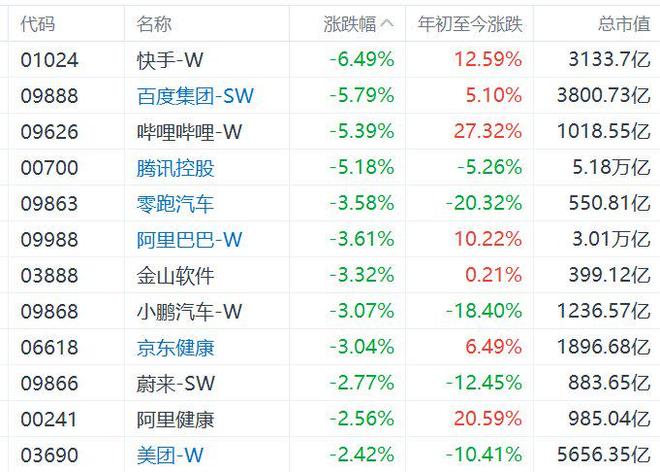
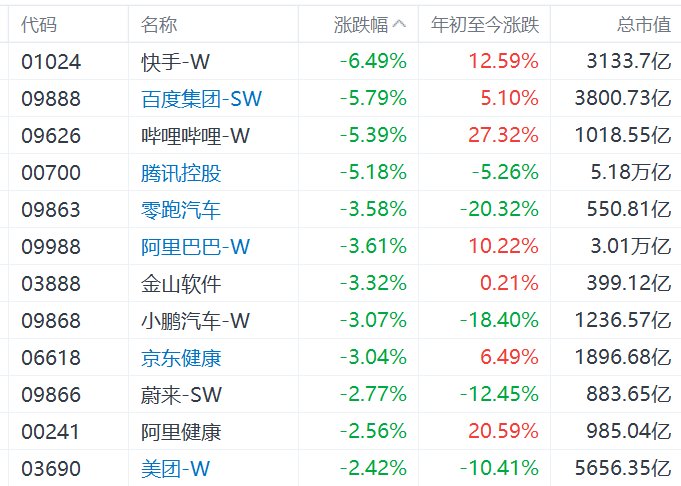
Group 1 - The Hong Kong stock market saw a collective decline among major internet giants, with Kuaishou dropping over 6%, Baidu, Bilibili, and Tencent falling over 5%, Alibaba down over 3%, and Meituan decreasing over 2% [1] Group 2 - Kuaishou's stock decreased by 6.49%, with a year-to-date increase of 12.59%, and a total market capitalization of 313.7 billion [2] - Baidu Group's stock fell by 5.79%, with a year-to-date increase of 5.10%, and a total market capitalization of 3800.73 billion [2] - Bilibili's stock declined by 5.39%, with a year-to-date increase of 27.32%, and a total market capitalization of 1018.55 billion [2] - Tencent Holdings experienced a drop of 5.18%, with a year-to-date decrease of 5.26%, and a total market capitalization of 5.18 trillion [2] - Alibaba's stock fell by 3.61%, with a year-to-date increase of 10.22%, and a total market capitalization of 3.01 trillion [2] - Meituan's stock decreased by 2.42%, with a year-to-date decrease of 10.41%, and a total market capitalization of 5656.35 billion [2]

互联网巨头集体下挫,腾讯跌超5%
Ge Long Hui· 2026-02-03 02:50
Core Viewpoint - The Hong Kong stock market experienced a significant decline among major internet companies, with notable drops in share prices for several key players on February 3rd [1] Group 1: Stock Performance - Kuaishou (快手) saw a decline of 6.49%, with a year-to-date increase of 12.59% and a total market capitalization of 313.7 billion [2] - Baidu Group (百度集团) dropped by 5.79%, with a year-to-date increase of 5.10% and a total market capitalization of 3800.73 billion [2] - Bilibili (哔哩哔哩) fell by 5.39%, with a year-to-date increase of 27.32% and a total market capitalization of 1018.55 billion [2] - Tencent Holdings (腾讯控股) decreased by 5.18%, with a year-to-date decline of 5.26% and a total market capitalization of 5.18 trillion [2] - Alibaba (阿里巴巴) experienced a drop of 3.61%, with a year-to-date increase of 10.22% and a total market capitalization of 3.01 trillion [2] - Meituan (美团) fell by 2.42%, with a year-to-date decline of 10.41% and a total market capitalization of 565.635 billion [2]
百度智能云年度生态成果:核心伙伴收入年增长超100%,千万级伙伴收入规模增长超三倍
Sou Hu Wang· 2026-02-03 02:47
Core Insights - Baidu Intelligent Cloud has made significant progress in its ecosystem construction with a "partner-first" strategy, achieving over 100% year-on-year growth in core partner revenue and a threefold increase in revenue from channel partners [1] - The company aims to provide a comprehensive AI toolkit to partners, facilitating easy integration into their products and solutions, thereby capturing the benefits of intelligent transformation [1] Group 1: Ecosystem Development - The company is building a "big ecosystem" that integrates four types of partner capabilities: product, opportunity, delivery, and channel, to create measurable value [2] - Product partners are converting industry knowledge into standardized solutions, exemplified by a collaboration with Xiamen Zhongshu Technology to create an intelligent procurement platform [2] Group 2: Revenue Growth - Opportunity partners have achieved significant growth, with total amounts from collaborations with Baidu Intelligent Cloud reaching several billion [3] - Channel partners have experienced rapid growth, with revenue from million-level partners increasing by 331% year-on-year, and a notable example is Henan Tengyou Technology, which saw a fourfold increase in overall performance after expanding its role [3] Group 3: Industry Innovation - Baidu Intelligent Cloud is collaborating with partners to define new industry standards through deep capability integration and joint innovation [4] - In the smart transportation sector, a partnership with Hubei Taiyue Satellite has led to a significant reduction in average vehicle delays by 8% in key urban areas, enhancing traffic efficiency [4] - In the smart elderly care sector, a project with Rui Lian Kang Da has established a scalable model for home-based elderly care, improving service response efficiency and user engagement [4] Group 4: Future Directions - The company plans to increase ecosystem investments in 2026, focusing on providing a richer product offering, building more open collaboration policies, and creating more integrated platform capabilities [5] - The overarching goal is to share greater growth dividends with partners by constructing a "value community" to address the opportunities presented by AI industrialization [6]
恒生科技指数跌超1%,明星科网股跌幅居前,百度(09888.HK)、快手(01024.HK)双双跌超4%。
Jin Rong Jie· 2026-02-03 02:32
恒生科技指数跌超1%,明星科网股跌幅居前,百度(09888.HK)、快手(01024.HK)双双跌超4%。 本文源自:金融界AI电报 ...
2026年中国人工智能生成内容(AIGC)产业链、用户规模及竞争现状,行业加速向垂直行业深度渗透[图]
Chan Ye Xin Xi Wang· 2026-02-03 01:35
Core Insights - The AIGC (Artificial Intelligence Generated Content) industry is experiencing explosive growth in China, with revenue expected to rise from approximately 440 million yuan in 2020 to 544.55 billion yuan by 2032, positioning China as a potential global leader in this market [1][10]. Group 1: AIGC Industry Overview - AIGC is defined as a new content production method utilizing AI technology to automatically generate content, categorized as a type of content from the producer's perspective [2]. - The core infrastructure of the AI industry consists of computing power, algorithms, and data, which are essential for the innovation and development of the AIGC sector [2]. Group 2: AIGC Industry Advantages - AIGC significantly reduces costs and increases efficiency by automating repetitive content production tasks, thus shortening the overall content creation cycle and lowering labor and time costs [3][4]. - The technology enables multi-modal creation, allowing for cross-media conversion of different content forms, enhancing creativity and broadening the scope of content presentation [3][4]. - AIGC offers high customization accuracy, deeply analyzing user inputs to generate tailored content that meets diverse user needs [4]. Group 3: AIGC Industry Policies - Since 2023, China has been establishing a multi-layered policy framework for AIGC, progressing from basic regulations to comprehensive empowerment and safety governance [5]. - Policies encourage innovation in AIGC technology across various fields, aiming to create a robust application ecosystem [5]. Group 4: AIGC Industry Chain - The upstream of the AIGC industry includes data collection, cleaning, and labeling, which provide high-quality data support for AI model training [7]. - The downstream involves various applications that utilize AI models to solve specific problems, including the development and operation of applications that automatically generate images, text, and music [7]. Group 5: AIGC Industry Development Status - Since 2023, advancements in large model capabilities and decreasing operational costs have accelerated the development of AIGC, with commercial products like ChatGPT and Midjourney emerging [8][9]. - The global AIGC market is projected to grow from approximately $2.3 billion in 2020 to about $19.5 billion by 2024, with a compound annual growth rate of 70.6% [9]. Group 6: AIGC User Growth - The user base for AIGC in China is expected to reach 515 million by June 2025, driven by the expansion of application scenarios and increased product usability [11][12]. - The demographic profile shows that young and middle-aged groups constitute the majority of users, reflecting the adoption patterns of emerging internet technologies [12]. Group 7: AIGC Competitive Landscape - Major international players in the AIGC space include OpenAI, Microsoft, Google, and Meta, while Chinese companies like Baidu, Alibaba, and Tencent are also significant competitors [13][14]. - The competition is shifting from technical parameter comparisons to the ability to implement and commercialize solutions across various scenarios [14]. Group 8: AIGC Industry Development Trends - AIGC technology is evolving towards systematic upgrades, with multi-modal integration breaking down barriers between different types of data [17]. - The industry is moving towards deeper penetration into vertical sectors, creating tailored solutions that meet specific needs [17].




雷军怒斥说小米二手车崩盘的人:保值率第一,超特斯拉保时捷;元宝红包刷屏被指「双标」,腾讯:非诱导分享;马斯克旗下SpaceX已收购xAI
雷峰网· 2026-02-03 00:36
Key Points - Elon Musk announced that SpaceX has acquired xAI, with a new company valuation of $1.25 trillion, integrating advanced rocket and satellite technology with AI capabilities [4][5] - Lei Jun refuted claims of Xiaomi's second-hand car price collapse, highlighting that the SU7 model has the highest resale value among electric vehicles at 86.05% [7][8] - Tencent's internal communication addressed concerns over its Yuanbao red envelope campaign, asserting it does not induce sharing, despite previous actions against similar marketing strategies [10][11] - Andrew Miles, former president of Sam's Club China, has joined Metro as a consultant, bringing extensive experience from his tenure at Walmart [14][15] - Huawei achieved the top market share in China's smartphone market for January at 18.6%, driven by strong sales of the Mate 80 series [17][19] - Mercedes-Benz has initiated a price reduction of approximately 10% on select models to improve dealer liquidity [25] - Tesla announced the upcoming launch of its third-generation humanoid robot, expected to produce one million units annually by 2026 [45][46] - Samsung and SK Hynix plan to expand their advanced NAND production capacity, targeting a monthly output of 40,000 to 50,000 wafers [48][49]




智通港股沽空统计|2月3日
智通财经网· 2026-02-03 00:23
Group 1 - Anta Sports (82020), Li Ning (82331), and JD Health (86618) have the highest short-selling ratios at 100.00% each [1][2] - BYD Company (01211), Meituan (03690), and Xiaomi Group (01810) lead in short-selling amounts, with 1.896 billion, 1.439 billion, and 0.965 billion respectively [1][2] - Li Ning (82331), Shangmei Group (02145), and Bank of China Hong Kong (82388) have the highest deviation values at 37.55%, 31.60%, and 30.16% respectively [1][2] Group 2 - The top short-selling ratio rankings include Anta Sports (82020) at 100.00%, Li Ning (82331) at 100.00%, and JD Health (86618) at 100.00% [2] - The top short-selling amounts are led by BYD Company (01211) at 1.896 billion, Meituan (03690) at 1.439 billion, and Xiaomi Group (01810) at 0.965 billion [2] - The top deviation values are led by Li Ning (82331) at 37.55%, Shangmei Group (02145) at 31.60%, and Bank of China Hong Kong (82388) at 30.16% [2]
盘前必读丨美股收涨存储板块爆发;白银基金将进行资产重估
Di Yi Cai Jing· 2026-02-03 00:01
Group 1 - The market is expected to enter a medium to long-term consolidation phase after a short-term momentum decline [10] - The Shanghai government has initiated a program to purchase second-hand housing for affordable rental housing projects, targeting new citizens, young people, and graduates [5] - The Ministry of Industry and Information Technology has approved a new national standard for automotive door handles, set to be implemented in 2027, addressing safety and usability issues [5] Group 2 - The National Development and Reform Commission and other departments have released guidelines for the construction of a low-altitude economy standard system, aiming for over 300 standards by 2030 [3] - The Ministry of Finance has introduced a temporary method for long-term asset input tax deduction, allowing full deduction for mixed-use assets upon purchase [4] - The stock of Guokai Military Industry has experienced significant price fluctuations, with a recent announcement clarifying that its commercial aerospace projects are still in the R&D phase and have minimal impact on revenue [7]



腾讯元宝、阿里千问“撒币”打响AI春节大战;支付宝集福2月3日开启| 蓝媒GPT
Sou Hu Cai Jing· 2026-02-02 23:51
Group 1 - Major tech companies are intensifying competition ahead of the 2026 Spring Festival, with Tencent's Yuanbao App launching a 1 billion yuan red envelope campaign, reaching the top of the free app rankings [1] - Qianwen App announced a 3 billion yuan investment for its Spring Festival strategy, integrating with Alibaba's ecosystem, set to launch on February 6 [1] - Alipay's "Collecting Blessings" event will start on February 3, introducing a new "Health Blessing" feature, continuing its tradition since 2016 with over 1 billion participants [3] Group 2 - Major tech giants including Tencent, Baidu, Alibaba, and ByteDance are entering a new phase of competition in the AI ecosystem with significant resources [2] - Guoxuan High-Tech and iFlytek signed a strategic cooperation agreement to leverage their strengths in AI and smart manufacturing [5] - Keli AI launched its new 3.0 series models, marking its entry into the 3.0 era with integrated multimodal capabilities [6] Group 3 - Alibaba revealed its "Cloud + AI + Chip" strategy, with its self-developed AI chip PPU having shipped hundreds of thousands of units, positioning it among the top domestic GPU manufacturers [7] - Nvidia's CEO clarified that the company's potential investment of 100 billion dollars in OpenAI was never a commitment, indicating a cautious approach to future investments [8]

智通ADR统计 | 2月3日
智通财经网· 2026-02-02 22:23
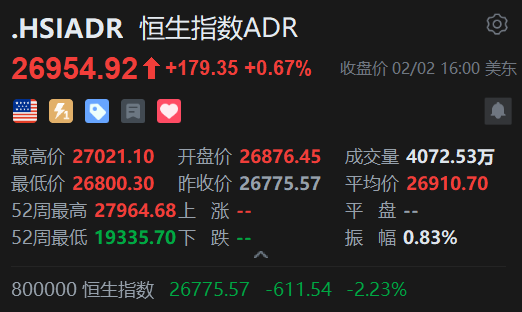
Market Overview - The Hang Seng Index (HSI) closed at 26,954.92, up by 179.35 points or 0.67% as of February 2, 16:00 Eastern Time [1] - The index reached a high of 27,021.10 and a low of 26,800.30 during the trading session, with a trading volume of 40.725 million shares [1] Major Blue-Chip Stocks Performance - HSBC Holdings closed at HKD 139.961, increasing by 3.91% compared to the Hong Kong close [2] - Tencent Holdings closed at HKD 595.694, down by 0.47% compared to the Hong Kong close [2] Stock Price Movements - Tencent Holdings: Latest price HKD 598.500, down by HKD 7.500 or 1.24% [3] - Alibaba Group: Latest price HKD 163.300, down by HKD 5.900 or 3.49% [3] - HSBC Holdings: Latest price HKD 134.700, down by HKD 1.900 or 1.39% [3] - AIA Group: Latest price HKD 89.050, down by HKD 1.300 or 1.44% [3] - Meituan: Latest price HKD 94.850, down by HKD 2.350 or 2.42% [3] - BYD Company: Latest price HKD 91.000, down by HKD 6.750 or 6.91% [3] - Kuaishou Technology: Latest price HKD 77.000, down by HKD 3.150 or 3.93% [3]