TRIP.COM(09961)

Search documents
【美股盘前】凌晨1时15分特朗普将与泽连斯基在白宫会晤,三大期指齐跌;中概股普涨,爱奇艺涨超15%;美联储放松银行加密货币监管,加密货币交易所股齐跌;W...
Mei Ri Jing Ji Xin Wen· 2025-08-18 11:11
Group 1 - Ukrainian President Zelensky arrived in Washington for a meeting with President Trump, scheduled for August 18, 1:15 PM ET, followed by a multilateral meeting with European leaders to discuss the Russia-Ukraine conflict [1] - Major U.S. stock index futures showed a decline, with Dow futures down 0.15%, S&P 500 futures down 0.16%, and Nasdaq futures down 0.16% [2] - U.S. semiconductor stocks experienced a collective drop, with Intel down 1.18%, AMD down 0.77%, and Nvidia down 0.38% [3] Group 2 - The Federal Reserve announced the cessation of its "new activity regulatory program" aimed at enhancing cryptocurrency business oversight in banks, leading to declines in cryptocurrency exchange stocks, with Coinbase down 1.67% and Circle down 1.07% [5] - Novo Nordisk's weight loss drug Wegovy received FDA approval for treating metabolic fatty liver disease, resulting in a 4.02% increase in the company's stock [6] - OpenAI employees plan to sell approximately $6 billion worth of stock at a valuation of $500 billion to a group of investors including Thrive Capital and SoftBank [7] Group 3 - Tesla is offering rental discounts of about 40% in the UK due to a significant drop in sales, with July sales falling to 987 units, a year-on-year decrease of approximately 60% [8] - NIO announced plans to enter the markets of Singapore, Uzbekistan, and Costa Rica between 2025 and 2026, with a collaboration in Singapore to launch its first right-hand drive model [9]






航旅纵横,成不了12306
虎嗅APP· 2025-08-18 09:47
Core Viewpoint - The article discusses the launch of the "official direct sales platform" by Hanglv Zongheng, which integrates resources from 38 airlines to sell tickets directly, aiming for transparency and eliminating hidden fees, but faces skepticism regarding its pricing strategy and potential competition with existing OTA platforms [5][6][16]. Group 1: Launch and Support - Hanglv Zongheng announced the integration of 38 airlines to create a direct sales platform for tickets, promising "0 markup, 0 bundling, 0 tricks" [6]. - Major airlines like Air China, China Southern Airlines, and China Eastern Airlines have expressed support for this initiative, positioning it as a significant direct sales channel [16][17]. - The platform is compared to "the civil aviation version of 12306," indicating its official backing and potential to reshape the ticketing landscape [6][8]. Group 2: Pricing and Market Position - Despite the promise of "source tickets," prices on Hanglv Zongheng are often higher than those on OTA platforms like Ctrip, with differences ranging from 50 to 100 yuan for certain routes [8][10]. - The pricing structure in the airline industry is complex, with airlines setting base fares influenced by various factors, and the final price often includes additional fees from OTAs or agents [10][12]. - Hanglv Zongheng's "source tickets" are not necessarily cheaper, as the platform aims to build trust through transparency rather than competing solely on price [12][14]. Group 3: Industry Dynamics - The relationship between airlines and OTAs has been historically contentious, with airlines seeking to reduce dependency on OTAs and increase direct sales [19][22]. - The introduction of Hanglv Zongheng is seen as a strategic move to balance the power dynamics between airlines and OTAs, allowing airlines to gain more control over pricing and distribution [22][23]. - The push for direct sales is further supported by regulatory changes aimed at increasing the proportion of direct sales by airlines [20][21]. Group 4: Challenges and Future Outlook - Hanglv Zongheng faces significant challenges in competing with established OTAs, particularly in user experience, customer service, and comprehensive travel solutions [26][27]. - The platform's ability to attract price-sensitive customers may be limited, as many users prioritize price over transparency, making it difficult to disrupt the existing OTA market [29][30]. - While Hanglv Zongheng may capture a niche market of users seeking transparency, it is unlikely to significantly alter the competitive landscape in the short term [30].

智通港股沽空统计|8月18日
智通财经网· 2025-08-18 00:27
Core Insights - The article highlights the top short-selling stocks in the market, focusing on their short-selling ratios, amounts, and deviation values [1][2][3] Short-Selling Ratios - The top three stocks by short-selling ratio are: - China Resources Beer-R (80291) at 100.00% - Bank of China Hong Kong-R (82388) at 88.69% - Kuaishou-WR (81024) at 80.08% [1][2] Short-Selling Amounts - The leading stocks by short-selling amount are: - Alibaba-SW (09988) with a short-selling amount of 2.949 billion - Tencent Holdings (00700) with 2.711 billion - Meituan-W (03690) with 2.333 billion [1][3] Deviation Values - The stocks with the highest deviation values are: - China Resources Beer-R (80291) at 51.62% - Kuaishou-WR (81024) at 43.86% - Bank of China Hong Kong-R (82388) at 39.84% [1][2][3]




携程发布“智旅未来”计划 助酒店降低流量焦虑
Mei Ri Shang Bao· 2025-08-17 22:18
Core Insights - The Chinese hotel industry is experiencing intensified competition with a projected total of 348,700 establishments and 17.64 million rooms by the end of 2024, surpassing the peak levels of 2018-2019 [1] - Ctrip's "Smart Travel Future" hotel empowerment plan aims to address challenges in language, technology, and traffic, focusing on enhancing service quality to achieve sustainable growth [1] Group 1: Industry Overview - The hotel industry in China is facing increasing competition due to a growing number of establishments and rooms, indicating a saturated market [1] - User decision-making is becoming more rational and diverse, posing challenges for hotels to maintain sustainable growth [1] Group 2: Ctrip's Strategy - Ctrip plans to optimize its review ecosystem to alleviate hotels' traffic concerns, enhancing trust through improved review descriptions and selection mechanisms [1] - The company aims to shift the industry focus from "traffic competition" to "service excellence" by encouraging hotels to prioritize service quality [1] Group 3: User Experience Enhancements - Ctrip is implementing features like intelligent room upgrade recommendations and a "stay first, pay later" payment option to boost user confidence and conversion rates [2] - Personalized recommendations and streamlined filtering options are being introduced to help users quickly find suitable hotels, significantly improving conversion rates for family-oriented packages [2] Group 4: Future Directions - Ctrip intends to continue developing the "Smart Travel Future" plan, collaborating with hotels to overcome challenges in language and technology, aiming for high-quality and sustainable growth [2]
智通ADR统计 | 8月16日
智通财经网· 2025-08-15 23:53
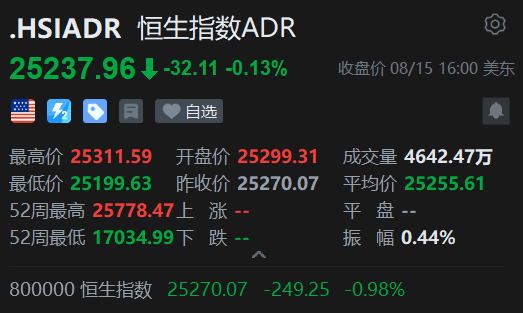
Market Overview - The Hang Seng Index (HSI) closed at 25,237.96, down by 32.11 points or 0.13% on August 15 [1] - The index reached a high of 25,311.59 and a low of 25,199.63 during the trading session [1] Major Blue-Chip Stocks Performance - HSBC Holdings closed at HKD 99.966, down 0.33% from the previous close [2] - Tencent Holdings closed at HKD 591.706, down 0.05% from the previous close [2] Stock Price Movements - Tencent Holdings (00700) increased by HKD 2.00, or 0.34%, to HKD 592.00 [3] - Alibaba Group (09988) decreased by HKD 3.70, or 3.04%, to HKD 118.10 [3] - China Construction Bank (00939) fell by HKD 0.18, or 2.26%, to HKD 7.80 [3] - HSBC Holdings (00005) decreased by HKD 0.10, or 0.10%, to HKD 100.30 [3] - Xiaomi Group (01810) dropped by HKD 0.35, or 0.66%, to HKD 52.85 [3] - AIA Group (01299) fell by HKD 1.95, or 2.54%, to HKD 74.95 [3] - Meituan (03690) decreased by HKD 2.70, or 2.17%, to HKD 121.70 [3] - NetEase (099999) dropped by HKD 7.60, or 3.66%, to HKD 200.20 [3] - Hong Kong Exchanges and Clearing (00388) increased by HKD 0.20, or 0.05%, to HKD 439.40 [3] - Industrial and Commercial Bank of China (01398) fell by HKD 0.19, or 3.09%, to HKD 5.96 [3] - Ping An Insurance (02318) decreased by HKD 0.30, or 0.52%, to HKD 57.60 [3] - BYD Company (01211) dropped by HKD 1.00, or 0.88%, to HKD 112.80 [3] - Bank of China (03988) fell by HKD 0.09, or 1.98%, to HKD 4.45 [3] - Kuaishou Technology (01024) decreased by HKD 0.40, or 0.53%, to HKD 74.80 [3] - Ctrip (09961) increased by HKD 1.80, or 0.37%, to HKD 489.00 [3] - Tencent Music (01698) decreased by HKD 0.90, or 0.89%, to HKD 99.90 [3] - BeiGene (06160) increased by HKD 6.50, or 3.51%, to HKD 191.50 [3]



“围剿”携程
3 6 Ke· 2025-08-15 11:47
Core Viewpoint - The travel and accommodation market is experiencing intense competition, with major players like Ctrip facing challenges from both established competitors and new entrants, leading to a potential shift in market dynamics [21][29]. Group 1: Ctrip's Historical Performance - Ctrip has maintained a leading position in the OTA market for a long time, with revenue increasing from 334 million yuan in its early years to 33.205 billion yuan in 2019, and net profit reaching 6.998 billion yuan [2]. - After a significant decline in revenue during 2020-2021 due to external factors, Ctrip began to recover in 2022 as the domestic tourism market rebounded [4]. Group 2: Market Dynamics and Competition - The domestic tourism market is projected to see 5.62 billion trips in 2024, a year-on-year increase of 14.8%, with total spending expected to reach approximately 5.8 trillion yuan, up 17.1% [5]. - The competitive landscape is intensifying, with traditional OTAs, internet giants, and self-operated businesses vying for market share, leading to a "price war" scenario [7][19]. - New entrants like Meituan, JD, and Douyin are making significant moves into the travel market, leveraging their existing platforms and user bases to capture market share [15][17][19]. Group 3: Shifts in Consumer Behavior - There is a noticeable shift in consumer preferences towards personalized and experiential travel, moving away from standardized group tours to more unique and culturally immersive experiences [22][23]. - The rise of local tourism and the increasing interest in smaller cities and unique destinations are creating new opportunities and challenges for traditional OTAs [22][24]. Group 4: Ctrip's Strategic Responses - Ctrip is exploring overseas markets for growth while facing competition from international players like Booking and Expedia [28]. - The company is also attempting to enhance its content ecosystem by integrating community features and user-generated content to increase user engagement [28].
携程集团-S:将于2025年8月28日(香港时间)交易时间前公布截至2025年6月30日止三个月及六个月的财务业绩
Jin Rong Jie· 2025-08-15 10:49
Group 1 - The board audit committee meeting of Trip.com Group will be held on August 27, 2025 [1] - The meeting will review the financial performance for the three and six months ending June 30, 2025 [1] - The financial results will be announced before trading hours on August 28, 2025 (Hong Kong time) [1]
携程集团-S(09961.HK):将于8月28日公布第二季度及上半年业绩
Ge Long Hui· 2025-08-15 10:14
格隆汇8月15日丨携程集团-S(09961.HK)宣布,公司的董事会审计委员会将于2025年8月27日(星期三)(香 港时间)举行会议,藉以(其中包括)批准本公司的截至2025年6月30日止三个月及六个月的财务业绩("业 绩")及其刊发。公司将于2025年8月28日(星期四)(香港时间)在香港联交所交易时间之前公布业绩。 ...
携程集团(09961) - 审计委员会会议日期及2025 年第二季度及上半年业绩公告日期
2025-08-15 10:01
Trip.com Group Limited 攜程集團有限公司 (於開曼群島註冊成立的有限公司) (股份代號:9961) 審計委員會會議日期及 2025 年第二季度及上半年業績公告日期 攜程集團有限公司(「本公司」)之董事會審計委員會將於2025年8月27日(星期三)(香港時 間)舉行會議,藉以(其中包括)批准本公司之截至2025年6月30日止三個月及六個月的財 務業績(「業績」)及其刊發。 香港交易及結算所有限公司及香港聯合交易所有限公司(「香港聯交所」)對本公告的內容概不負責,對其準確性或 完整性亦不發表任何聲明,並明確表示概不會就本公告全部或任何部分內容而產生或因倚賴該等內容而引致的任 何損失承擔任何責任。 電話會議的網上直播及重播將於網站http://investors.trip.com登載。有關電話將會被錄音, 於該網站保存十二個月。 所有參與者必須辦理預先登記方能通過使用參與者登記鏈接https://register-conf.media- server.com/register/BI721587a0c39340f2abf725eb0ffb89eb參與是次電話會議。 在辦理登記後,各參與者將收取是 ...
Trip.com Group Limited to Report Second Quarter and First Half of 2025 Financial Results on August 27, 2025 U.S. Time
Prnewswire· 2025-08-15 10:00
Core Viewpoint - Trip.com Group Limited is set to announce its financial results for the three and six months ending June 30, 2025, on August 27, 2025, after market close [1] Group 1: Financial Results Announcement - The financial results will be disclosed after market hours on August 27, 2025, U.S. Time [1] - The management team will host a conference call at 8:00 PM U.S. Eastern Time on the same day [2] - The conference call will be available via live webcast and will be archived for twelve months [2] Group 2: Conference Call Registration - Participants must pre-register to join the conference call using a provided registration link [3] - Upon registration, participants will receive details including dial-in numbers and a unique access PIN [3] Group 3: Company Overview - Trip.com Group Limited is a leading global one-stop travel platform, offering a comprehensive suite of travel products and services [4] - The company operates under various brands, including Ctrip, Qunar, Trip.com, and Skyscanner, and aims to provide cost-effective travel solutions [4] - Founded in 1999, the company was listed on Nasdaq in 2003 and on HKEX in 2021, with a mission to pursue the perfect trip for a better world [4]