
WL DELICIOUS(09985)

Search documents
零食板块2025中报总结:行业成长分化,个股亮点显著
GOLDEN SUN SECURITIES· 2025-09-01 11:52
Investment Rating - The industry investment rating is maintained as "Add" [5] Core Viewpoints - The snack sector is experiencing differentiated growth, with individual companies showing significant highlights. In H1 2025, the overall revenue of the snack sector was 25.51 billion yuan, a year-on-year decrease of 2.2%. The sector's net profit attributable to shareholders was 1.09 billion yuan, down 40.3% year-on-year, primarily due to cost pressures and the weakening of channel dividends [1][10][12] - In Q2 2025, the snack sector's revenue reached 11.09 billion yuan, a year-on-year increase of 2.2%. However, the net profit attributable to shareholders dropped to 250 million yuan, a decrease of 55.1% year-on-year, indicating increased profit pressure due to cost and expense pressures [2][12] - The report highlights three types of companies that are expected to perform well: those that create core blockbuster products, those that rapidly expand channels, and those that continuously innovate [2][20][22] Summary by Sections Industry Overview - In H1 2025, the snack sector's overall revenue was 25.51 billion yuan, down 2.2% year-on-year. The decline is attributed to the timing of the Spring Festival affecting inventory preparation and a return to normal operating rhythms in Q2 [10][12] - The average gross margin for the snack sector in H1 2025 was 28.3%, a decrease of 2.1 percentage points year-on-year, primarily due to rising costs and changes in channel structure [11][18] Q2 Performance - The snack sector's revenue in Q2 2025 was 11.09 billion yuan, up 2.2% year-on-year, indicating a return to positive growth despite seasonal challenges. However, net profit fell to 250 million yuan, down 55.1% year-on-year, reflecting significant profit pressure [2][12] - The average gross margin in Q2 2025 was 28.4%, down 1.7 percentage points year-on-year, influenced by rising costs and changes in channel structure [13][18] Growth Catalysts - The report emphasizes the importance of product innovation and channel expansion as key growth drivers. Companies that can create blockbuster products and effectively expand their channels are expected to outperform [20][21] - The report identifies specific companies with strong growth potential, including Wei Long, Yan Jin Pu Zi, and You You Food, which are leveraging product demand and channel expansion to drive growth [22] Investment Recommendations - The report suggests focusing on companies that can successfully execute growth strategies along two main lines: product innovation and channel expansion. Key companies highlighted include Wei Long, Yan Jin Pu Zi, You You Food, and Wan Chen Group, which are expected to benefit from favorable market conditions [22]



卫龙美味(09985) - 董事名单与其角色及职能
2025-08-31 23:00
(於 開 曼 群 島 註 冊 成 立 的 有 限 公 司) (股 份 代 號:9985) 董事名單與其角色及職能 衛 龍 美味全球控股有限公司董事(「董 事」)會(「董事會」)成 員 載 列 如 下: 香港交易及結算所有限公司及香港聯合交易所有限公司對本公告的內容概不 負 責,對 其 準 確 性 或 完 整 性 亦 不 發 表 任 何 聲 明,並 明 確 表 示 概 不 就 因 本 公 告 全 部或任何部分內容而產生或因依賴該等內容而引致的任何損失承擔任何責任。 衛龍美味全球控股有限公司 WEILONG Delicious Global Holdings Ltd – 1 – 董 事 會 下 設 三 個 委 員 會。下 表 提 供 各 董 事 會 成 員 在 該 等 委 員 會 中 所 擔 任 的 職 位 信 息。 | 董 事 | | 董事會委員會 | | | --- | --- | --- | --- | | | 審核委員會 | 提名委員會 | 薪酬委員會 | | 劉衛平 | | 主席 | | | 劉福平 | | | | | 劉忠思 | | | | | 余風 | | | 成員 | | 徐黎黎 | 成員 | 成 ...
盐津铺子、卫龙美味靠魔芋制品狂飙背后:原料价持续走高,企业面临毛利率下滑风险
Bei Jing Shang Bao· 2025-08-25 14:16
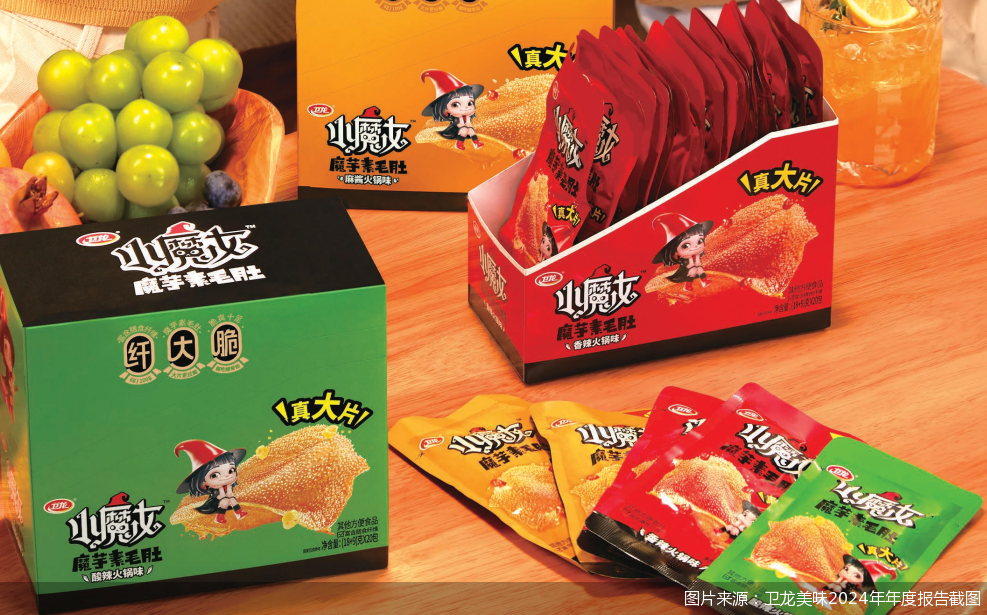
Core Insights - The konjac snack products, known as "konjac strips" and "vegetarian tripe," are becoming a phenomenon in the snack food sector, significantly driving revenue growth for companies like Salted Fish and Wei Long [1][3] - The konjac snack market is expected to maintain high growth rates from 2025 to 2027, with over 30 brands entering the market to capture this segment [1][7] Company Performance - In 2024, konjac strips contributed to Wei Long's vegetable product revenue growth of 59.1%, reaching 3.37 billion yuan, accounting for 53.8% of total revenue [3] - Salted Fish's konjac snack revenue reached 838 million yuan in 2024, a year-on-year increase of 76.09%, making it a key driver of the company's growth [3] - In the first half of 2025, Wei Long's vegetable product revenue grew by 44.3% to 2.109 billion yuan, while Salted Fish's konjac snack revenue surged by 155.1% to 791 million yuan [3][4] Market Trends - The konjac industry is projected to exceed 30 billion yuan by 2025, with an annual compound growth rate (CAGR) of 11.8% expected until 2030 [7] - The increasing focus on health-conscious eating is driving consumer demand for low-calorie, high-fiber konjac products, leading to a shift in Wei Long's product strategy away from traditional spicy snacks [5][6] Cost Pressures - The explosive growth in downstream demand for konjac products is putting pressure on upstream raw material supply, leading to rising prices for konjac powder [8][9] - The average purchase price of konjac has doubled from 2 yuan per jin to 4 yuan per jin due to supply constraints and increased export demand [8] - Both Salted Fish and Wei Long reported declines in gross margins due to rising raw material costs, with Salted Fish's gross margin dropping from 32.53% to 29.66% and Wei Long's from 49.8% to 47.2% [9][10] Strategic Initiatives - Salted Fish plans to deepen its core product strategy for its "Big Demon King" konjac tripe and enhance sales through diversified marketing and brand collaborations [4] - Wei Long is focusing on expanding its konjac product line and has increased its production capacity for vegetable products by 59.43% [4][6]

魔芋零食收入激增155%,盐津铺子半年报亮眼
Mei Ri Jing Ji Xin Wen· 2025-08-21 08:02
Core Insights - The konjac snack segment has seen significant revenue growth, with companies reporting substantial increases in sales figures for these products [1][2]. Company Performance - Salted Fish (002847.SZ) reported that its konjac snack products generated revenue of 791 million RMB, accounting for 26.90% of total revenue, marking a year-on-year growth of 155.10% [1][4]. - Wei Long's parent company, Wei Long Mei Wei (09985.HK), reported a revenue of 2.11 billion RMB for its vegetable products segment, which includes konjac snacks, reflecting a year-on-year increase of 44.3% and representing 60.5% of total revenue [2][6]. Market Trends - The demand for konjac snacks is driven by their low-calorie and high dietary fiber attributes, leading to increased consumer interest [2]. - Despite the growth in konjac snack sales, the prices of raw materials, particularly konjac powder, have risen by over 30% year-on-year [2]. - The konjac snack market is expected to surpass traditional spicy strips in market size due to its diverse flavors and forms, appealing to a broader consumer base [2].
卫龙美味涨超5% 上半年盈利表现亮眼 机构称其中长期增长动能充沛
Zhi Tong Cai Jing· 2025-08-21 07:11
Core Viewpoint - Weitlong Delicious (09985) reported a significant increase in stock price, rising over 5% to HKD 13.68, with a trading volume of HKD 119 million, following the release of its semi-annual report [1] Financial Performance - The company achieved total revenue of approximately CNY 3.483 billion in the first half of the year, representing a year-on-year increase of 18.5% [1] - The profit attributable to the company's owners was approximately CNY 733 million, reflecting a year-on-year growth of 18% [1] Revenue Growth Drivers - Revenue growth was primarily driven by the company's ongoing enhancement of omnichannel development and brand building, as well as optimization of channel structure [1] - Vegetable products showed strong growth, with revenue increasing by 44.3% year-on-year to CNY 2.109 billion, accounting for 60.5% of total revenue, up from 49.7% in the previous year [1] Market Outlook - Zheshang Securities believes that the company has strong medium to long-term growth momentum due to its brand barriers and continuous innovation in product incubation [1] - Dongwu Securities noted that new products, such as stinky tofu, are set to be launched in the second half of the year, and the third quarter is expected to be a peak season, which could lead to revenue growth [1] - The company has significant overseas potential, with konjac as a major product expected to enhance its international influence [1]
港股异动 | 卫龙美味(09985)涨超5% 上半年盈利表现亮眼 机构称其中长期增长动能充沛
智通财经网· 2025-08-21 07:08
Core Viewpoint - Weitlong Delicious (09985) has seen a stock price increase of over 5%, currently at 13.68 HKD, with a trading volume of 119 million HKD, following the release of its semi-annual report showing significant revenue growth [1] Financial Performance - The company reported total revenue of approximately 3.483 billion CNY for the first half of the year, representing a year-on-year increase of 18.5% [1] - The profit attributable to the owners of the company was about 733 million CNY, reflecting a year-on-year growth of 18% [1] Revenue Growth Drivers - Revenue growth was primarily driven by the company's ongoing enhancement of omnichannel development and brand building, as well as optimization of channel structure [1] - Vegetable products demonstrated strong growth, with revenue increasing by 44.3% year-on-year to 2.109 billion CNY, accounting for 60.5% of total revenue, up from 49.7% in the previous year [1] Market Outlook - Zheshang Securities believes that the company has strong medium to long-term growth momentum due to its brand barriers and continuous innovation in product incubation [1] - Dongwu Securities indicates that new products, such as stinky tofu, will begin to be launched in the second half of the year, with Q3 entering a peak season, suggesting potential revenue growth from new product launches [1] - The company has significant overseas potential, with konjac as a major product expected to enhance its influence in international markets [1]
卫龙美味(09985.HK):魔芋延续高景气 公司内部降本增效显著
Ge Long Hui· 2025-08-20 18:55
Core Viewpoint - The company reported a strong performance in H1 2025, with revenue and net profit showing significant year-on-year growth, driven by the popularity of konjac products and a robust offline channel strategy [1][2]. Financial Performance - In H1 2025, the company achieved revenue of 3.483 billion yuan, an increase of 18.5% year-on-year, and a net profit of 733 million yuan, up 18% year-on-year [1]. - The proposed interim dividend is 0.18 yuan per share, totaling 438 million yuan, which represents approximately 60% of net profit [1]. Product Segment Performance - Revenue from konjac products continued to thrive, while the seasoning noodle products experienced a slight decline. Revenue for seasoning noodles, vegetable products, and bean products was 1.31 billion, 2.109 billion, and 64 million yuan, respectively, with year-on-year changes of -3.24%, +44.31%, and -48.06% [1]. - The decline in seasoning noodle revenue was attributed to the company's strategic resource reallocation and product matrix optimization, expanding flavors from sweet and spicy to include mala, crayfish, and barbecue [1]. Channel Performance - Revenue from domestic and overseas markets reached 3.429 billion and 53 million yuan, respectively, with year-on-year growth of 18.09% and 54.43% [2]. - Online and offline revenues were 336 million and 3.147 billion yuan, with year-on-year changes of -3.81% and +21.53%, representing 9.6% and 90.4% of total revenue [2]. - The decline in online revenue was primarily due to a 21.1% drop in online distribution revenue to 108 million yuan, while direct online sales grew by 7.3% to 228 million yuan [2]. Cost and Efficiency - The company's gross margin for H1 2025 was 47.2%, a decrease of 2.6 percentage points year-on-year, influenced by rising raw material costs and a "more quantity without increasing price" strategy [2]. - Management and sales expense ratios were 5.8% and 15.1%, down 2.4 percentage points and 1.1 percentage points year-on-year, respectively, indicating improved efficiency [3]. - The utilization rates for spicy strips and konjac production lines were 80.8% and 77.5%, with year-on-year changes of +24.3 percentage points and -7.4 percentage points, respectively [3]. Future Outlook - The company is expected to continue benefiting from internal cost reduction and efficiency improvement initiatives, which are anticipated to release long-term value despite short-term cost fluctuations [3]. - Revenue projections for 2025 to 2027 are set at 7.473 billion, 8.751 billion, and 10.110 billion yuan, with net profits of 1.430 billion, 1.737 billion, and 2.035 billion yuan, respectively [3].
卫龙美味2025中期业绩稳增长第二曲线收入同比增长44.3%
Qi Lu Wan Bao· 2025-08-20 11:04
Core Insights - The company reported a total revenue of 3.483 billion RMB for the first half of 2025, reflecting an 18.5% year-on-year growth, with net profit also increasing by 18.5% to approximately 736 million RMB, showcasing strong operational efficiency and growth potential [1][4][12] Revenue and Profit Growth - The company achieved a total revenue of 3.483 billion RMB, with a net profit of approximately 736 million RMB, both showing double-digit growth compared to the previous year [1] - The core categories of the company demonstrated a structural growth pattern, contributing significantly to the overall revenue increase [3][4] Product Innovation and Market Expansion - The company launched several new products in the first half of 2025, including various flavors of snacks, which contributed to an accelerated market share expansion [3][4] - The vegetable product line, particularly the konjac snacks, generated over 2.1 billion RMB in revenue, marking a 44.3% increase year-on-year, and now accounts for 60.5% of total revenue [4][12] Channel Strategy and Marketing - The company has strengthened its omnichannel strategy, achieving over 3.4 billion RMB in revenue from both online and offline channels, with offline sales growing by 21.5% year-on-year [7][9] - The company has engaged in co-branding marketing strategies, collaborating with various brands to enhance its market presence and brand image [9][10] Production Efficiency and Sustainability - The introduction of the seventh-generation konjac production line has significantly improved production efficiency, doubling capacity while reducing the footprint by half [10][12] - The company has implemented smart technologies for energy monitoring and water-saving processes, aligning with green and low-carbon production goals [12] Future Outlook - The spicy snack market is projected to reach 132.38 billion RMB by 2029, indicating a robust growth trajectory for the industry [12] - The company aims to continue its multi-category strategy and deepen its structural transformation to maintain resilience in a competitive market [12]
卫龙2025半年报亮眼:蔬菜制品营收大增44.3%,千亿辣味零食赛道新格局浮现
Mei Ri Jing Ji Xin Wen· 2025-08-20 03:20
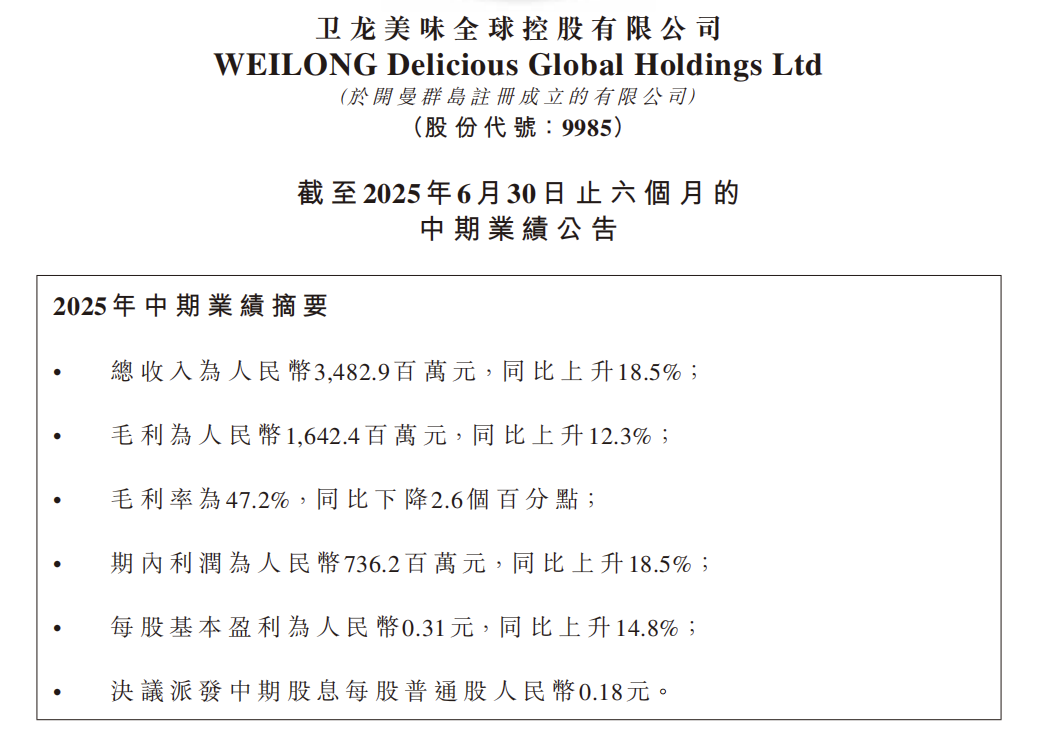
Core Viewpoint - Wei Long's performance report for the first half of 2025 shows a total revenue of 3.483 billion yuan, a year-on-year increase of 18.5%, and a net profit of 736 million yuan, also up 18.5%, indicating a steady growth trend. The company's revenue structure has shifted from a reliance on spicy strips to a diversified product range, with vegetable products now accounting for 60.5% of total revenue, highlighting significant changes in consumer preferences and market dynamics [1][3][4]. Part 1: Financial Performance - In the first half of 2025, Wei Long achieved a total revenue of 3.483 billion yuan, up from 2.939 billion yuan in the same period last year, marking an 18.5% growth. Net profit also increased by 18.5% to 736 million yuan, with basic earnings per share at 0.31 yuan, reflecting effective management of profitability during expansion [3][4]. - The gross profit for the first half reached 1.642 billion yuan, a 12.3% increase year-on-year, with a stable net profit margin of 21.1%, despite rising raw material costs [3][4]. - The board has declared an interim dividend of 0.18 yuan per share, maintaining a payout ratio of nearly 60%, consistent with its stable return strategy since listing [3]. Part 2: Product Structure Transformation - Wei Long's core product category, flavored noodle products, generated 1.31 billion yuan in revenue, accounting for 37.6% of total revenue. In contrast, vegetable products, primarily including konjac and seaweed, saw revenue soar by 44.3% to 2.109 billion yuan, now representing 60.5% of total revenue [4]. - The shift in product structure is attributed to Wei Long's precise response to changing consumer demands, focusing on health, personalization, and diverse consumption scenarios [4][6]. Part 3: Market Trends and Consumer Insights - The Chinese spicy snack food market is entering a golden growth period, with a projected compound annual growth rate of 9.6%, expected to reach a market size of 273.7 billion yuan by 2026 [11]. - The primary consumer demographic for spicy snacks is the post-90s and post-00s generations, with a notable preference for mild and fusion flavors [11][13]. - The demand characteristics include diversified consumption scenarios, quality upgrades, and emotional value addition, with Wei Long's strategies aligning well with these trends [14].
卫龙美味(09985):2025半年报点评:魔芋延续高景气,公司内部降本增效显著
Guohai Securities· 2025-08-19 06:01
Investment Rating - The investment rating for the company is "Buy" (maintained) [1][12] Core Insights - The company continues to experience high demand for konjac products, while the revenue from flavored noodle products has slightly declined. In H1 2025, the company achieved a revenue of 3.483 billion yuan, representing a year-on-year increase of 18.5%, and a net profit attributable to shareholders of 733 million yuan, also up by 18% [7][8][11] Summary by Sections Recent Performance - In H1 2025, the revenue breakdown was as follows: flavored noodle products at 1.31 billion yuan (down 3.24%), vegetable products at 2.109 billion yuan (up 44.31%), and other products at 64 million yuan (down 48.06%) [8] - The company’s revenue from China and overseas markets was 3.429 billion yuan (up 18.09%) and 53 million yuan (up 54.43%), respectively [8] Financial Metrics - The company proposed an interim dividend of 0.18 yuan per share, totaling 438 million yuan, which accounts for approximately 60% of the net profit [7] - The gross profit margin for H1 2025 was 47.2%, a decrease of 2.6 percentage points year-on-year, primarily due to rising raw material costs [9] Cost Management and Efficiency - The company has effectively reduced management and sales expense ratios, with management expenses at 5.8% and sales expenses at 15.1%, down 2.4 and 1.1 percentage points year-on-year, respectively [9] - The utilization rates for production lines were 80.8% for spicy strips and 77.5% for konjac products, with overall capacity utilization increasing from 66.5% in H1 2024 to 79.0% in H1 2025 [9] Future Projections - The company’s revenue forecasts for 2025 to 2027 are 7.473 billion yuan, 8.751 billion yuan, and 10.110 billion yuan, respectively, with net profits projected at 1.430 billion yuan, 1.737 billion yuan, and 2.035 billion yuan [10][11] - The expected EPS for the same period is 0.59 yuan, 0.71 yuan, and 0.84 yuan, with corresponding P/E ratios of 20, 17, and 14 times [10][11]