SMIC(688981)

Search documents
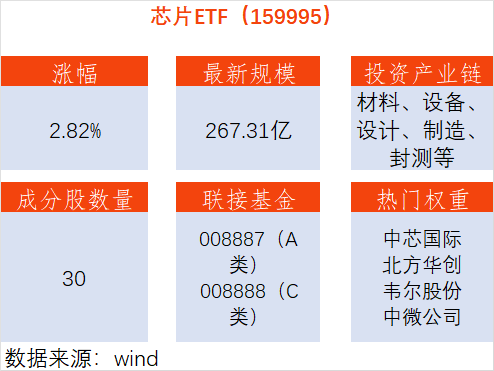
存储全面涨价成共识,芯片ETF(159995.SZ)上涨2.82%,海光信息领涨6.26%
Xin Lang Cai Jing· 2025-11-27 02:17
Group 1 - A-shares indices collectively rose on November 27, with the Shanghai Composite Index increasing by 0.47%, led by gains in electronics, communications, and power equipment sectors, while transportation and banking sectors saw declines [1] - The chip technology sector experienced a strong surge, with the chip ETF (159995.SZ) rising by 2.82% and notable increases in component stocks such as Haiguang Information (up 6.26%), Zhaoyi Innovation (up 4.83%), and Cambrian (up 4.05%) [1] Group 2 - According to TrendForce, enterprise-level storage demand is currently strong, with higher specifications and capacities compared to portable terminal products, and mainstream storage product prices have begun to rise since Q2 2025, showing a quarter-on-quarter increase [3] - Ping An Securities indicates that the consensus in the industry is that storage prices are rising, driven by sustained high demand for high-end storage due to AI, and domestic storage manufacturers are expected to improve their operational performance [3] - The chip ETF (159995) tracks the Guozheng Chip Index, which includes 30 leading companies in the A-share chip industry across materials, equipment, design, manufacturing, packaging, and testing, including SMIC, Cambrian, Changdian Technology, and Northern Huachuang [3]




港股半导体板块震荡走高,华虹半导体涨近5%
Mei Ri Jing Ji Xin Wen· 2025-11-27 02:12
Core Viewpoint - The semiconductor sector in Hong Kong experienced a notable upward trend on November 27, with significant gains in several key companies. Group 1: Market Performance - The Hong Kong semiconductor sector saw a rise, with Hua Hong Semiconductor increasing by nearly 5% [1] - SMIC (Semiconductor Manufacturing International Corporation) rose by over 3% [1] - Other companies such as Innoscience and Shanghai Fudan also reported gains exceeding 2% [1]

超400亿资金加仓港股科技类ETF
2 1 Shi Ji Jing Ji Bao Dao· 2025-11-27 02:07
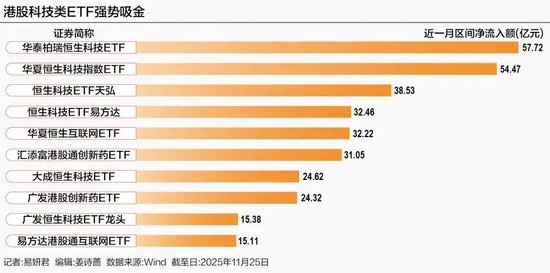
Core Viewpoint - The Hong Kong technology sector has experienced a correction after reaching a yearly high in early October, with major indices showing declines of over 7% in the past month. Despite this, ETF funds have been increasing their positions in the sector, indicating investor confidence in the long-term value of technology companies [1][4][5]. Group 1: Market Performance - The Hong Kong technology sector indices, including the CSI Hong Kong Stock Connect Technology Index and the Hang Seng Technology Index, have seen declines of 7.20%, 7.39%, and 8.58% respectively [4]. - Major technology stocks such as Alibaba and SMIC have experienced significant price drops of 6.24% and 15.06% respectively in the past month [3]. - Despite the downturn, there has been a net inflow of 439 billion yuan into technology-related ETFs in the past month, with 13 Hang Seng Technology ETFs attracting over 240 billion yuan [1][6]. Group 2: Investor Sentiment - Investors are optimistic about the long-term growth potential of technology companies in Hong Kong, viewing the current market adjustment as temporary [7]. - The current price-to-earnings ratio (P/E) of the Hang Seng Technology Index is 22.5, which is at the 27th percentile over the past decade, indicating a favorable valuation level [7]. - The influx of funds into technology ETFs suggests that investors recognize the current valuation levels of Hong Kong technology stocks [7]. Group 3: AI and Market Dynamics - Concerns regarding an "AI bubble" have emerged, but some analysts believe that AI technology still holds significant potential, and short-term market fluctuations do not diminish the investment value of the underlying industries [12]. - The ongoing AI revolution is seen as a long-term trend rather than a bubble, with the potential for substantial productivity improvements and market applications [11][12]. - Companies that can effectively integrate leading AI models with diverse business scenarios are expected to benefit the most from the ongoing changes in the industry [12]. Group 4: Future Outlook - Analysts suggest that if short-term pressures on the Hong Kong market are alleviated, the influx of capital and the presence of high-quality assets could support a continued bullish trend [8]. - The technology sector is expected to remain a key focus, particularly as AI continues to drive market dynamics and create opportunities for leading companies [8]. - The valuation of the Hong Kong technology sector is currently attractive, with a significant discount compared to the NASDAQ 100 index, providing a potential for valuation recovery [9].
芯片50ETF(516920)开盘涨0.41%,重仓股中芯国际涨0.97%,寒武纪涨3.45%
Xin Lang Cai Jing· 2025-11-27 01:37
Core Viewpoint - The Chip 50 ETF (516920) opened with a slight increase of 0.41%, indicating a positive market sentiment towards semiconductor stocks [1] Group 1: ETF Performance - The Chip 50 ETF (516920) opened at 0.978 yuan, reflecting a modest gain [1] - Since its establishment on July 27, 2021, the fund has recorded a return of -2.60% [1] - Over the past month, the fund's return has decreased by 10.86% [1] Group 2: Major Holdings - Key stocks within the Chip 50 ETF include: - SMIC (中芯国际) with a gain of 0.97% [1] - Cambricon (寒武纪) with a gain of 3.45% [1] - Haiguang Information (海光信息) with a gain of 1.57% [1] - Northern Huachuang (北方华创) with a gain of 0.28% [1] - Lattice Semiconductor (澜起科技) with a gain of 0.93% [1] - GigaDevice (兆易创新) with a gain of 1.21% [1] - Zhongwei Company (中微公司) with a gain of 0.53% [1] - OmniVision (豪威集团) with a gain of 0.30% [1] - Chipone (芯原股份) with a gain of 2.94% [1] - JCET (长电科技) with a gain of 0.14% [1] Group 3: Management Information - The Chip 50 ETF is managed by Huatai-PineBridge Fund Management Co., Ltd. [1] - The fund manager is Wei Lizhu (为何丽竹) [1]

科创ETF(588050)开盘涨0.52%,重仓股中芯国际涨0.97%,海光信息涨1.57%
Xin Lang Cai Jing· 2025-11-27 01:37
Core Viewpoint - The article discusses the performance of the Science and Technology Innovation ETF (科创ETF, 588050) and its major holdings, highlighting both gains and losses among its constituent stocks [1]. Group 1: ETF Performance - The Science and Technology Innovation ETF (588050) opened with a gain of 0.52%, priced at 1.357 yuan [1]. - Since its inception on September 28, 2020, the ETF has recorded a return of -5.97%, with a recent one-month return of -10.05% [1]. Group 2: Major Holdings - Key stocks within the ETF include: - SMIC (中芯国际) up by 0.97% - Haiguang Information (海光信息) up by 1.57% - Cambricon (寒武纪) up by 3.45% - Lattice Semiconductor (澜起科技) up by 0.93% - Zhongwei Company (中微公司) up by 0.53% - United Imaging Healthcare (联影医疗) up by 0.07% - Kingsoft Office (金山办公) down by 0.61% - Chipone Technology (芯原股份) up by 2.94% - Stone Technology (石头科技) up by 0.49% - Transsion Holdings (传音控股) down by 0.57% [1].

中芯国际11月26日获融资买入6.39亿元,融资余额134.01亿元
Xin Lang Cai Jing· 2025-11-27 01:25
Core Insights - SMIC's stock price increased by 0.92% on November 26, with a trading volume of 4.731 billion yuan [1] - The company reported a net financing outflow of 61.39 million yuan on the same day, with a total financing balance of 13.425 billion yuan [1] Financing Overview - On November 26, SMIC had a financing buy-in of 639 million yuan, with a financing balance of 13.401 billion yuan, representing 5.95% of its market capitalization [1] - The financing balance is above the 80th percentile of the past year, indicating a high level of financing activity [1] Short Selling Overview - On November 26, SMIC repaid 8,794 shares in short selling and sold 22,400 shares, amounting to 2.5199 million yuan at the closing price [1] - The short selling balance stood at 2.354 million yuan, with a remaining short selling volume of 208,900 shares, also above the 50th percentile of the past year [1] Company Performance - As of September 30, SMIC had 336,200 shareholders, an increase of 33.27% from the previous period, while the average number of circulating shares per shareholder decreased by 25.41% [2] - For the first nine months of 2025, SMIC reported revenue of 49.51 billion yuan, a year-on-year increase of 18.22%, and a net profit attributable to shareholders of 3.818 billion yuan, up 41.09% year-on-year [2] Institutional Holdings - As of September 30, 2025, major shareholders included E Fund's STAR 50 ETF and Huaxia's STAR 50 ETF, both of which reduced their holdings significantly [2] - New entrants among the top shareholders included the Jiashi STAR Chip ETF and E Fund's CSI 300 ETF [2]
AI应用推升存储芯片需求 机构:当下正处在新一轮存储大周期的起点(附概念股)
Zhi Tong Cai Jing· 2025-11-27 00:11
Group 1 - The global investor confidence in AI is being restored, driven by the explosion of AI large models like Google's Gemini 3.0 and Alibaba's Qianwen, leading to renewed interest in storage chips as a crucial material for AI infrastructure [1] - The price of DDR5 memory is expected to rise significantly, with a monthly increase of over 102% for DDR5 16Gb and over 92% for DDR4 16Gb in October, as demand from AI applications continues to surge [1][2] - The global DDR5 memory capacity shortage is projected to be around 15% by 2025, with demand growing at an annual rate of 20%, indicating a strong market for memory products [2] Group 2 - Major memory manufacturers like Samsung and SanDisk have initiated a new round of price increases, with Samsung raising some memory chip prices by up to 60% in November [2] - The semiconductor industry is entering a new storage cycle driven by emerging technologies and AI demand, suggesting a potential increase in market size and product value [3] - Companies like SMIC and Huahong Semiconductor reported significant revenue growth in Q3, with SMIC's revenue at $2.382 billion (up 9.7%) and Huahong's at $635.2 million (up 20.7%), reflecting strong demand in the memory sector [4][5]
港股概念追踪 AI应用推升存储芯片需求 机构:当下正处在新一轮存储大周期的起点(附概念股)
Jin Rong Jie· 2025-11-27 00:03
Core Insights - The global investor confidence in AI is being revived due to the surge in applications of AI models like Google's Gemini 3.0 and Alibaba's Qianwen, leading to renewed interest in storage chips as a crucial material for AI infrastructure [1] - The price of storage chips is expected to continue rising, particularly for DDR5, with significant increases noted in recent months [1][2] - The demand for high-performance storage is escalating due to AI, causing a shift in production capacity towards advanced memory products like HBM, resulting in tighter supply for conventional storage used in devices [1] Industry Overview - The global DDR5 memory capacity gap is projected to be around 15% by 2025, with demand growing at an annual rate of 20% [2] - Major manufacturers like Samsung and SK Hynix are increasing prices, with Samsung's DDR5 DRAM contract prices rising by over 102% in October [1][2] - The memory market is entering a new cycle driven by emerging technologies, with AI demand expected to significantly boost storage market growth [3] Company Performance - Semiconductor companies like SMIC reported a Q3 revenue of $2.382 billion, a 9.7% year-on-year increase, with a gross margin of 22% [4] - Huahong Semiconductor achieved a Q3 revenue of $635.2 million, up 20.7% year-on-year, driven by increased demand for flash, logic, and analog products [4] - Fudan Shanghai reported a diverse product line in chip design, including security and identification chips, non-volatile memory, and FPGA [5]
超400亿资金流入港股科技类ETF 基金经理:AI不是泡沫
2 1 Shi Ji Jing Ji Bao Dao· 2025-11-26 13:04
Core Viewpoint - The Hong Kong technology sector has experienced a correction after reaching a yearly high in early October, with significant declines in major indices, yet ETF funds are increasing their investments in this sector, indicating confidence in the long-term value of technology companies [1][2][3]. Market Performance - The Hong Kong technology indices, including the CSI Hong Kong Stock Connect Technology Index and the Hang Seng Technology Index, have seen declines exceeding 7% in the past month [1][3]. - Major technology stocks such as Alibaba and SMIC have also faced price drops of 6.24% and 15.06% respectively in the same period [2]. Fund Flows - As of November 25, technology-related ETFs in Hong Kong have seen a net inflow of 439 billion yuan over the past month, with 13 Hang Seng Technology ETFs collectively attracting over 240 billion yuan [1][5]. - Specific ETFs like Huatai-PB Hang Seng Technology ETF and Huaxia Hang Seng Technology Index ETF have led the inflows, with amounts of 57.72 billion yuan and 54.47 billion yuan respectively [5][6]. Investor Sentiment - Despite short-term price volatility, the continuous inflow of funds suggests that investors maintain confidence in the long-term value of the Hong Kong technology sector [7]. - The sector is home to many companies with core competitiveness and growth potential, such as Tencent and Alibaba, which are expected to perform well in technology innovation and market share expansion [8]. Valuation Insights - The current valuation of the Hang Seng Technology Index, with a PE ratio of 22.5, is at a relatively low level compared to historical standards, providing a strong investment appeal [8][10]. - The technology sector's valuation is significantly discounted compared to the NASDAQ 100, indicating potential for valuation recovery [10]. AI Bubble Concerns - Concerns regarding an "AI bubble" have emerged, but some analysts remain optimistic, arguing that AI represents a fundamental shift in productivity rather than a mere upgrade of existing technologies [11][12]. - The potential for AI technology remains strong, with expectations that leading companies capable of integrating AI into diverse business scenarios will benefit the most [12][13].
恒生科技涨幅居前,医疗、互联网、大消费等紧随其后,银行相对弱势
Ge Long Hui· 2025-11-26 12:40
Group 1 - The Hang Seng Index has risen by 1.15%, with the Hang Seng Tech sector leading the gains, followed by healthcare, internet, and consumer sectors, while banks are relatively weak [1] - The consumer sector opened high and has maintained a strong position, currently up by 1.88%. Notable stocks include Xiaomi Group up by 5.33%, Baidu Group up by 3.94%, and Kuaishou up by 3.5%, with several others like Alibaba, SMIC, and BYD also showing gains around 2% [3] - The healthcare sector has also seen significant gains, currently up by 1.95%. Key performers include Kangfang Biotech up by 4.98%, CSPC Pharmaceutical up by 4.37%, and China Biologic Products up by 3.79% [3] Group 2 - The banking sector experienced a sharp decline at the open but has since rebounded slightly, currently up by 0.42%. Notable increases include Citic Bank up by 2.34%, with nearly ten other banks like Qingdao Bank and Agricultural Bank also rising over 1% [3] - Some banks, such as Zhengzhou Bank and Everbright Bank, are experiencing slight declines despite the overall sector rebound [3]