
SPD BANK(600000)

Search documents
浦发银行大宗交易成交24.84亿元
Zheng Quan Shi Bao Wang· 2026-01-16 15:32
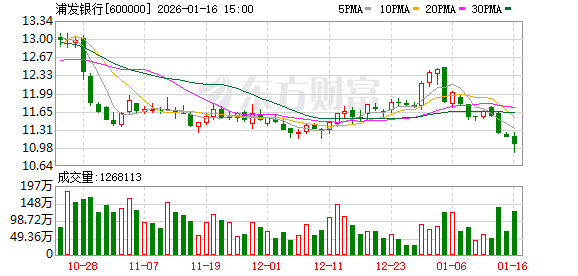
1月16日浦发银行大宗交易一览 | 成交量 | 成交金额 | 成交价 | 相对当日收盘 | | | | --- | --- | --- | --- | --- | --- | | (万 | (万元) | 格 | 折溢价(%) | 买方营业部 | 卖方营业部 | | 股) | | (元) | | | | | 22520.29 | 248398.82 | 11.03 | -0.09 | 信达证券股份有限公司北 | 信达证券股份有限公司 | | | | | | 京科丰桥证券营业部 | 资产管理事业部 | (文章来源:证券时报网) 证券时报·数据宝统计显示,浦发银行今日收盘价为11.04元,下跌1.08%,日换手率为0.38%,成交额为 13.99亿元,全天主力资金净流入7081.98万元,近5日该股累计下跌4.33%,近5日资金合计净流出2.15亿 元。 两融数据显示,该股最新融资余额为31.65亿元,近5日增加6844.16万元,增幅为2.21%。 机构评级来看,近5日共有6家机构给予该股评级,预计目标价最高的是浙商证券,1月13日浙商证券发 布的研报预计公司目标价为16.77元。(数据宝) 浦发银行1月16日大 ...


浦发银行薛宏立:银行要做全要素生产率革命的“催化剂”
2 1 Shi Ji Jing Ji Bao Dao· 2026-01-16 12:57
Core Viewpoint - The core viewpoint emphasizes that commercial banks must adapt to a new growth paradigm focused on enhancing total factor productivity through technological innovation and optimized resource allocation, transitioning from traditional financing for expansion to providing support for innovation and transformation [1][2]. Group 1: Top-Level Design - The strategic goals of commercial banks should align deeply with national priorities, moving beyond traditional financial metrics to establish a comprehensive strategic goal system that supports high-quality development [1]. - Resource allocation must shift from serving tangible assets to enhancing intangible assets, creating a new resource allocation system that integrates technology, scenarios, and value [1][2]. - Organizational structures need to adapt to functional transformations, fostering agility, collaboration, and professionalism to enable a closed-loop operation driven by industry research and customer needs [2]. Group 2: Business Innovation - Commercial banks should focus on three main lines: breakthroughs in technological innovation, upgrading industrial structures, and enhancing openness, creating a diversified and comprehensive financial service system [2]. - In the field of technology finance, banks need to develop a toolbox of products that align with the innovation lifecycle, offering tailored financial products for startups, growth-stage companies, and mature enterprises [2]. - The approach to industrial finance should transition from serving individual enterprises to supporting entire industrial chains, ensuring financial services effectively reach all levels of the industry [2]. - In cross-border finance, banks should expand their global service networks to support enterprises' integration into global production chains, innovating products and services for cross-border settlements, financing, and currency risk hedging [2]. Group 3: Risk Control - The risk landscape for the real economy has changed significantly, necessitating the development of a risk control model that aligns with quality enhancement [3]. - A data-driven intelligent risk control system should be established, shifting focus from tangible assets to intangible assets like patents and intellectual property, and evolving from post-event identification to preemptive warning [3]. - A differentiated risk management approach is essential, avoiding a one-size-fits-all strategy and tailoring risk control standards to different industries, scales, and development stages [3]. - Strengthening risk control capabilities through technology integration, such as knowledge graphs and machine learning, is crucial for real-time risk assessment and management [3].
浦发银行今日大宗交易折价成交2.25亿股,成交额24.84亿元
Xin Lang Cai Jing· 2026-01-16 09:29
1月16日,浦发银行大宗交易成交2.25亿股,成交额24.84亿元,占当日总成交额的63.97%,成交价11.03 元,较市场收盘价11.04元折价0.09%。 ...
银行业“10万亿俱乐部”扩容至10家,陈国汪详解大中小银行划分标准
Jin Rong Jie· 2026-01-16 09:09
Group 1 - The core viewpoint of the articles highlights that both Pudong Development Bank and CITIC Bank have successfully surpassed the 10 trillion yuan asset threshold, expanding the "10 trillion asset club" in China's banking industry to 10 members, which includes six major state-owned banks and four national joint-stock banks [1] - The total asset scale of the 10 banks now accounts for 60% of the entire banking industry, indicating a growing concentration of resources among leading institutions [1] - Chen Guowang, director of the Financial Industry Research Institute, noted that the significant changes in asset scale among banks have created a clear disparity with the classification standards established in 2015, which need to be updated to better reflect the current industry landscape [2] Group 2 - The classification standards for banks, established in 2015, categorize institutions based on asset size, but the threshold for large banks is no longer applicable as multiple institutions have surpassed the 10 trillion yuan mark [2] - The current classification includes various types of banks, such as policy banks, state-owned commercial banks, joint-stock banks, urban commercial banks, rural small banks, and private banks, indicating a diverse banking landscape [2] - Chen Guowang suggests that the asset scale classification standards should be revised to adapt to the new developments in the banking industry [2]



股份制银行板块1月16日跌1.73%,华夏银行领跌,主力资金净流出5.02亿元
Zheng Xing Xing Ye Ri Bao· 2026-01-16 08:56
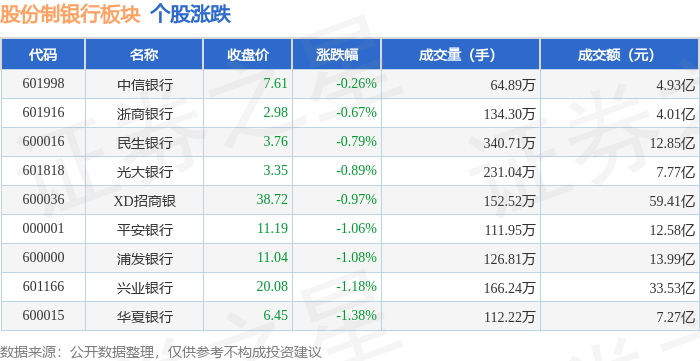
Market Overview - The banking sector saw a decline of 1.73% on January 16, with Huaxia Bank leading the drop [1] - The Shanghai Composite Index closed at 4101.91, down 0.26%, while the Shenzhen Component Index closed at 14281.08, down 0.18% [1] Individual Bank Performance - CITIC Bank closed at 7.61, down 0.26% with a trading volume of 648,900 shares and a transaction value of 493 million [1] - Zheshang Bank closed at 2.98, down 0.67% with a trading volume of 1.34 million shares and a transaction value of 401 million [1] - Minsheng Bank closed at 3.76, down 0.79% with a trading volume of 3.41 million shares and a transaction value of 1.285 billion [1] - Everbright Bank closed at 3.35, down 0.89% with a trading volume of 2.31 million shares and a transaction value of 777 million [1] - China Merchants Bank (XD) closed at 38.72, down 0.97% with a trading volume of 1.52 million shares and a transaction value of 5.941 billion [1] - Ping An Bank closed at 11.19, down 1.06% with a trading volume of 1.12 million shares and a transaction value of 1.258 billion [1] - Pudong Development Bank closed at 11.04, down 1.08% with a trading volume of 1.27 million shares and a transaction value of 1.399 billion [1] - Industrial Bank closed at 20.08, down 1.18% with a trading volume of 1.66 million shares and a transaction value of 3.353 billion [1] - Huaxia Bank closed at 6.45, down 1.38% with a trading volume of 1.12 million shares and a transaction value of 727 million [1] Capital Flow Analysis - The banking sector experienced a net outflow of 502 million from institutional investors and 687 million from retail investors, while retail investors saw a net inflow of 1.189 billion [1] - Specific capital flows for individual banks indicate varying trends, with Shanghai Pudong Bank seeing a net inflow of 88.92 million from institutional investors [2] - CITIC Bank had a net inflow of 42.84 million from institutional investors, while retail investors experienced a net outflow of 53.64 million [2] - Everbright Bank had a net inflow of 13.72 million from institutional investors, but retail investors faced a net outflow of 53.07 million [2] - Minsheng Bank saw a net outflow of 51.56 million from institutional investors, while retail investors had a net inflow of 51.08 million [2] - Huaxia Bank experienced a significant net outflow of 114 million from institutional investors, with a smaller net inflow of 10.25 million from retail investors [2] - Ping An Bank had a net outflow of 139 million from institutional investors, but retail investors saw a net inflow of 95.90 million [2]





浦发银行郑州分行创新金融工具赋能区域高质量发展
Huan Qiu Wang· 2026-01-16 08:45
Core Viewpoint - The successful implementation of the first counter bond pledge-style repurchase business in Henan Province by SPD Bank's Zhengzhou branch marks a significant innovation in regional finance, enhancing liquidity tools in the local counter bond market and injecting strong momentum into the construction of a multi-level bond market in the region [1][2]. Group 1: Business Innovation and Impact - The counter bond pledge-style repurchase business provides short-term financing by using counter bonds as collateral, creating a closed loop of "investment + financing" functions [1]. - This innovation meets the investment needs of financial institution clients while broadening liquidity management channels and improving capital efficiency [1][2]. - The launch of this business signifies a transition in the Henan counter bond market from a single investment focus to a more integrated investment and financing model, providing a replicable practice sample for refined regional financial ecosystem construction [1][3]. Group 2: Strategic Initiatives and Future Plans - SPD Bank's Zhengzhou branch has actively responded to the headquarters' strategic goals, focusing on the needs of financial institutions in Henan and establishing a dual-driven service model of "customer ecosystem + transaction ecosystem" [2]. - The branch has a history of empowering regional development through innovative practices, having served over 137,000 clients and facilitated nearly 5.5 billion yuan in online financing through its "PuHui LaiLe" app [2]. - Future plans include expanding service coverage to more financial institutions and local state-owned enterprises, deepening scene innovation, and integrating business with key areas such as technological innovation and rural revitalization [3].
在硬科技的深水区,银行何以成为“耐心资本”?
阿尔法工场研究院· 2026-01-16 05:37
Core Viewpoint - Shanghai Pudong Development Bank (SPDB) is transforming its role from a "fund provider" to an "ecosystem partner," leveraging financial resources to support the development of an "AI City" and the broader technology finance landscape [7][31]. Group 1: AI Industry and IPO Trends - The AI industry is experiencing a rare "IPO wave" in early 2026, with several unicorns like MiniMax and others successfully listing on the Hong Kong Stock Exchange, marking a significant moment for AGI companies [3][4]. - In just 30 days, Shanghai has contributed five major AI and integrated circuit companies to the capital market, indicating a profound financial ecosystem transformation [4]. Group 2: SPDB's Role in Technology Finance - As of Q3 2025, SPDB's technology finance loan balance exceeded 1 trillion yuan, serving over 250,000 technology enterprises, with nearly 90% coverage of companies listed on the Sci-Tech Innovation Board [6][10]. - SPDB's transition to an "ecosystem partner" reflects a strategic shift towards building a comprehensive technology finance ecosystem, moving from initial trials to large-scale, systematic operations [10][11]. Group 3: Innovative Evaluation Systems - SPDB has developed the "Technology Five Forces Model" and "Technology Radar" evaluation systems to bridge the gap between traditional banking assessments and the unique needs of tech companies, focusing on innovation and future potential rather than historical financial metrics [14]. - The bank's proactive approach includes a "Technology Enterprise M&A Loan Action Plan," with over 10 billion yuan allocated to support mergers and acquisitions in the tech sector [14]. Group 4: Long-term Commitment to Technology Innovation - SPDB emphasizes the importance of patience and understanding in supporting technology innovation, positioning itself as a reliable partner throughout the growth cycles of tech companies [16]. - The bank has played a crucial role in supporting domestic GPU companies, providing tailored financial solutions that alleviate cash flow pressures during critical development phases [19]. Group 5: Ecosystem Development in Shanghai - SPDB's technology finance strategy aligns with Shanghai's ambition to become a global technology innovation center, with projections indicating that the AI industry in Shanghai will exceed 550 billion yuan by 2025 [26]. - The bank's comprehensive service model integrates financial support with local industry needs, fostering collaboration among various stakeholders in the technology ecosystem [29][30]. Group 6: Comprehensive Service Framework - SPDB's technology finance services have formed a "four-chain integration" system, connecting innovation, industry, funding, and talent to empower technology enterprises [32][33]. - The bank's approach goes beyond financing, focusing on integrating knowledge, technology, and resources to become a key enabler and builder of the industry ecosystem [34].
晨会纪要2026年第8期-20260116
Guohai Securities· 2026-01-16 05:21
Group 1 - The report indicates that Shanghai Pudong Development Bank is expected to maintain a double-digit profit growth, with risk indicators reaching optimal levels in recent years [4][5] - The bank's revenue is projected to grow by 1.88% year-on-year in 2025, while net profit attributable to shareholders is expected to increase by 10.52% [4][5] - The total assets of the bank are anticipated to exceed 10 trillion yuan, with a year-on-year growth rate rising from 5.05% to 6.55% in Q4 2025 [4][5] Group 2 - The transportation industry report highlights growth in transportation operations and dividend value in infrastructure businesses for 2026 [6] - The aviation sector is expected to see improved supply-demand dynamics, with passenger load factors reaching 85.2% and a potential recovery in ticket prices [8][9] - The express delivery sector is projected to maintain structural growth, with a business volume of 180.74 billion pieces in 2025, reflecting a year-on-year increase of 14.9% [10][11] Group 3 - The maritime sector is expected to experience long-term upward trends, particularly in oil transportation due to increasing demand and potential supply reductions [13][14] - The report notes that the demand for container shipping remains stable, with improvements in supply structure, while bulk shipping is supported by increased demand from specific projects [13][14] Group 4 - The report on Aerospace Hongtu indicates a promising outlook for overseas business growth, with significant contracts signed for satellite and ground system procurement [19][21] - The company is actively expanding its commercial aerospace capabilities, having launched a series of high-resolution radar satellites and developed an integrated satellite and rocket layout [22][23] Group 5 - The report on Zhuoyi Information emphasizes the dual growth drivers of AI and IDE products, with significant market potential and a focus on domestic and international developer communities [24][25] - The company is positioned to benefit from the integration of its BIOS products into the supply chain, enhancing its market presence in the context of domestic substitution [27][28] Group 6 - Zhonghui Biopharmaceutical is focused on innovative vaccine development, with its quadrivalent influenza vaccine already on the market and significant growth expected in its product pipeline [31][32] - The company aims to achieve profitability by 2027, driven by the commercialization of its core products and a robust vaccine pipeline [34]





银行“十万亿俱乐部”成员达10家
21世纪经济报道· 2026-01-16 03:03
记者丨叶麦穗 编辑丨方海平 银行业绩快报捷足先登,截至1月15日,已经有浦发银行、中信银行2家银行先后发布了2025 年的"成绩单",双双实现归母净利润正增长,不过从业绩快报来看,两家银行去年的发展路 径,有一定的区别,其中中信银行"稳扎稳打",浦发银行则是"高举高打",值得一提的是, 两大股份行还联袂迈入"10万亿俱乐部",至此该俱乐部的成员达到10家 。 规模指标上,报告期末,浦发银行集团口径下资产总额达100817.46亿元,较上年末增加 6198.66 亿 元 , 增 长 6.55%; 负 债 总 额 92573.16 亿 元 , 较 上 年 末 增 加 5402.17 亿 元 , 增 长 6.20%。 资产质量方面,两家银行则全部得以改善。中信银行不良率1.15%,略降0.01个百分点;拨备 覆盖率203.61%,同比下降5.82个百分点。整体来看算是"稳扎稳打"。 浦发银行则明显更加"进攻"。不良率1.26%,同比下降0.10个百分点;拨备覆盖率200.72%, 同比上升13.76个百分点显示出要将"蛋糕做大"的想法。 浙商证券银行业分析师邱冠华的观点认为,2025年浦发银行规模增长方面,总资产同 ...

17家公司业绩快报抢先看
Zheng Quan Shi Bao Wang· 2026-01-16 01:37
Core Insights - The article discusses the performance forecasts and reports of 17 companies that released their earnings reports as of January 16, 2025, highlighting the accuracy of earnings quick reports compared to forecasts [1] Group 1: Revenue Performance - The highest revenue among the companies reporting was achieved by CITIC Bank, with a revenue of 212.475 billion yuan, showing a year-on-year decline of 0.55% [1] - Following CITIC Bank, Shanghai Pudong Development Bank and Yangtze Power reported revenues of 173.964 billion yuan and 85.882 billion yuan, respectively [1] - Eleven companies reported a year-on-year increase in revenue, with the highest growth recorded by Siyuan Electric, which achieved a revenue of 21.205 billion yuan, up 37.18% [1][2] - CITIC Securities and Beiding Co. also showed significant revenue growth, with increases of 28.75% and 26.04%, respectively [1][2] Group 2: Profit Performance - All companies that released earnings quick reports reported profits, with five companies achieving net profits exceeding 10 billion yuan [2] - CITIC Bank led in net profit with 70.618 billion yuan, reflecting a year-on-year increase of 2.98% [2] - Shanghai Pudong Development Bank and Yangtze Power followed with net profits of 50.017 billion yuan and 34.167 billion yuan, respectively [2] - Ten companies reported an increase in net profit, with the highest growth seen in Quanyuan Spring, which achieved a net profit of 0.15 billion yuan, up 147.89% [2] - Beiding Co. and Siyuan Electric also reported substantial net profit growth, with increases of 59.05% and 54.35%, respectively [2]


