SPD BANK(600000)

Search documents
深度|银行业“瘦身”
2 1 Shi Ji Jing Ji Bao Dao· 2025-12-26 13:02
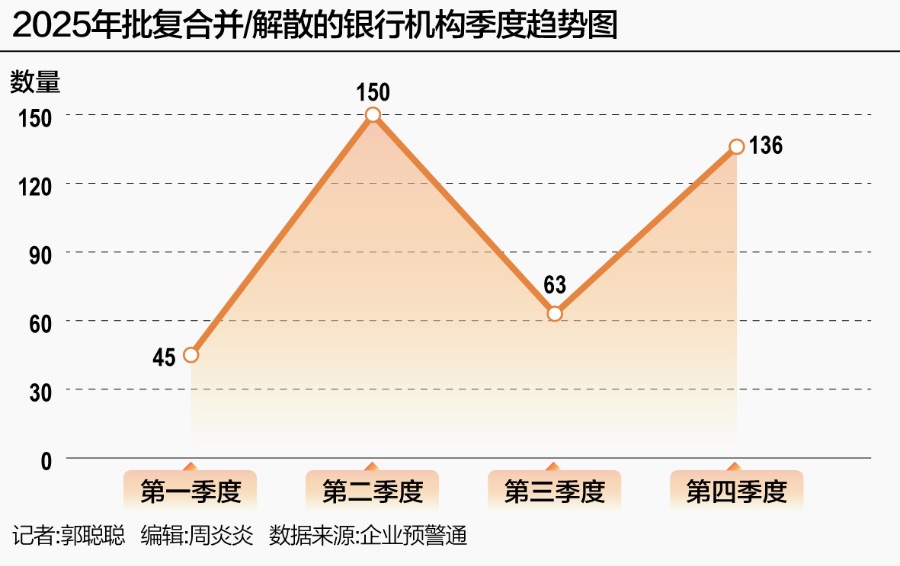
Core Insights - The wave of mergers and restructuring among China's small and medium-sized banks has progressed with unexpected intensity and speed, focusing on financial risk prevention and high-quality industry development as the core themes of the year [1][2]. Summary by Sections Mergers and Restructuring - As of December 26, 2025, a total of 394 banking institutions were approved to exit the market through mergers and dissolutions, doubling the total from 2024 [1][7]. - Between 2024 and 2025, nearly 550 banking institutions were reduced through mergers and restructuring, surpassing the total from the previous seven years [1]. - The restructuring involved 28 provinces, with Inner Mongolia leading by integrating 139 institutions, followed by Shandong (33), Henan (26), and others [1][9]. Characteristics of the Restructuring - The integration of small and medium-sized banks in 2025 is characterized by two significant trends: the involvement of state-owned banks in "village-to-branch" transformations and the acceleration of provincial-level reforms in the rural credit system [1][15]. - The core entities in the restructuring are village banks (231), followed by rural commercial banks (81) and rural credit cooperatives (71) [12]. Policy and Regulatory Framework - The central financial work conference in 2024 emphasized the need to "properly handle risks in small financial institutions," placing them alongside local debts and real estate as key areas for financial risk prevention [3]. - The regulatory focus during the "14th Five-Year Plan" period has been on risk prevention and resolution for small financial institutions, with a commitment to personalized reform strategies based on regional differences [4]. Achievements and Future Directions - Significant progress has been made in risk resolution, with over 40% more non-performing asset disposals compared to the previous five-year period, and the total capital and provisions in the industry exceeding 50 trillion yuan [5]. - The government work report for 2025 outlined a market-oriented and legal approach to risk resolution and transformation of local small financial institutions [5]. Service Upgrades and Market Dynamics - The restructuring is not merely a reduction in numbers but aims to enhance the quality and efficiency of financial services, particularly for rural and small enterprises [19][20]. - Merged institutions are expected to improve operational standards, risk resistance, and expand their service offerings through enhanced digital capabilities [19][20]. Long-term Outlook - The ongoing restructuring of small and medium-sized banks is anticipated to continue into 2026, with a focus on quality improvement and effective integration as the core theme [21].




浦发银行披露关联交易:对信达资产集团等五家关联方核定综合授信额度
Xin Lang Cai Jing· 2025-12-26 10:39
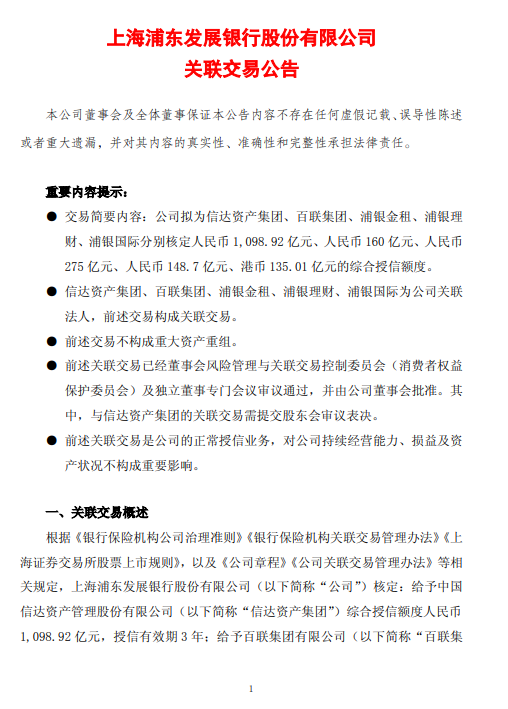
Core Viewpoint - Shanghai Pudong Development Bank has announced the approval of significant credit limits to several related parties, which constitutes major related transactions requiring board and shareholder approval due to the amounts exceeding certain thresholds of the bank's audited net assets [1][17]. Group 1: Credit Limits Approved - The bank has approved a comprehensive credit limit of RMB 1,098.92 billion to China Cinda Asset Management Co., Ltd. for a period of 3 years [1][16]. - A credit limit of RMB 160 billion has been granted to Bailian Group Co., Ltd. with a validity of 1 year [1][16]. - The bank has set a credit limit of RMB 275 billion for Pudong Financial Leasing Co., Ltd., expiring on November 17, 2026 [1][16]. - A credit limit of RMB 148.7 billion has been approved for Pudong Wealth Management Co., Ltd., with an expiration date of September 30, 2026 [1][16]. - A credit limit of HKD 135.01 billion has been allocated to Pudong International Holdings Co., Ltd., expiring on December 2, 2026 [1][16]. Group 2: Related Transactions and Approvals - The transactions are classified as major related transactions since the credit amounts exceed 1% of the bank's latest audited net assets of RMB 7,363.29 billion [1][17]. - The transaction with China Cinda Asset Management Co., Ltd. requires shareholder approval as it exceeds 5% of the bank's audited net assets [1][17]. - The board's risk management and related transaction control committee, along with independent directors, have reviewed and approved these transactions before submission to the board [2][17]. Group 3: Related Parties Overview - China Cinda Asset Management Co., Ltd. is a major shareholder and related party, involved in managing and disposing of non-performing assets [9][24]. - Bailian Group Co., Ltd. is also a major shareholder and related party, engaged in state asset management and investment development [10][25]. - Pudong Financial Leasing Co., Ltd. is a subsidiary of the bank, involved in financing leasing and investment activities [11][26]. - Pudong Wealth Management Co., Ltd. is a wholly-owned subsidiary, focusing on public and private wealth management services [12][27]. - Pudong International Holdings Co., Ltd. is another wholly-owned subsidiary, involved in various financial services [13][28].

浦发银行:对信达资产集团等五家关联方核定综合授信额度
Bei Jing Shang Bao· 2025-12-26 10:24
Core Viewpoint - Shanghai Pudong Development Bank (SPDB) has announced significant credit approvals to various entities, indicating a strategic move to enhance its lending portfolio and strengthen relationships with key partners [1][2] Group 1: Credit Approvals - SPDB has granted a comprehensive credit limit of RMB 109.89 billion to China Cinda Asset Management Co., Ltd. with a validity period of 3 years [1] - A credit limit of RMB 16 billion has been approved for Bailian Group Co., Ltd. with a validity period of 1 year [1] - SPDB has allocated RMB 27.5 billion to Pudong Development Bank Financial Leasing Co., Ltd., expiring on November 17, 2026 [1] - A credit limit of RMB 14.87 billion has been set for Pudong Development Bank Wealth Management Co., Ltd., expiring on September 30, 2026 [1] - SPDB has also approved a credit limit of HKD 13.501 billion for Pudong International Holdings Co., Ltd., with an expiration date of December 2, 2026 [1] Group 2: Regulatory Compliance - The credit transactions exceed 1% of SPDB's latest audited net assets of RMB 736.33 billion, categorizing them as significant related-party transactions [2] - The board's risk management and related-party transaction control committee, along with independent directors, reviewed the transactions before submission to the board for approval [2] - The transaction with China Cinda Asset Management, due to its size exceeding 5% of SPDB's net assets, requires shareholder approval [2]
谁是银行贵金属之王?
Xin Lang Cai Jing· 2025-12-26 10:11
Core Viewpoint - The global market is experiencing a rare super cycle in precious metals, driven by a reassessment of the dollar's credibility and real demand from new industrial revolutions such as AI and hydrogen energy [2][24]. Group 1: Market Dynamics - As of December 24, spot gold reached $4500 per ounce, with international silver and platinum increasing over 140% for the year [2][24]. - The demand for precious metals has shifted from traditional safe-haven assets to being driven by monetary credit, geopolitical factors, and green technology [10][34]. Group 2: Banking Sector Adjustments - Major banks like ICBC, CCB, and CITIC are cleaning up personal precious metal accounts that have been inactive, indicating a strategic shift towards focusing on quality clients rather than quantity [3][26]. - This move is not a retreat but a strategic adjustment to enhance service quality, risk control, and long-term trust [27][36]. Group 3: Asset Growth and Competition - By Q3 2025, ICBC led the market with precious metal assets of 385.43 billion yuan, followed by Bank of China, China Construction Bank, Agricultural Bank of China, and Shanghai Pudong Development Bank, all surpassing 100 billion yuan [29][31]. - The growth in precious metal assets is built on a solid foundation from 2024, with ICBC showing consistent expansion from 254.30 billion yuan in Q1 to 385.43 billion yuan in Q3 2025 [32][33]. Group 4: Future Outlook - Goldman Sachs predicts that gold prices may reach $4900 per ounce by 2026, with several financial institutions forecasting gold to potentially hit $5000 per ounce [21][41]. - The competition in the precious metals sector will focus on compliance, customer trust, and long-term strategies, with the true "king of precious metals" being the bank that retains the most engaged and trusting clients after account clean-ups [42].



浦发银行(600000) - 上海浦东发展银行股份有限公司关联交易公告
2025-12-26 09:45
公告编号:临2025-078 证券代码:600000 证券简称:浦发银行 优先股代码:360003 360008 优先股简称:浦发优1 浦发优2 上海浦东发展银行股份有限公司 关联交易公告 本公司董事会及全体董事保证本公告内容不存在任何虚假记载、误导性陈述 或者重大遗漏,并对其内容的真实性、准确性和完整性承担法律责任。 根据《银行保险机构公司治理准则》《银行保险机构关联交易管理办法》《上 海证券交易所股票上市规则》,以及《公司章程》《公司关联交易管理办法》等相 关规定,上海浦东发展银行股份有限公司(以下简称"公司")核定:给予中国 信达资产管理股份有限公司(以下简称"信达资产集团")综合授信额度人民币 1,098.92 亿元,授信有效期 3 年;给予百联集团有限公司(以下简称"百联集 1 ● 交易简要内容:公司拟为信达资产集团、百联集团、浦银金租、浦银理 财、浦银国际分别核定人民币 1,098.92 亿元、人民币 160 亿元、人民币 275 亿元、人民币 148.7 亿元、港币 135.01 亿元的综合授信额度。 ● 信达资产集团、百联集团、浦银金租、浦银理财、浦银国际为公司关联 法人,前述交易构成关联交易 ...
浦发银行(600000) - 上海浦东发展银行股份有限公司监事会2025年第十二次会议决议公告
2025-12-26 09:45
公告编号:临2025-077 证券代码:600000 证券简称:浦发银行 优先股代码:360003 360008 优先股简称:浦发优1 浦发优2 上海浦东发展银行股份有限公司 监事会 2025 年第十二次会议决议公告 本公司监事会及全体监事保证本公告内容不存在任何虚假记载、误导性陈述 或者重大遗漏,并对其内容的真实性、准确性和完整性承担法律责任。 上海浦东发展银行股份有限公司(以下简称"公司")监事会2025年第十二 次会议于2025年12月25日以书面传签方式召开,会议通知及会议文件于2025年12 月15日以电子邮件方式发出。应参加会议监事8名,实际参加会议监事8名,符合 《公司法》及《公司章程》关于召开监事会法定人数的规定,表决所形成的决议 合法、有效。 会议审议并经表决通过了: 1.《公司关于向上海启源国资创新策源公益基金会等捐赠事项的议案》 同意:8票 弃权:0票 反对:0票 2.《公司关于修订<规章制度管理办法>的议案》 同意:8票 弃权:0票 反对:0票 3.《公司关于2025年度外包范围变更的议案》 同意:8票 弃权:0票 反对:0票 6.《公司关于与中国信达资产管理股份有限公司关联交易的议案 ...
浦发银行(600000) - 上海浦东发展银行股份有限公司董事会2025年第十三次会议决议公告
2025-12-26 09:45
董事会 2025 年第十三次会议决议公告 本公司董事会及全体董事保证本公告内容不存在任何虚假记载、误导性陈述 或者重大遗漏,并对其内容的真实性、准确性和完整性承担法律责任。 证券代码:600000 证券简称:浦发银行 优先股代码:360003 360008 优先股简称:浦发优1 浦发优2 上海浦东发展银行股份有限公司 上海浦东发展银行股份有限公司(以下简称"公司")董事会2025年第十三 次会议于2025年12月25日以书面传签方式召开,会议通知及会议文件于2025年12 月15日以电子邮件方式发出。应参加会议董事13名,实际参加会议董事13名,符 合《公司法》及《公司章程》关于召开董事会法定人数的规定,表决所形成的决 议合法、有效。公司监事、高级管理人员通过审阅会议资料方式列席本次会议。 会议审议并经表决通过了: 1.《公司关于向上海启源国资创新策源公益基金会等捐赠事项的议案》 同意:13票 弃权:0票 反对:0票 公告编号:临2025-076 4.《公司关于2025年度第二次预期信用损失法模型优化和参数更新的议案》 同意:13票 弃权:0票 反对:0票 5.《公司关于金融机构及非一般公司类客户信用评级模型 ...
股份制银行板块12月26日跌0.18%,中信银行领跌,主力资金净流入4.48亿元
Zheng Xing Xing Ye Ri Bao· 2025-12-26 09:07
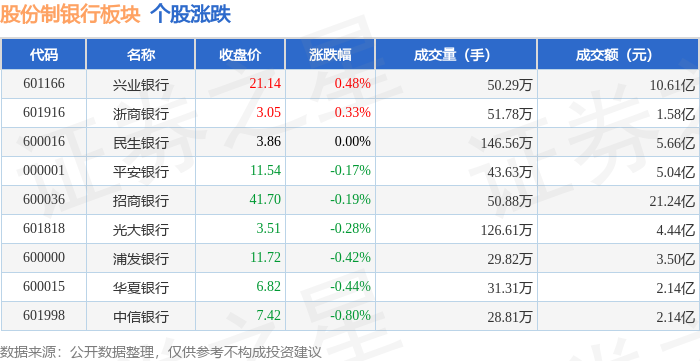
Market Overview - On December 26, the share price of the banking sector fell by 0.18% compared to the previous trading day, with CITIC Bank leading the decline [1] - The Shanghai Composite Index closed at 3963.68, up 0.1%, while the Shenzhen Component Index closed at 13603.89, up 0.54% [1] Individual Bank Performance - Industrial Bank (601166) closed at 21.14, up 0.48% with a trading volume of 502,900 shares and a transaction value of 1.061 billion [1] - Zhejiang Commercial Bank (601916) closed at 3.05, up 0.33% with a trading volume of 517,800 shares and a transaction value of 158 million [1] - Minsheng Bank (600016) closed at 3.86, unchanged with a trading volume of 1,465,600 shares and a transaction value of 566 million [1] - Ping An Bank (000001) closed at 11.54, down 0.17% with a trading volume of 436,300 shares and a transaction value of 504 million [1] - China Merchants Bank (600036) closed at 41.70, down 0.19% with a trading volume of 508,800 shares and a transaction value of 2.124 billion [1] - Everbright Bank (601818) closed at 3.51, down 0.28% with a trading volume of 1,266,100 shares and a transaction value of 444.1 million [1] - Shanghai Pudong Development Bank (600000) closed at 11.72, down 0.42% with a trading volume of 298,200 shares and a transaction value of 350 million [1] - Huaxia Bank (600015) closed at 6.82, down 0.44% with a trading volume of 313,100 shares and a transaction value of 214 million [1] - CITIC Bank (601998) closed at 7.42, down 0.80% with a trading volume of 288,100 shares and a transaction value of 214 million [1] Fund Flow Analysis - The banking sector saw a net inflow of 448 million from main funds, while retail funds experienced a net outflow of 231 million and 217 million respectively [1] - In terms of individual banks, China Merchants Bank had a main fund net inflow of 241 million, while retail funds saw a net outflow of 79.09 million [2] - Industrial Bank had a main fund net inflow of 159 million, with retail funds experiencing a net outflow of 108 million [2] - Shanghai Pudong Development Bank recorded a main fund net inflow of 62.09 million, while retail funds had a net outflow of 776,980 [2] - Everbright Bank had a main fund net inflow of 39.78 million, with retail funds seeing a net outflow of 1.45 million [2] - Ping An Bank had a main fund net inflow of 29.27 million, while retail funds experienced a net outflow of 4.01 million [2] - Minsheng Bank had a significant main fund net outflow of 67.19 million, but retail funds saw a net inflow of 27.19 million [2]




浦发银行再收千万罚单,年内累计罚超4000万元
Mei Ri Shang Bao· 2025-12-26 02:10
近日,国家金融监督管理总局发布一系列行政处罚信息,上海浦东发展银行股份有限公司及相关责任人 员因理财、代销等业务管理不审慎、员工管理不到位等问题,被处以罚款1560万元。同时,相关责任人 高红、何刚、陈从治、孔令孜、任威、黄乃嘉被警告并罚款共计30万元。穆矢、杨再斌等7名人员被处 以禁止从事银行业工作5年至15年不等的处罚。 本次浦发银行接到的罚单,对比10月的罚单,尤其值得注意的是对个人的禁业处罚。要知道,此前监管 对个人的处罚多为警告、罚款、取消任职资格等,禁业处罚是较为严厉的行政处罚措施。这透露出监管 层面对浦发银行代理业务等违法违规行为的"零容忍",对于严重违反信贷业务审慎经营规则的相关责任 人员坚决重拳出击的信号。 这已经不是浦发银行近期首次收到监管罚单。12月15日,国家金融监督管理总局云南监管局对上海浦东 发展银行昆明分行因贷款"三查"严重不尽职,处以50万元罚款;对其相关分支另处70万元罚款,责任人 李仙周、张昱被警告。11月25日,浦发银行龙岩分行因"个人贷款贷前调查不尽职、贷后管理不到位 等",被龙岩金融监管分局罚款70万元。而更早的10月31日,浦发银行因相关互联网贷款、代销等业务 管理 ...
金融向新力|是谁见证“无人驾驶矿卡第一股”的成长之路?
Xin Lang Cai Jing· 2025-12-26 02:06
Core Viewpoint - Xidi Zhijia officially listed on the Hong Kong Stock Exchange, becoming the world's first publicly traded autonomous mining truck company, highlighting the potential of the autonomous driving sector [3] Group 1: Company Development - Xidi Zhijia was founded in 2018 by experts from Hong Kong University of Science and Technology and Silicon Valley, initially requiring financial support during its early stages [6] - The company has evolved into a leading autonomous driving enterprise in China, achieving commercialization solutions in closed environments, urban roads, and intercity roads [9] Group 2: Financial Support and Partnership - SPD Bank provided crucial financial support during Xidi Zhijia's startup phase, utilizing government risk compensation funds to facilitate initial funding [6] - SPD Bank expanded credit limits through the "Specialized, Refined, and New Little Giant Loan" to support Xidi Zhijia's technology research, market expansion, and capacity enhancement [7] - As Xidi Zhijia approached its IPO, SPD Bank leveraged its comprehensive service advantages to assist in the company's entry into the international capital market [7] Group 3: Future Collaboration - Post-IPO, Xidi Zhijia plans to deepen collaboration with SPD Bank in industrial finance and capital operations, aiming to create new value together [9] - SPD Bank is committed to providing professional and warm financial services to support more technology companies in their innovative endeavors [11]