
CM BANK(600036)

Search documents
多家银行股东及高管密集增持
Zheng Quan Ri Bao Wang· 2025-09-16 12:25
Core Insights - Recent actions by shareholders and executives of listed banks to increase their holdings indicate a strong confidence in the banking sector's future performance [1][3] - Institutional investors, including insurance and trust companies, are actively investing in bank stocks, highlighting the sector's investment value [1][4] Group 1: Shareholder and Executive Actions - Multiple listed banks have disclosed announcements of share buybacks by shareholders and executives, with significant amounts being committed [2][3] - For instance, Qilu Bank announced a plan for its executives to buy back shares worth at least 3.5 million yuan, while Nanjing Bank's major shareholder increased its stake from 12.56% to 13.02% through a purchase of 56.78 million shares [2] - This trend of increasing shareholdings reflects confidence in the banks' long-term investment value and future growth prospects [3] Group 2: Institutional Investment Trends - Insurance and trust companies have shown a notable increase in their investments in bank stocks, indicating a strong preference for long-term holdings in this sector [4] - Major insurance firms, such as Ping An Life, have actively increased their stakes in banks, focusing on both A-shares and H-shares, which demonstrates a robust commitment to the banking sector [4] - As of June, 18 trust companies were among the top ten shareholders in 25 A-share listed companies, with a total investment value of 59.21 billion yuan, many of which were bank stocks [4] Group 3: Market Outlook and Valuation - Analysts maintain an optimistic outlook for bank stocks, suggesting that there is still room for valuation recovery and highlighting their long-term investment appeal [5] - The banking sector has experienced a phase of adjustment, and the overall performance in the mid-year reports has been positive, with expectations for a rebound in return on equity (ROE) [5] - Factors such as the low interest rate environment and the ongoing shift of household deposits to equity markets are expected to support the demand for bank stocks, enhancing their appeal as a stable income source [5]





招商银行9月16日现1笔大宗交易 总成交金额1252.5万元 溢价率为0.00%
Xin Lang Cai Jing· 2025-09-16 10:17
进一步统计,近3个月内该股累计发生10笔大宗交易,合计成交金额为47.45亿元。该股近5个交易日累 计下跌2.52%,主力资金合计净流出16.32亿元。 责任编辑:小浪快报 炒股就看金麒麟分析师研报,权威,专业,及时,全面,助您挖掘潜力主题机会! 9月16日,招商银行收跌1.11%,收盘价为41.75元,发生1笔大宗交易,合计成交量30万股,成交金额 1252.5万元。 第1笔成交价格为41.75元,成交30.00万股,成交金额1,252.50万元,溢价率为0.00%,买方营业部为华 泰证券股份有限公司广州珠江西路证券营业部,卖方营业部为华泰证券股份有限公司广州珠江西路证券 营业部。 ...
招商银行今日大宗交易平价成交30万股,成交额1252.5万元
Xin Lang Cai Jing· 2025-09-16 09:39
9月16日,招商银行大宗交易成交30万股,成交额1252.5万元,占当日总成交额的0.35%,成交价41.75 元,较市场收盘价41.75元持平。 | | | | | 华泰证券股份有限 below couple come and can and can and | 华泰证券股份有限 with bank calleries and 19 to 100 com | | | --- | --- | --- | --- | --- | --- | --- | | 交易日期 025-09-16 | 证券商标 招商银行 | 莅券代码 600036 | 成交价(元) 成交金额(万元) 成交量(*) 莫入营业部 41.75 1252.5 | 公司广州珠江西路 | 美出营业部 公司广州珠江西路 | 是否为专场 кар | ...


银行行业9月16日资金流向日报
Zheng Quan Shi Bao Wang· 2025-09-16 09:22
银行行业资金流向排名 | 代码 | 简称 | 今日涨跌幅(%) | 今日换手率(%) | 主力资金流量(万元) | | --- | --- | --- | --- | --- | | 600016 | 民生银行 | -1.43 | 2.79 | -124908.82 | | 600036 | 招商银行 | -1.11 | 0.42 | -96548.52 | | 601169 | 北京银行 | -1.87 | 2.29 | -76484.34 | | 601166 | 兴业银行 | -1.76 | 0.52 | -56186.70 | | 601328 | 交通银行 | -1.27 | 1.15 | -51101.59 | | 601818 | 光大银行 | -1.66 | 1.23 | -47138.82 | | 601288 | 农业银行 | -1.68 | 0.13 | -44072.33 | | 601988 | 中国银行 | -0.92 | 0.15 | -31174.70 | | 002142 | 宁波银行 | -1.90 | 0.71 | -25716.69 | | 600015 | 华夏银行 ...




深圳8家金融机构集体“官宣”:披露信贷业务第三方合作机构
2 1 Shi Ji Jing Ji Bao Dao· 2025-09-16 08:54
Group 1 - The first batch of 8 banking financial institutions in Shenzhen has publicly announced a list of third-party cooperation agencies for credit business, which includes major banks such as Industrial and Commercial Bank of China, Agricultural Bank of China, and China Bank [1] - The third-party agencies primarily cover three categories: marketing and customer acquisition, guarantee and credit enhancement, and collection services [1] - Financial institutions will continuously update the list based on business developments and encourage customers to verify the legitimacy of any third-party claims [1] Group 2 - The public disclosure of the third-party cooperation agency list is an effort to implement regulatory requirements, protect financial consumers' rights, and combat illegal loan intermediaries [2] - Illegal loan intermediaries have been a significant issue in the financial sector, with instances of companies falsely claiming partnerships with banks to attract customers [2] - Common tactics used by illegal loan intermediaries include impersonating legitimate financial institutions, offering low-interest rates, and making false service promises, which can lead to consumer financial losses and data breaches [2] Group 3 - Regulatory authorities have intensified efforts to combat financial "black and gray industries," focusing on illegal loan intermediaries and related financial crimes [3] - A new regulation from the National Financial Supervision Administration mandates that commercial banks manage and disclose lists of platform operators and credit enhancement service providers, effective October 1 [3] - The regulation prohibits banks from collaborating with institutions not on the approved list for internet lending services [3]


股份制银行板块9月16日跌1.54%,浦发银行领跌,主力资金净流出34.2亿元
Zheng Xing Xing Ye Ri Bao· 2025-09-16 08:46
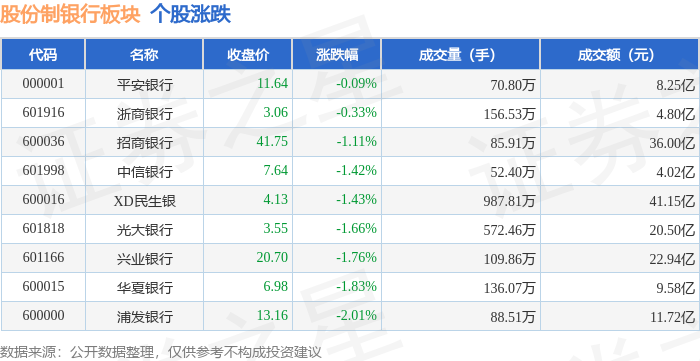
Core Viewpoint - The banking sector, particularly the joint-stock banks, experienced a decline of 1.54% on September 16, with Shanghai Pudong Development Bank leading the drop [1] Group 1: Market Performance - The Shanghai Composite Index closed at 3861.87, up 0.04%, while the Shenzhen Component Index closed at 13063.97, up 0.45% [1] - The individual performance of joint-stock banks showed varied results, with most banks experiencing a decline in share price [1] Group 2: Individual Bank Performance - Ping An Bank closed at 11.64, down 0.09% with a trading volume of 708,000 shares and a transaction value of 82.58 million [1] - Zhejiang Commercial Bank closed at 3.06, down 0.33% with a trading volume of 1,565,300 shares and a transaction value of 4.80 million [1] - China Merchants Bank closed at 41.75, down 1.11% with a trading volume of 859,100 shares and a transaction value of 3.60 billion [1] - CITIC Bank closed at 7.64, down 1.42% with a trading volume of 524,000 shares and a transaction value of 402 million [1] - Minsheng Bank closed at 4.13, down 1.43% with a trading volume of 9,878,100 shares and a transaction value of 4.11 million [1] - Everbright Bank closed at 3.55, down 1.66% with a trading volume of 5,724,600 shares and a transaction value of 2.05 billion [1] - Industrial Bank closed at 20.70, down 1.76% with a trading volume of 1,098,600 shares and a transaction value of 2.29 billion [1] - Huaxia Bank closed at 6.98, down 1.83% with a trading volume of 1,360,700 shares and a transaction value of 958 million [1] - Shanghai Pudong Development Bank closed at 13.16, down 2.01% with a trading volume of 885,100 shares and a transaction value of 1.17 billion [1] Group 3: Capital Flow - The joint-stock banking sector saw a net outflow of 3.42 billion in principal funds, while speculative funds saw a net inflow of 1.45 billion and retail investors saw a net inflow of 1.97 billion [1]



招商银行呼和浩特分行金融知识宣传周全面启动
Zhong Guo Jin Rong Xin Xi Wang· 2025-09-16 06:49
Core Viewpoint - The Inner Mongolia branch of China Merchants Bank has launched the 2025 Financial Knowledge Promotion Week, focusing on online and offline integration to enhance financial literacy and public risk awareness [1] Group 1: Promotion Activities - The financial promotion week centers around physical branches, featuring consumer rights protection materials and "Financial Knowledge Mini Classes" to create a strong learning atmosphere [3] - The bank organizes outreach activities in enterprises, schools, communities, and business districts, targeting key demographics such as the elderly and youth to ensure comprehensive coverage [3] Group 2: Online and Outdoor Innovations - The bank is leveraging its mobile banking platform for an online event titled "Learn Financial Knowledge and Explore Beautiful Inner Mongolia," combining knowledge learning with local tourism to enhance user engagement [5] - Outdoor activities are planned in collaboration with the credit card center, including a "Financial Energy Supply Station" and interactive games to deepen public memory of financial risk prevention [5] Group 3: Community Engagement - The bank will participate in the third Community Neighbors Festival in Hohhot, delivering financial knowledge directly to the community to foster harmonious neighborhoods [8] - A financial knowledge competition will be held in collaboration with universities to enhance financial literacy among students and gather feedback on their knowledge needs [8] - The bank is also placing impactful financial knowledge posters at popular transportation hubs to promote positive investment concepts and highlight illegal financial risks [8]

27家深企入围中国500强,研发驱动和全球化成突围关键
Nan Fang Du Shi Bao· 2025-09-16 06:41
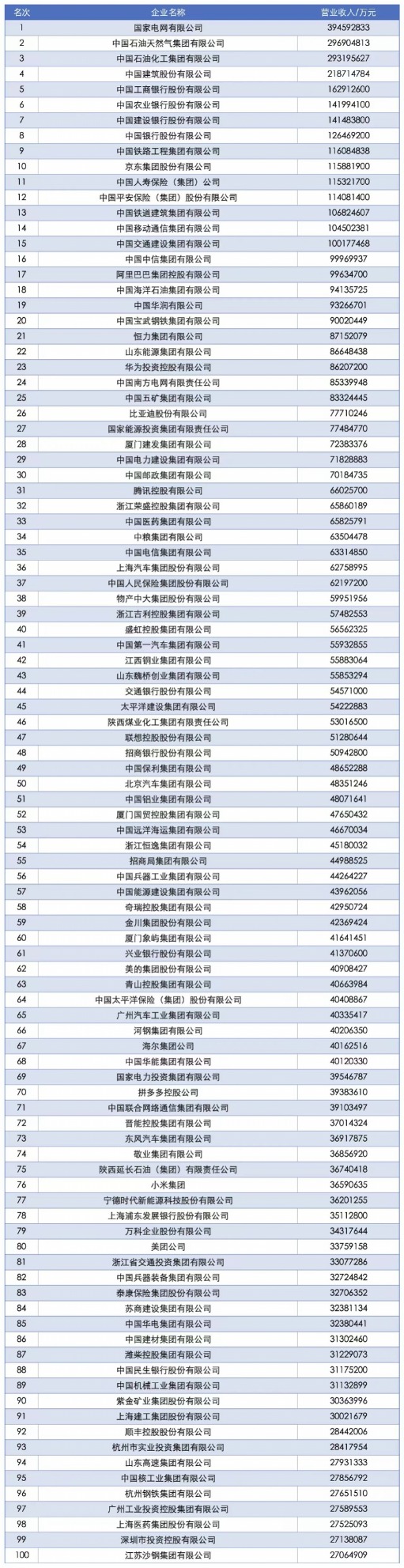
Core Insights - The "2025 China Top 500 Enterprises" list highlights Shenzhen's strong performance, with 27 companies making the list, including 8 in the top 100, showcasing the city's innovation and growth potential in technology and advanced manufacturing [1][2] Group 1: Company Performance - Shenzhen's top companies include Ping An (12th), Huawei (23rd), BYD (26th), Tencent (31st), and others, reflecting a diverse industry presence in finance, technology, manufacturing, and logistics [2][6] - Huawei reported a revenue of 427.039 billion yuan in the first half of the year, with a net profit of 37.195 billion yuan, leading the domestic smartphone market with a 18.1% share [5] - BYD achieved a revenue of 371.281 billion yuan, with a net profit of 15.511 billion yuan, becoming the global leader in new energy vehicle sales [6] Group 2: R&D Investment - The total R&D investment of the top 500 companies reached 1.73 trillion yuan, with an average R&D intensity of 1.95%, while Shenzhen companies exceeded this average significantly [1][2] - Huawei's R&D investment for 2024 is projected to be 179.7 billion yuan, accounting for 20.8% of its revenue, with over 1249 billion yuan invested in the past decade [7] - BYD's R&D investment for 2024 is expected to be 54.2 billion yuan, representing 6.97% of its revenue, surpassing Tesla's R&D intensity [7] Group 3: Globalization Strategy - Shenzhen companies are increasingly adopting globalization as a strategy for growth, with Huawei establishing 16 R&D centers globally and expanding its cloud services [9][10] - BYD's overseas sales reached 470,000 units, a 132% increase, with significant revenue growth from international markets [9][10] - The global expansion of Shenzhen companies is seen as essential for overcoming domestic market challenges and achieving sustainable revenue growth [10]



大盘价值的底层支撑:龙头集群与行业比较优势
Xin Lang Cai Jing· 2025-09-16 06:08
Core Viewpoint - The Shanghai Stock Exchange 50 Index (SSE 50) has become a core target in value investing due to its precise selection of quality constituent stocks and scientific industry allocation, providing a robust underlying support for returns amidst market volatility [1][2]. Group 1: Constituent Stock Quality - The top ten constituent stocks of the SSE 50 form a "leader matrix" covering multiple core sectors, representing the pricing power and profit resilience of China's core economic assets [1]. - Key sectors include food and beverage, finance, public utilities, resources, and pharmaceuticals, with leading companies establishing strong competitive moats [1][2]. - For instance, Kweichow Moutai, with a weight of 10.55% and a market capitalization exceeding 1.8 trillion, leverages brand scarcity and rigid consumption scenarios to maintain high profitability across economic cycles [1][4]. Group 2: Industry Allocation Advantages - The SSE 50 exhibits a strategic positioning in core sectors, emphasizing "economic foundation + consumption upgrade," which provides a comparative advantage over the CSI 300 and CSI 500 indices [2][7]. - In the financial sector, the SSE 50's allocation is significant, with a combined weight of 36.4% in banking and non-banking financial sectors, substantially higher than the CSI 300's 26.2% and CSI 500's 9.5% [7][8]. - Leading banks like Industrial and Commercial Bank of China and China Merchants Bank are noted for their superior asset quality management and interest margin control, contributing to a "double boost" effect on performance during economic recovery [7][8]. Group 3: Consumer Sector Focus - The food and beverage sector holds a weight of 13.6% in the SSE 50, significantly surpassing the CSI 300's 8.1% and CSI 500's 1.8%, focusing on high-end consumer leaders like Kweichow Moutai [8][9]. - The current TTM price-to-earnings ratio for the food and beverage index is 21.76, indicating it is at a historically low relative valuation, which, combined with a recovering consumption trend, suggests potential for valuation recovery [8][9]. - The food and beverage sector is positioned as a "stabilizer" for the SSE 50, with expectations for steady earnings growth and reasonable valuation recovery, contributing to ongoing cash flow and valuation elasticity [9].




“二选一”阳谋:“排他性销售”引发公募基金代销合规战事
2 1 Shi Ji Jing Ji Bao Dao· 2025-09-16 06:01
Core Viewpoint - The recent controversy surrounding exclusive sales practices in the fund distribution industry, particularly involving China Merchants Bank (CMB), has raised questions about the fairness of sales channels and investor choice [1][2][4]. Fund Sales Practices - Several funds are reported to be "suspended for sale" on third-party platforms like Ant Financial and Tiantian Fund, while still available for purchase at CMB with standard fees [2][3]. - The phenomenon of exclusive sales is common in the fund industry, especially in a bank-dominated market [8][11]. - The new regulatory draft issued on September 5 aims to reform fund sales fee structures, potentially reducing the viability of exclusive sales practices [1][15]. Regulatory Changes - The new regulations propose to lower the maximum subscription fees for different fund types, which could diminish the profit margins for banks and encourage competition based on service rather than pricing [15][16]. - Industry insiders believe that the new rules will likely reduce the prevalence of exclusive sales and shift the focus towards service innovation among distribution channels [16][17]. Competitive Landscape - CMB's exclusive sales practices have been criticized as abnormal, with some funds only available through CMB while being unavailable on major platforms [4][6]. - The competition between CMB and internet platforms like Ant Financial is intensifying, with both sides employing different pricing strategies for fund sales [8][11]. - The operational costs associated with bank channels are higher, leading to a reluctance to offer discounts compared to internet platforms, which typically have lower costs [12][13]. Industry Dynamics - Fund companies face a dilemma in choosing sales channels, often having to decide between CMB and internet platforms based on product compatibility and market potential [9][10]. - The ongoing competition has led to a situation where fund companies may feel pressured to choose exclusive partnerships with banks or internet platforms, impacting their distribution strategies [10][11]. Future Outlook - The implementation of the new regulations is expected to create a more level playing field among distribution channels, potentially leading to a reduction in exclusive sales practices [16][17]. - The industry may see a shift towards enhanced service offerings and innovative solutions as channels adapt to the new regulatory environment and competitive pressures [17].