
FOTON(600166)

Search documents
【联合发布】新能源商用车周报(2025年12月第4周)
乘联分会· 2025-12-29 08:38
Policy and Regulations - The National Development and Reform Commission and the National Energy Administration aim for a total installed capacity of solar thermal power to reach 15 million kilowatts by 2030, with a goal to make the cost of electricity comparable to coal power [15][14]. - Chongqing plans to build over 100 high-power charging stations and promote more than 1,500 electric supercharged heavy trucks by 2026-2028, focusing on logistics and port scenarios [12][11]. Market Insights - The core technology modules of new energy city distribution logistics vehicles include electric drive, battery management, intelligent and automated technologies, lightweight design, charging infrastructure, and environmental adaptability [19][17]. - Intelligent technology is driving new energy city distribution logistics vehicles towards greater efficiency, sustainability, and intelligence [21][20]. - The main technical fields of new energy city distribution logistics vehicles face challenges in range, battery costs, autonomous driving, and lightweight design, necessitating continuous innovation [24][25]. Company Developments - Foton Motor's 2026 business conference set marketing targets of 200,000 units each for new energy and exports, with a projected market share increase to 17% in 2025 [31][33]. - Foton Motor plans to launch several new products, including the Aoling Extreme Electric light truck and the new cold chain vehicle brand, targeting various operational scenarios [34][35]. - The Foton Kaven LeTu customized flagship light truck was launched, focusing on tailored solutions for different operational environments [36][38].


奇瑞回应与追觅合作传闻
第一财经· 2025-12-29 04:06
编辑 |心一 12月29日早间,有消息称,追觅造车目前最主要合作伙伴是奇瑞,双方合作车型为捷途纵横G700,第 一款车预计大概2026年第一季度会推出。奇瑞方面回应第一财经称:"并无此事"。 记者 |葛慧 ...
重汽第一!陕汽/解放暴涨!11月新能源自卸车渗透率破50% 创多项新纪录 | 头条
第一商用车网· 2025-12-29 02:48
Core Viewpoint - The new energy heavy truck market experienced significant growth in November 2025, with a year-on-year increase of 178%, reaching a record sales volume of 28,000 units, driven by strong performance in sub-segments like new energy tractors and charging heavy trucks [1][4]. Group 1: Market Performance - In November 2025, the sales of new energy heavy trucks reached 28,000 units, a month-on-month increase of 39% and a year-on-year increase of 178% [4]. - New energy dump trucks sold 2,606 units in November, achieving a year-on-year growth of 105% and marking the highest monthly sales in the history of new energy dump trucks [4][5]. - The penetration rate of new energy dump trucks surpassed 50% for the first time, indicating a strong market acceptance [4][11]. Group 2: Market Share and Competition - In the new energy heavy truck market, new energy dump trucks accounted for 9.32% of total sales in November, a decline from 11.07% in the previous month, marking the first time this segment fell below 10% [7]. - The cumulative sales of new energy dump trucks from January to November 2025 reached 21,700 units, representing an 86% year-on-year increase, with several companies achieving over 100% growth [22][24]. - Major players in the new energy dump truck market include XCMG, China National Heavy Duty Truck Group, and SANY, with XCMG leading with a market share of 22.91% [22][24]. Group 3: Technological Trends - The majority of new energy dump trucks are pure electric models, with 97% of the total new energy dump trucks sold being pure electric [13]. - The distribution of new energy dump trucks across regions remains uneven, with the top eight provinces accounting for over 60% of total sales [13]. Group 4: Future Outlook - The new energy dump truck market is expected to remain competitive, with ongoing interest from manufacturers, as indicated by the increase in market participants from 25 to 26 companies [20]. - The period from March to November 2025 has been the highest for new energy dump truck sales, suggesting a robust market environment [26].






自动驾驶又火了,离完全替代司机还有多久?
3 6 Ke· 2025-12-29 00:31
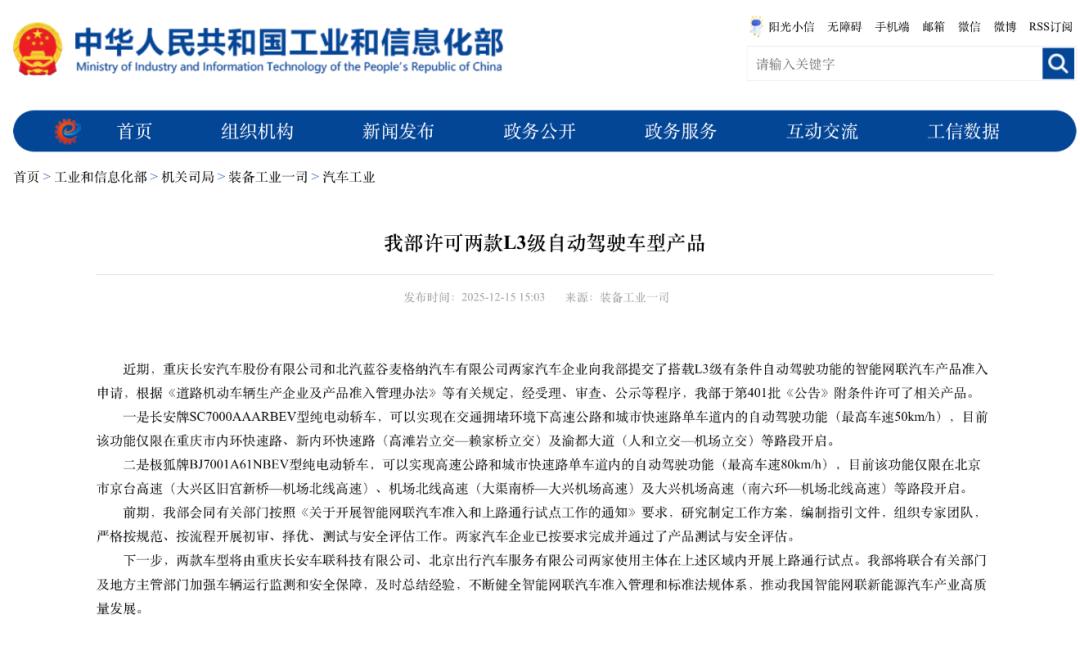
从北汽、长安获得"准入资格",到何小鹏拿"同事裸奔打赌",最近的几个动作和信息,又把 L3 级自动驾驶,推上了热搜,咱们来看看咋回事? 先是北汽新能源和长安汽车,这两家搭载 L3 级有条件自动驾驶功能的智能网联汽车产品,已正式获得工信部准入许可。 可以分别在北京、重庆的特定路段,以最高 80km/h 和最高 50km/h 的速度,实现自动驾驶。 可能有小伙伴会好奇,之前已经有多家车企获得了 L3 级自动驾驶测试资格,北汽和长安的这次有啥新鲜的? 和大家简单解释一下,从测试路开往真实路,这意味着 L3 级自动驾驶,已经逐渐开始走向实战。 深层次,以北京、重庆为先行区,我们的自动驾驶正在落地,后面通过这两个城市的运行方式,可以复制、推广到其他更多的城市,实现加速和普及。 玩的是不是有点大。到了这里不太懂车的小伙伴们,或许还一头雾水,从 L2 级到 L5 级,不同的级别到底代表了啥呢? 严格说,按照我国实施的《汽车驾驶自动化分级》,共有 L0 到 L5 六个等级。 其中,我们比较熟悉、现阶段的主流 L2 级别,为组合驾驶辅助,即车辆可以同时控制车速和方向,完成基本的驾驶任务,但驾驶员仍需监控周围环境并 随时准备接管 ...



解放/重汽/东风/潍柴等超20家企业“换帅”,对2026影响几何?| 头条
第一商用车网· 2025-12-28 12:05
Core Viewpoint - The commercial vehicle industry in 2025 has undergone significant leadership changes across major companies, indicating a strategic shift in management amidst intense market competition [1][46]. Group 1: Major Company Leadership Changes - FAW Jiefang appointed Li Sheng as the new chairman, replacing Wu Bilei, and also saw a significant marketing leadership change with Yu Guangjiang taking over as the head of the marketing headquarters [1][9]. - China National Heavy Duty Truck Group (CNHTC) saw multiple leadership adjustments, with Liu Hongyong becoming chairman and Liu Zhengtai appointed as president [9][10]. - Dongfeng Motor Corporation experienced a series of leadership changes, including Zhang Xiaofan becoming chairman and Liu Liceng taking over as general manager [15][16]. - Weichai Power's president, Li Pengcheng, resigned due to work changes [17]. - Anhui Jianghuai Automobile Group announced a new leadership team with Xiang Xingchu as chairman and Li Ming as general manager [18]. Group 2: Other Notable Changes - The China Ordnance Industry Group appointed Zhou Zhiping as chairman [20]. - Beiben Heavy Truck Group appointed Liu Xiaodong as general manager [23]. - Foton Motor renewed the contract of its general manager, Wu Xibin [23]. - Guangzhou Automobile Group saw Feng Xingya take over as chairman, succeeding Zeng Qinghong [25]. - Changan Automobile Group was established as a new central enterprise, with Zhu Huarong as chairman and Zhao Fei as vice chairman [28]. Group 3: International and Joint Ventures - Cummins China announced several managerial changes across its joint ventures, including new appointments for general managers in various subsidiaries [40]. - Volvo Group China appointed Francis Sum as president, overseeing strategic planning and operations [41]. - ZF Group announced a leadership change with Matthias Miedreich becoming the new chairman [42]. - MAN Truck & Bus appointed Andrew O'Brooks as the new president for Greater China [43].



奇瑞汽车销量迅速跻身哥伦比亚前15
Shang Wu Bu Wang Zhan· 2025-12-27 16:51
Group 1 - The Colombian automotive market is experiencing a recovery, with new brands entering rapidly, particularly Chinese brands showing strong performance [1] - Chery Automobile has seen a significant increase in sales, ranking among the top 15 automotive brands in Colombia [1] - In November 2025, Chery's sales in Colombia grew by 401% year-on-year, increasing from 70 units to 351 units, and its ranking rose to 12th in the country [1] Group 2 - In October 2025, Chery achieved a year-on-year sales increase of 321%, marking the highest growth rate for that month [1] - Since entering the local market in August 2024, Chery has sold over 2,000 vehicles, with expectations to surpass 3,000 units by the first quarter of 2026 [1] - Chery is currently among the leading brands in overall sales and has become one of the top-selling electric vehicle brands in the region [1]
北京发放首批L3级高速公路自动驾驶车辆号牌
Xin Lang Cai Jing· 2025-12-27 16:36
(来源:中国妇女报) 转自:中国妇女报 北京市交管部门介绍,在北京首批上牌的北汽极狐L3级自动驾驶汽车共有3辆,号牌分别为:京 AA0001Z、京AA0733Z、京AA0880Z。车型经过前期系列测试,目前处于有条件的自动驾驶阶段,系 统可在限定条件下执行动态驾驶任务,实现高速公路和城市快速路单车道内最高时速80公里的自动驾驶 功能。负责人强调,尽管可实现限定道路的自动驾驶功能,但仍需驾驶人坐在驾驶位驾车,并作为紧急 情况下接管车辆控制的后援。 据悉,目前"有条件的自动驾驶"功能仅限在北京市京台高速(大兴区旧宫新桥—机场北线高速)、机场 北线高速(大渠南桥—大兴机场高速)及大兴机场高速(南六环—机场北线高速)路段开启。在其他道 路或区域,该功能将被系统强制关闭。 近日,首批L3级高速公路自动驾驶车辆专用号牌由北京市公安局交通管理局正式发放。 ...

远程连冠!长安超五菱,江铃/东风翻倍涨!11月新能源轻客销量增24% | 头条
第一商用车网· 2025-12-27 13:41
Core Viewpoint - The new energy light commercial vehicle (NE LCV) market is experiencing fluctuations, resembling a mature market, with a cumulative sales growth of 18% year-on-year as of October 2025, amounting to nearly 36,000 units [1][5]. Group 1: Market Performance - In November 2025, NE LCV sales reached 28,700 units, marking a 24% year-on-year increase and achieving a "seven consecutive months of growth" [5][34]. - The NE LCV market has shown a pattern of alternating growth and decline throughout the year, with a notable increase in sales from May to November, maintaining monthly sales above 20,000 units [7][34]. - The cumulative sales for NE LCVs from January to November 2025 reached 262,600 units, reflecting a 19% year-on-year growth, surpassing the total sales of the previous year [11][28]. Group 2: Market Penetration and Share - The penetration rate of NE LCVs in the commercial vehicle market has exceeded 70% in recent months, indicating a strong adoption of electric vehicles in this segment [2][9]. - In November 2025, NE LCVs accounted for 70.80% of the total light commercial vehicle market, marking the highest penetration rate recorded [9][32]. - By the end of November 2025, three companies held over 10% market share in the NE LCV sector, with SAIC-GM-Wuling leading at 20.65%, followed closely by Farizon at 19.67% and Changan at 13.35% [25][32]. Group 3: Regional Performance - All 31 provincial-level administrative regions in mainland China have registered NE LCVs, with Guangdong province leading with 47,400 units, accounting for 18.04% of the national total [13][15]. - Notably, provinces like Chongqing and Yunnan have seen their NE LCV registrations double compared to the previous year, while Guangdong experienced a decline in registrations [15][17]. Group 4: Company Performance - In November 2025, 14 companies sold over 300 units of NE LCVs, with 9 companies exceeding 1,000 units, indicating a competitive market landscape [19][21]. - Companies such as Changan, Jiangling, and Dongfeng reported significant year-on-year growth rates, with Changan and Jiangling achieving increases of 128% and 315%, respectively [21][26]. - The cumulative sales rankings for NE LCVs from January to November 2025 show that SAIC-GM-Wuling, Farizon, and Changan are the top three companies, with respective sales of 54,200, 51,700, and 35,100 units [30][32].


汽车行业 2026 年度投资策略报告:不必悲观,结构存机会-20251227
Guohai Securities· 2025-12-27 13:27
Core Insights - The report maintains a "Recommended" rating for the automotive industry, emphasizing that there are opportunities despite potential challenges in 2026 [1][2] - The automotive sector showed a 20% increase over the past 12 months, outperforming the Shanghai and Shenzhen 300 index, which increased by 16.8% [3] Group 1: Industry Overview - The automotive industry is expected to experience a strong performance in commercial vehicles while passenger vehicles may face challenges in 2026 [4] - The report highlights that the passenger vehicle market in 2025 was supported by trade-in policies, leading to stable performance, but anticipates pressure on total volume in 2026 [4] - The heavy truck segment is projected to see positive growth in 2026, driven by domestic demand recovery and increased exports [4] Group 2: Opportunities in Passenger Vehicles - The report identifies a significant opportunity in the high-end passenger vehicle market, particularly for models priced above 300,000 yuan, which is expected to continue to grow [4][5] - Domestic brands are anticipated to make substantial advancements in the high-end market with new models launching in 2026 [5] Group 3: Heavy Truck Market Insights - The heavy truck market is expected to benefit from a recovery in domestic demand and a favorable export environment, with wholesale volumes projected to grow positively in 2026 [4][5] - The report notes that the penetration rate of electric heavy trucks may stabilize in 2026 after significant increases in 2025, which could positively impact profitability [5] Group 4: Smart Driving and Technology - The report discusses the acceleration of high-level autonomous driving technology penetrating lower-priced models, which is expected to drive volume growth in 2026 [5] - The introduction of new AI-driven cockpit technologies is anticipated to enhance the value of smart cabins, creating additional investment opportunities in related components [5] Group 5: Robotics Sector - The report indicates that the humanoid robotics sector is entering a new phase, with significant growth potential for leading manufacturers and their supply chains [5] - The collaboration between domestic and international manufacturers is expected to enhance production capabilities and technological advancements in humanoid robots [5] Group 6: Investment Recommendations - The report recommends several companies for investment, including Jianghuai Automobile, Top Group, and BYD, highlighting their potential in the evolving automotive landscape [6][9] - Specific recommendations for heavy truck manufacturers include China National Heavy Duty Truck Group and Weichai Power, which are expected to benefit from industry growth [6][9]



经济日报:自动驾驶“准入许可”不等于大规模量产
Xin Lang Cai Jing· 2025-12-27 02:14
Core Viewpoint - The issuance of the first L3-level highway autonomous vehicle special license plates in Beijing marks a significant milestone in China's autonomous driving development, transitioning from technical validation to mass production application [1][4]. Group 1: L3-Level Autonomous Driving Overview - L3-level autonomous driving represents a critical transition from "driving assistance" to "autonomous driving," allowing the system to perform driving tasks under certain conditions without continuous driver monitoring [2]. - The first three quarters of this year saw a 21.2% year-on-year increase in new car sales with L2-level driving assistance features, achieving a penetration rate of 64% [2]. Group 2: Regulatory Framework and Testing - The Ministry of Industry and Information Technology (MIIT) has issued strict limitations on the operational scenarios, road types, urban areas, and speed limits for the two approved models, emphasizing a cautious regulatory approach [3]. - There is a distinction between "road test licenses" issued by local authorities and "product access licenses" from national departments, with the latter being significantly more challenging to obtain [3]. Group 3: Future Implications and Challenges - The successful implementation of L3-level autonomous driving requires not only technological advancements but also supportive policies, industry ecosystems, and infrastructure [4]. - The current pilot approach is characterized by "small-scale initiation and conditional implementation," indicating that mass production is not imminent despite the recent approvals [4].