Hengrui Pharma(600276)

Search documents
中国创新药的2026:又一个全球交易的大年? | 海斌访谈
Di Yi Cai Jing· 2026-01-24 01:26
Core Insights - The momentum of Chinese pharmaceutical companies expanding overseas is expected to be sustainable, with strong activity continuing into 2026, although the total number of transactions or amounts may not exceed those of 2025 [1][21]. Group 1: Overseas Licensing Transactions - In January 2025 alone, Chinese pharmaceutical companies completed 10 overseas licensing deals, with a notable transaction between Rongchang Biotech and AbbVie involving an upfront payment of $650 million [1]. - The total number of overseas licensing transactions for Chinese innovative drugs reached 158 in 2025, with a total transaction value of $135.7 billion, marking a ten-year high in both quantity and value [6]. - The upfront payments for overseas licensing transactions in 2025 totaled $7 billion, surpassing the $5.2 billion raised in the primary market by pharmaceutical companies [8]. Group 2: Market Dynamics and Trends - The metabolic field has seen a surge in licensing deals, largely driven by the success of weight-loss drugs from companies like Eli Lilly and Novo Nordisk [4]. - The U.S. remains the primary trading partner for Chinese pharmaceutical companies, accounting for approximately 48% of all licensing transactions over the past decade [12]. - Major pharmaceutical companies are increasingly seeking new pipelines to offset revenue declines from expiring patents, leading to heightened interest in innovative products from Chinese biotech firms [13]. Group 3: Clinical Research and Cost Advantages - China has established a competitive edge in clinical research, with a significantly lower average cost per patient for clinical trials compared to the U.S. ($25,000 in China vs. $70,000 in the U.S.) and a higher patient enrollment rate [16]. - The rapid development of clinical research capabilities in China is expected to continue, further enhancing the country's attractiveness for pharmaceutical partnerships [22]. Group 4: Future Outlook - The interest from multinational pharmaceutical companies in Chinese innovations is expected to remain high, with many companies increasing their presence in China to identify promising assets [20]. - Despite geopolitical tensions, collaboration in innovative drug development between China and the U.S. is strengthening, indicating a logical partnership in addressing healthcare needs [21].



恒瑞医药:公司稳步推进国际化战略,在欧盟地区有药品出口销售业务
Zheng Quan Ri Bao Wang· 2026-01-23 11:47
Group 1 - The company is steadily advancing its internationalization strategy, particularly in the European Union region [1] - The company has a diverse approach to its drug export sales business in the EU [1] - Currently, the revenue from the EU business accounts for a small proportion of the company's overall operating income [1]
医药生物行业周报:九部门发文促进药品零售行业高质量发展,期待药店经营拐点-20260123
BOHAI SECURITIES· 2026-01-23 07:28
Investment Rating - The industry is rated as "Neutral" [8][60] - Specific company ratings include "Buy" for 恒瑞医药 (Hengrui Medicine) and "Increase" for 药明康德 (WuXi AppTec) [8][60] Core Insights - The report highlights the issuance of opinions by nine departments, including the Ministry of Commerce, aimed at promoting high-quality development in the pharmaceutical retail industry, indicating a potential turning point for pharmacy operations [8][16] - The report emphasizes the expected benefits for leading chain pharmacies from policy support and increased industry concentration [8][16] - The inclusion of the drug替尔泊肽 (Tirzepatide) as a breakthrough therapy for treating metabolic-associated fatty liver disease is noted as a significant development [8][16] Industry News - The National Medical Insurance Administration issued a guideline for the pricing of surgical and treatment auxiliary services, consolidating existing price projects into 37 items [16] - The report discusses the promotion of pharmaceutical retail industry transformation towards a "health service hub" through enhanced pharmacy services and optimized purchasing experiences [16][17] - The report mentions the ongoing development of AI applications in healthcare and pharmaceuticals, suggesting investment opportunities in AI-related companies [8][58] Industry Data - As of January 22, 2026, the price index for traditional Chinese medicine shows a year-on-year decline of 14%, with specific herbs like 连翘 (Forsythia) and 党参 (Codonopsis) experiencing significant price drops of 31% and 36% respectively [18][23] - The SW pharmaceutical industry’s price-to-earnings ratio (TTM) is reported at 52.01 times, with a valuation premium of 266% relative to the CSI 300 index [52] Company Announcements - 恒瑞医药 (Hengrui Medicine) received clinical trial approval for multiple drugs, including SHR-7787 and 阿得贝利 (Adalimumab) [30] - 百利天恒 (Baili Tianheng) has had its drug application for treating recurrent or metastatic esophageal squamous cell carcinoma accepted [31] - 复星医药 (Fosun Pharma) announced plans to spin off a subsidiary for listing and received clinical trial approval for a drug targeting advanced colorectal cancer [35]

中欧基金葛兰:一季度医药板块有望延续结构性行情,看好创新药械产业链出海、消费医疗等投资机会
Sou Hu Cai Jing· 2026-01-23 06:53
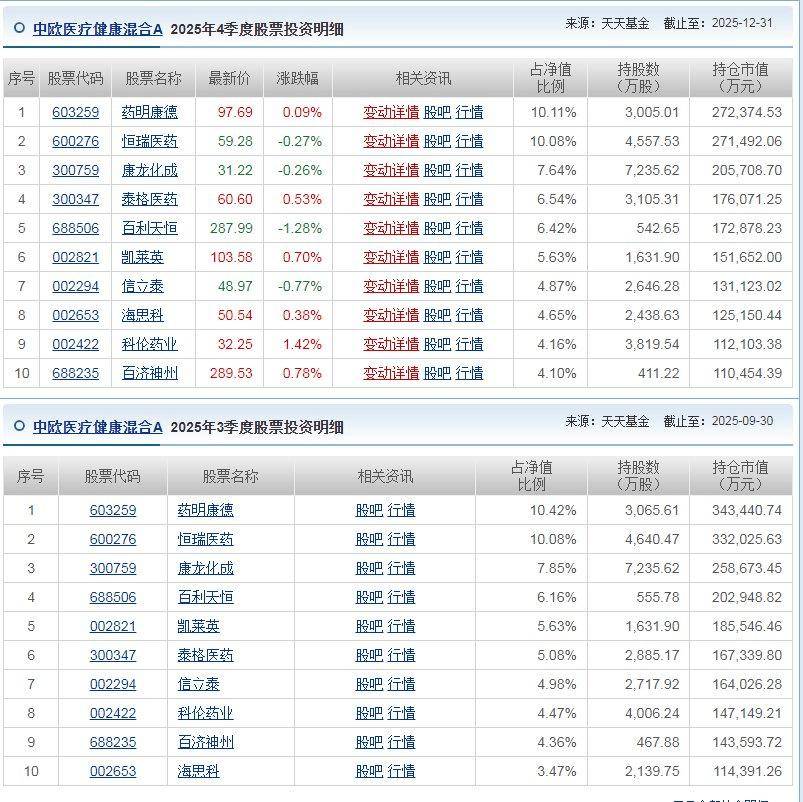
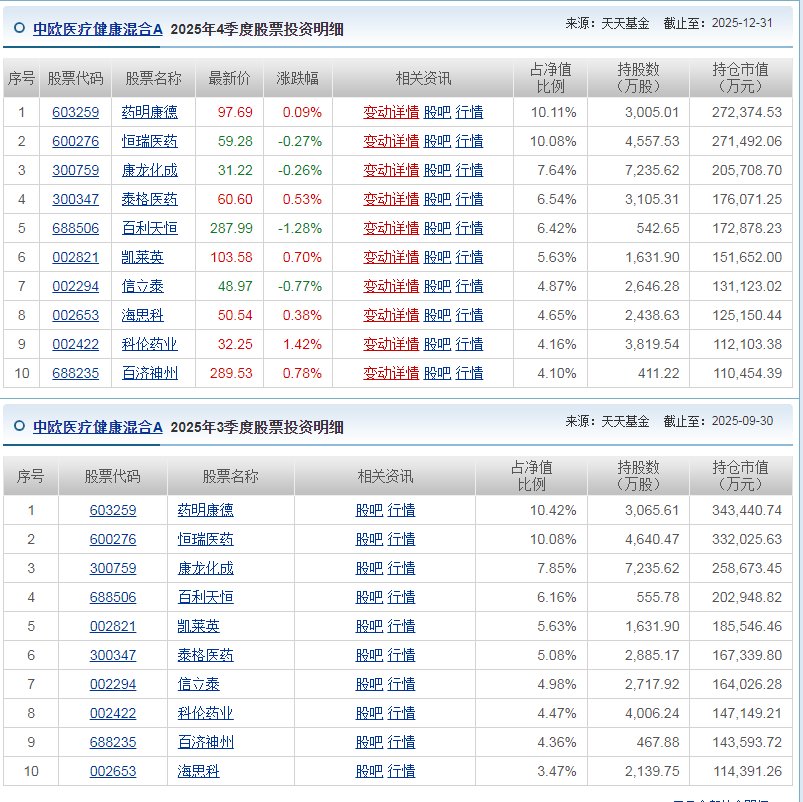
Core Viewpoint - The report highlights the performance of the China Europe Medical Health Mixed Fund managed by Ge Lan and Zhao Lei, indicating a decline in total fund size and negative returns compared to benchmarks [1][4]. Fund Performance - As of December 31, 2025, the total size of the funds managed by Ge Lan decreased from 43.544 billion to 35.389 billion yuan [1]. - The A-class share of the China Europe Medical Health Mixed Fund recorded a net value growth rate of -14.81%, while the C-class share saw a decline of -14.98%, both underperforming the benchmark return of -8.21% [1][3]. Holdings Overview - The top ten holdings of the China Europe Medical Health Fund include WuXi AppTec, Heng Rui Medicine, and Kanglong Chemical, with notable increases in holdings for Hai Si Ke and Tai Ge Medicine, while reductions were seen in stocks like Ke Lun Pharmaceutical and Xin Li Tai [1][2]. Market Context - In Q4 2025, the CSI Pharmaceutical Index fell by 12.7%, underperforming the CSI 300 Index, which declined by only 0.2%. The report notes significant differentiation within sub-sectors, with innovative industries experiencing corrections while traditional Chinese medicine and pharmaceutical commerce remained relatively stable [3]. Future Outlook - Looking ahead to Q1 2026, improvements in global liquidity are expected to boost investment and financing in innovative pharmaceuticals, supported by domestic policy enhancements. The innovative drug and device industry is anticipated to maintain a high level of activity, with several key domestic drugs approaching critical data readouts [4][5]. - The report suggests that the pharmaceutical sector may continue to experience structural trends due to macroeconomic improvements, supportive industry policies, and ongoing innovation, with investment opportunities focusing on the progress of innovative drug and device exports, domestic substitution in equipment, and recovery in consumer healthcare demand [5].

中欧基金葛兰:一季度医药板块有望延续结构性行情 看好创新药械产业链出海、消费医疗等投资机会
Zhi Tong Cai Jing· 2026-01-23 06:33
Core Viewpoint - The report highlights the performance of the China Europe Medical Health Mixed Fund, managed by Ge Lan and Zhao Lei, indicating a decline in total fund size and negative returns compared to benchmarks for the fourth quarter of 2025 [1][4]. Fund Performance - As of December 31, 2025, the total size of funds managed by Ge Lan decreased from 43.544 billion to 35.389 billion yuan [1]. - The net value growth rate for Class A shares of the China Europe Medical Health Mixed Fund was -14.81%, while the benchmark return was -8.21% [1]. - Class C shares experienced a net value growth rate of -14.98%, also underperforming the benchmark [1]. Holdings Overview - The top ten holdings of the China Europe Medical Health Mixed Fund include WuXi AppTec, Heng Rui Medicine, and Kanglong Chemical, with notable increases in holdings for Hai Si Ke and Tai Ge Medicine, while reductions were seen in stocks like Ke Lun Pharmaceutical and Xin Li Tai [1][2]. - The largest holding, WuXi AppTec, accounted for 10.11% of the fund's net value, with a market value of approximately 2.724 billion yuan [2]. Market Context - The CSI Medical Index fell by 12.7% in the fourth quarter of 2025, underperforming the Shanghai and Shenzhen 300 Index, which declined by only 0.2% [3]. - There was significant differentiation within sub-sectors, with the innovative industry chain entering a correction phase after previous gains, while traditional Chinese medicine and pharmaceutical commerce showed relative stability [3]. Future Outlook - Looking ahead to the first quarter of 2026, improvements in global liquidity are expected to boost investment and financing in innovative drugs, supported by domestic policy enhancements [4]. - The innovative drug and medical device industry chain is anticipated to maintain high levels of activity, with several key domestic drugs approaching critical data readout points [5]. - The CXO sector is expected to benefit from a recovery in biotechnology financing, leading to improved order conditions [5]. - The pharmaceutical sector is projected to experience structural trends driven by macroeconomic improvements, supportive industry policies, and ongoing innovation [5].
百川发布循证增强医疗大模型M3 Plus,医疗创新ETF(516820)连续5天净流入
Sou Hu Cai Jing· 2026-01-23 05:56
Group 1 - The core viewpoint of the news highlights the performance of the medical innovation sector, with the China Securities Medical and Medical Device Innovation Index (931484) rising by 0.51% and notable increases in constituent stocks such as Ganli Pharmaceutical (3.05%) and Zhejiang Pharmaceutical (2.29%) [1] - The Medical Innovation ETF (516820) has seen a net inflow of funds over the past five days, with a peak single-day net inflow of 40.537 million yuan, totaling 62.4623 million yuan, averaging a daily net inflow of 12.4925 million yuan [1] - Baichuan Intelligent has launched the Baichuan-M3 Plus evidence-enhanced medical model, achieving a hallucination rate of 2.6%, the lowest globally, and introduced the "Evidence Anchoring" technology to provide citation sources for medical conclusions [1] Group 2 - Everbright Securities emphasizes that the AI+ healthcare sector should focus on several core areas: AI drug development, AI medical imaging, AI chronic disease management, and AI surgical robots, highlighting the strong willingness of pharmaceutical companies to invest in AI drug development due to its potential to significantly shorten drug development cycles [2] - The China Securities Medical and Medical Device Innovation Index selects 30 publicly listed companies with good profitability and growth potential from the pharmaceutical and healthcare sector, reflecting the overall performance of profitable and growth-oriented companies [2] - As of December 31, 2025, the top ten weighted stocks in the index include WuXi AppTec, Hengrui Medicine, Mindray Medical, and others, accounting for 63.75% of the total index weight [2]


“旭易”东升 基金重仓股变迁 折射中国资本市场深刻变化
Shang Hai Zheng Quan Bao· 2026-01-22 18:42
Group 1 - The A-share market experienced fluctuations at relatively high levels in Q4 2025, with a slight decrease in overall equity positions of public funds compared to Q3 2025 [1][2] - The average equity positions for stock and mixed funds were 89.06% and 81.05%, respectively, showing a minor decline from the previous quarter [2] - Major holdings in public funds included leading light module companies, with Zhongji Xuchuang and Xinyi Sheng surpassing Ningde Times and Tencent Holdings to become the top two heavyweights [1][4] Group 2 - Several actively managed equity funds significantly increased their positions, with notable examples including Bosera Huixing and GF Chengxiang, which raised their equity positions by 12.31 and 10.3 percentage points, respectively [2] - Fund managers expressed optimism about the A-share market for 2026, citing potential dual benefits from domestic and international liquidity [3][9] - The focus on technology sectors continued, with managers identifying investment opportunities in storage chips, solid-state batteries, and humanoid robots [7][10] Group 3 - The top 50 heavyweights in public funds were primarily concentrated in information technology, consumer goods, and investment sectors, with 18 stocks in the information technology sector [4][6] - AI-related stocks gained prominence, with Zhongji Xuchuang, Xinyi Sheng, and Hanwujing entering the top seven heavyweights due to the AI boom [4][6] - The number of innovative drug companies in the top 50 heavyweights decreased from eight to five by the end of Q4 2025, indicating a shift in investment focus [5] Group 4 - Fund managers anticipate that the AI investment theme will continue to be a primary focus, with expectations for rapid growth in AI applications in the coming years [9][10] - The investment strategy is shifting towards AI applications, including smart driving, edge AI, and humanoid robots, as the industry matures [9][10] - The overall sentiment among fund managers is that the AI-driven technology market will remain a significant area of investment for the next several years [9][10]


医药生物行业1月22日资金流向日报
Zheng Quan Shi Bao Wang· 2026-01-22 09:24
Market Overview - The Shanghai Composite Index rose by 0.14% on January 22, with 22 out of the 28 sectors in the Shenwan classification experiencing gains, led by the construction materials and defense industries, which increased by 4.09% and 3.23% respectively [1] - The beauty and banking sectors saw the largest declines, with decreases of 0.76% and 0.43% respectively [1] Capital Flow Analysis - The main capital outflow from the two markets totaled 21.612 billion yuan, with 12 sectors experiencing net inflows [1] - The telecommunications sector had the highest net inflow, amounting to 8.019 billion yuan, and it rose by 2.83% [1] - The defense industry also saw significant inflow, with a net inflow of 5.713 billion yuan and a daily increase of 3.23% [1] - The electronics sector faced the largest net outflow, totaling 13.206 billion yuan, followed by the power equipment sector with an outflow of 7.206 billion yuan [1] Pharmaceutical and Biological Industry Performance - The pharmaceutical and biological sector declined by 0.42%, with a net capital outflow of 3.027 billion yuan [2] - Out of 478 stocks in this sector, 253 rose while 204 fell, with 2 stocks hitting the daily limit up [2] - The top three stocks with the highest net inflow were Sanbo Brain Science (1.42 billion yuan), Yunnan Baiyao (667.561 million yuan), and Innovation Medical (637.008 million yuan) [2] - The sector's outflow was led by Hengrui Medicine, which saw a net outflow of 372.7538 million yuan, followed by Xingqi Eye Medicine and Aidi Pharmaceutical with outflows of 208.3529 million yuan and 121.6946 million yuan respectively [3]


主力资金 | 5股尾盘获大幅抢筹
Sou Hu Cai Jing· 2026-01-21 11:59
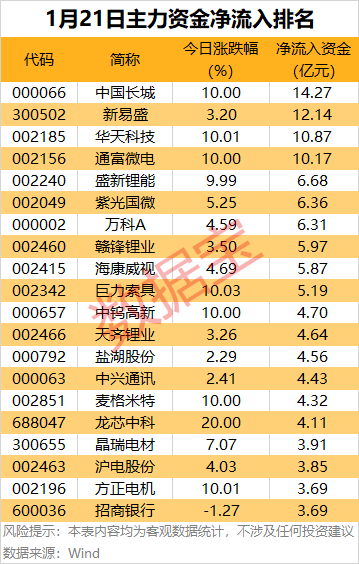
电子行业主力资金净流入金额居首。 A股主要指数今日(1月21日 )集体收涨,行业板块涨多跌少,贵金属、能源金属、采掘行业、电机、 半导体、小金属、电子元件等板块涨幅居前,煤炭、酿酒、商业百货、电网设备等板块跌幅居前。 从今日主力资金情况来看,沪深两市全天主力资金净流入56.08亿元。17个行业主力资金净流入,电 子、有色金属、银行、机械设备行业主力资金净流入金额分别为52.2亿元、43.76亿元、21.59亿元、 11.36亿元;非银金融、通信、计算机、交通运输等行业主力资金净流入金额均超5亿元。 14个主力资金净流出行业中,电力设备、国防军工、传媒行业主力资金净流出金额居前,分别为44.51 亿元、28.47亿元、11.42亿元; 农林牧渔、食品饮料、家用电器、商贸零售行业主力资金净流出金额均 超6亿元。 10股获主力资金净流入均超5亿元 从个股看,56股主力资金净流入均超2亿元,10股获主力资金净流入均超5亿元。 中国长城主力资金净流入14.27亿元,居首。公司近日发布业绩预告,2025年度归母净利润亏损收窄至 3500万元至7000万元,同比减亏95.27%至97.63%,显著改善;扣非净利润亏损6.3 ...




【21日资金路线图】电子板块净流入逾240亿元居首 龙虎榜机构抢筹多股
证券时报· 2026-01-21 11:53
Market Overview - The A-share market saw an overall increase on January 21, with the Shanghai Composite Index closing at 4116.94 points, up 0.08%, the Shenzhen Component Index at 14255.13 points, up 0.7%, and the ChiNext Index at 3295.52 points, up 0.54% [2]. Capital Flow - The net inflow of main funds in the A-share market was 56.08 billion yuan, with an opening net outflow of 41.97 billion yuan and a tail-end net inflow of 6.26 billion yuan [3]. - The CSI 300 index experienced a net inflow of 154.35 billion yuan, while the ChiNext and STAR Market saw net outflows of 61.61 billion yuan and 17.06 billion yuan, respectively [5]. Sector Performance - The electronics sector led with a net inflow of 240.76 billion yuan, followed by non-ferrous metals with 103.65 billion yuan and machinery equipment with 92.59 billion yuan [7]. - The banking sector had the highest net outflow at -104.20 billion yuan, followed by non-bank financials at -84.79 billion yuan and electric power equipment at -76.06 billion yuan [8]. Stock Highlights - China Great Wall had the highest net inflow of main funds at 14.27 billion yuan [9]. - Institutions showed significant interest in stocks such as Zhongtung High-tech, which saw a net purchase of 30.50 million yuan, and Dazhu CNC with a net purchase of 27.86 million yuan [12]. Institutional Focus - Recent institutional ratings include China Railway with a target price of 8.15 yuan, indicating a potential upside of 48.72%, and Hikvision with a target price of 45.00 yuan, suggesting a 38.04% upside [13].