
TONGWEI CO.,LTD(600438)

Search documents
风机大型化节奏明确放缓,十五五规划建议点名氢能“未来产业”
Ping An Securities· 2025-10-28 07:15
Investment Rating - The report maintains an "Outperform" rating for the industry [1] Core Insights - The pace of wind turbine large-scale development is clearly slowing down, with a focus on hydrogen energy as a "future industry" in the 14th Five-Year Plan [1][7] - The wind power index increased by 5.91%, outperforming the CSI 300 index by 2.66 percentage points [4][12] - The overall PE ratio for the wind power index is 25.72 times [12] Summary by Sections Wind Power - The recent Beijing International Wind Energy Conference showcased few new products, with a trend towards standardizing rotor diameters rather than further increasing size [6][11] - The domestic wind turbine market is expected to stabilize, with a focus on international expansion, leading to a gradual recovery in profitability for wind turbine manufacturers by 2026 [6][11] - The wind power index's performance indicates a strong market sentiment, with a year-to-date increase of 40.03% [12][13] Photovoltaics - Tongwei's Q3 earnings showed significant improvement, with a revenue of 24.09 billion yuan, a year-on-year decrease of 1.57%, and a net loss reduction of 5.29 billion yuan [6][4] - The overall PE ratio for the photovoltaic sector is approximately 44.31 times, indicating a high valuation despite short-term supply-demand challenges [4][12] Energy Storage & Hydrogen Energy - The 14th Five-Year Plan emphasizes hydrogen energy as a key future industry, highlighting its potential for significant market growth [7] - The report suggests that the hydrogen energy sector is gaining policy support, with expectations for orderly project implementation across the entire industry chain [7] - Investment opportunities are identified in companies focusing on green hydrogen project investment and operation [7] Investment Recommendations - For wind power, the report recommends focusing on domestic offshore demand, profitability recovery, and international expansion opportunities, highlighting companies like Mingyang Smart Energy and Goldwind [7] - In photovoltaics, attention is drawn to structural opportunities within the industry, with recommended stocks including Dier Laser and Longi Green Energy [7] - In energy storage, the report suggests looking at companies with strong global competitiveness and low valuations, such as Sungrow Power Supply [7]



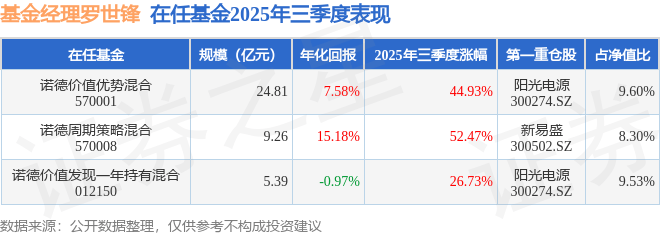
罗世锋2025年三季度表现,诺德周期策略混合基金季度涨幅52.47%
Sou Hu Cai Jing· 2025-10-27 23:31
Core Insights - The best-performing fund managed by fund manager Luo Shifeng is the Nord Cycle Strategy Mixed Fund (570008), which achieved a quarterly net value increase of 52.47% by the end of Q3 2025 [1] Fund Performance Summary - The Nord Value Advantage Mixed Fund (570001) has a total fund size of 24.81 billion, with an annualized return of 7.58% and a Q3 2025 increase of 44.93%, with its top holding being Sungrow Power [2] - The Nord Cycle Strategy Mixed Fund (570008) has a fund size of 9.26 billion, an annualized return of 15.18%, and a Q3 2025 increase of 52.47%, with its top holding being NewEase [2] - The Nord Value Discovery - Annual Holding Mixed Fund (012150) has a fund size of 5.39 billion, with a negative annualized return of -0.97% and a Q3 2025 increase of 26.73%, with its top holding also being Sungrow Power [2] Stock Trading Cases - Notable stock trading cases managed by Luo Shifeng include: - Sungrow Power: Bought in Q3 2020 and sold in Q1 2021, with an estimated return of 300.71% and a company performance growth of 25.15% during the holding period [3] - Longi Green Energy: Held from Q1 2018 to Q2 2023, with an estimated return of 231.97% and a company performance growth of 488.96% [3] - Midea Group: Held from Q2 2016 to Q4 2017, with an estimated return of 136.18% and a company performance growth of 51.35% [3] Underperforming Stock Cases - Underperforming stock cases include: - Opcon Vision: Bought in Q3 2021 and sold in Q1 2024, with an estimated return of -76.32% despite a company performance growth of 40.04% [4] - Tongce Medical: Held from Q3 2021 to Q2 2023, with an estimated return of -63.37% and a company performance growth of 2.37% [4] - Sanan Optoelectronics: Held from Q4 2017 to Q2 2019, with an estimated return of -51.40% [4]






通威股份有限公司关于召开2025年第三季度业绩说明会的公告
Shang Hai Zheng Quan Bao· 2025-10-27 21:18
Core Viewpoint - The company, Tongwei Co., Ltd., is set to hold an investor briefing on November 3, 2025, to discuss its Q3 2025 performance and financial results, allowing for interactive communication with investors [2][3][4]. Group 1: Meeting Details - The investor briefing will take place on November 3, 2025, from 13:00 to 14:00 [4]. - The location for the meeting is the Shanghai Stock Exchange Roadshow Center, accessible online [4]. - The meeting will be conducted in an interactive online format, enabling real-time engagement with investors [3][4]. Group 2: Participation Information - Investors can participate in the briefing by logging into the Shanghai Stock Exchange Roadshow Center on the scheduled date and time [5]. - A pre-question submission period is available from October 27 to October 31, 2025, allowing investors to submit questions via the Roadshow Center or the company's email [5]. Group 3: Company Representatives - Key representatives attending the briefing include the Chairwoman and CEO Liu Shuqin, Independent Director Chen Lei, CFO Zhou Bin, and Board Secretary Yan Ke [4]. Group 4: Contact Information - For inquiries, investors can contact the company via phone at 028-86168555 or email at zqb@tongwei.com [6]. Group 5: Post-Meeting Access - After the briefing, investors can access the meeting details and main content through the Shanghai Stock Exchange Roadshow Center [7].
通威股份 - 2025 年三季度息税前利润转为小幅盈利
2025-10-27 12:06
Summary of Tongwei Co. Ltd. Conference Call Company Overview - **Company**: Tongwei Co. Ltd. - **Ticker**: 600438.SS - **Industry**: China Utilities - **Market Cap**: Rmb99,989.1 million - **Current Share Price**: Rmb22.21 (as of October 24, 2025) - **Price Target**: Rmb21.85 - **52-Week Range**: Rmb32.05 - Rmb14.89 - **Average Daily Trading Value**: Rmb1,517 million Key Financial Highlights - **3Q25 Performance**: - Reported a net loss of Rmb315 million, a significant improvement from losses of Rmb2.4 billion in 2Q25 and Rmb2.6 billion in 1Q25 [3][8] - Revenue remained stable at Rmb24.1 billion, slightly down from Rmb24.6 billion in 2Q25 [3] - Gross margin improved to 7.2%, up from 2.0% in 2Q25 and -2.9% in 1Q25, attributed to the recovery in polysilicon prices [3][8] - EBIT turned to a mild profit of Rmb88 million in 3Q25 after consecutive losses since 1Q24 [8] Industry Context - **Polysilicon Price Recovery**: The recovery in polysilicon prices since early July has positively impacted Tongwei's gross profit margin and reduced asset impairment [8] - **Asset Impairment**: Reduced to Rmb247 million in 3Q25 from -Rmb1.6 billion in 2Q25 and -Rmb796 million in 1Q25, indicating improved inventory management and market conditions [3][8] Investment Thesis - **Market Outlook**: The overall industry view is considered attractive, with expectations of meaningful upside in the next 12 months [2][5] - **Consensus EPS Direction**: Financial results are seen as aligning with or exceeding consensus expectations, leading to a revision of earnings forecasts higher [2] Risks and Considerations - **Upside Risks**: - Higher-than-expected photovoltaic (PV) installations globally - Less-than-expected new polysilicon capacity from new entrants - Higher-than-expected polysilicon prices - Faster development in next-generation solar cell technologies [11] - **Downside Risks**: - Lower-than-expected PV installations worldwide - Intensified competition and pricing pressures across the supply chain - Slower overseas market exploration for its module business - Intensified trade tensions [11] Valuation Methodology - **Valuation Approach**: Price target derived from discounted cash flow (DCF) methodology, capturing long-term cash flows for 2026-2036 with a WACC of 9.5% [9] Conclusion - **Investment Rating**: Equal-weight, indicating a neutral stance on the stock with potential for moderate returns in line with industry performance [5][29]
通威股份(600438):25Q3大幅减亏,多晶硅盈利改善显著
Minsheng Securities· 2025-10-27 10:04
Investment Rating - The report maintains a "Recommended" rating for the company [6] Core Views - The company significantly reduced its losses in Q3 2025, with notable improvement in polysilicon profitability due to price increases and cost reductions during the wet season [2][3] - The company is expected to see revenue growth from 2025 to 2027, with projected revenues of 908.33 billion, 1074.77 billion, and 1201.88 billion respectively, and a return to profitability by 2026 [3][5] Summary by Sections Financial Performance - For the first three quarters of 2025, the company reported revenues of 646.00 billion, a year-on-year decrease of 5.38%, and a net loss attributable to shareholders of 52.70 billion, which is an increase in losses compared to the previous year [1] - In Q3 2025, the company achieved revenues of 240.91 billion, a decrease of 1.57% year-on-year and 1.97% quarter-on-quarter, with a net loss of 3.15 billion, showing a significant reduction in losses compared to previous quarters [1] Polysilicon Market Dynamics - The polysilicon prices saw a substantial increase from the low point in June 2025, with N-type and granular silicon prices rising by 55% and 51% respectively by the end of September 2025 [2] - The improvement in profitability for polysilicon is attributed to the "anti-involution" measures in the photovoltaic sector, which led to price adjustments above the comprehensive cost line [2] Cash Flow and Operational Efficiency - The company reported a positive operating cash flow of 47.76 billion in Q3 2025, indicating a significant improvement in operational quality [3] Future Projections - The company forecasts a return to profitability with net profits of -57.91 billion in 2025, 30.50 billion in 2026, and 60.25 billion in 2027, with corresponding PE ratios of 34X and 17X for 2026 and 2027 respectively [3][5]
通威股份(600438) - 通威股份有限公司关于召开2025年第三季度业绩说明会的公告
2025-10-27 09:31
证券代码:600438 证券简称:通威股份 公告编号:2025-083 通威股份有限公司 关于召开 2025 年第三季度业绩说明会的公告 本公司董事会及全体董事保证本公告内容不存在任何虚假记载、误导性陈述 或者重大遗漏,并对其内容的真实性、准确性和完整性承担法律责任。 重要内容提示: 通威股份有限公司(以下简称"公司")已于 2025 年 10 月 25 日发布公司 2025 年第三季度报告,为便于广大投资者更全面深入地 了解公司 2025 年前三季度经营成果、财务状况,公司计划于 2025 年 11 月 3 日 (星期一) 13:00-14:00 举行 2025 年第三季度业绩说 明会,就投资者关心的问题进行交流。 一、 说明会类型 会议召开时间:2025 年 11 月 3 日(星期一) 13:00-14:00 会 议 召 开 地 点 : 上 海 证 券 交 易 所 上 证 路 演 中 心 ( 网 址 : https://roadshow.sseinfo.com/) 会议召开方式:上证路演中心网络互动 投资者可于 2025 年 10 月 27 日 (星期一) 至 10 月 31 日 (星 期五)16:00 ...
通威股份(600438):Q3业绩环比减亏 经营现金流回正
Xin Lang Cai Jing· 2025-10-27 08:29
Company Performance - In Q3 2025, the company achieved revenue of 24.09 billion yuan, with a year-on-year and quarter-on-quarter decrease of 1.6% and 2.0% respectively, and a net profit attributable to shareholders of -0.31 billion yuan, improving from losses of 0.53 billion yuan and 2.05 billion yuan in the previous periods [1] - The company's operating cash flow significantly improved, reaching 4.78 billion yuan in Q3 2025, indicating a notable enhancement in operational quality [1] - As of the end of Q3 2025, the company had sufficient cash reserves, with total cash and financial assets amounting to 34.77 billion yuan, an increase of 4.6% quarter-on-quarter [1] Silicon Material Business - The profitability of the silicon material business showed significant recovery in Q3, driven by the ongoing "anti-involution" efforts, which are expected to lead to a continuous recovery in silicon material prices [1][2] - As of the end of September 2025, the average price of N-type dense silicon material was 49,700 yuan per ton, a 56% increase from the end of June 2025, aiding in the recovery of previous inventory losses [1][2] - The reduction in electricity prices during the abundant water period in regions like Yunnan and Sichuan, along with production process optimizations, is expected to further lower production costs [1] Industry Outlook - The silicon material sector is viewed as a key focus for the photovoltaic "anti-involution" strategy, which aims to eliminate outdated production capacity through energy consumption control and capacity storage [2] - The National Standardization Administration's draft on energy consumption limits for polysilicon and germanium products indicates tightening energy consumption standards, which may support the structural adjustment of polysilicon capacity [2] - The domestic photovoltaic market saw a total of 240.27 GW of new installations in the first nine months of 2025, a year-on-year increase of 49%, although Q3 2025 installations dropped by 52% due to weakened demand following a rush to install [2] Profit Forecast and Valuation - The company maintains profit forecasts for 2025-2027 at -6.182 billion yuan, 3.571 billion yuan, and 5.132 billion yuan respectively, with corresponding EPS of -1.37, 0.79, and 1.14 yuan [3] - The company is expected to benefit from the ongoing supply-side reforms in the silicon material sector, with a stable dual leadership position in silicon material and battery production [3] - A target price of 31.66 yuan is set for 2026, based on a price-to-earnings ratio of 40.08x, reflecting an increase from the previous target of 25.39 yuan [3]
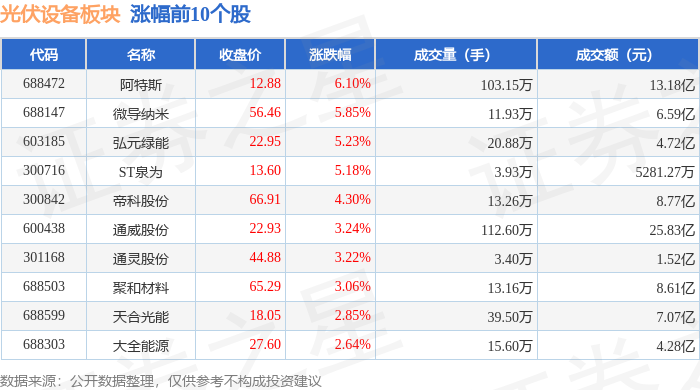
光伏设备板块10月27日涨0.97%,阿特斯领涨,主力资金净流出6.92亿元
Zheng Xing Xing Ye Ri Bao· 2025-10-27 08:25
Market Overview - The photovoltaic equipment sector rose by 0.97% on October 27, with Canadian Solar leading the gains [1] - The Shanghai Composite Index closed at 3996.94, up 1.18%, while the Shenzhen Component Index closed at 13489.4, up 1.51% [1] Top Gainers in Photovoltaic Equipment Sector - Canadian Solar (688472) closed at 12.88, up 6.10% with a trading volume of 1.0315 million shares and a transaction value of 1.318 billion [1] - Micro導Nano (688147) closed at 56.46, up 5.85% with a trading volume of 119,300 shares and a transaction value of 659 million [1] - Hongyuan Green Energy (603185) closed at 22.95, up 5.23% with a trading volume of 208,800 shares and a transaction value of 472 million [1] - Other notable gainers include ST Quanwei (300716), Dike Co., Ltd. (300842), and Tongwei Co., Ltd. (600438) with respective increases of 5.18%, 4.30%, and 3.24% [1] Top Losers in Photovoltaic Equipment Sector - Zhonglai Co., Ltd. (300393) closed at 5.93, down 6.17% with a trading volume of 577,500 shares and a transaction value of 34.6 million [2] - ST Muban (603398) closed at 7.65, down 4.85% with a trading volume of 289,400 shares and a transaction value of 223 million [2] - Jing Sheng Mechanical and Electrical (300316) closed at 40.15, down 4.59% with a trading volume of 430,500 shares and a transaction value of 174.2 million [2] Fund Flow Analysis - The photovoltaic equipment sector experienced a net outflow of 690 million from institutional investors, while retail investors saw a net inflow of 377 million [2] - Notable net inflows from retail investors were observed in stocks like Canadian Solar and Micro導Nano, while institutional investors showed significant outflows from Tongwei Co., Ltd. and TCL Zhonghuan [3]



德意志银行将通威股份评级上调至买进,目标价30元人民币。
Xin Lang Cai Jing· 2025-10-27 07:45
Group 1 - Deutsche Bank upgraded Tongwei Co., Ltd. to a "Buy" rating [1] - The target price for Tongwei Co., Ltd. is set at 30 RMB [1]
通威股份(600438):Q3业绩环比减亏,经营现金流回正
HTSC· 2025-10-27 07:00
Investment Rating - The report maintains a "Buy" rating for the company with a target price of RMB 31.66 [6]. Core Views - The company reported a significant reduction in losses in Q3 2025, with a net profit of -3.1 billion RMB, improving from losses of 5.3 billion RMB year-on-year and 20.5 billion RMB quarter-on-quarter, primarily due to rising silicon material prices and a decrease in electricity prices during the wet season [1][2]. - The company's operating cash flow turned positive at 47.8 billion RMB in Q3 2025, indicating a substantial improvement in operational quality [1]. - The company has sufficient cash reserves, with total cash and financial assets amounting to 34.77 billion RMB as of the end of Q3 2025, reflecting a 4.6% increase [1]. Summary by Sections Silicon Material Business - Q3 2025 saw a significant recovery in profitability for the silicon material business, with the average price of N-type dense silicon reaching 49,700 RMB per ton by the end of September 2025, a 56% increase from June 2025 [2]. - The decrease in electricity prices during the wet season in regions like Yunnan and Sichuan, combined with production process optimizations, is expected to lead to a continued decline in production costs [2]. - The report emphasizes that silicon materials are a key focus of the photovoltaic "anti-involution" strategy, which aims to eliminate outdated production capacity through energy consumption control and capacity storage [2]. Battery Component Business - The battery component business faced operational pressure in Q3 2025, with a year-on-year decline in new installations of photovoltaic systems by 52% in Q3 2025, leading to a potential decrease in the company's battery and component shipments [3]. - Due to declining returns from downstream power plants, there is limited room for price increases in battery components, which may continue to pressure profitability [3]. - The report remains optimistic about long-term demand driven by quality requirements for battery components and projects like large-scale wind and solar bases, photovoltaic desertification, and green electricity connections [3]. Profit Forecast and Valuation - The company’s projected net profits for 2025-2027 are -6.18 billion RMB, 3.57 billion RMB, and 5.13 billion RMB, respectively, with corresponding EPS of -1.37, 0.79, and 1.14 RMB [4]. - The report highlights the company's strong position in both silicon materials and batteries, benefiting from ongoing supply-side reforms and the anti-involution trend [4]. - The target price is set at 31.66 RMB, based on a PE ratio of 40.08x for 2026, reflecting a positive outlook compared to the previous target of 25.39 RMB [4].