
ACC(600585)

Search documents
10亿,安徽海螺新兴产业基金完成签约
FOFWEEKLY· 2025-11-06 10:00
Core Viewpoint - The establishment of the Anhui Conch Emerging Industry Equity Investment Fund aims to promote strategic emerging industries and enhance local economic development through targeted investments in key sectors [1]. Group 1: Fund Overview - The Emerging Industry Fund has a total scale of 1 billion yuan, managed by Conch Private Equity [1]. - The fund is a collaboration between Conch Capital, Wuhu Yijiang District, Anhui High-tech Investment, and Haitong Kaiyuan [1]. Group 2: Investment Focus - The fund focuses on strategic emerging industries such as new materials, new energy, energy conservation and environmental protection, and next-generation information technology [1]. - It aims to implement differentiated investment strategies to strengthen and extend the industrial chain, thereby releasing scale effects [1]. Group 3: Economic Impact - The fund is designed to facilitate dual empowerment and collaborative growth between local economic and industrial development [1].


水泥板块11月6日跌0.66%,福建水泥领跌,主力资金净流出1.81亿元
Zheng Xing Xing Ye Ri Bao· 2025-11-06 08:51
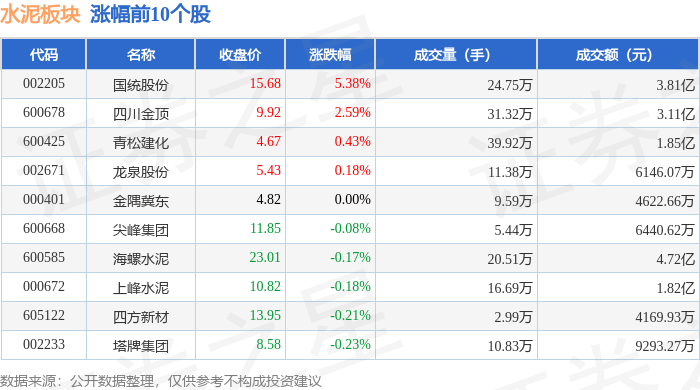
Market Overview - The cement sector experienced a decline of 0.66% on November 6, with Fujian Cement leading the drop [1] - The Shanghai Composite Index closed at 4007.76, up 0.97%, while the Shenzhen Component Index closed at 13452.42, up 1.73% [1] Individual Stock Performance - Fujian Cement saw a significant drop of 9.97%, closing at 7.13, with a trading volume of 490,300 shares and a turnover of 356 million yuan [2] - Other notable declines included: - Hongzhi Fertilizer down 5.84% to 4.35 - Han Jian Heshan down 5.80% to 6.01 [2] - Conversely, Guotong Co. rose by 5.38% to 15.68, with a trading volume of 247,500 shares [1] Capital Flow Analysis - The cement sector experienced a net outflow of 181 million yuan from institutional investors, while retail investors contributed a net inflow of 180 million yuan [2] - The main capital inflows were observed in: - Sichuan Jinding with a net inflow of 37.54 million yuan [3] - Guotong Co. with a net inflow of 25.43 million yuan [3] - Notable outflows included: - Conch Cement with a net outflow of 54.04 million yuan [3] - Sichuan Jinding with a net outflow of 5.30 million yuan [3]


海螺水泥(600585):行业量价下行,三季度业绩环比承压
Hua Yuan Zheng Quan· 2025-11-05 09:15
Investment Rating - The investment rating for the company is "Accumulate" (maintained) [5] Core Views - The report indicates that the cement industry is facing downward pressure on both volume and price, leading to a sequential decline in performance for the third quarter [5][7] - The company's revenue for the third quarter was 20.006 billion yuan, a year-on-year decrease of 11.42%, while the net profit attributable to shareholders increased by 3.41% to 1.937 billion yuan [7] - The report forecasts a recovery in net profit for 2025-2027, with expected figures of 9.706 billion, 10.097 billion, and 10.898 billion yuan respectively [7] Financial Summary - The company's total market capitalization is approximately 121.94 billion yuan, with a circulating market capitalization of the same amount [3] - The company's earnings per share (EPS) for 2023 is projected at 1.97 yuan, decreasing to 1.45 yuan in 2024, and then recovering to 1.83 yuan in 2025 [6] - The company's return on equity (ROE) is expected to be 5.00% in 2025, with a gradual increase to 5.26% by 2027 [6] - The company's gross profit margin for the first three quarters was 24.30%, up 4.76 percentage points year-on-year, but down 4.75 percentage points sequentially in the third quarter [7]
3户省属企业控股上市公司荣获上交所最高评价“A级”
Sou Hu Cai Jing· 2025-11-05 08:27
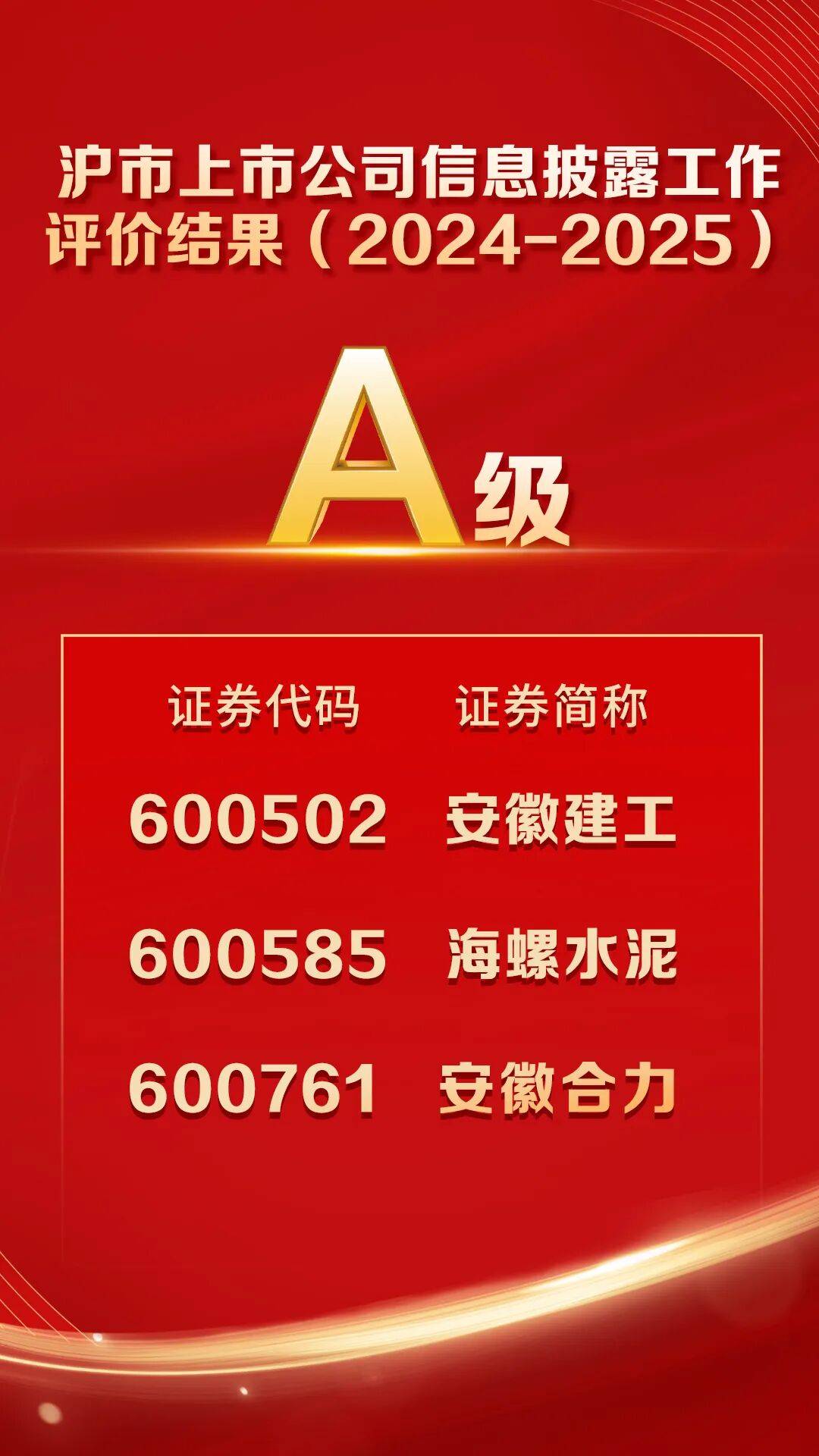
Core Viewpoint - The evaluation of information disclosure practices among listed companies in the Shanghai market for the 2024-2025 period emphasizes the importance of compliance, best practices, and enhancing the quality of listed companies [8]. Group 1: Company Practices - Anhui Construction is focused on improving its information disclosure system and mechanisms, optimizing content and format, and enhancing disclosure quality, with a cumulative cash dividend of 1.339 billion yuan over the past three years [5]. - Conch Cement is committed to enhancing governance efficiency and operational standards, establishing diverse communication channels with investors, and implementing a stable long-term dividend policy to improve investor satisfaction [6]. - Anhui Hefei has optimized its information disclosure management system, covering regular reports and ESG reports, while also strengthening market value management and promoting multi-level investor return mechanisms [7]. Group 2: Evaluation Standards - The Shanghai Stock Exchange has revised its information disclosure evaluation standards to focus on improving disclosure quality, deepening investor communication, strengthening cash dividend supervision, and enhancing the investment value of listed companies [8]. - A total of 2,263 listed companies were evaluated, with 430 companies receiving an "A" grade for their information disclosure practices, representing 19% of the total [8].


西部证券晨会纪要-20251105
Western Securities· 2025-11-05 02:18
Group 1: China Jushi (600176.SH) - The company achieved a revenue of 139.04 billion yuan in the first three quarters of 2025, representing a year-on-year increase of 19.53% [6] - The net profit attributable to shareholders reached 25.68 billion yuan, up 67.51% year-on-year, with a non-recurring net profit of 26.12 billion yuan, increasing by 125.91% [6][9] - The company is expected to achieve net profits of 34.91 billion, 41.07 billion, and 46.48 billion yuan from 2025 to 2027, driven by the recovery of fiberglass prices and demand from various downstream sectors [9] Group 2: Transsion Holdings (688036.SH) - The company reported a revenue of 204.66 billion yuan in Q3 2025, a year-on-year increase of 22.60%, while the net profit attributable to shareholders was 9.35 billion yuan, down 11.06% year-on-year [11] - The company is expected to achieve revenues of 694.0 billion, 751.7 billion, and 871.6 billion yuan from 2025 to 2027, with net profits of 38.2 billion, 56.7 billion, and 70.8 billion yuan respectively [13] Group 3: Tonglian Precision (688210.SH) - The company reported a revenue of 2.4 billion yuan in Q3 2025, a year-on-year increase of 5.75%, while the net profit attributable to shareholders was 884,000 yuan, down 91.67% year-on-year [15] - The company is expected to achieve revenues of 11.4 billion, 15.5 billion, and 21.1 billion yuan from 2025 to 2027, with net profits of 1.0 billion, 1.9 billion, and 2.9 billion yuan respectively [17] Group 4: Topband Co., Ltd. (002139.SZ) - The company achieved a revenue of 26.9 billion yuan in Q3 2025, a slight increase of 0.1% year-on-year, while the net profit attributable to shareholders was 900 million yuan, down 44.7% year-on-year [18] - The company is expected to achieve net profits of 6.2 billion, 8.5 billion, and 10.8 billion yuan from 2025 to 2027 [19] Group 5: Inspur Information (000977.SZ) - The company reported a revenue of 1206.69 billion yuan in the first three quarters of 2025, a year-on-year increase of 45%, with a net profit of 14.82 billion yuan, up 15% year-on-year [25] - The company is expected to achieve net profits of 26.38 billion, 37.31 billion, and 47.77 billion yuan from 2025 to 2027 [26] Group 6: Benda Pharmaceutical (300558.SZ) - The company achieved a revenue of 27.17 billion yuan in the first three quarters of 2025, a year-on-year increase of 15.90%, while the net profit attributable to shareholders was 3.17 billion yuan, down 23.86% year-on-year [28] - The company is expected to achieve revenues of 35.50 billion, 43.71 billion, and 53.09 billion yuan from 2025 to 2027, with net profits of 5.73 billion, 7.21 billion, and 8.56 billion yuan respectively [29] Group 7: XWANDA (300207.SZ) - The company reported a revenue of 435.34 billion yuan in the first three quarters of 2025, a year-on-year increase of 13.73%, with a net profit of 14.05 billion yuan, up 15.94% year-on-year [35] - The company is expected to achieve net profits of 21.83 billion, 30.29 billion, and 40.31 billion yuan from 2025 to 2027 [37] Group 8: YH Technology (688080.SH) - The company achieved a revenue of 2 billion yuan in Q3 2025, a year-on-year increase of 34.5%, with a net profit of 400 million yuan, up 17.5% year-on-year [39] - The company is expected to achieve net profits of 1.5 billion, 2 billion, and 2.6 billion yuan from 2025 to 2027 [40] Group 9: Zhongji Xuchuang (300308.SZ) - The company reported a revenue of 102.2 billion yuan in Q3 2025, a year-on-year increase of 56.8%, with a net profit of 31.4 billion yuan, up 125% year-on-year [42] - The company is expected to achieve net profits of 107 billion, 205 billion, and 268 billion yuan from 2025 to 2027 [43] Group 10: Dongfang Tower (002545.SZ) - The company achieved a revenue of 33.92 billion yuan in the first three quarters of 2025, a year-on-year increase of 9.05%, with a net profit of 8.28 billion yuan, up 77.57% year-on-year [44] - The company is expected to achieve net profits of 12.68 billion, 14.46 billion, and 17.19 billion yuan from 2025 to 2027 [46]


天风证券晨会集萃-20251105
Tianfeng Securities· 2025-11-04 23:41
Group 1 - The report highlights the overall stability of the A-share market in October, with the Shanghai Composite Index slightly increasing by 1.85%, while the ChiNext Index decreased by 1.56% [3] - In the fixed income market, the central bank maintained a tight balance in October, with a net withdrawal of funds amounting to 25.3 billion yuan, and liquidity remained stable towards the end of the month [3] - Commodity prices showed a rebound in October, with non-ferrous metals and precious metals increasing, while pork prices continued to decline [3] - The report anticipates a continuation of stable and flexible policies in the second half of the year, focusing on economic construction and addressing potential geopolitical risks [3][30] Group 2 - The bond market showed signs of recovery in October, with improved trading sentiment and a noticeable decrease in interest rate fluctuations compared to September [5] - Large banks increased their net purchases of short-term bonds, while insurance companies and rural commercial banks shifted their selling focus towards shorter-term bonds [5][31] - The report suggests that the year-end "rush for allocation" may not occur this year due to the volatile bond market and accumulated losses for some institutional investors [5][34] Group 3 - The report emphasizes the importance of understanding the lifecycle of new materials for investment, indicating that many new materials are in the development or introduction phase [6][8] - It suggests that short-term excess returns in new materials investment are closely tied to market trends, and emotional factors play a significant role in theme-based investments [8] - The report recommends focusing on solid-state batteries and electronic fabrics as key investment areas within the new materials sector [8] Group 4 - Haier Smart Home reported a revenue of 234.05 billion yuan for the first three quarters of 2025, reflecting a year-on-year growth of 10%, with a net profit of 17.37 billion yuan, up 14.7% [10] - The company’s domestic air conditioning segment drove growth, while overseas markets showed resilience, particularly in North America and Europe [10] - Midea Group achieved a revenue of 1119.3 billion yuan in Q3 2025, with a net profit of 11.87 billion yuan, indicating strong performance in domestic sales [11][17] Group 5 - The report on environmental utilities indicates that ChuanTou Energy's Q3 revenue was 429 million yuan, down 11.3% year-on-year, with a net profit of 176 million yuan, down 16.96% [18] - The report notes that the company is developing multiple renewable energy projects to enhance future profitability [18] - Guotou Power's Q3 revenue was 14.88 billion yuan, down 14% year-on-year, but the overall performance remained stable due to the coal price decline [19]





海螺水泥(600585):Q3盈利小幅改善 期待反内卷释放盈利弹性
Ge Long Hui· 2025-11-04 19:53
Core Viewpoint - The company reported a decline in revenue for the first three quarters of 2025, but an increase in net profit, indicating improved profitability despite challenging market conditions [1]. Financial Performance - For the first three quarters of 2025, the company achieved revenue of 61.3 billion yuan, a year-on-year decrease of 10.1%, while net profit attributable to shareholders was 6.31 billion yuan, reflecting a year-on-year increase of 21.3% [1]. - In Q3 alone, the company recorded revenue of 20.01 billion yuan, down 11.4% year-on-year, but net profit increased by 3.4% to 1.94 billion yuan [1]. - The company's gross margin in Q3 was 22.44%, up 1.66 percentage points year-on-year, attributed to a larger decline in coal and raw material prices compared to cement prices, as well as the release of high-margin overseas capacity [1]. Cost and Cash Flow - The overall expense ratio for the first three quarters was 10.66%, an increase of 0.74 percentage points year-on-year, with specific changes in expense categories: sales (+0.64), management (+0.89), R&D (-0.49), and financial expenses (-0.29) [1]. - Operating cash flow for Q3 was 2.81 billion yuan, a decrease of 666 million yuan year-on-year [1]. Industry Outlook - The cement industry is currently at a cyclical low in profitability, with demand expected to remain stable but slightly declining due to weak infrastructure and housing demand [1]. - The industry is strengthening measures against overproduction, with a policy document released in July 2025 aimed at enhancing supply coordination, which may lead to a gradual recovery in profitability [1]. - As an industry leader, the company is expected to benefit from cost advantages that provide profit elasticity [1]. Profit Forecast - Revenue projections for 2025 and 2026 are 90.8 billion yuan and 92.5 billion yuan, respectively, with year-on-year changes of -0.3% and +1.9% [2]. - Expected net profits for 2025 and 2026 are 8.81 billion yuan and 9.92 billion yuan, reflecting year-on-year increases of 14.5% and 12.6% [2]. - Corresponding price-to-earnings ratios for 2025 and 2026 are projected at 14.0X and 12.4X [2].
水泥板块11月4日跌0.2%,上峰水泥领跌,主力资金净流入6857.27万元
Zheng Xing Xing Ye Ri Bao· 2025-11-04 08:48
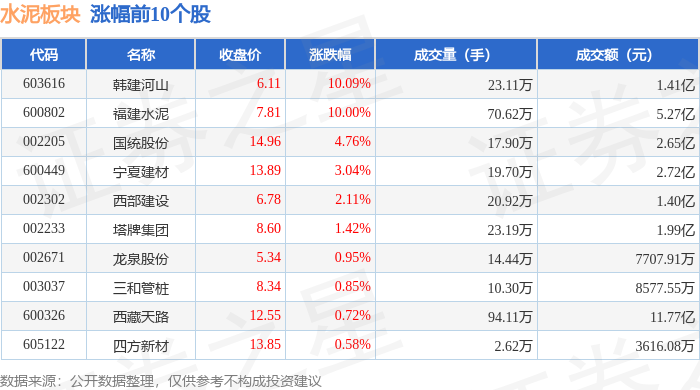
Market Overview - The cement sector experienced a decline of 0.2% on November 4, with Shangfeng Cement leading the drop [1] - The Shanghai Composite Index closed at 3960.19, down 0.41%, while the Shenzhen Component Index closed at 13175.22, down 1.71% [1] Individual Stock Performance - Hanjian Heshan saw a significant increase of 10.09%, closing at 6.11, with a trading volume of 231,100 shares and a turnover of 141 million yuan [1] - Fujian Cement also rose by 10.00%, closing at 7.81, with a trading volume of 706,200 shares and a turnover of 527 million yuan [1] - Conversely, Shangfeng Cement fell by 1.83%, closing at 10.74, with a trading volume of 152,300 shares and a turnover of 164 million yuan [2] Capital Flow Analysis - The cement sector had a net inflow of 68.57 million yuan from institutional investors, while retail investors saw a net outflow of 93.65 million yuan [2][3] - Notably, Fujian Cement experienced a net inflow of 102 million yuan from institutional investors, but a net outflow of 68.33 million yuan from retail investors [3] - Hanjian Heshan had a substantial net inflow of 77.89 million yuan from institutional investors, with a significant net outflow of 39.61 million yuan from retail investors [3]


海螺水泥(600585):Q3盈利小幅改善,期待反内卷释放盈利弹性
China Post Securities· 2025-11-04 07:50
Investment Rating - The investment rating for the company is "Buy" [13] Core Views - The company reported a slight improvement in Q3 earnings, with a focus on the potential for profit elasticity due to anti-competitive measures in the industry [5][7] - The overall revenue for the first three quarters of 2025 was 61.3 billion yuan, a year-on-year decline of 10.1%, while net profit attributable to shareholders increased by 21.3% to 6.31 billion yuan [5][6] - The report anticipates a gradual recovery in profitability driven by cost advantages and improved operational efficiency [7] Company Overview - The latest closing price is 23.19 yuan, with a total market capitalization of 122.9 billion yuan [4] - The company has a total share capital of 5.299 billion shares, with 4 billion shares in circulation [4] - The debt-to-asset ratio stands at 21.3%, and the price-to-earnings ratio is 15.88 [4] Financial Performance - Q3 revenue was 20.01 billion yuan, down 11.4% year-on-year, but net profit for the quarter rose by 3.4% to 1.94 billion yuan [5][6] - The gross margin for Q3 improved to 22.44%, an increase of 1.66 percentage points year-on-year, attributed to falling coal and raw material prices [6] - The company expects revenues of 90.8 billion yuan and 92.5 billion yuan for 2025 and 2026, respectively, with net profits projected at 8.81 billion yuan and 9.92 billion yuan [7][9] Profitability Forecast - The report forecasts a net profit growth of 14.5% in 2025 and 12.6% in 2026, with corresponding price-to-earnings ratios of 14.0X and 12.4X [7][9] - The EBITDA for 2025 is estimated at 25.17 billion yuan, reflecting a significant recovery in operational performance [9][12]
海螺水泥(600585):需求承压导致Q3收入降幅扩大,但业绩仍彰显韧性
Western Securities· 2025-11-04 07:02
Investment Rating - The investment rating for the company is "Buy" [6] Core Views - The company has demonstrated resilience in its performance despite a significant decline in revenue due to weak demand, with a year-on-year revenue decrease of 10.06% for the first three quarters of 2025, while net profit increased by 21.28% [1][2] - The cement industry has faced continuous demand pressure, with national cement production declining by 1.43%, 5.7%, and 6.8% year-on-year in Q1, Q2, and Q3 respectively, leading to a further drop in prices [2][3] - The company is expected to benefit from policies aimed at tightening supply in the cement industry, which may lead to the elimination of outdated production capacity [3][4] Summary by Sections Financial Performance - For the first three quarters of 2025, the company achieved revenue of 612.98 billion yuan, a decrease of 10.06% year-on-year, while net profit reached 63.05 billion yuan, an increase of 21.28% [1][6] - In Q3 alone, the company reported revenue of 200.06 billion yuan, down 11.42% year-on-year, but net profit increased by 3.41% to 19.37 billion yuan [1][2] Profitability Metrics - The company's gross margin for the first three quarters of 2025 improved by 4.76 percentage points to 24.30%, while the net profit margin increased by 2.76 percentage points to 10.45% [3] - In Q3, the gross margin was 22.44%, showing a decline from the previous quarter but an increase year-on-year [3] Future Outlook - The company is projected to achieve net profits of 87.94 billion yuan, 105.86 billion yuan, and 125.15 billion yuan for the years 2025, 2026, and 2027 respectively, with corresponding EPS of 1.66, 2.00, and 2.36 yuan per share [4] - The company is expected to maintain its leadership position in the industry, benefiting from cost and scale advantages even during periods of declining demand [4]