Tsingtao Brewery(600600)

Search documents
低度酒行业上市公司董秘观察:50(含)岁以上是主力青岛啤酒董秘张瑞祥59岁年龄最大
Xin Lang Cai Jing· 2025-08-08 04:32
Summary of Key Points Core Viewpoint - The 2024 A-share Secretary Data Report indicates that the total salary of secretaries in A-share listed companies reached 4.086 billion yuan, with an average annual salary of 700,000 yuan, highlighting the significant role of secretaries in connecting investors and listed companies [1]. Group 1: Salary Overview - The total salary for secretaries in the low-alcohol beverage industry amounted to 10.5195 million yuan, with an average salary of 657,500 yuan, which is below the market average [1]. - In the low-alcohol beverage sector, 56% of secretaries earn between 500,000 yuan and 1 million yuan, while 13% earn between 1 million yuan and 2 million yuan [2]. Group 2: Age and Education - Among the secretaries in the low-alcohol beverage industry, 56% are aged 50 and above, while 31% are aged between 40 and 50, and only 2 are aged between 30 and 40 [2]. - The majority of secretaries in this industry hold a bachelor's degree, accounting for 75%, while only 25% have a master's degree [2]. Group 3: Individual Salary Highlights - The highest-paid secretary is from Chongqing Beer, earning 1.3047 million yuan, followed by Yanjing Beer at 1.0516 million yuan, and Zhangyu A at 997,200 yuan [3]. - The lowest-paid secretary is from Mogao Co., earning only 140,000 yuan, with the second lowest being *ST Lanhua at 293,300 yuan [3]. - Five companies reported an increase in secretary salaries, with Yanjing Beer’s secretary seeing the highest increase of 244,300 yuan [3].



低度酒行业上市公司董秘观察:重庆啤酒董秘邓炜薪酬最高达到130.47万元
Xin Lang Cai Jing· 2025-08-08 04:32
Summary of Key Points Core Viewpoint - The 2024 A-share Secretary Data Report indicates that the total salary of secretaries in A-share listed companies reached 4.086 billion yuan, with an average annual salary of 700,000 yuan, highlighting the significant role of secretaries in connecting investors and listed companies [1]. Salary Distribution - In the low-alcohol beverage industry, the total salary for secretaries across 16 listed companies was 10.5195 million yuan, with an average salary of 657,500 yuan, which is below the market average [1]. - The majority of secretaries in the low-alcohol beverage sector earn between 500,000 yuan and 1 million yuan, accounting for 56% of the total [2]. Age and Education - Among the secretaries in the low-alcohol beverage industry, 56% are aged 50 and above, while 31% are aged between 40 and 50, and only 13% are aged between 30 and 40 [2]. - The educational background of secretaries shows that 75% hold a bachelor's degree, while only 25% have a master's degree [2]. Individual Salary Highlights - The highest-paid secretary is from Chongqing Beer, earning 1.3047 million yuan, followed by Yanjing Beer at 1.0516 million yuan, and Zhangyu A at 997,200 yuan [3]. - The lowest-paid secretary is from Mogaogongsi, earning only 140,000 yuan, followed by ST Lanhua at 293,300 yuan [3]. Salary Changes - Among the secretaries, five experienced salary increases, with the highest increase being 244,300 yuan for Yanjing Beer [3]. - Conversely, five secretaries saw salary reductions, with the largest decrease being 252,400 yuan for Zhangyu A [3].


低度酒行业上市公司董秘观察:薪酬最低的是莫高股份何文天 仅为14万元
Xin Lang Zheng Quan· 2025-08-08 03:57
Core Insights - The report highlights that in 2024, the total salary of A-share listed company secretaries reached 4.086 billion yuan, with an average annual salary of 754,300 yuan [1] - The low-alcohol beverage industry has 16 listed companies with a total secretary salary of 10.5195 million yuan, averaging 657,500 yuan, which is below the market average [1] Salary Distribution - In the low-alcohol beverage sector, 56% of secretaries earn between 500,000 yuan and 1 million yuan, while 13% earn between 1 million yuan and 2 million yuan [3] - The highest-paid secretary is from Chongqing Beer, earning 1.3047 million yuan, followed by Yanjing Beer at 1.0516 million yuan, and Zhangyu A at 997,200 yuan [3] - The lowest salary recorded is 140,000 yuan from Mogao Co., followed by 293,300 yuan from *ST Lanhua [3] Salary Changes - Among the companies, five secretaries saw salary increases, with the highest increase of 244,300 yuan for Yanjing Beer’s secretary [3] - Conversely, five secretaries experienced salary reductions, with the largest decrease being 252,400 yuan for Zhangyu A’s secretary [3] Demographics - The majority of secretaries in the low-alcohol beverage industry are aged 50 and above, accounting for 56%, while those aged 40-50 make up 31%, and only 2 are aged 30-40 [1] - Educationally, 75% of secretaries hold a bachelor's degree, while 25% have a master's degree [1]


低度酒行业上市公司董秘观察:重庆啤酒董秘邓炜薪酬最高 达到130.47万元
Xin Lang Zheng Quan· 2025-08-08 03:48
Core Insights - The report highlights that in 2024, the total salary of A-share listed company secretaries reached 4.086 billion yuan, with an average annual salary of 754,300 yuan [1] - The low-alcohol beverage industry has 16 listed companies with a total secretary salary of 10.5195 million yuan, averaging 657,500 yuan, which is below the market average [1] Salary Distribution - In the low-alcohol beverage sector, 56% of secretaries earn between 500,000 yuan and 1 million yuan, while 13% earn between 1 million yuan and 2 million yuan [3] - The highest-paid secretary is from Chongqing Beer, earning 1.3047 million yuan, followed by Yanjing Beer at 1.0516 million yuan, and Zhangyu A at 997,200 yuan [3] - The lowest salary recorded is 140,000 yuan from Mogao Co., followed by 293,300 yuan from *ST Lanhua [3] Salary Changes - Among the companies, five secretaries saw salary increases, with Yanjing Beer’s secretary having the highest increase of 244,300 yuan [3] - Conversely, five secretaries experienced salary reductions, with Zhangyu A's secretary facing the largest decrease of 252,400 yuan [3] Demographics - The majority of secretaries in the low-alcohol beverage industry are aged 50 and above, accounting for 56%, while those aged 40 to 50 make up 31% [1] - Educationally, 75% of secretaries hold a bachelor's degree, while only 25% have a master's degree [1]
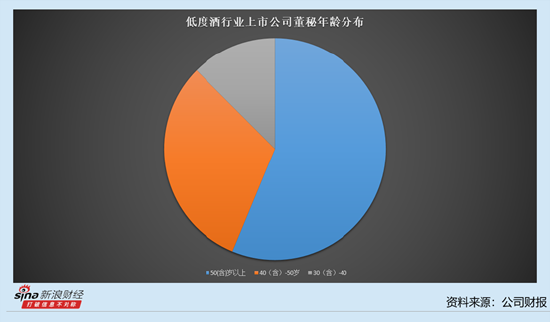
低度酒行业上市公司董秘观察:50(含)岁以上是主力 青岛啤酒董秘张瑞祥59岁年龄最大
Xin Lang Zheng Quan· 2025-08-08 03:42
Core Insights - The report highlights that in 2024, the total salary for A-share company secretaries reached 4.086 billion yuan, with an average annual salary of 754,300 yuan [1] - The report indicates that over 21% of company secretaries earn more than 1 million yuan annually [1] Salary Overview - The total salary for company secretaries in the low-alcohol beverage industry amounted to 10.5195 million yuan, with an average salary of 657,500 yuan, which is below the market average [1] - In the low-alcohol beverage sector, 56% of company secretaries earn between 500,000 yuan and 1 million yuan, while 13% earn between 1 million and 2 million yuan [3] - The highest-paid company secretary is from Chongqing Beer, earning 1.3047 million yuan, followed by Yanjing Beer at 1.0516 million yuan [3] Age and Education Demographics - Among company secretaries in the low-alcohol beverage industry, 56% are aged 50 and above, while 31% are aged between 40 and 50 [1] - The majority of company secretaries hold a bachelor's degree, accounting for 75%, while only 25% have a master's degree [1] Salary Changes - Five companies reported an increase in company secretary salaries, with the highest increase being 244,300 yuan for Yanjing Beer [3] - Conversely, five companies experienced a decrease in salaries, with the largest drop being 252,400 yuan for the company secretary of Zhangyu A [3]
【宝鸡】(青岛)啤酒音乐美食季促消费活动启动
Shan Xi Ri Bao· 2025-08-08 00:06
"本次活动以茵香小镇为主会场,联动文化里、恒太城、新民巷、一城天街四大分会场,构建起覆 盖全城的欢乐矩阵。我们精心策划美食品鉴、沉浸消费、音乐之夜、露营休闲等系列活动,让大家开启 味蕾的狂欢、尽享购物的乐趣、感受山水的诗意,共赴一场银河为幕、晚风为歌的浪漫邀约。"渭滨区 相关负责人说。 宝鸡市商务局相关负责人介绍,今年以来,宝鸡市深挖消费潜力,培育消费动能,全力打好提振消 费硬仗。此次活动覆盖城乡,将形成"主会场领航、分会场各美其美"的消费矩阵,让每个县区都有"家 门口的诗和远方"。宝鸡诚邀八方宾客走进21个会场,以啤酒为媒、以音乐为伴、以美食为桥,领略"看 山水、品文化、享生活"的独特魅力。(记者:刘坤) 8月4日晚,2025宝鸡(青岛)啤酒音乐美食季促消费活动在宝鸡市渭滨区茵香小镇启动。接下来的 两个月,活动将联动宝鸡市20个分会场,依托地域特色,轮番呈现啤酒、美食与音乐交织的城市盛宴。 本次活动以"乐购宝鸡 悦享生活"为主题,聚焦餐饮消费、夜间消费、青年消费、文旅消费、大宗 消费五大领域,相继开展"品味宝鸡"美食季、餐饮消费券发放、非遗夜市、"票根经济"促销、微体育赛 事、暑期文化旅游、汽车展销等活动, ...
啤酒:渠道变革,精酿崛起
2025-08-06 14:45
Summary of Key Points from the Conference Call on the Beer Industry Industry Overview - The Chinese beer market has entered a mature phase, with a gradual decline in per capita penetration rates and a decrease in the primary drinking population, posing challenges for total growth [1][5] - The high-end beer segment's growth has slowed due to economic cycles and policy impacts, but long-term economic recovery may drive structural upgrades in high-end consumption [1][5] Core Trends and Insights - The rise of craft beer and new retail channels are identified as key development trends starting from 2024, providing growth opportunities for both large and regional breweries [2][3] - New retail channels have accelerated channel equality, allowing mid-tier brands to utilize OEM to manage production capacity, while major brands like Heineken, Budweiser, and Tsingtao still dominate sales in these channels [2][4] - The new generation of consumers (post-90s and post-00s) emphasizes value for money and emotional value, driving demand for product innovation rather than solely focusing on high-end branding [3][6] Craft Beer Market Dynamics - The craft beer market in China is growing rapidly, with a penetration rate still lower than that of mature markets, indicating significant future growth potential [1][9] - As of 2024, craft beer sales in China are projected to increase from 40,000 tons in 2021 to 390,000 tons, with a penetration rate of approximately 1% [9] - Major players in the craft beer market include large industrial breweries, regional breweries, imported brands, and private label brands [9] Challenges Facing the Beer Industry - The industry faces challenges such as declining sales volume, a shrinking primary drinking population, and a slowdown in the high-end segment due to economic conditions and regulatory impacts [5][6] - The current market environment requires innovation in product categories and channels to find new growth opportunities [6][7] Future Directions - The focus on product innovation and the shift in drinking culture from social enjoyment to personal satisfaction will shape future strategies for breweries [6][7] - The craft beer segment is expected to thrive, with large brands leveraging their scale and brand strength to capture growth opportunities [3][12] Impact of New Retail Channels - New retail channels are reshaping the competitive landscape by increasing the share of non-traditional sales channels, but they primarily optimize existing sales methods rather than creating new consumer segments [13][14] - The sales performance of major brands in new retail channels indicates that consumer preferences still lean towards established high-end brands [14][15] Conclusion - The beer industry in China is at a crossroads, with significant opportunities in craft beer and new retail channels, but also facing challenges from market saturation and changing consumer preferences. The ability of both large and small breweries to adapt to these changes will be crucial for future success [1][12][17]
青岛啤酒交易所登陆1903MIX极地海洋公园店解锁沉浸式啤酒消费新体验
Xin Lang Cai Jing· 2025-08-05 12:04
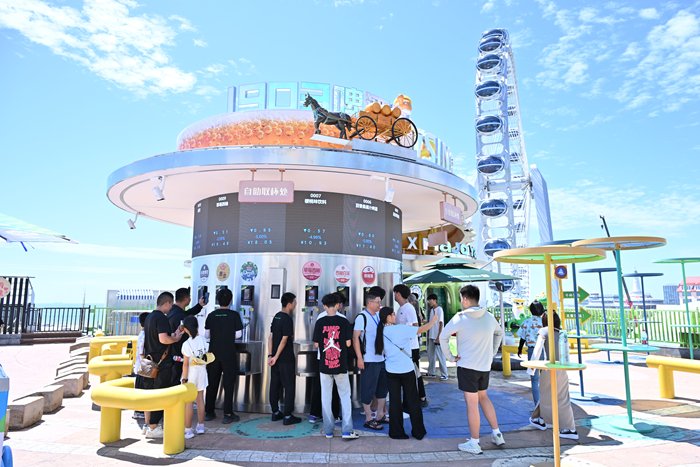
从啤酒交易所的创新互动到周末啤酒节的社交狂欢,再到新鲜饮品与美食的多元呈现,TSINGTAO 1903正以"啤酒+体验"的跨界思维,让百年啤酒文化在年轻群体中焕发新活力。 来源:推广 转自:推广 文 | 周涛 当啤酒文化遇上创新消费场景,青岛正书写着属于自己的 "微醺图鉴"。近日,凭借 "酒价随行就市" 火出圈的青岛啤酒交易所正式登陆 1903MIX 极地海洋公园店,将金融交易的趣味与啤酒 在1903MIX极地海洋公园店的啤酒交易所区域,智能屏幕上实时跳动的价格曲线格外吸睛。从经典生啤的醇厚麦香到果味精酿的清新酸甜,15余种啤酒风味组成"酒市大盘",价格随消费者的实 版 啤酒交易所的热度持续发酵,也让TSINGTAO 1903青岛啤酒吧的"周末啤酒节"成为年轻人的社交新据点。每逢周末,这里便化身欢乐竞技场,各类趣味赛事轮番上演。王牌速饮赛上,参赛者比 在饮品与美食的呈现上,TSINGTAO 1903始终坚守"新鲜"与"创意"。鲜爽生啤是绝对主角,从工厂直送的原浆、纯生等品类,通过冷链确保新鲜度,每一口都带着麦芽的鲜活香气。搭配的生鲜 ...
中国必选消费8月投资策略:关注政策催化带来的结构性机会
Haitong Securities International· 2025-08-04 09:33
Investment Focus - The report highlights a focus on structural opportunities driven by policy catalysis, particularly in essential consumer sectors such as dairy products and liquor, while cautioning against the risks in the soft drink sector [7]. Demand Analysis - In July, among the eight tracked essential consumer sectors, six maintained positive growth, while two experienced negative growth. The sectors with single-digit growth included dining (+4.4%), soft drinks (+2.7%), frozen foods (+1.7%), condiments (+1.1%), dairy products (+1.1%), and beer (+0.6%). The declining sectors were high-end and above liquor (-4.0%) and mass-market liquor (-3.9%) [3][9]. - The report notes that five sectors saw a deterioration in growth rates compared to the previous month, while three improved. The new alcohol ban and adverse weather conditions were identified as significant negative factors affecting demand [3][9]. Price Trends - In July, most liquor wholesale prices stabilized after a period of decline. Specific prices included Feitian at 1915/1880/655 yuan for different packaging, with year-on-year declines of 665/500/155 yuan. The price of Wuliangye was 930 yuan, showing a slight increase of 10 yuan from the previous month [3][22][24]. - The report indicates that the prices of liquid milk and beer saw a reduction in discount rates, while soft drink discounts increased, with stable prices for infant formula, convenience foods, and condiments [4][19]. Cost Analysis - The report states that the spot cost index for various sectors, including dairy, soft drinks, frozen foods, and beer, generally decreased in July, while futures cost indices showed mixed results. For instance, the spot cost index for dairy products fell by 2.92% [4]. Fund Flow - As of the end of July, net inflows into Hong Kong Stock Connect amounted to 124.1 billion yuan, with the essential consumer sector's market capitalization share rising to 5.05%. The food additives sector saw a decrease in share, while the dairy sector experienced an increase [5]. Valuation Insights - By the end of July, the historical PE ratio for the food and beverage sector was at 16% (20.2x), remaining stable from the previous month. The report notes that the median valuation for leading A-share companies was 20x, a decrease of 1x from the previous month [6]. Sector Recommendations - The report recommends focusing on sectors benefiting from policy support, particularly dairy and liquor, while being cautious about the soft drink sector's marginal deterioration. Specific companies to watch include China Feihe, Yili, Mengniu, Master Kong, Uni-President, Yanghe, WH Group, and China Foods [7].





中国必选消费品7月需求报告:多数行业增速变差
Haitong Securities International· 2025-08-04 08:20
Investment Rating - The investment rating for the Chinese consumer staples sector is "Outperform" for multiple companies including Guizhou Moutai, Wuliangye, and Yili [1]. Core Insights - In July 2025, among the eight key tracked consumer staples industries, six maintained positive growth while two experienced negative growth. The industries with single-digit growth include catering, soft drinks, frozen foods, condiments, dairy products, and beer, while the only declining industry was Baijiu [30]. - The growth rate of most industries has deteriorated compared to the previous month, with five industries showing a decline in growth rates and three showing improvement. The new alcohol ban and adverse weather conditions are significant negative factors impacting the sector [3][30]. Summary by Industry Baijiu (Chinese Liquor) - For the high-end and above Baijiu segment, July revenue was 19 billion yuan, down 4.0% year-on-year, with cumulative revenue from January to July at 243.1 billion yuan, a decrease of 0.8% [10]. - The low-end Baijiu segment saw July revenue of 11 billion yuan, down 3.9% year-on-year, with cumulative revenue from January to July at 115.9 billion yuan, down 12.8% [12]. Beer - The domestic beer industry reported July revenue of 17.6 billion yuan, a year-on-year increase of 0.6%, with cumulative revenue from January to July at 111.9 billion yuan, up 0.7% [15]. Condiments - The condiment industry generated July revenue of 36.6 billion yuan, a year-on-year increase of 1.1%, with cumulative revenue from January to July at 261.6 billion yuan, up 1.6% [17]. Dairy Products - The dairy industry reported July revenue of 38.4 billion yuan, a year-on-year increase of 1.1%, with cumulative revenue from January to July at 267.8 billion yuan, up 0.3% [19]. Frozen Foods - The frozen food industry had July revenue of 7.58 billion yuan, a year-on-year increase of 1.7%, with cumulative revenue from January to July at 64.5 billion yuan, up 1.4% [21]. Soft Drinks - The soft drink industry reported July revenue of 71 billion yuan, a year-on-year increase of 2.7%, with cumulative revenue from January to July at 425 billion yuan, up 2.5% [23]. Catering - The catering sector generated July revenue of 16.7 billion yuan, a year-on-year increase of 4.4%, with cumulative revenue from January to July at 103.9 billion yuan, up 3.0% [25].