HAIER SMART HOME(600690)

Search documents
海尔取得用于空调的通风格栅专利
Sou Hu Cai Jing· 2025-12-30 12:31
Group 1 - Haier Smart Home Co., Ltd. has obtained a patent for "Ventilation Grille and Air Conditioner" with authorization number CN119713550B, applied on September 2023 [1] - Qingdao Haier Smart Building Technology Co., Ltd. was established in 2003, focusing on general equipment manufacturing, with a registered capital of 100 million RMB [1] - Qingdao Haier Air Conditioning Electronics Co., Ltd. was founded in 1999, specializing in manufacturing specialized equipment, with a registered capital of approximately 967.09 million RMB [1] Group 2 - Qingdao Haier Air Conditioner Co., Ltd. was established in 1996, primarily engaged in electrical machinery and equipment manufacturing, with a registered capital of approximately 936.38 million RMB [2] - Qingdao Haier Intelligent Technology Research and Development Co., Ltd. was founded in 2014, focusing on research and experimental development, with a registered capital of 13 million RMB [2] - Haier Smart Home Co., Ltd. was established in 1994, primarily engaged in electrical machinery and equipment manufacturing, with a registered capital of approximately 943.81 million RMB [2]
2025年A股十大最惨板块,跌麻了
Ge Long Hui· 2025-12-30 11:30
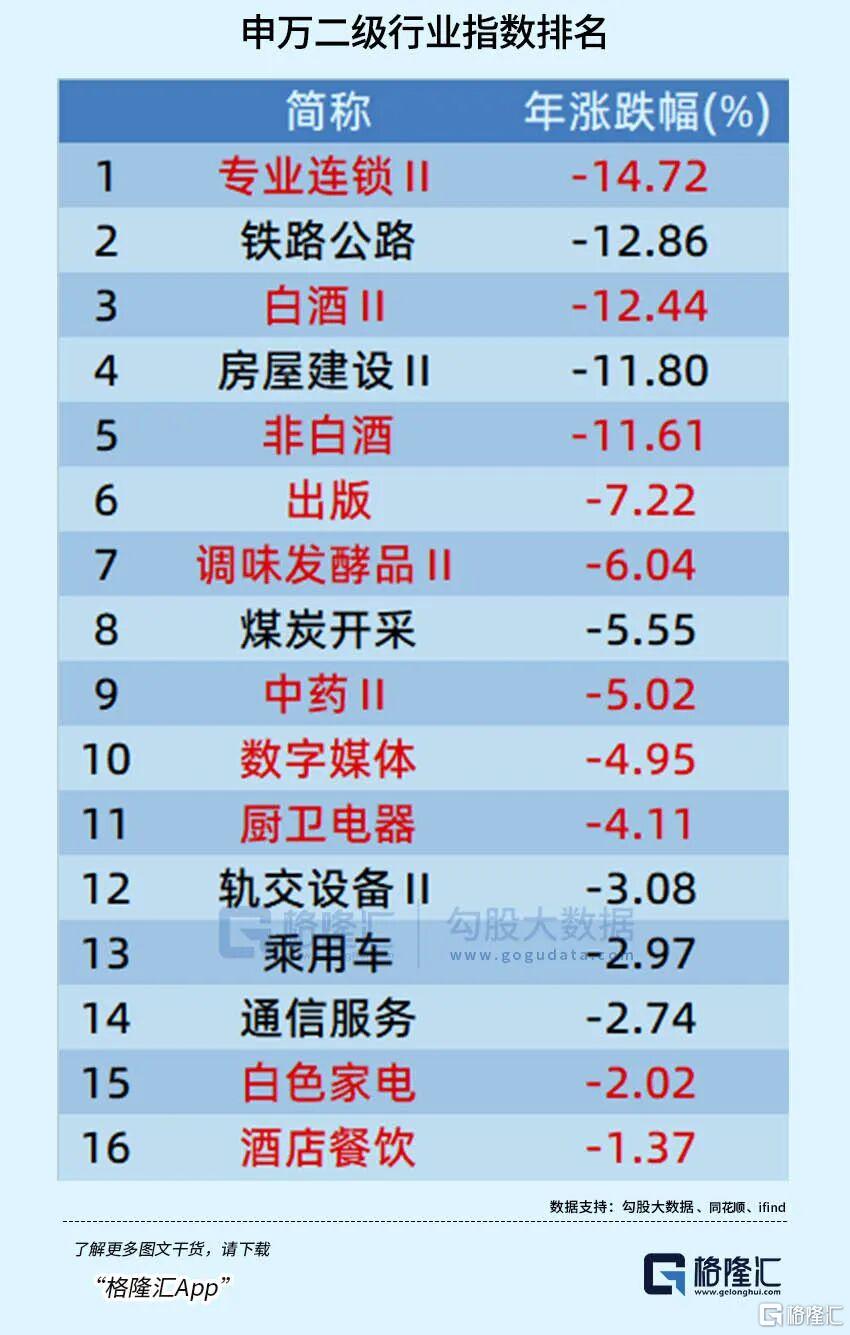
Core Viewpoint - The consumer sector has faced significant challenges in the past year, with many sub-sectors experiencing declines despite overall market growth. The focus on domestic demand and consumption has not translated into positive performance for many consumer-related industries [1][5]. Consumer Sector Performance - In the first half of the year, 10 out of 16 declining industries were from the consumer sector, indicating a broader trend of underperformance [1]. - The white liquor sector, a key component of the consumer market, has seen a year-to-date decline of 12.44%, with major brands like Wuliangye experiencing significant drops in revenue and profit [6][9]. - The professional chain sector has been particularly hard-hit, with a year-to-date decline of 14.72%, exemplified by the struggles of companies like Renrenle [16][20]. White Liquor Sector - The white liquor industry is facing its eighth consecutive year of production decline, with both volume and price dropping simultaneously [10]. - Wuliangye reported a 10.26% decline in revenue and a 13.72% drop in net profit for the first three quarters, marking its first negative growth in a decade [9]. - The industry is shifting from a growth-driven model to one focused on consumer choice, with a need for companies to adapt to changing consumer preferences [15]. Professional Chain Sector - The professional chain sector is experiencing a crisis, with many physical stores closing and traditional business models failing [16][20]. - Renrenle, once a leading private supermarket, has seen its market value plummet and is now facing delisting due to ongoing financial struggles [21][24]. - The shift towards online shopping and personalized consumer demands has further exacerbated the challenges faced by traditional retail chains [24][25]. Non-White Liquor Sector - The non-white liquor sector, including beer and wine, has also faced declines, with the beer segment seeing a notable drop in sales and profits [27][32]. - Budweiser APAC reported an 8.2% decline in domestic sales and a 24.4% drop in net profit, reflecting broader industry challenges [32][33]. - The market is witnessing a trend of cross-industry competition, with liquor companies diversifying into new beverage categories [34]. Publishing Sector - The publishing industry has shown resilience despite a 10.4% decline in the overall market for printed books, with listed companies managing to increase net profits by 14.65% [43][44]. - However, leading companies like Zhongwen Media are struggling, with significant revenue and profit declines due to changes in educational material procurement policies [45][48]. Seasoning Sector - The seasoning industry has faced a 6.04% decline, with companies like Qianhe Flavor struggling due to falling revenues and a loss of consumer trust [51][55]. - The industry is experiencing a shift in consumer preferences and increased competition, necessitating a reevaluation of business strategies [60]. Traditional Chinese Medicine Sector - The traditional Chinese medicine sector is facing challenges, with companies like Pian Zai Huang reporting significant declines in revenue and profit due to rising costs and regulatory pressures [61][66]. - The industry is undergoing a transformation as companies seek to innovate and diversify their product offerings [70]. Digital Media Sector - The digital media industry has seen a 4.95% decline, with companies like Mango TV reporting significant drops in revenue and profit due to changing consumer behaviors and market dynamics [71][74]. - The sector is grappling with the need to adapt to new content consumption trends while facing pressure from traditional advertising models [75]. Kitchen and Bathroom Appliances Sector - The kitchen and bathroom appliance sector has experienced a 4.11% decline, largely due to reduced demand from the real estate market [78][79]. - Companies like Boss Electric are facing revenue declines for the first time in years, highlighting the challenges of adapting to a changing market landscape [79][80]. White Goods Sector - The white goods sector has seen a 2.02% decline, with major players like Gree Electric facing significant revenue and profit pressures due to increased competition and market saturation [83][84]. - The industry is shifting towards a focus on product quality and brand strength as external stimuli diminish [88]. Hotel and Restaurant Sector - The hotel and restaurant sector has faced a 1.37% decline, with revenue pressures stemming from changing consumer spending habits and increased competition from online platforms [89][92]. - Companies are beginning to adopt more refined operational strategies to navigate the challenging market environment [96].




今年十大最惨板块,跌麻了
格隆汇APP· 2025-12-30 11:04
Core Viewpoint - The article discusses the significant downturn in various consumer sectors, particularly the liquor and retail industries, highlighting the challenges and potential opportunities for recovery amidst changing consumer behaviors and market dynamics [2][4][43]. Group 1: Liquor Industry - The liquor sector, especially the white liquor segment, has faced substantial declines, with the overall white liquor market down by 12.44% this year [9][15]. - Major brands like Wuliangye have reported significant drops in revenue and profit, with a 10.26% decline in revenue and a 13.72% drop in net profit for the first three quarters [17]. - The white liquor industry is experiencing a shift from a growth-driven model to one focused on consumer preferences, with a need for companies to adapt to changing consumption patterns [26][27]. Group 2: Retail Industry - The professional chain sector has seen a dramatic decline of 14.72%, with many traditional retail models struggling to survive [28][30]. - Companies like Renrenle have faced severe financial difficulties, leading to a significant reduction in store numbers and ultimately triggering delisting procedures [34][35]. - The shift towards online shopping and changing consumer preferences have forced traditional retailers to innovate or face extinction [36][39]. Group 3: Non-White Liquor Sector - The non-white liquor sector, including beer and wine, has also suffered, with a reported decline of 11.61% this year [40]. - Major players like Budweiser APAC have experienced significant sales drops, with a 9.5% revenue decrease and a 24.4% decline in net profit [46]. - The industry is witnessing a trend of cross-industry competition, with liquor companies diversifying into other beverage categories to adapt to market changes [51][56]. Group 4: Publishing Industry - The publishing sector has faced a 7.22% decline, with the overall market for printed books down by 10.40% [60]. - Despite the downturn, some publishing companies have managed to increase profits through cost control and operational efficiency, with a 14.65% rise in net profit for listed companies [61][62]. - The industry is undergoing significant transformation, moving from traditional sales models to more dynamic content management and IP development strategies [70][71]. Group 5: Seasoning Industry - The seasoning sector has seen a 6.04% decline, with companies like Qianhe Flavor struggling due to a drop in revenue and profit [74]. - The industry is facing challenges from both market saturation and changing consumer preferences, necessitating a shift in strategy for many companies [81]. Group 6: Traditional Chinese Medicine - The traditional Chinese medicine sector has experienced a 5.02% decline, with companies like Pian Zai Huang facing significant revenue and profit drops [86]. - The industry is under pressure from regulatory changes and increased competition, pushing companies to innovate and diversify their product offerings [91][92]. Group 7: Digital Media - The digital media sector has reported a 4.95% decline, with traditional advertising models struggling to adapt to new market realities [97][100]. - Companies like Mango TV have seen significant revenue drops, highlighting the challenges of maintaining profitability in a rapidly changing landscape [101][104]. Group 8: Kitchen and Bathroom Appliances - The kitchen and bathroom appliance sector has faced a 4.11% decline, with major players like Boss Electric experiencing revenue drops for the first time in years [112]. - The industry is grappling with reduced demand due to a slowdown in the real estate market, necessitating a shift towards innovation and international expansion [117][118]. Group 9: White Goods - The white goods sector has seen a 2.02% decline, with companies like Gree Electric facing significant challenges due to market saturation and increased competition [126][129]. - The industry is shifting towards a more rational consumer base that prioritizes product quality and brand reputation over traditional growth drivers [133]. Group 10: Hotel and Restaurant Industry - The hotel and restaurant sector has experienced a 1.37% decline, with many businesses struggling to convert increased tourism into profits [140][141]. - The industry is witnessing a shift towards more refined operational models, with companies focusing on member engagement and digital transformation to enhance profitability [142][143].




海尔智家取得室内机智能控制方法专利
Sou Hu Cai Jing· 2025-12-30 10:58
海尔智家股份有限公司,成立于1994年,位于青岛市,是一家以从事电气机械和器材制造业为主的企 业。企业注册资本943811.4893万人民币。通过天眼查大数据分析,海尔智家股份有限公司共对外投资 了59家企业,参与招投标项目1887次,财产线索方面有商标信息285条,专利信息5000条,此外企业还 拥有行政许可10个。 声明:市场有风险,投资需谨慎。本文为AI基于第三方数据生成,仅供参考,不构成个人投资建议。 青岛海尔空调器有限总公司,成立于1996年,位于青岛市,是一家以从事电气机械和器材制造业为主的 企业。企业注册资本93638.162532万人民币。通过天眼查大数据分析,青岛海尔空调器有限总公司共对 外投资了20家企业,参与招投标项目4866次,财产线索方面有商标信息259条,专利信息5000条,此外 企业还拥有行政许可19个。 青岛海尔智能技术研发有限公司,成立于2014年,位于青岛市,是一家以从事研究和试验发展为主的企 业。企业注册资本13000万人民币。通过天眼查大数据分析,青岛海尔智能技术研发有限公司共对外投 资了9家企业,参与招投标项目7次,财产线索方面有商标信息22条,专利信息5000条,此 ...
海尔智家(06690.HK)12月30日耗资145.43万元回购5.5万股A股
Ge Long Hui· 2025-12-30 10:27
Core Viewpoint - Haier Smart Home (06690.HK) announced a share buyback on December 30, 2025, spending RMB 1.4543 million to repurchase 55,000 A-shares at a price range of RMB 26.44 to 26.46 per share [1] Related Events - On December 30, 2025, Haier Smart Home repurchased 55,000 A-shares for a total cost of RMB 1.4543 million [1] - On December 29, 2025, the company spent RMB 1.788 million to buy back 67,000 A-shares [1]
海尔取得空调系统用传输管组件专利
Sou Hu Cai Jing· 2025-12-30 10:22
Group 1 - The State Intellectual Property Office of China has granted a patent titled "Transmission Pipe Component for Air Conditioning Systems and Air Conditioning Systems" to multiple subsidiaries of Haier, with the announcement number CN119687538B and application date of September 2023 [1] - Qingdao Haier Smart Building Technology Co., Ltd. was established in 2003, has a registered capital of 100 million RMB, and has participated in 1,031 bidding projects with 436 patents [1] - Qingdao Haier Air Conditioning Electronics Co., Ltd. was founded in 1999, has a registered capital of approximately 967.09 million RMB, and has participated in 4,706 bidding projects with 5,000 patents [1][2] Group 2 - Qingdao Haier Air Conditioner Co., Ltd. was established in 1996, has a registered capital of approximately 936.38 million RMB, and has participated in 4,866 bidding projects with 5,000 patents [2] - Qingdao Haier Intelligent Technology Research and Development Co., Ltd. was founded in 2014, has a registered capital of 13 million RMB, and has participated in 7 bidding projects with 5,000 patents [2] - Haier Smart Home Co., Ltd. was established in 1994, has a registered capital of approximately 943.81 million RMB, and has participated in 1,887 bidding projects with 5,000 patents [2]
海尔智家(06690)12月30日斥资145.43万元回购5.5万股A股
Zhi Tong Cai Jing· 2025-12-30 09:58
(原标题:海尔智家(06690)12月30日斥资145.43万元回购5.5万股A股) 智通财经APP讯,海尔智家(06690)发布公告,于2025年12月30日,该公司斥资人民币145.43万元回购5.5 万股A股,每股回购价格为26.44-26.46元。 ...
生态环境部核发2026年度消耗臭氧层物质和氢氟碳化物生产、使用和进口配额
Xin Lang Cai Jing· 2025-12-30 09:44
Group 1 - The Ministry of Ecology and Environment has issued a notification regarding the allocation of production, usage, and import quotas for ozone-depleting substances and hydrofluorocarbons for the year 2026 [1] - A total of 17 companies, including Inner Mongolia San Aifu Wanhao Fluorochemical Co., Ltd., have been granted production quotas for hydrochlorofluorocarbons, while 14 companies, including Aux Air Conditioning Co., Ltd., have received usage quotas for the same substances [1] - Additionally, 7 companies, including Lianlong Bohua (Tianjin) Pharmaceutical Chemical Co., Ltd., have been allocated usage quotas for carbon tetrachloride [1] Group 2 - A total of 34 companies, including Tianjin Green Bell Gas Co., Ltd., have been granted production and internal usage quotas for hydrofluorocarbons, while 36 companies, including Zhejiang Penglai Refrigerant Co., Ltd., have received import quotas for hydrofluorocarbons [1]
海尔智家(06690) - 翌日披露报表
2025-12-30 09:29
FF305 翌日披露報表 (股份發行人 ── 已發行股份或庫存股份變動、股份購回及/或在場内出售庫存股份) FF305 確認 根據《主板上市規則》第13.25C條 / 《GEM上市規則》第17.27C條,我們在此確認,據我們所知所信,第一章節所述的每項股份發行或庫存股份出售或轉讓已獲發行人董事會正式授權批准,並遵 照所有適用上市規則、法律及其他監管規定進行,並在適用的情況下: 表格類別: 股票 狀態: 新提交 公司名稱: 海爾智家股份有限公司 呈交日期: 2025年12月30日 如上市發行人的已發行股份或庫存股份出現變動而須根據《香港聯合交易所有限公司(「香港聯交所」)證券上市規則》(「《主板上市規則》」)第13.25A條 / 《香港聯合交易所有限公司GEM證券 上市規則》(「《GEM上市規則》」)第17.27A條作出披露,必須填妥第一章節 。 | 第一章節 | | | | | | | | --- | --- | --- | --- | --- | --- | --- | | 1. 股份分類 | 普通股 | A 股份類別 | | 於香港聯交所上市 | 否 | | | 證券代號 (如上市) | 600690 | ...
罗永浩炮轰,空调售后成“暴利江湖”?
商业洞察· 2025-12-30 09:23
Core Viewpoint - The article discusses the high costs associated with air conditioning maintenance and repair services, highlighting the lack of regulation in the air conditioning after-market, which has become a lucrative but problematic area for consumers and companies alike [2][4][15]. Group 1: High Costs of Air Conditioning Maintenance - The cost for seasonal cleaning and filter replacement for central air conditioning units can reach approximately 15,000 yuan, with filter replacement accounting for 70% of this cost [4][7]. - Consumers have expressed frustration over the high service fees, with some stating that the cost of maintenance can exceed the price of purchasing new units, especially as air conditioning prices have dropped significantly due to market competition [5][10]. - The average cleaning costs for other brands like Midea and Gree range from 100 to 300 yuan, indicating that the prices for maintenance services can vary widely across different brands [10][11]. Group 2: Issues in the After-Market - The air conditioning after-market is plagued by issues such as price opacity, inflated repair costs, and unnecessary upselling, leading to consumer distrust [15][16]. - Reports indicate that third-party service providers often charge significantly more than official brand service teams, sometimes up to 3-4 times higher [15][18]. - The lack of regulation in the after-market allows for a variety of service quality, with many third-party companies operating outside of formal oversight [18]. Group 3: Competitive Landscape and Service Improvements - Major appliance brands like Gree and Midea are increasingly focusing on enhancing their after-sales service networks, with Gree boasting over 15,000 authorized service points [20][22]. - The article notes a shift in service strategies, with brands like Midea and Xiaomi introducing longer warranty periods and comprehensive service packages to improve customer satisfaction [22][24]. - As the price competition in the air conditioning market reaches its limits, companies are recognizing the importance of service quality as a key differentiator in maintaining market share [23][24].