
HAIER SMART HOME(600690)

Search documents
海尔智家孙丹凤:AI元年引领数智化跃迁 构建产业链协同新生态
Sou Hu Cai Jing· 2025-12-31 05:32
Core Insights - The event "Qihang·2025 Financial Annual Conference" highlighted Haier Smart Home's strategic focus on "AI Year" in 2025, emphasizing the clear path for digital transformation in the home appliance industry [1][2] Digital Transformation Strategy - Haier Smart Home's digital transformation is driven by the integration of AI and digital technologies, aiming to maximize user value while serving customer, employee, and corporate values [4][5] - The company has iterated its core methodology of "Four Reconstructions Creating Four Values," reinforcing the importance of user-centric value creation in the AI era [4] AI Implementation Progress - Haier Smart Home has achieved significant milestones in AI implementation, currently positioned at L3 (Intelligent Agent) in the AI application maturity model, with the development of "Zhi Xiao Neng," a super intelligent agent [5][6] - The transition from L3 to L5 is projected to take approximately five years, with the goal of AI assisting in 40% of work tasks [6] Integration with Green and Low-Carbon Initiatives - The home appliance industry is transitioning from digitalization to intelligentization, with a focus on ecological collaboration and the integration of AI with green and low-carbon initiatives [7] - Haier Smart Home has committed to achieving global carbon neutrality by 2050 and plans to utilize 100% renewable energy, showcasing the synergy between digital transformation and sustainability [7] Industry Collaboration and Efficiency - The company emphasizes the need for collaborative data integration across the supply chain to enhance industry efficiency by 10%-20% [8] - Haier Smart Home aims to leverage its supply chain advantages to retain high-value efficiency work in China, enhancing the global competitiveness of Chinese home appliance enterprises [8]



2026年国补来了!1月1日起淘宝天猫开放领取使用
Xin Lang Cai Jing· 2025-12-31 05:31
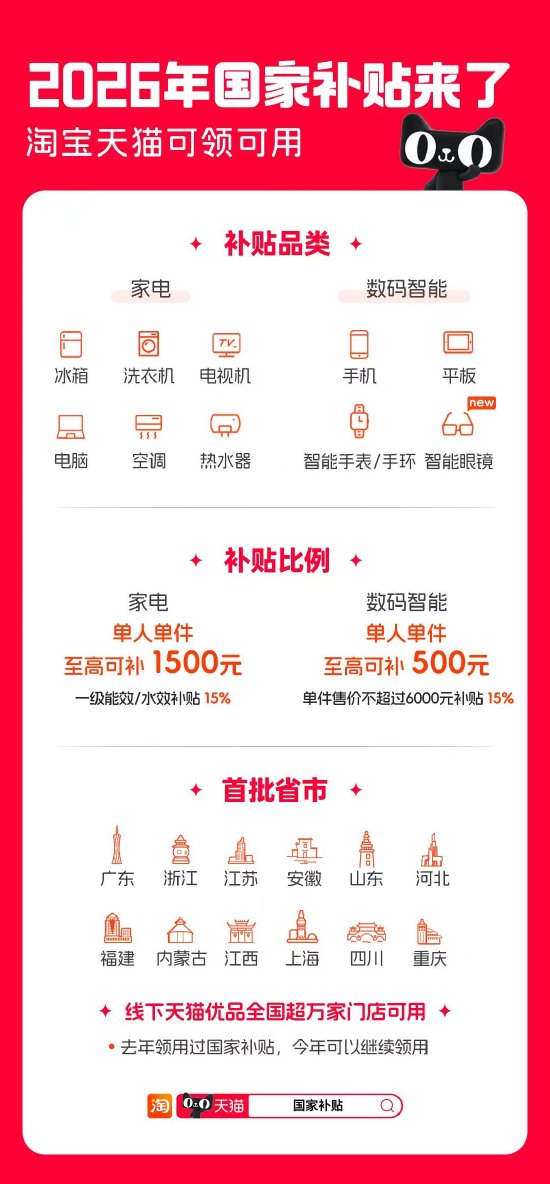
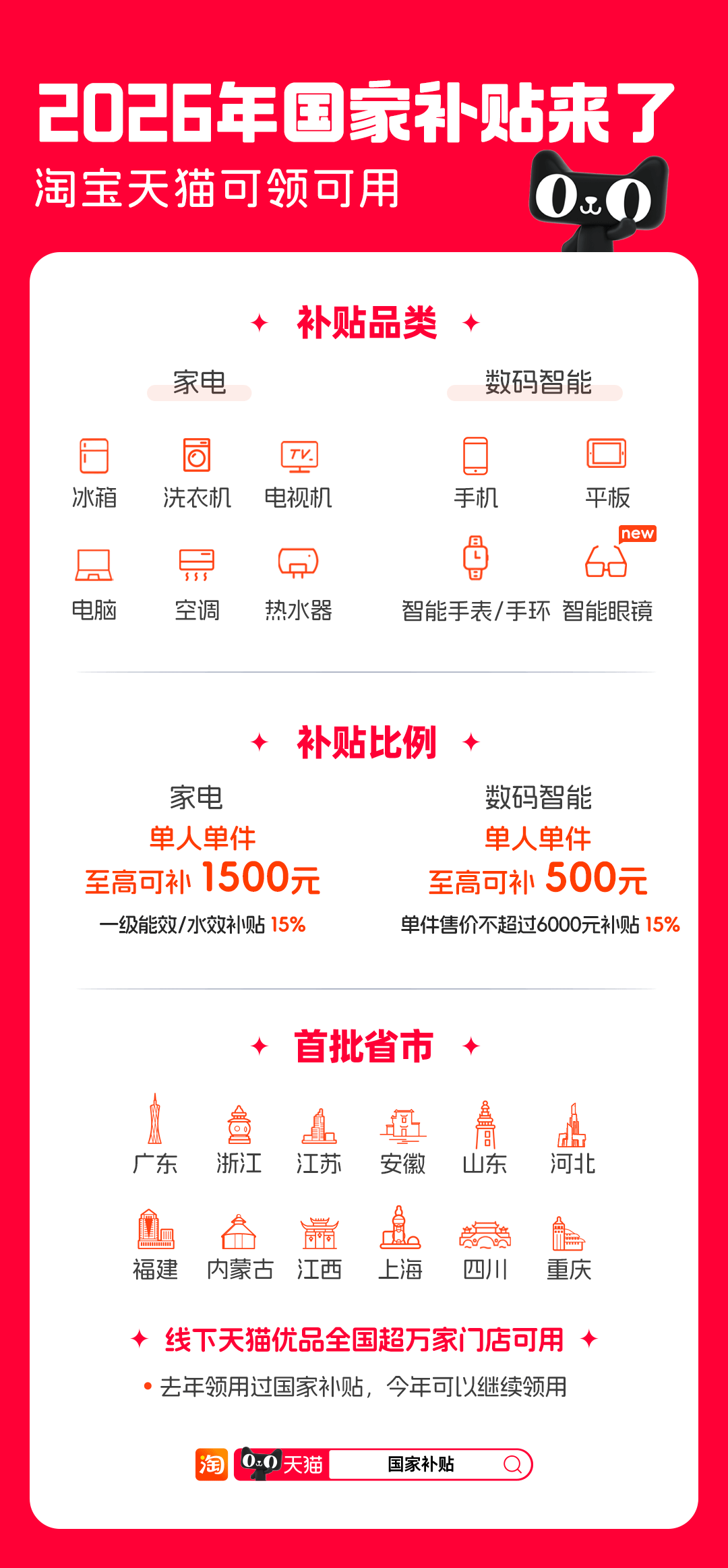
Core Viewpoint - The new round of national subsidies for 2026 is officially launched, effective from January 1, allowing consumers to claim subsidies on platforms like Taobao and Tmall, as well as in over ten thousand offline Tmall stores nationwide [1][5]. Group 1: Subsidy Details - The 2026 national subsidy covers ten categories: refrigerators, washing machines, televisions, air conditioners, computers, water heaters, mobile phones, tablets, smartwatches, and smart glasses, with smart glasses being a new addition for this year [4][7]. - The subsidy rate is set at 15%, with a maximum subsidy of 1500 yuan for energy/water-efficient home appliances and a maximum of 500 yuan for digital and smart products priced under 6000 yuan [4][7]. Group 2: Implementation and Promotions - The subsidy program is initially available in provinces such as Guangdong, Zhejiang, Jiangsu, Anhui, Fujian, Inner Mongolia, Jiangxi, Shanghai, Sichuan, Shandong, Hebei, and Chongqing, accessible through the 'National Subsidy' channel on the Taobao app [4][7]. - From January 1 to 3, Tmall will collaborate with brands like Haier, Midea, Huawei, and Siemens to host the "National Subsidy Renewal Season" event, offering additional discounts and vouchers, with household appliances available at up to 50% off [4][7]. - In 2025, over 3000 categories, more than 10,000 brands, and 500,000 products are expected to participate in the national subsidy program, attracting an average of over 150 million daily visits to the subsidy section on Taobao [4][7].


家电数码补贴15% 2026年国家补贴上线淘宝天猫
Huan Qiu Wang· 2025-12-31 03:07
Core Viewpoint - A new round of national subsidies has been officially launched, effective from January 1, 2026, covering ten categories of products including refrigerators, washing machines, televisions, air conditioners, computers, water heaters, mobile phones, tablets, smartwatches, and smart glasses, with smart glasses being a newly added category [1][4]. Group 1: National Subsidy Details - The national subsidy rate is set at 15%, with a maximum subsidy of 1500 yuan for energy-efficient appliances and 500 yuan for digital and smart products priced under 6000 yuan [1]. - The subsidy program is available on platforms like Taobao and Tmall, with over 10,000 offline Tmall stores nationwide participating [4]. Group 2: Promotional Activities - From January 1 to 3, Tmall is collaborating with brands like Haier, Midea, Huawei, and Siemens to host a "National Subsidy Renewal Season" event, offering additional discounts of up to 90% and extra consumption vouchers worth 950 yuan [4]. - The promotion allows consumers to purchase home appliances at prices as low as 50% after applying the national subsidy and additional discounts [8]. Group 3: Product Pricing and Discounts - Specific products and their original and discounted prices include: - Gree air conditioner originally priced at 4799 yuan, discounted to 4.1 times lower after subsidies [8]. - Haier refrigerator originally priced at 11999 yuan, available at 50% off after discounts [8]. - Vivo X300 Pro originally priced at 5299 yuan, with a subsidy saving of 500 yuan [8]. - Thunderbird smart glasses Air 4 Pro originally priced at 1888 yuan, eligible for additional discounts [8]. Group 4: Market Reach and Consumer Engagement - By 2025, over 3000 product categories and more than 10,000 brands will be available under the national subsidy program on Taobao and Tmall, attracting an average of over 150 million daily visits to the subsidy section [8].



美的、海尔、海信、TCL,一场决定未来十年命运的战争
Xin Lang Cai Jing· 2025-12-31 02:07
Core Viewpoint - The Chinese home appliance industry is at a critical juncture, with the theme for 2026 being "going overseas" as domestic market saturation and overcapacity issues become more pronounced. This shift represents a "second entrepreneurship" for companies like Haier, Midea, Hisense, and TCL, marking a decisive battle for the next decade [2]. Group 1: Market Overview - The global home appliance market is nearly 4.5 trillion yuan, indicating significant overseas market potential [4]. - Midea and Haier are projected to generate around 270 billion yuan in revenue each in 2024, translating to a global market share of only about 6% [5]. - Domestic brands struggle to exceed 10% market share in most overseas regions, while leading competitors like Samsung and LG dominate [8]. Group 2: Historical Context and Challenges - Chinese home appliance companies have historically relied on capacity export and brand acquisitions for overseas expansion, but this growth model is becoming less effective [9]. - The gap between global manufacturing share (over 45%) and retail share (less than 20%) highlights a significant challenge in value creation and brand premium [9]. - Haier and Midea's overseas revenue share has stagnated around 50% and 42% respectively over the past five years, indicating a lack of growth [9]. Group 3: Brand and Channel Development - The need for a "second entrepreneurship" in brand and channel development is emphasized, as domestic brands face challenges in replicating their successful domestic strategies in international markets [15]. - Building brand recognition and effective distribution channels in overseas markets is crucial, as traditional strategies may not apply [16][20]. - The complexity of overseas channels, dominated by large retailers, poses significant barriers for Chinese companies [20]. Group 4: Opportunities and Strategies - Technological innovation is seen as a key to overcoming brand premium challenges, with Chinese companies making strides in areas like AI and smart home technology [22]. - Emerging markets such as Southeast Asia and Latin America present significant growth opportunities due to low penetration rates and less established competition [29]. - E-commerce is becoming a vital channel for market entry, allowing brands to reach consumers without heavy investment in physical stores [34]. Group 5: Future Outlook - The transition to a full value chain operation by 2026 signifies a shift from manufacturing management to comprehensive brand and channel strategies [36]. - Success in this transformation is critical for elevating Chinese manufacturing from a "global factory" to a "global brand," enhancing competitiveness in the global market [36].


2026年家电以旧换新政策出台,有望提振家电消费景气
Guotou Securities· 2025-12-31 02:04
Investment Rating - The report assigns an "A" rating for the investment in major appliance companies such as Midea Group, Haier Smart Home, and Gree Electric Appliances, indicating a "Buy" recommendation with target prices of 94.68, 31.81, and 50.60 CNY respectively [4]. Core Insights - The 2026 appliance replacement policy is expected to boost consumer demand for home appliances, focusing on energy-efficient products and providing subsidies of 15% of the product price, capped at 1500 CNY per item [1][2]. - The 2026 policy has optimized the subsidy scope, reducing the number of supported appliance categories from eight to six, and lowering the subsidy rate from 20% to 15% for high-efficiency products [2][11]. - The first batch of funding for the 2026 policy amounts to 625 billion CNY, a 23% decrease from the previous year's 810 billion CNY, indicating a potential decline in total subsidy funds for the year [2][12]. Summary by Sections Policy Changes - The 2026 policy focuses on six categories: refrigerators, washing machines, televisions, air conditioners, computers, and water heaters, excluding other appliances like stoves and microwaves [2][11]. - The subsidy for high-efficiency products is now set at 15% of the sales price, with a cap of 1500 CNY per item, and consumers can only receive one subsidy per product category [2][11]. Market Impact - The 2025 replacement policy effectively stimulated appliance consumption, with retail sales of home appliances increasing by 14.8% year-on-year from January to November 2025, and over 12.84 million units replaced [3]. - The introduction of the 2026 policy is expected to improve domestic appliance sales, despite some pressure on consumption due to earlier demand release and high base effects [3][9]. Investment Recommendations - The report suggests focusing on three investment themes: 1. High-quality white goods companies with strong cash flow and high dividend yields, such as Midea Group and Haier Smart Home [9]. 2. Companies with strong global capabilities, particularly in emerging markets where appliance penetration is low [9]. 3. Technology-driven appliance companies that are expanding into new business areas, leveraging AI and robotics to enhance product offerings [9].
制冷设备行业2026年度投资策略:产业并购活跃,布局全球化与前沿冷却技术
Donghai Securities· 2025-12-31 01:46
1. Report Industry Investment Rating The provided content does not include the report industry investment rating. 2. Core Views - The Chinese refrigeration and air - conditioning equipment industry is at a critical turning point. The domestic household market is in a stable development stage dominated by stock replacement demand, and growth is driven by the improvement of energy - efficiency standards. The report analyzes structural growth opportunities and long - term evolution trends by benchmarking overseas leading companies [2]. - Overseas expansion should focus on local in - depth development and value extension of the industrial chain. It is a systematic project, and mergers and acquisitions are strategic choices. Chinese enterprises are moving from the initial stage of "Made in China, Sold Globally" to the new stage of globalization of "brand, technology, and management" [2]. - The commercial refrigeration field, especially the data center refrigeration track, is a short - term growth highlight. The capital expenditure of overseas HVAC giants is directed towards data center infrastructure, and there is a market for high - end refrigeration solutions due to the need to improve energy efficiency and reduce PUE [2]. - Investment suggestions: In the household refrigeration equipment field, pay attention to industry leaders such as Midea Group; in the special - purpose refrigeration equipment field, focus on companies like Invic and Shenling Environment; for upstream components, pay attention to Hanzhong Precision Machinery, Binglun Environment, and Sanhua Intelligent Control [2]. 3. Summary by Relevant Catalog 3.1 Traditional Refrigeration Equipment Overview - **Global Refrigeration and Air - Conditioning Market**: The global refrigeration and air - conditioning market has shown steady growth. From 2018 to 2024, the global air - conditioner sales increased from 232.5 million units to 261.2 million units, with a compound annual growth rate of 2.0%. The proportion of household air - conditioners in 2024 was 73.7%, and the central air - conditioning market grew faster, with a compound annual growth rate of 4.0% from 2018 to 2024. It is predicted that by 2028, the global air - conditioner sales will reach 293.3 million units, with a compound annual growth rate of 2.9% from 2024 to 2028. Asia, North America, and Europe are important regional markets, and China is the largest single air - conditioning market [22]. - **Household Air - Conditioning**: In the 2024 cold year, China's household air - conditioner production accounted for 80.8% of the global total. Many domestic enterprises are increasing overseas layout. In the 2024 cold year, overseas production capacity increased by nearly 7 million units. In the 2025 cold year, domestic household air - conditioner exports were about 99.29 million units, a year - on - year increase of 16.7%, with the highest export proportion to Asia [28]. - **Central Air - Conditioning and Chiller Units**: There are various types of central air - conditioning and chiller units. The export of screw and centrifugal chiller units for data centers is strong. The Asian market has a large - scale demand and is gradually recovering, while the North American market has a prominent growth rate due to its small base. The domestic market is waiting to stabilize, and leading enterprises are strengthening their competitive advantages [33]. 3.2 Household Market: Domestic Sales Review and Challenges for Leading Companies - **Price Wars and Market Competition**: After several price wars, the concentration of the domestic household refrigeration and air - conditioning market has increased. The competition has evolved from scale and price to technology, product, channel, service, and ecosystem. In 2025, the domestic sales volume of household air - conditioners increased by 8.7% year - on - year, but the growth driven by policies and climate is difficult to sustain. The long - term driving force is stock replacement and structural upgrading [35][36]. - **Energy - Efficiency Upgrade**: China has introduced multiple air - conditioner energy - efficiency standards, which have promoted the transformation from fixed - frequency to variable - frequency air - conditioners. Leading enterprises have advantages in technology and industrial layout for energy - efficiency improvement [39]. - **Challenges for Leading Companies**: In 2024 - 2025, a new round of price wars occurred. Xiaomi's entry has challenged the traditional hardware - profit model. Leading companies are facing challenges in terms of efficiency and sustainable profit growth. They are promoting digital reform, channel and logistics innovation to enhance competitiveness [40][43][44]. 3.3 Overseas Expansion of Domestic Enterprises - **Difficulties and Solutions**: There are differences in regional usage habits overseas. The US market has high access barriers, and the European market has low air - conditioner penetration and high energy - efficiency requirements. Overseas acquisitions are an important way to enter the market. Chinese enterprises are accelerating overseas production capacity construction in Southeast Asia and other regions [52][54]. - **Southeast Asian Market**: Exports to ASEAN are on an upward trend. In 2024, China's cumulative exports of white goods to ASEAN reached $14.87 billion, a year - on - year increase of 19.8%. The demand in the ASEAN market is driven by urbanization and industrialization [63]. 3.4 Overview of Overseas Representative Enterprises' Operations - **Business Models and Strategies**: Overseas HVAC representative enterprises have different business models and strategies. Johnson Controls has transformed from an equipment manufacturer to a builder of smart building ecosystems; Trane Technologies has upgraded its services and transformed its strategy; Daikin has acquired relevant enterprises to supplement its data center refrigeration business [73][82]. - **Performance of Leading Enterprises**: Leading international enterprises such as Trane Technologies, Johnson Controls, Carrier Global, and Vertiv have shown different performance. They are all focusing on high - growth areas such as data center refrigeration [83][86][87][88]. 3.5 Commercial Market: Pay Attention to Refrigeration Demand in Data Centers - **Demand for Data Center Refrigeration**: The development of AI and other industries is expected to drive the construction of data centers. The demand for data center capacity is expected to increase at a compound average growth rate of 19% from 2023 to 2030. Reducing the energy consumption of refrigeration equipment is crucial for the green and low - carbon development of data centers [94]. - **Refrigeration Technologies**: There are various data center refrigeration technologies, including water - cooled, air - cooled, indirect evaporation cooling, "glacier" phase - change cooling, and liquid cooling. Liquid cooling has advantages in energy consumption, and the development of liquid - cooling technology is a trend [96][104]. - **Investment Suggestions**: Enterprises in different segments are recommended, including traditional HVAC enterprises such as Midea Group, precision temperature - control equipment enterprises such as Invic, special - purpose air - conditioner manufacturers such as Shenling Environment, and upstream component enterprises such as Hanzhong Precision Machinery, Binglun Environment, and Sanhua Intelligent Control [112][113].
家用电器行业投资策略周报-20251230
CAITONG SECURITIES· 2025-12-30 13:17
Core Insights - The report maintains a positive outlook on the home appliance sector, particularly focusing on the cost reduction potential of aluminum replacing copper in air conditioning systems [2][5] - The adoption of aluminum-copper technology is seen as a significant step towards reducing production costs amid rising copper prices and resource scarcity [10][15] Group 1: Aluminum-Copper Technology Impact - The use of aluminum instead of copper in air conditioning units can lead to substantial cost savings, with estimates suggesting a reduction of 208 to 277 RMB per unit when replacing 50% of copper, and up to 416 to 554 RMB when replacing 100% [11][12] - Copper currently constitutes about 26% to 33% of the cost in standard air conditioning units, with high-end models reaching over 40% [11][12] - The global market has seen significant adoption of aluminum-copper products, particularly in Japan where approximately 40% to 50% of air conditioners use aluminum heat exchangers [15][16] Group 2: Domestic Market Challenges - Despite the cost advantages, the domestic promotion of aluminum-copper air conditioners faces challenges, including inferior thermal conductivity and corrosion resistance compared to copper [19][20] - Consumer perception is a major barrier, as negative opinions about aluminum's reliability persist, complicating market acceptance [19][20] - The first domestic aluminum-copper air conditioner was launched by Wanbao in collaboration with JD.com, targeting the mid-to-low-end market, which may help accelerate industry-wide material transitions [16][17] Group 3: Industry Performance and Trends - The home appliance sector has shown mixed performance, with the overall index increasing by 0.44%, while specific segments like white goods and black goods experienced varied changes [21][22] - Recent data indicates a decline in domestic sales growth for air conditioners, refrigerators, and washing machines, reflecting broader market challenges [33][47] - The report highlights the importance of monitoring raw material prices, with copper and aluminum prices showing significant fluctuations that could impact production costs [29][31]


海尔智家取得空调器室内机智能加湿控制方法专利
Sou Hu Cai Jing· 2025-12-30 12:54
国家知识产权局信息显示,海尔智家股份有限公司取得一项名为"空调器室内机的控制方法、空调器室 内机及空调器"的专利,授权公告号CN119063213B,申请日期为2023年6月。 声明:市场有风险,投资需谨慎。本文为AI基于第三方数据生成,仅供参考,不构成个人投资建议。 青岛海尔智能技术研发有限公司,成立于2014年,位于青岛市,是一家以从事研究和试验发展为主的企 业。企业注册资本13000万人民币。通过天眼查大数据分析,青岛海尔智能技术研发有限公司共对外投 资了9家企业,参与招投标项目7次,财产线索方面有商标信息22条,专利信息5000条,此外企业还拥有 行政许可4个。 海尔智家股份有限公司,成立于1994年,位于青岛市,是一家以从事电气机械和器材制造业为主的企 业。企业注册资本943811.4893万人民币。通过天眼查大数据分析,海尔智家股份有限公司共对外投资 了59家企业,参与招投标项目1887次,财产线索方面有商标信息285条,专利信息5000条,此外企业还 拥有行政许可10个。 青岛国创智能家电研究院有限公司,成立于2019年,位于青岛市,是一家以从事计算机、通信和其他电 子设备制造业为主的企业。企业 ...
海尔智家取得路由表查询方法和装置专利
Sou Hu Cai Jing· 2025-12-30 12:48
Group 1 - Haier U+ Smart Technology (Beijing) Co., Ltd., Qingdao Haier Technology Co., Ltd., and Haier Smart Home Co., Ltd. have obtained a patent for "Method and Device for Querying Routing Tables, Storage Medium, and Electronic Device," with authorization announcement number CN115767668B, applied for on October 2022 [1] - Haier U+ Smart Technology (Beijing) Co., Ltd. was established in 2015, located in Beijing, with a registered capital of 143 million RMB. The company has participated in 16 bidding projects and holds 2 administrative licenses, along with 2038 patent information [1] - Qingdao Haier Technology Co., Ltd. was established in 2000, located in Qingdao, with a registered capital of 80 million RMB. The company has participated in 80 bidding projects and holds 7 administrative licenses, along with 3883 patent information [1] Group 2 - Haier Smart Home Co., Ltd. was established in 1994, located in Qingdao, with a registered capital of approximately 9438 million RMB. The company has invested in 59 enterprises and participated in 1887 bidding projects, holding 10 administrative licenses and 5000 patent information [2]
海尔取得基于用户优先级的空调控制专利
Sou Hu Cai Jing· 2025-12-30 12:48
国家知识产权局信息显示,青岛海尔空调电子有限公司、青岛海尔空调器有限总公司、青岛海尔智能技 术研发有限公司、海尔智家股份有限公司取得一项名为"基于用户优先级的空调控制方法、装置、设备 及空调"的专利,授权公告号CN116951693B,申请日期为2023年7月。 天眼查资料显示,青岛海尔空调电子有限公司,成立于1999年,位于青岛市,是一家以从事专用设备制 造业为主的企业。企业注册资本96709.088914万人民币。通过天眼查大数据分析,青岛海尔空调电子有 限公司共对外投资了14家企业,参与招投标项目4707次,财产线索方面有商标信息128条,专利信息 5000条,此外企业还拥有行政许可29个。 青岛海尔空调器有限总公司,成立于1996年,位于青岛市,是一家以从事电气机械和器材制造业为主的 企业。企业注册资本93638.162532万人民币。通过天眼查大数据分析,青岛海尔空调器有限总公司共对 外投资了20家企业,参与招投标项目4866次,财产线索方面有商标信息259条,专利信息5000条,此外 企业还拥有行政许可19个。 青岛海尔智能技术研发有限公司,成立于2014年,位于青岛市,是一家以从事研究和试验发展 ...