CHINA MOBILE(600941)

Search documents
2025年中国移动通信手持机(手机)产量为15.4亿台 累计下降5.8%
Chan Ye Xin Xi Wang· 2026-02-21 02:53
Core Insights - The production of mobile communication handsets (smartphones) in China is projected to decline, with a total output of 150 million units in December 2025, representing a year-on-year decrease of 9.5% [1] - Cumulatively, the total production for the year 2025 is expected to reach 1.54 billion units, which indicates a decline of 5.8% compared to the previous year [1] Industry Data - The data is sourced from the National Bureau of Statistics, indicating a significant trend in the mobile communication handset market in China [2] - The report highlights the ongoing challenges faced by the industry, as reflected in the declining production figures over the specified period [2]



中国移动近期动态:股份回购、分红政策及业务进展
Jing Ji Guan Cha Wang· 2026-02-19 13:57
Group 1: Stock Performance - China Mobile recently repurchased 7.3035 million shares in the Hong Kong market at prices ranging from HKD 56.65 to HKD 58.15, costing approximately HKD 422 million [1] - The company has been consistently conducting share buybacks to reward shareholders [1] Group 2: Company Status - China Mobile has emphasized shareholder returns, announcing an increase in the cash dividend ratio for the full year of 2025 compared to 2024 [2] - Since 2002, the company has maintained a continuous dividend payout, with cumulative dividends amounting to approximately HKD 1.44 trillion (including mid-year dividends for 2025) [2] Group 3: Business Progress - The company has made advancements in several cutting-edge businesses, including obtaining a license for satellite mobile communication and promoting the Tian Tong satellite service, with over 1 million users for its Beidou satellite messaging service and more than 30 million terminal devices [3] - In the low-altitude economy and integrated sensing, over 700 integrated sensing base stations have been opened, exploring business applications in five typical scenarios including low-altitude economy and security [3] - In the AI and computing network sector, direct revenue from the government and enterprise market has seen rapid growth, with the company positioning "cloud as the computing infrastructure of the AI era" and striving to become a "first-class cloud service provider" [3] Group 4: Financial Performance - For the first three quarters of 2025, the company reported revenue of CNY 794.7 billion and a net profit attributable to shareholders of CNY 115.4 billion, with the market keenly awaiting the official financial report for the full year of 2025 to assess overall performance and development trends [4]
春晚广告位争夺战:四十年国民记忆与商业暗流
创业邦· 2026-02-17 10:32
Core Viewpoint - The evolution of the Spring Festival Gala sponsorship reflects the changing landscape of China's economy and consumer behavior over the past 40 years, showcasing the transition from material scarcity to technological innovation and brand storytelling [4][24]. Group 1: 1980s to Early 1990s - The 1980s marked a period of material scarcity, where items like watches and radios were symbols of wealth and status, leading to the first brand sponsorship by 康巴丝 (Kangbasi) at the Spring Festival Gala [5][7]. - 康巴丝 sponsored the gala by trading 3,000 quartz watches for advertising, which significantly boosted its brand recognition and sales, reaching an annual production of 1.26 million watches by 1987 [8]. - The sponsorship model evolved, with 中华自行车 (Zhonghua Bicycle) taking over the sponsorship in 1995, reflecting the changing consumer demands and economic conditions [9][14]. Group 2: Mid-1990s to Early 2000s - The mid-1990s saw a surge in consumer spending, with the emergence of "标王" (advertising king) sponsorships, particularly in the liquor industry, exemplified by 山东孔府宴酒 (Shandong Confucius Feast Wine) and 秦池酒 (Qinchijiu) [11][12]. - 秦池酒's sponsorship led to a dramatic increase in sales from 1.8 billion yuan in 1995 to 9.5 billion yuan in 1996, highlighting the impact of gala sponsorship on brand visibility and sales [16]. - The era was characterized by a shift towards consumerism, with brands leveraging the gala to enhance their market presence, although some faced backlash due to quality issues [16]. Group 3: 2000s to Early 2010s - The early 2000s marked the rise of home appliance brands, with 美的 (Midea) becoming a prominent sponsor, securing 11 sponsorships from 2003 to 2014, reflecting the growing importance of brand trust [17][19]. - The cost of advertising skyrocketed, with Midea's sponsorship fee increasing from 6.8 million yuan in 2005 to 57.2 million yuan in 2011, indicating the gala's significant viewership and advertising value [21]. - Brands began to focus on storytelling and emotional connections with consumers, moving beyond mere product promotion to build brand loyalty [23]. Group 4: Mid-2010s to Present - The 2010s saw the rise of internet companies as key players in the advertising space, with platforms like WeChat revolutionizing audience engagement through interactive features like the "red envelope battle" during the gala [25][26]. - The digital transformation of the gala allowed for unprecedented levels of interaction, with WeChat reporting 10.1 billion red envelope transactions on New Year's Eve, significantly enhancing its user base [26]. - The emergence of technology companies in the gala sponsorship landscape reflects a broader shift towards innovation and digital engagement, with brands like Xiaomi and AI robotics showcasing advancements in technology [32].







信号满格归途畅 智护团圆赴新春——中国移动广西公司推进返乡专项保障行动
Huan Qiu Wang· 2026-02-15 01:55
Core Viewpoint - China Mobile Guangxi Company is implementing a comprehensive return home support action during the Spring Festival, focusing on enhancing communication networks and providing warm services to ensure a smooth travel experience for returning citizens [1]. Group 1: Communication Network Enhancements - The company has upgraded the communication network at key transportation hubs, such as Nanning East Station, to handle increased passenger flow during the Spring Festival, achieving a 20% increase in capacity based on historical data [8]. - The overall network capacity has been doubled, with 4G and 5G networks expanded in high-traffic areas like waiting halls and platforms to meet the demands for internet access and communication [8]. - New and temporary base stations have been established along high-speed rail and highways to improve coverage, ensuring that even remote areas have reliable communication during the festive season [8]. Group 2: Smart Transportation Solutions - The company is utilizing smart technology to enhance traffic management, deploying police drones to monitor traffic flow and assist in emergency responses during the Spring Festival [9]. - In collaboration with local police, a drone patrol system has been implemented to monitor road conditions and manage congestion, significantly improving traffic efficiency during the holiday [9]. Group 3: Customer Service Initiatives - The company is providing a range of warm services at its service centers, including cultural activities and AI interaction experiences to engage customers and assist the elderly in using technology [10]. - Mobile service stations have been set up in communities to offer convenient services such as new number activation and network repairs, ensuring that residents have easy access to necessary support [10]. - Service centers are also offering free amenities like hot water and charging stations, creating a welcoming environment for travelers during their journeys [10]. Group 4: Fraud Prevention Efforts - During the Spring Festival, the company is actively promoting anti-fraud awareness among the public, distributing materials and educating citizens about common scams [11]. - Utilizing big data and intelligent monitoring, the company is enhancing network security and promptly addressing potential risks associated with telecommunications fraud [11]. - Volunteers are engaging with communities to provide guidance on installing anti-fraud applications, ensuring that safety measures reach the public effectively [11].
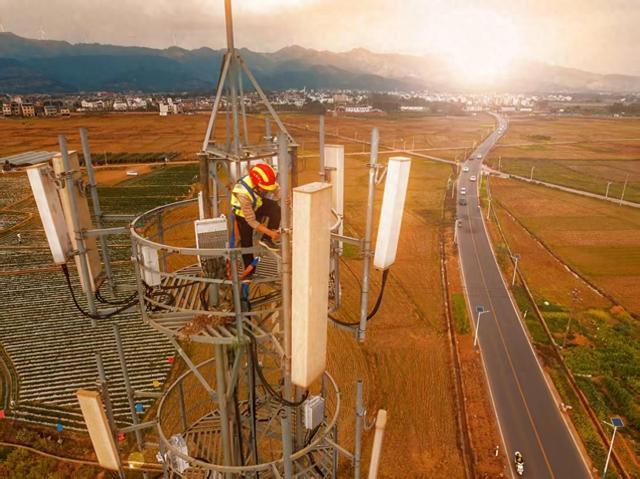
谁是中国AI“第一城”?
机器人圈· 2026-02-14 09:48
Core Insights - The article highlights the rapid growth and development of China's artificial intelligence (AI) industry, showcasing significant user adoption and innovation across various sectors [3][4][14][24][31]. Group 1: AI Industry Growth - By the end of 2025, China's generative AI user base is projected to reach 602 million, a 141.7% increase from the end of 2024, with a penetration rate of 42.8%, up 25.2 percentage points year-on-year [3]. - The AI industry in Beijing has surpassed 2,400 companies, including 46 listed firms and 36 unicorns, accounting for over half of the national total [4]. - Shanghai's AI industry is expected to exceed 550 billion yuan in scale by the end of 2025, with a year-on-year growth rate of over 30% [14]. Group 2: Key Players and Innovations - Major companies leading the AI sector include ByteDance, Baidu, and Huawei, focusing on areas such as large models, AI algorithms, and smart driving [5][24]. - Shenzhen has seen a 22.6% year-on-year growth in its core AI industry, with a total scale reaching 368.5 billion yuan in 2024, indicating a shift towards source innovation [24]. - Hangzhou's AI industry is projected to grow from 300 billion yuan in 2023 to 399 billion yuan in 2024, with 84 listed companies and 10 unicorns by the end of 2025 [31]. Group 3: Data and Infrastructure - Beijing has registered 123 large model products and established a data foundation with over 150 petabytes of data [4]. - Shanghai has completed 137 registrations for generative AI services, building a workforce of 300,000 in the AI sector [14]. - Shenzhen's AI industry encompasses a full range of the supply chain, from chips to applications, with 2,887 related enterprises [24].






创新创造 推动转型升级——因地制宜发展新质生产力一线故事(下)
Xin Lang Cai Jing· 2026-02-14 05:04
Group 1: Humanoid Robots in Shenzhen - Shenzhen-based company, Yuejiang Technology, has developed a humanoid robot capable of serving popcorn in cinemas, working up to 14 hours a day and selling over 1,000 cups daily without errors [1][2] - The robot's development faced challenges in coordination of its "eyes, brain, and hands," requiring precise environmental recognition and decision-making [1][2] - Yuejiang Technology has achieved a 90% self-research rate for key components and a 100% localization rate, marking a significant milestone in the humanoid robot industry in Shenzhen [2] Group 2: Green Chemical Innovations in Shanghai - Shanghai-based Kubei Chemical has developed a method to recycle waste wind turbine blades, turning epoxy resin into renewable materials and separating carbon fibers [3][4] - The company’s innovative approach addresses the global issue of wind turbine waste, which has traditionally been managed through environmentally harmful methods [3][4] - Kubei's recyclable epoxy resin has been recognized by the Ministry of Industry and Information Technology and has led to the production of the world's first recyclable carbon fiber blades [4] Group 3: Intelligent Manufacturing in Suzhou - Hengtong Optical Technology in Suzhou has implemented a digital factory utilizing AI and 5G technology, significantly reducing the need for manual labor in fiber production [5][6] - The factory's intelligent manufacturing control center manages the entire production process, ensuring efficiency and adaptability to environmental changes [6] - By 2025, Suzhou aims to achieve an industrial output value of 4.9 trillion yuan, with Hengtong exemplifying the city's embrace of AI in manufacturing [6] Group 4: Steel Industry Transformation in Rizhao - Rizhao Steel has adopted advanced ESP technology, reducing energy consumption by over 70% and CO2 emissions by 80% in steel production [12][13] - The company has established multiple innovation centers to overcome technological monopolies and enhance production efficiency [12][13] - AI technology has been integrated into the steel manufacturing process, improving operational efficiency and reducing human error [13] Group 5: Data Center Development in Ningxia - Ningxia Zhongwei has become a hub for data centers, with significant investments leading to the establishment of a robust infrastructure capable of handling massive data processing tasks [14][15] - The region's favorable climate allows for energy-efficient cooling solutions, reducing energy consumption by over 60% compared to traditional methods [14][15] - By 2025, the data center cluster in Zhongwei is expected to support a substantial increase in the information technology service industry [15] Group 6: Smart Manufacturing in Shanxi - Tianbao Technology in Shanxi has modernized its flange manufacturing process through digital and intelligent systems, significantly increasing production efficiency [17][18] - The company has achieved an 80% rate of CNC equipment utilization, enhancing the precision and monitoring of production processes [18] - The local government supports innovation and collaboration among enterprises to foster a new quality of production in traditional industries [18] Group 7: Intelligent Mining in Guizhou - The mining industry in Guizhou is undergoing a transformation with the introduction of intelligent machinery, improving safety and efficiency in coal extraction [19] - The implementation of smart monitoring systems allows for real-time data analysis and remote control of mining operations, enhancing operational safety [19] - Guizhou's initiative to upgrade coal mining technology aims to shift the industry's perception from hazardous to innovative and efficient [19]
因犯单位行贿罪,300941实控人张更生一审被判2年,缓刑2年!其被留置后1个月内,三位核心高管密集减持股份
Mei Ri Jing Ji Xin Wen· 2026-02-13 16:52
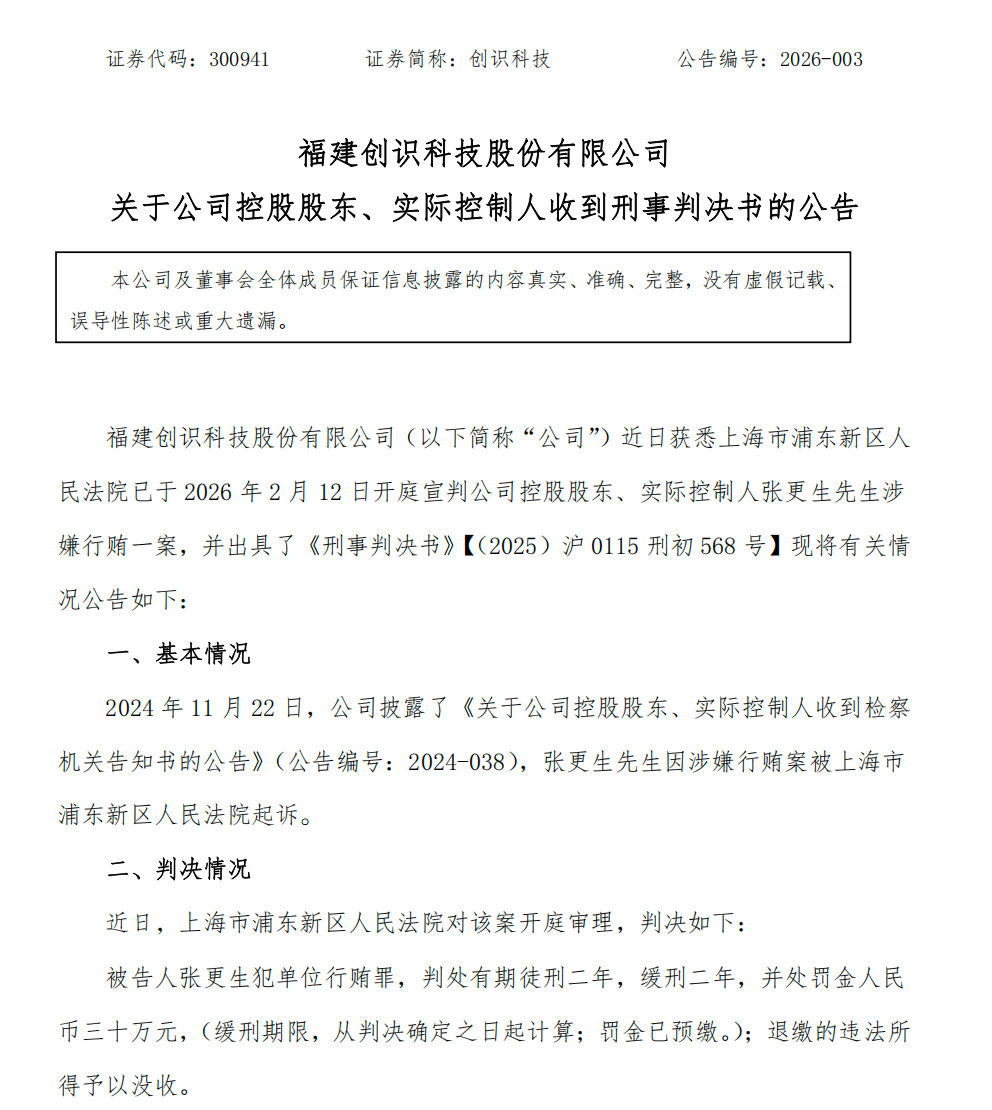
Core Viewpoint - The company Chuangshi Technology (SZ300941) is facing significant challenges following the conviction of its controlling shareholder Zhang Gengsheng for bribery, which has led to a sharp decline in net profit and the sale of shares by key executives [1][2][4]. Group 1: Legal Issues - Zhang Gengsheng, the controlling shareholder and actual controller of Chuangshi Technology, was sentenced to two years in prison (suspended for two years) and fined 300,000 RMB for bribery [2][3]. - The court ruling indicates that the illegal gains will be confiscated, and Zhang Gengsheng has been under investigation since November 2024 [4][3]. - Despite the legal issues, the company asserts that Zhang Gengsheng's sentencing will not impact his rights as a shareholder, and he has already paid the fine [4][5]. Group 2: Executive Actions - Following the announcement of Zhang Gengsheng's legal troubles, three key executives, including the CFO and two vice presidents, sold portions of their shares during a critical period [6][7]. - The CFO, Jiang Xiuyan, sold 320,000 shares at an average price of 23.5553 RMB per share, reducing her holdings from 322,969 shares to just 2,969 shares [7]. - The two vice presidents also executed significant share sales, with one selling 380,000 shares and the other 630,000 shares at average prices of 24.1389 RMB and 24.5270 RMB, respectively [7]. Group 3: Financial Performance - Chuangshi Technology reported a 15.45% increase in revenue for the first three quarters of 2025, reaching 156 million RMB, but net profit fell by 45.84% to 15.326 million RMB [8]. - The decline in profitability is attributed to a decrease in high-margin software and service sales compared to the previous year [8].


300941,实控人被判刑
Zhong Guo Ji Jin Bao· 2026-02-13 12:48
Core Viewpoint - Zhang Gengsheng, the controlling shareholder and actual controller of Chuangshi Technology, was sentenced to two years in prison with a two-year probation for the crime of unit bribery, along with a fine of 300,000 RMB [1][5]. Group 1: Company Background - Chuangshi Technology, founded in the 1990s, specializes in providing electronic payment IT solutions, including hardware and software products for merchants and banks [6]. - As of February 13, Chuangshi Technology's stock closed at 23.68 RMB per share, with a market capitalization of 4.848 billion RMB [6]. Group 2: Legal Proceedings - Zhang Gengsheng was prosecuted by the Shanghai Pudong New Area People's Court due to involvement in a bribery case related to company director Huang Zhongheng [5]. - The court's ruling on February 12, 2026, is a first-instance judgment and has not yet taken effect, with the possibility of Zhang appealing within the legal timeframe [6]. Group 3: Impact on Company Operations - The company stated that Zhang Gengsheng is no longer serving as a director or senior management personnel, and the judgment does not affect his shareholder rights [6]. - The penalties and fines have been fully paid by Zhang, and the company’s daily operations are reported to be normal, with the board and management team fulfilling their responsibilities [6].
中国移动:数智力量赋能“智慧中坡” 绘就梧州乡村振兴新图景
Huan Qiu Wang· 2026-02-13 09:40
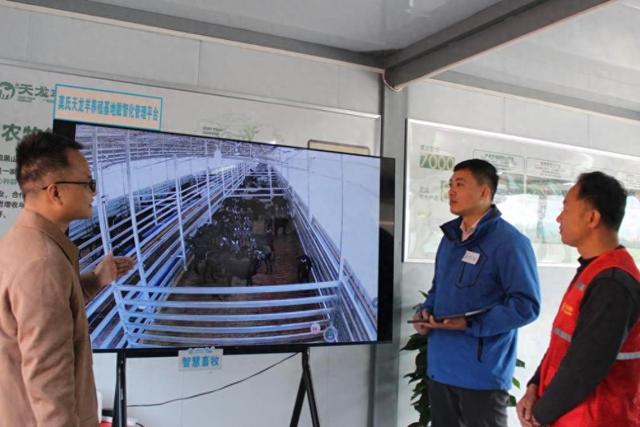
Core Viewpoint - The "Smart Zhongpo" digital village management platform, launched by China Mobile Guangxi Company and Guangxi Mo's Agricultural Group, represents a significant step in implementing the national digital rural development strategy, enhancing grassroots governance and modern agriculture through digitalization [1][3]. Group 1: Digital Infrastructure and Technology - China Mobile Guangxi Company plays a crucial role in building new information infrastructure and digital rural development, leveraging its advanced "connection + computing power + capability" service system to support the "Smart Zhongpo" platform [3]. - The platform is built on a digital foundation supported by 5G, cloud computing, and the Internet of Things, utilizing "N+31+X" mobile cloud resources to create a dedicated "smart agricultural big data platform" [3]. Group 2: Agricultural Innovation - Guangxi Mo's Agricultural Group utilizes AI visual recognition and edge computing provided by China Mobile to establish a full-process visualization traceability system from farm to table, enhancing smart farming practices [5]. - AI cameras analyze sheep behavior in real-time, enabling automatic inventory and precise estrus warnings, with future plans for smart ear tags and pedometers to monitor health indicators continuously [5]. Group 3: Rural Governance and Services - The "Smart Zhongpo" platform serves as both the "smart brain" for industrial digitalization and the "nerve center" for modern rural governance, focusing on three core areas: rural governance, public services, and industrial development [7]. - The platform offers a one-stop solution covering five application scenarios: safe rural areas, comprehensive management, public services, industrial revitalization, and ecological governance, facilitating digital processing of village affairs and improving service equality between urban and rural areas [7]. Group 4: Future Development and Goals - The project has entered a regular operational phase, enhancing village-level affairs, public service efficiency, and industrial transformation [10]. - China Mobile aims to deepen platform capabilities, expand application scenarios, and create replicable experiences to contribute to the digital rural construction in Cengxi and Guangxi, establishing a "Zhongpo model" for rural revitalization [10].
(新春走基层)探访突破“不可能三角”的通信攻坚队:年轻骨干挑大梁
Zhong Guo Xin Wen Wang· 2026-02-13 08:33
Core Insights - The article highlights the efforts of a communication team at China Mobile Chongqing in overcoming the "impossible triangle" challenge of balancing performance, cost, and power consumption in communication technology [1][6]. Group 1: Project Overview - The project focuses on the innovation and application of low-cost phased array coverage enhancement technology based on intelligent ultra-surfaces, which is a potential core technology for 6G [1]. - The team has successfully developed the industry's first series of products that integrate "passive, distributed, and active" technologies, addressing long-standing issues in communication coverage [6][4]. Group 2: Team Dynamics and Challenges - The team faced significant challenges, including self-excitation interference from active integrated devices and interoperability between different manufacturers' equipment [1][3]. - The team worked intensively, often late into the night, to optimize data and validate algorithms, demonstrating a strong commitment to overcoming technical hurdles [3][4]. Group 3: Innovation and Learning - The experience has emphasized the importance of a complete closed loop from technology to value in corporate innovation, highlighting the need for practical application and benefit creation [6]. - The project has fostered a system-level innovation mindset among team members, illustrating that true technological breakthroughs often arise from interdisciplinary collaboration [6].