
BAOFENG ENERGY(600989)

Search documents
钛白粉大厂开启全球化布局,重视行业底部修复机遇


Shenwan Hongyuan Securities· 2025-10-19 13:39
Investment Rating - The report maintains an "Optimistic" rating for the chemical industry [3][4]. Core Insights - The report highlights a recovery opportunity at the bottom of the chemical cycle, particularly in the titanium dioxide sector, with major companies expanding globally and focusing on asset acquisitions [3][4]. - Global oil supply is expected to increase significantly, driven by non-OPEC production, while demand remains stable with a projected global GDP growth of 2.8% [4][5]. - The report emphasizes the importance of various chemical chains, including textiles, agriculture, and exports, as well as the potential for recovery in profitability for titanium dioxide due to easing trade tensions and improved overseas real estate conditions [3][4]. Summary by Sections Industry Dynamics - Oil supply is anticipated to rise, with OPEC+ expected to increase production, while demand is stable but may slow due to tariffs [4]. - Coal prices are expected to stabilize at a low level, and natural gas exports from the U.S. are likely to increase, reducing import costs [4]. Chemical Product Prices and Trends - The report notes that the PPI for all industrial products fell by 2.3% year-on-year in September, indicating a narrowing decline compared to August [5]. - Manufacturing PMI rose to 49.8%, suggesting a continued recovery in manufacturing activity [5]. Investment Analysis - The report suggests focusing on four key areas for investment: textiles, agriculture, export-related chemicals, and sectors benefiting from reduced competition [3]. - Specific companies to watch include Lu Xi Chemical, Tongkun Co., and Huafeng Chemical in the textile chain, and various firms in the agricultural sector such as Hualu Hengsheng and Baofeng Energy [3][4]. Key Company Valuations - The report provides a valuation table for key companies, indicating their market capitalization and projected earnings for the coming years [14].
化工周报:钛白粉大厂开启全球化布局,重视行业底部修复机遇-20251019
Shenwan Hongyuan Securities· 2025-10-19 11:42
Investment Rating - The report maintains an "Optimistic" rating for the chemical industry [3][4]. Core Insights - The report highlights the global expansion of major titanium dioxide manufacturers, emphasizing the opportunity for industry recovery from the bottom of the cycle. The acquisition of Venator UK's titanium dioxide assets and the establishment of subsidiaries in Malaysia and the UK are key developments [4][5]. - The macroeconomic outlook for the chemical sector indicates stable oil demand despite a slight slowdown due to tariffs, with global GDP growth projected at 2.8%. The report also notes that coal prices are stabilizing and natural gas export facilities in the U.S. are expected to accelerate [4][5]. - The report suggests investment strategies across various sectors, including textiles, agriculture, and chemicals, with a focus on companies benefiting from the "anti-involution" policies [4][5]. Summary by Sections Industry Dynamics - The report discusses the current macroeconomic conditions affecting the chemical industry, including oil supply and demand dynamics, with a forecast of increased production from non-OPEC sources and stable global oil demand [5][6]. - It notes that the PPI for industrial products decreased by 2.3% year-on-year in September, indicating a stabilization in prices due to improved supply-demand structures [6]. Investment Analysis - The report recommends a diversified investment approach focusing on sectors such as textiles, agriculture, and export-oriented chemicals, highlighting specific companies for potential investment [4][18]. - Key materials for growth are identified, including semiconductor materials and packaging materials, with specific companies mentioned for each category [4][18]. Price Movements - The report provides detailed price movements for various chemical products, including titanium dioxide, fertilizers, and pesticides, indicating a mixed outlook with some prices stabilizing while others show slight declines [11][14][20]. - It highlights the impact of external factors such as raw material costs and international trade dynamics on pricing trends within the chemical sector [11][14].
10月16日新丝路(399429)指数跌0.69%,成份股西部黄金(601069)领跌
Sou Hu Cai Jing· 2025-10-16 09:29
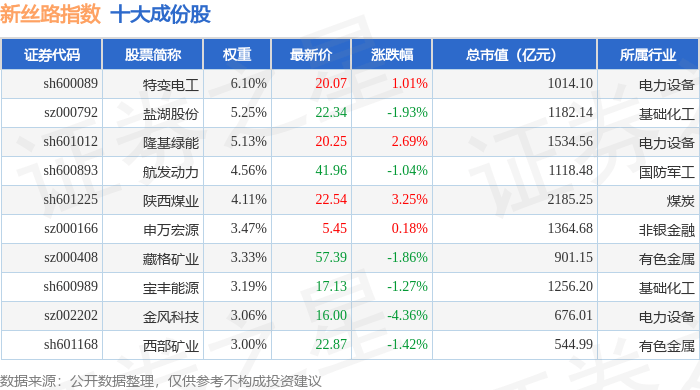
Core Points - The New Silk Road Index (399429) closed at 1575.16 points, down 0.69%, with a trading volume of 58.815 billion yuan and a turnover rate of 2.12% [1] - Among the index constituents, 23 stocks rose, with Baiyin Nonferrous leading with a 10.0% increase, while 75 stocks fell, with Western Gold leading the decline at 6.2% [1] Index Constituents Summary - The top ten constituents of the New Silk Road Index include: - TBEA Co., Ltd. (6.10% weight, latest price 20.07, 1.01% increase, market cap 101.41 billion yuan) in the Power Equipment sector - Salt Lake Industry (5.25% weight, latest price 22.34, 1.93% decrease, market cap 118.21 billion yuan) in the Basic Chemicals sector - LONGi Green Energy (5.13% weight, latest price 20.25, 2.69% increase, market cap 153.46 billion yuan) in the Power Equipment sector - AVIC Aviation Power (4.56% weight, latest price 41.96, 1.04% decrease, market cap 111.85 billion yuan) in the Defense and Military sector - Shaanxi Coal and Chemical Industry (4.11% weight, latest price 22.54, 3.25% increase, market cap 218.53 billion yuan) in the Coal sector - Shenwan Hongyuan (3.47% weight, latest price 5.45, 0.18% increase, market cap 136.47 billion yuan) in the Non-Bank Financial sector - Zangge Mining (3.33% weight, latest price 57.39, 1.86% decrease, market cap 90.12 billion yuan) in the Nonferrous Metals sector - Yuxing Energy (3.19% weight, latest price 17.13, 1.27% decrease, market cap 125.62 billion yuan) in the Basic Chemicals sector - Goldwind Technology (3.06% weight, latest price 16.00, 4.36% decrease, market cap 67.60 billion yuan) in the Power Equipment sector - Western Mining (3.00% weight, latest price 22.87, 1.42% decrease, market cap 54.50 billion yuan) in the Nonferrous Metals sector [1] Capital Flow Summary - The New Silk Road Index constituents experienced a total net outflow of 1.81 billion yuan from main funds, while retail investors saw a net inflow of 1.744 billion yuan [3] - Notable capital flows include: - Baiyin Nonferrous: 5.16 million yuan net inflow from main funds, 2.30 million yuan net outflow from retail investors - LONGi Green Energy: 172 million yuan net inflow from main funds, 15.1 million yuan net outflow from retail investors - New Mileage: 1.59 million yuan net inflow from main funds, 93.05 million yuan net outflow from retail investors - Other companies like China Western Electric and Zhongcai Zihuan also showed varying degrees of net inflows and outflows [3]





基础化工 2025 年 Q3 业绩前瞻:Q3 淡季叠加成本走高,周期品价差回落,化工盈利季节性承压
Shenwan Hongyuan Securities· 2025-10-14 09:00
Investment Rating - The report maintains an "optimistic" rating for the chemical industry [4] Core Insights - Q3 is traditionally a low season for downstream chemical products, with prices of chemical products retreating from high levels. However, high demand in sub-sectors like agricultural chemicals supports performance [3][4] - The supply side of the chemical sector is nearing the end of capital expenditure, and policies aimed at reducing excess capacity are expected to accelerate the exit of outdated production capacity. Demand is anticipated to trend upward in the long term due to stabilizing oil prices and easing liquidity [4] Summary by Relevant Sections Agricultural Chemicals - The agricultural chain is expected to see steady growth in fertilizer demand due to increasing cultivated areas and higher penetration of genetically modified crops. Key companies to watch include Hualu Hengsheng and Baofeng Energy for nitrogen fertilizers, Yuntianhua and Xingfa Group for phosphate fertilizers, and Yara International for potash fertilizers [4] Textile and Apparel Chain - The textile and apparel chain has maintained high growth rates, with supply-side production peaks having passed. Companies like Luxi Chemical and Tongkun Co. are highlighted for their potential in this sector [4] Export-Related Chemicals - With overall overseas inventory at historical lows and expectations of interest rate cuts, demand for export-related chemical products is expected to rise. Key companies include Juhua Co. and Sanmei Co. in the fluorochemical sector, and Wanhua Chemical in the MDI segment [4] New Materials - The report emphasizes the acceleration of domestic self-sufficiency in key materials, particularly in semiconductor materials and OLED panel materials. Companies like Yake Technology and Ruijie New Materials are noted for their growth potential [5]



绿色燃料进入产业化元年,投资逻辑将从主题炒作转向业绩驱动 | 投研报告
Zhong Guo Neng Yuan Wang· 2025-10-14 02:11
Core Insights - The launch of the first batch of green liquid fuel industrialization pilot projects by the National Energy Administration marks a significant acceleration in the industrialization of green liquid fuels, defining 2025 as the "substantial industrialization year" for China's green liquid fuel development [2][4]. Group 1: Policy and Project Overview - The National Energy Administration announced nine pilot projects focusing on green methanol, green ammonia, and cellulose ethanol, including significant projects like the coupling of wind power and biomass to produce methanol in Jilin and the production of 50,000 tons of green methanol in Inner Mongolia [2][4]. - The projects require simultaneous technological breakthroughs and market validation, with a completion deadline set for the end of 2026, ensuring a closed-loop system from production to application [2][4]. Group 2: Future Industry Landscape - The future green fuel industry is envisioned as a comprehensive ecosystem driven by green electricity, utilizing green hydrogen as a bridge, and integrating biomass resources to serve transportation, shipping, and green chemicals [3]. - Key technological pathways include the synthesis of green methanol from green hydrogen and captured CO2, and the production of biodiesel from various biomass materials, which will play a crucial role in decarbonizing shipping [3]. Group 3: Investment Recommendations - The shift in investment logic for the green liquid fuel industry will transition from "theme speculation" to "performance-driven," with the concentration of projects expected to generate substantial orders and revenue for related listed companies [4][5]. - Recommended areas for investment include full industry chain integrators, core equipment manufacturers, key materials and components suppliers, and fuel production and operation enterprises, with specific companies highlighted for their critical roles in the industry [5].

化学原料板块10月13日跌1.62%,卫星化学领跌,主力资金净流出4.67亿元
Zheng Xing Xing Ye Ri Bao· 2025-10-13 12:38
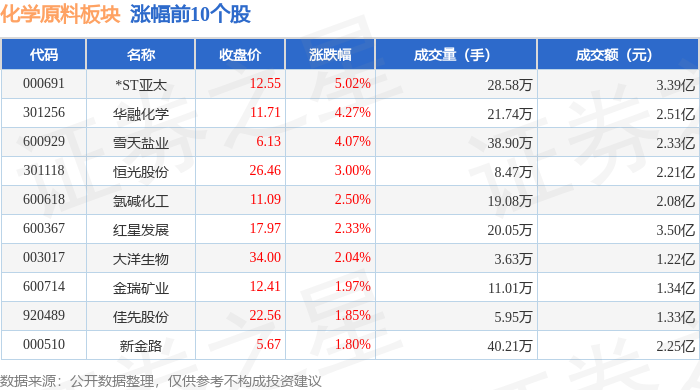
Market Overview - The chemical raw materials sector experienced a decline of 1.62% on October 13, with Satellite Chemical leading the drop [1] - The Shanghai Composite Index closed at 3889.5, down 0.19%, while the Shenzhen Component Index closed at 13231.47, down 0.93% [1] Stock Performance - Notable gainers in the chemical raw materials sector included: - *ST Asia Pacific: Closed at 12.55, up 5.02% with a trading volume of 285,800 shares and a turnover of 339 million yuan - Huarong Chemical: Closed at 11.71, up 4.27% with a trading volume of 217,400 shares and a turnover of 251 million yuan - Xutian Salt Industry: Closed at 6.13, up 4.07% with a trading volume of 389,000 shares and a turnover of 233 million yuan [1] - Conversely, significant decliners included: - Satellite Chemical: Closed at 18.84, down 4.61% with a trading volume of 672,900 shares and a turnover of 1.257 billion yuan - Luxi Chemical: Closed at 14.10, down 4.02% with a trading volume of 313,800 shares and a turnover of 441 million yuan - Baofeng Energy: Closed at 17.60, down 3.40% with a trading volume of 675,500 shares and a turnover of 1.191 billion yuan [2] Capital Flow - The chemical raw materials sector saw a net outflow of 467 million yuan from institutional investors, while retail investors experienced a net inflow of 486 million yuan [2] - Detailed capital flow for selected stocks showed: - Zhongke Titanium White: Net inflow of 64.89 million yuan from institutional investors, with a net outflow of 90.82 million yuan from retail investors [3] - Proposal Co.: Net inflow of 38.51 million yuan from institutional investors, with a net outflow of 10.74 million yuan from retail investors [3]


宝丰能源跌3.4% 某券商上周五喊买入
Zhong Guo Jing Ji Wang· 2025-10-13 09:45
Core Viewpoint - Baofeng Energy (600989.SH) reported a closing price of 17.60 yuan, with a decline of 3.40% on October 13 [1] Group 1 - A brokerage firm released a research report on October 10 titled "Baofeng Energy: Coal-to-Olefin Leader's Inner Mongolia Project Launches Growth Potential" [1] - The brokerage maintains a "Buy-B" rating for Baofeng Energy [1]
绿色燃料进入产业化元年,投资逻辑将从主题炒作转向业绩驱动
Shanxi Securities· 2025-10-13 09:40
Investment Rating - The report maintains an investment rating of "Buy-B" for the following stocks:昊华科技 (600378.SH), 中国旭阳集团 (01907.HK), 宝丰能源 (600989.SH), and "Buy-A" for 卓越新能 (688196.SH) [1] Core Insights - The green liquid fuel industry is entering a substantial industrialization phase, marking 2025 as the "first year of substantial industrialization" in China, with a shift in investment logic from thematic speculation to performance-driven [2][4][29] - The National Energy Administration has initiated the first batch of green liquid fuel industrialization pilot projects, focusing on green methanol, green ammonia, and cellulose ethanol, which are expected to be operational by the end of 2026 [2][9][10] - The future green fuel industry will be a comprehensive ecosystem driven by green electricity, utilizing green hydrogen as a bridge, and integrating biomass resources to serve transportation, shipping, and green chemicals [3][15] Summary by Sections 1. Green Liquid Fuel Industrialization - The first batch of pilot projects includes nine projects, such as the integration of wind power and biomass for methanol production, with a focus on creating a closed-loop system from production to application [2][9][10] - The projects require simultaneous technological breakthroughs and market validation, emphasizing the need for clear end-user applications [9][10] 2. Market Performance - The report highlights the weekly performance of the chemical market, with specific segments like phosphate fertilizers and titanium dioxide showing significant gains [20][21] - The manufacturing PMI for September 2025 is reported at 49.8, indicating a slight improvement, while the industrial PPI has decreased by 2.9% year-on-year [16] 3. Investment Recommendations - The report suggests focusing on full industry chain integrators, core equipment manufacturers, key materials and components suppliers, and fuel production and operation companies [4][29] - Recommended companies include昊华科技, 中国旭阳集团, 宝丰能源, and 卓越新能, which are positioned to benefit from the industrialization of green liquid fuels [4][29]

山西证券研究早观点-20251013
Shanxi Securities· 2025-10-13 01:02
Industry Overview - The solar energy sector experienced a significant decline in new installations, with August 2025 seeing a year-on-year decrease of 55.3%, totaling 7.4 GW. However, cumulative installations from January to August 2025 reached 230.61 GW, reflecting a 64.7% increase year-on-year [7]. - In terms of exports, solar module exports in August 2025 amounted to 20.95 billion yuan, marking a year-on-year growth of 20.4% and a month-on-month increase of 31.9%. Cumulatively, from January to August 2025, the export value was 132.21 billion yuan, down 18.0% year-on-year [7]. - Inverter exports also showed growth, with August 2025 exports valued at 6.29 billion yuan, a year-on-year increase of 2.2%, although it decreased by 3.4% month-on-month. Cumulative exports from January to August 2025 reached 43.4 billion yuan, up 8.0% year-on-year [7]. Company Analysis: Baofeng Energy (600989.SH) - Baofeng Energy is a leading player in the coal-to-olefins sector, with a significant project in Inner Mongolia set to enhance its growth potential. The company holds approximately 23.8% of the national coal-to-olefins production capacity, which is projected to reach 13.42 million tons per year by the end of 2024 [10]. - The company benefits from a cost advantage in coal-to-olefins production, as current coal prices are on a downward trend, allowing for lower production costs compared to oil-based methods. The company's gross margin for polyolefin products is higher than its peers, attributed to effective cost control and advanced production processes [10]. - The Inner Mongolia project, which is the largest coal-to-olefins project globally, is expected to be fully operational by April 2025, doubling the company's polyolefin production capacity. This expansion is anticipated to significantly contribute to the company's revenue growth [10]. - Future projects in Ningdong and Xinjiang are also in the pipeline, with a planned capacity increase of over 4.56 million tons, indicating strong long-term growth potential [10]. - Profit forecasts for Baofeng Energy suggest net profits of 12.2 billion yuan, 13.2 billion yuan, and 14.4 billion yuan for 2025 to 2027, with corresponding price-to-earnings ratios of 11, 10, and 9 times [10].
研报掘金丨山西证券:维持宝丰能源“买入-B”评级,内蒙项目投产打开成长空间
Ge Long Hui A P P· 2025-10-11 08:04
Core Viewpoint - Baofeng Energy is a leading enterprise in coal-to-olefins, with the Inner Mongolia project set to enhance growth potential [1] Industry Overview - By the end of 2024, the total domestic coal-to-olefins production capacity is expected to reach 13.42 million tons per year, with Baofeng Energy accounting for approximately 23.8% of this capacity [1] - The company has a leading position in terms of unit product cost and energy consumption within the industry [1] Company Developments - In March 2023, the company commenced construction of its Inner Mongolia olefins project, which is projected to be fully operational by April 2025, adding 3 million tons of olefins capacity [1] - The new project will more than double the company's polyolefins production capacity, significantly enhancing growth opportunities [1] Future Growth Potential - The company's cost advantages as a leader in coal-to-olefins, along with the incremental performance expected from the Inner Mongolia project, are likely to support long-term growth [1] - Planned projects in the Ningdong and Xinjiang bases are expected to further bolster the company's long-term growth prospects [1] - The investment rating for the company is maintained at "Buy-B" [1]