NJBK(601009)

Search documents
银行密集发布股东高管增持公告
21世纪经济报道· 2025-11-28 06:18
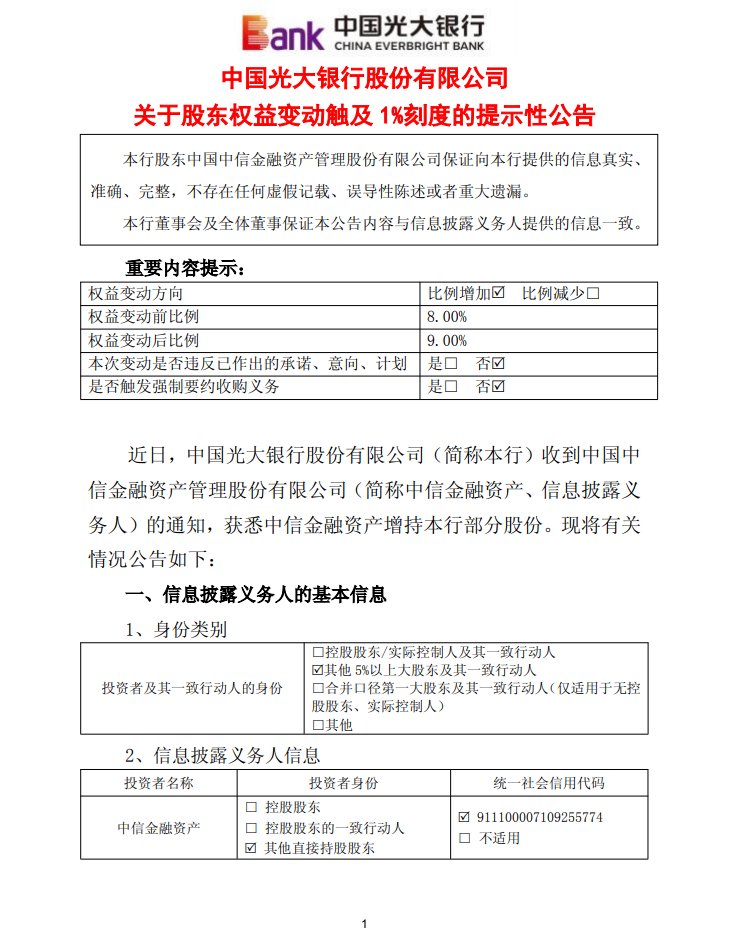
Core Viewpoint - The article highlights the significant increase in shareholding by major shareholders and executives in various banks, indicating strong confidence in the banking sector's future performance amidst market fluctuations [1][11]. Group 1: Shareholding Changes - China Citic Financial Asset Management Co., Ltd. increased its stake in Everbright Bank from 8.00% to 9.00%, acquiring approximately 275 million A-shares and 315 million H-shares, totaling 1.00% of the bank's total equity [6][7]. - Nanjing Bank's major shareholder, BNP Paribas, increased its stake by over 128 million shares, raising its holding to 18.06% [7]. - Chengdu Bank's actual controller and shareholders increased their holdings by approximately 34.2 million shares, investing a total of 611 million yuan [7]. Group 2: Overall Market Trends - Since the beginning of the year, the banking sector has seen net increases in shareholdings amounting to approximately 9.03 billion yuan, ranking first among 31 industries [8]. - The banking sector has experienced a total increase in shareholdings of about 12.63 billion yuan, second only to the transportation industry, with a decrease of around 3.6 billion yuan [8]. - More than half of the listed banks have disclosed plans for major shareholders or executives to increase their holdings, with the top five banks by increase amount being Nanjing Bank (7.38 billion yuan), Suzhou Bank (1.74 billion yuan), Everbright Bank (1.24 billion yuan), Shanghai Pudong Development Bank (890 million yuan), and Chengdu Bank (610 million yuan) [8]. Group 3: Market Performance - The banking index has risen nearly 8% in the fourth quarter, driven by the continuous buying from shareholders and executives [10][11]. - Major banks like Agricultural Bank of China and Industrial and Commercial Bank of China have reached historical highs in stock prices, indicating a strong performance in the banking sector [11]. - Analysts suggest that the ongoing buying activity from shareholders and executives provides support for bank stock prices, especially as the market experiences significant volatility [11]. Group 4: Future Outlook - The article suggests that the ongoing shareholding increases reflect confidence in the long-term investment value of banks, particularly those with stable operations and strong regional economic resilience [12]. - Future valuation recovery for bank stocks is expected to be driven by low valuations, high dividend yields, regional economic support, and favorable policy conditions [12].




股东高管加速“抢筹” 11月七家银行获增持
2 1 Shi Ji Jing Ji Bao Dao· 2025-11-28 04:52
Core Viewpoint - The continuous share buybacks by major shareholders in various banks indicate strong confidence in the banks' future performance, even as the broader market struggles to maintain stability around the 3000-point mark [1]. Shareholder Actions - China Citic Financial Asset Management Co., Ltd. increased its stake in Everbright Bank from 8.00% to 9.00%, acquiring approximately 275 million A-shares and 315 million H-shares, totaling 1.00% of the bank's total equity [6][7]. - In November, several banks, including Nanjing Bank and Chengdu Bank, reported significant share purchases by their major shareholders, reflecting confidence in their growth potential [7][8]. Market Performance - The banking sector has shown resilience, with the banking index rising nearly 8% in the fourth quarter, driven by shareholder and executive buybacks [10]. - The banking sector has seen a net increase in share purchases amounting to approximately 9.03 billion yuan, ranking first among 31 industries [8]. Investment Sentiment - Analysts suggest that the ongoing buybacks by bank shareholders and executives signal a strong belief in the long-term investment value of these banks, particularly those with stable operations and strong regional economic resilience [10][11]. - The increase in share buybacks is seen as a positive indicator for market valuation, providing a clear valuation anchor for investors [10].
超2600亿“红包”落地!13家银行中期分红,六大行贡献七成
Xin Jing Bao· 2025-11-27 12:05
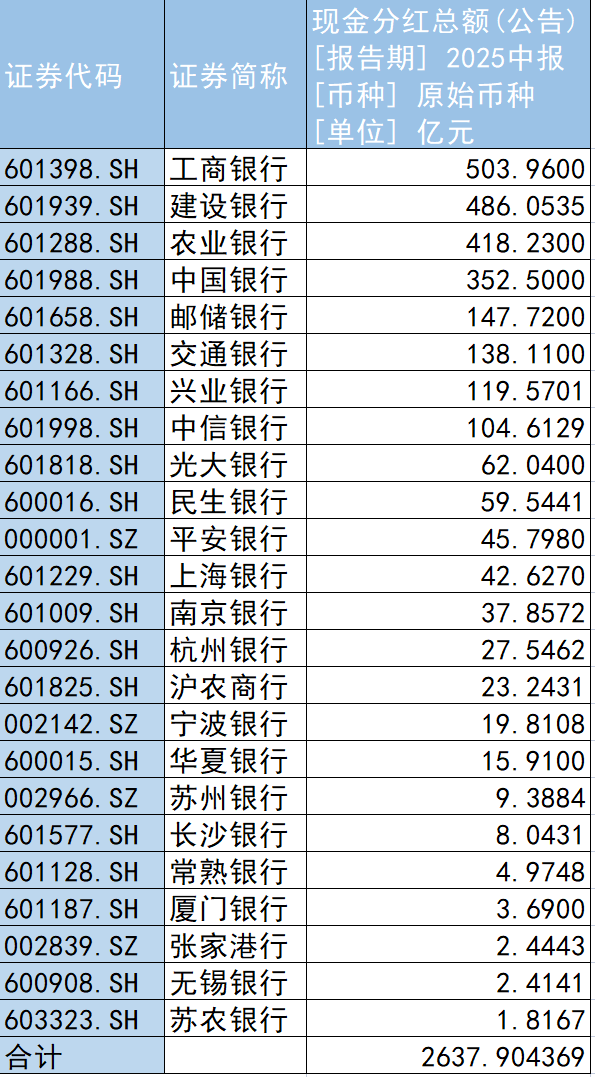
Core Viewpoint - The mid-term dividends of listed banks have exceeded 260 billion yuan, reflecting a trend towards enhancing shareholder returns and stabilizing market confidence [1][2][5]. Group 1: Dividend Distribution - As of November 26, 2025, 42 A-share listed banks have distributed a total of 263.79 billion yuan in mid-term dividends, with 13 banks having completed their distributions [1][2]. - The six major state-owned banks contributed over 70% of the total mid-term dividends, amounting to 204.66 billion yuan, with Industrial and Commercial Bank of China leading at 50.40 billion yuan [2][3]. - Several banks, including Shanghai Bank and Nanjing Bank, have also participated in mid-term dividends, with total distributions from city commercial banks reaching 3.10 billion yuan [2][4]. Group 2: Market Impact and Investor Confidence - The implementation of mid-term dividends is seen as a signal of stable operations, enhancing market confidence and attracting long-term capital [1][5][9]. - First-time dividend issuers have experienced positive short-term stock performance, indicating that dividends can boost shareholder confidence and improve capital efficiency [5][9]. - The trend of mid-term dividends is aligned with regulatory encouragement for banks to optimize dividend policies and improve shareholder returns [1][6]. Group 3: Future Outlook and Strategic Considerations - The decision to implement mid-term dividends reflects banks' strong financial performance and stable profit models, which provide a solid foundation for such distributions [6][9]. - Analysts suggest that banks should balance short-term dividend payouts with long-term growth strategies, ensuring that capital is adequately retained for future development [9]. - The ongoing trend of mid-term dividends is viewed as a sign of the maturation of China's capital markets and a shift towards greater emphasis on investor returns [9].


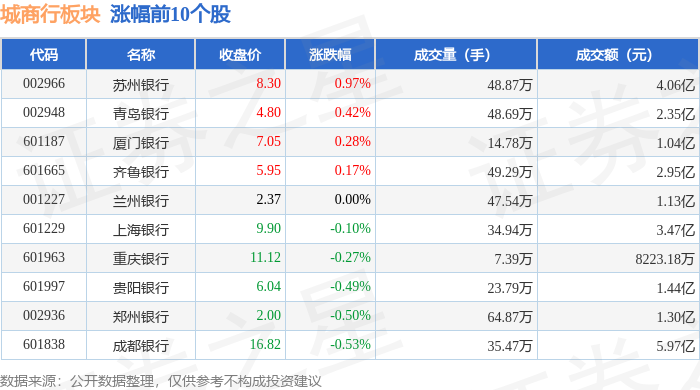
城商行板块11月26日跌0.59%,南京银行领跌,主力资金净流出1.47亿元
Zheng Xing Xing Ye Ri Bao· 2025-11-26 09:05
Market Performance - The city commercial bank sector declined by 0.59% on November 26, with Nanjing Bank leading the drop [1] - The Shanghai Composite Index closed at 3864.18, down 0.15%, while the Shenzhen Component Index rose by 1.02% to 12907.83 [1] Individual Stock Performance - Suzhou Bank closed at 8.30, up 0.97% with a trading volume of 488,700 shares and a transaction value of 406 million yuan [1] - Nanjing Bank closed at 11.49, down 1.29% with a trading volume of 514,300 shares and a transaction value of 592 million yuan [2] - Chengdu Bank closed at 16.82, down 0.53% with a trading volume of 354,700 shares and a transaction value of 597 million yuan [2] Capital Flow Analysis - The city commercial bank sector experienced a net outflow of 147 million yuan from institutional investors, while retail investors saw a net inflow of 152 million yuan [2] - Among individual stocks, Suzhou Bank had a net outflow of 31.27 million yuan from institutional investors, while Nanjing Bank saw a net inflow of 27.56 million yuan [3]


外汇展业改革参与银行增至26家 三季度工行等4家入列
2 1 Shi Ji Jing Ji Bao Dao· 2025-11-26 07:00
Core Insights - The foreign exchange business reform has been positively received by commercial banks and the public, with 26 banks participating as of September 2025, covering various types of banks across the country [1][2] Group 1: Reform Implementation and Participation - As of September 2025, 26 banks are involved in the foreign exchange business reform, including 5 large banks, 9 joint-stock banks, 4 city commercial banks, and 8 foreign banks [1] - The newly added banks in the third quarter include Industrial and Commercial Bank of China, Deutsche Bank, Mizuho Bank, and Mitsubishi UFJ Financial Group [2] Group 2: Benefits of the Reform - The reform has reduced the burden on enterprises, allowing them to handle foreign exchange transactions more efficiently, with some businesses experiencing a significant reduction in processing time from days to minutes [3] - Banks have improved their customer identification and service capabilities, leading to a reduction in average processing time for transactions by over 50% [3] - The reform has enhanced regulatory quality, with banks establishing risk monitoring systems to better track cross-border transactions and identify abnormal activities early [3] Group 3: Future Directions - The State Administration of Foreign Exchange plans to further enhance the foreign exchange management system, focusing on convenience, openness, security, and intelligence [4] - Future efforts will include expanding the coverage of the reform to benefit more enterprises and integrating various facilitation policies [4] - The application of new technologies such as artificial intelligence and big data will be encouraged to improve efficiency in foreign exchange services [4]




银行股增持潮起股东用资本投票
Zhong Guo Zheng Quan Bao· 2025-11-25 20:27
Core Viewpoint - The recent surge in share buybacks by shareholders and executives in A-share banks, particularly city commercial banks like Nanjing Bank and Chengdu Bank, reflects strong confidence in the banks' fundamentals and a market preference for high-dividend assets [1][2]. Group 1: Shareholder and Executive Buybacks - Nanjing Bank announced that BNP Paribas (QFII) increased its stake by 12.8 million shares, raising its total holding from 17.02% to 18.06% [1]. - Chengdu Bank's major shareholders, Chengdu Industrial Capital Group and Chengdu Xintianyi, collectively spent 611 million yuan to buy 3.4247 million shares, with plans for further purchases [2]. - Executives from Changshu Bank and Shanghai Rural Commercial Bank also announced their intentions to buy shares, indicating a commitment to their banks' long-term value [2]. Group 2: Market Conditions and Valuation - The increase in buybacks is attributed to expectations of economic recovery, improved performance, and valuation corrections, with 38 out of 42 A-share listed banks seeing stock price increases this year [2][3]. - The banking sector's overall price-to-book ratio remains at historical lows, suggesting potential for valuation recovery [2][3]. Group 3: Investment Outlook - Analysts express optimism regarding the banking sector, highlighting the appeal of high-dividend, low-valuation characteristics of bank stocks, especially during periods of economic stagnation [4]. - Investment strategies focus on banks with regional advantages and strong performance certainty, particularly in areas like Jiangsu, Shanghai, Chengdu, Shandong, and Fujian [4].
银行股增持潮起 股东用资本投票
Zhong Guo Zheng Quan Bao· 2025-11-25 20:26
Core Viewpoint - The recent surge in share buybacks by shareholders and executives in the A-share banking sector reflects strong confidence in the banks' fundamentals and a preference for high-dividend assets in the market [1][4]. Group 1: Shareholder and Executive Buybacks - Several city commercial banks, including Nanjing Bank and Chengdu Bank, have announced significant share buybacks, indicating a robust trend among mid-sized banks [1][2]. - Nanjing Bank reported that BNP Paribas increased its stake by 1.28 million shares, raising its total holding from 17.02% to 18.06%, marking its second buyback this year [2]. - Chengdu Bank's major shareholders have invested 611 million yuan to buy back 3.4247 million shares, with plans for further purchases [2][3]. Group 2: Management Buybacks - Management teams at smaller banks are also participating in buybacks, with Changshu Bank's executives planning to purchase at least 550,000 shares over the next six months [3]. - Shanghai Rural Commercial Bank's executives have already bought 259,100 shares at prices between 9.02 and 9.08 yuan, committing to a two-year lock-up [3]. Group 3: Market Dynamics and Valuation - The recent buyback trend is attributed to expectations of economic recovery, improved performance, and valuation corrections, with 38 out of 42 A-share listed banks seeing stock price increases this year [4]. - The banking sector's overall price-to-book ratio remains at historical lows, despite a positive cycle of performance recovery and increased dividends [4]. - Analysts note a shift in strategy, with recent buybacks occurring during price increases, indicating a proactive approach to guiding valuation recovery [4]. Group 4: Future Outlook - Analysts maintain an optimistic outlook for the banking sector, suggesting that the time window for reallocating investments in bank stocks has opened [5][6]. - The high dividend yield and low valuation characteristics of bank stocks are expected to attract more capital, particularly from insurance institutions and asset management companies [6]. - Key investment themes include focusing on banks with regional advantages and strong performance certainty, as well as those offering high dividends [6].
增持不停歇!银行股成“香饽饽”,大股东、高管“真金白银”组团力挺
Bei Jing Shang Bao· 2025-11-25 13:37
Core Viewpoint - A surge in share buybacks by listed banks in China's A-share market is observed, driven by strong confidence from major shareholders and management teams in the banks' future prospects and the current undervaluation of bank stocks [1][5][6] Group 1: Share Buyback Activities - Numerous listed city commercial banks and rural commercial banks, including Nanjing Bank, Suzhou Rural Commercial Bank, Chengdu Bank, and others, have disclosed their share buyback progress since November [1][3] - Chengdu Bank reported that its major shareholders, Chengdu Industrial Capital Holding Group and Chengdu Xintianyi Investment, have cumulatively increased their holdings by 14.04 million shares, amounting to 253 million yuan [3][4] - Nanjing Bank's major shareholder, BNP Paribas, increased its stake by 128 million shares, raising its total holding from 17.02% to 18.06% [4] Group 2: Financial Performance and Market Sentiment - The banking sector's fundamentals remain robust, with commercial banks achieving a net profit of 1.9 trillion yuan in the first three quarters, and 24 listed banks announcing a total cash dividend of 263.79 billion yuan [5][6] - The stock prices of several banks have reached historical highs, with Agricultural Bank of China seeing a year-to-date increase of nearly 60% [6][7] - Analysts suggest that the current buyback trend reflects internal confidence in the banks' future and signals to the market that their value is underestimated [5][7] Group 3: Future Outlook - The ongoing recovery in the macroeconomic environment is expected to support the banking sector's performance, with analysts highlighting the importance of sustained economic recovery, interest rate changes, and long-term capital inflows for future stock performance [7][8] - Investors are advised to maintain a long-term perspective and focus on banks with strong fundamentals, emphasizing the importance of asset quality, profitability, and dividend policies [7][8]

高息优先股密集退场 银行优先股投资逻辑生变
Zhong Guo Jing Ying Bao· 2025-11-25 13:12
Core Viewpoint - Recent announcements from multiple commercial banks regarding the redemption of preferred shares indicate a shift in capital management strategies within the banking sector [1][2]. Group 1: Redemption of Preferred Shares - Several banks, including Ping An Bank and Nanjing Bank, have announced plans to redeem preferred shares issued over five years ago, with Ping An Bank set to redeem 200 million shares worth 20 billion yuan by March 2026 and Nanjing Bank planning to redeem 49 million shares worth 4.9 billion yuan by December 2025 [1]. - Since July, at least nine banks, including Industrial and Commercial Bank of China and Bank of Beijing, have disclosed similar redemption plans, creating a notable trend in the market [1]. Group 2: Reasons for Redemption - The high dividend rates set at the time of issuance, combined with declining market interest rates, incentivize banks to redeem high-cost preferred shares and replace them with lower-cost perpetual bonds [2]. - Regulatory changes and the need for banks to optimize their capital structures are also significant factors driving the decision to redeem high-cost preferred shares [2]. Group 3: Capital Management Strategies - The banking sector is transitioning from a focus on scale expansion to a cost-efficiency-centered model, emphasizing the need for banks to balance the redemption of high-interest preferred shares with the issuance of low-cost capital tools [3]. - Banks are adopting more diversified and flexible capital supplement tools, allowing them to respond to market conditions effectively, such as redeeming high-interest preferred shares when interest rates are low [3].

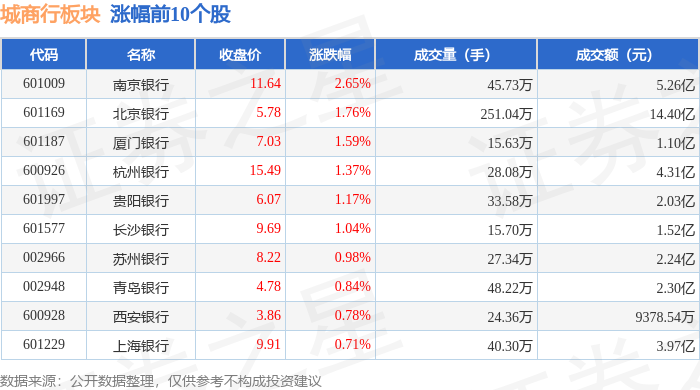
城商行板块11月25日涨0.99%,南京银行领涨,主力资金净流入3.66亿元
Zheng Xing Xing Ye Ri Bao· 2025-11-25 09:09
Core Insights - The city commercial bank sector experienced a rise of 0.99% on November 25, with Nanjing Bank leading the gains [1] - The Shanghai Composite Index closed at 3870.02, up 0.87%, while the Shenzhen Component Index closed at 12777.31, up 1.53% [1] Stock Performance - Nanjing Bank (600T009) closed at 11.64, with a gain of 2.65% and a trading volume of 457,300 shares, amounting to a transaction value of 526 million [1] - Beijing Bank (601169) closed at 5.78, up 1.76%, with a trading volume of 2,510,400 shares [1] - Xiamen Bank (601187) closed at 7.03, up 1.59%, with a trading volume of 156,300 shares [1] - Hangzhou Bank (600926) closed at 15.49, up 1.37%, with a trading volume of 128,080 shares [1] - Guiyang Bank (601997) closed at 6.07, up 1.17%, with a trading volume of 335,800 shares [1] - Other notable performances include Changsha Bank (601577) at 69.6 (+1.04%), Suzhou Bank (002966) at 8.22 (+0.98%), and Qingdao Bank (002948) at 4.78 (+0.84%) [1] Capital Flow - The city commercial bank sector saw a net inflow of 366 million in main funds, while retail funds experienced a net outflow of 305 million [2] - The main funds' net inflow for Hangzhou Bank was 97.67 million, while retail funds saw a net outflow of 48.86 million [3] - Qilu Bank (601665) had a main fund net inflow of 67.32 million, with retail funds experiencing a net outflow of 50.62 million [3] - Jiangsu Bank (601009) reported a main fund net inflow of 38.10 million, while retail funds had a net outflow of 45.88 million [3]