Chongqing Rural Commercial Bank(601077)

Search documents
银行股又见新高!公募业绩基准考核,对银行股配置影响几何?
Hua Er Jie Jian Wen· 2025-05-14 06:14
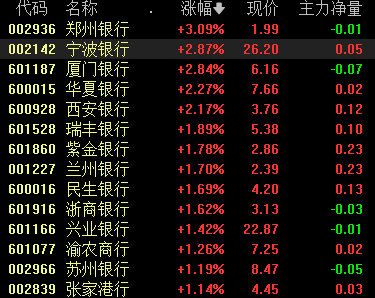
Core Viewpoint - The A-share banking sector has shown significant strength, reaching new highs not seen since mid-July 2015, with major banks like Agricultural Bank of China, Shanghai Bank, and China Everbright Bank hitting historical price peaks. This surge has positively impacted the ChiNext Index and the Shanghai Composite Index, which rose over 1% in the afternoon session [1]. Group 1: Market Performance - The banking sector's performance has led to a notable increase in stock prices, with several banks achieving record highs [1]. - Specific banks such as Zhengzhou Bank, Ningbo Bank, and Xiamen Bank have shown positive growth percentages, with increases of 3.09%, 2.87%, and 2.84% respectively [2]. Group 2: Fund Management Regulations - New regulations for public funds are expected to significantly boost the valuation recovery of A-share banking stocks, as these regulations will guide asset allocation towards the CSI 300 index, necessitating an increase in bank stock holdings due to a substantial "allocation gap" [2][3]. - As of the end of 2024, the proportion of bank holdings in actively managed funds is only 3.81%, while the banking sector's weight in the CSI 300 index is 13.67%, indicating a deviation of nearly 10 percentage points [3][9]. Group 3: Individual Bank Analysis - Under the new fund allocation trends, banks that were previously underweighted, such as China Merchants Bank, Industrial Bank, and Bank of Communications, are expected to benefit the most from increased fund allocations [5][12]. - Specific banks like China Merchants Bank and Industrial Bank have the highest underweight ratios, with deviations of 1.9% and 1.5% respectively [11]. Group 4: Regulatory Changes - The new public fund regulations emphasize a performance-based assessment system, increasing the weight of fund performance metrics in evaluating fund managers, with a minimum of 80% weight on fund product performance indicators [6][10]. - Funds that significantly deviate from performance benchmarks will be closely monitored, with quarterly reports required to detail industry allocation differences and adjustment plans [10].






农村商业银行中的龙头——重庆农商行2024年财报分析
数说者· 2025-05-13 14:34
2010 年,重庆农商行在香港上市,股票代码为 3618.HK , 2019 年又在上交所上市,股票代码为 601077 ,股票简称" 渝农商行 "。 重庆农商行下辖 7 家分行( 6 家位于重庆市内, 1 家位于云南省曲靖市)、 35 家支行,共 1743 个 营业机构,并发起设立 1 家金融租赁公司(渝农商金融租赁有限责任公司)、 1 家理财公司(渝农商理 财有限责任公司) 、 12 家村镇银行(位于江苏、四川、云南、福建和广西),此外还持有 重庆小米消 费金融有限公司 30% 股权。 截至 2024 年末,重庆农商行有从业人员 1.45 万人。 一、规模类增速有所放缓,但仍为头部农商行,且高于部分股份行 截至 2024 年末,重庆农商行总资产达到 1.51 万亿元,较 2023 年末增长 5.13% ,资产增速一般。 当年实现营业收入 282.61 亿元,同比增长 1.09% ,增速一般,特别是在 2022 年和 2023 年分别出现 -6.00% 和 -3.57% 的下降后, 2024 年仅增加 1% 出头,其营业收入尚未恢复到 2021 年的 300 亿以上规 模。 2024 年公司归母净利润 11 ...
银行股连创新高,低利率环境考验非息收入创造能力
Di Yi Cai Jing Zi Xun· 2025-05-13 12:56
Core Viewpoint - Bank stocks have shown resilience and have risen against the market trend, with the China Securities Bank Index reaching a new high since February 2018, driven by multiple favorable policies and market conditions [1][2][3]. Market Performance - On May 13, the China Securities Bank Index rose by 1.53% to close at 7629.55 points, marking a new high since February 2018, with many individual stocks hitting historical highs [1][2]. - Over the last five trading days, the bank sector has increased by 5.76%, outperforming the Shanghai Composite Index, which rose by 1.77% [2]. - Notable individual stock performances include Chongqing Bank and Shanghai Bank, both rising over 3%, with Chongqing Bank leading with a 10.9% increase [2]. Policy Impact - Recent monetary policies, including interest rate cuts and reserve requirement ratio reductions, are expected to have a neutral impact on banks' net interest margins, with adjustments on the liability side helping to mitigate pressures [1][6][7]. - The establishment of Financial Asset Investment Companies (AIC) is seen as a significant opportunity for banks to enhance their comprehensive benefits and support technology enterprises [3][4][5]. Earnings and Profitability - Despite the pressure on profitability, bank stocks remain attractive due to their stability and dividend yields, especially as regulatory measures encourage long-term capital inflows [3][4]. - The average net interest margin for listed banks is projected to be 1.52% by the end of 2024, continuing a five-year decline, with a notable decrease in interest income reported for the previous year [6][8]. Strategic Adjustments - Banks are adapting to the low-interest-rate environment by diversifying their income sources and optimizing their operational structures to maintain profitability [8][9]. - The focus on non-interest income generation is becoming increasingly critical for banks to navigate the challenges posed by a shrinking net interest margin [8][9].



银行业周报:降准降息落地,稳定市场预期-20250513
Bank of China Securities· 2025-05-13 08:15
Investment Rating - The report rates the banking industry as "Outperform" [1] Core Insights - Recent monetary policy adjustments, including a 0.5 percentage point reduction in the reserve requirement ratio and a 0.1 percentage point decrease in policy interest rates, are expected to stabilize market expectations and provide approximately 1 trillion yuan in long-term liquidity [2][3] - The establishment of financial asset investment companies by three joint-stock banks aims to enhance their ability to serve the real economy, although it may put pressure on their capital and asset quality [4][5] - The banking sector is viewed positively, with a focus on high dividend investment opportunities, particularly in undervalued banks such as China Merchants Bank and Agricultural Bank of China [1] Summary by Sections Monetary Policy - The People's Bank of China has implemented a series of policies to support market stability, including lowering the reserve requirement ratio and interest rates [2][3] - Specific measures include reducing the LPR by approximately 0.1 percentage points and adjusting various structural monetary policy tool rates [2] Financial Asset Investment Companies - Three joint-stock banks are in the process of establishing financial asset investment companies to enhance their service capabilities for the real economy [4] - This move is seen as a response to the slowing credit growth among joint-stock banks and aims to optimize corporate capital structures [5] Market Performance - The banking sector index increased by 1.88% this week, while the overall A-share index rose by 2.74%, indicating a slight underperformance of the banking sector [12] - Among different types of banks, joint-stock banks showed a notable increase of 3.79%, while state-owned banks experienced a decline of 0.89% [12][19] Individual Bank Performance - All A-share banks saw an increase in stock prices, with joint-stock banks leading the gains, particularly Shanghai Pudong Development Bank and China Merchants Bank [19][21] - The average price-to-book (P/B) ratio for state-owned banks is 0.67X, while joint-stock banks have a lower average P/B of 0.54X [21] Bond Market and Financing - The bond market saw a total financing of 1.749 trillion yuan this week, with net financing increasing significantly compared to the previous week [44] - The issuance of interbank certificates of deposit reached 857.9 billion yuan, reflecting a substantial increase in issuance volume [59]


前十大农商行2024净利榜:两家连续两年降幅两位数
Zhong Guo Jing Ji Wang· 2025-05-12 23:19
Core Insights - The China Banking Association released the "Top 100 Chinese Banks for 2024," featuring 17 rural commercial banks, with Shanghai Rural Commercial Bank leading in net profit [1] - Shanghai Rural Commercial Bank achieved a net profit of 12.288 billion yuan, followed by Chongqing Rural Commercial Bank and Beijing Rural Commercial Bank with 11.513 billion yuan and 7.973 billion yuan respectively [1] Summary by Category Net Profit Performance - Shanghai Rural Commercial Bank: 12.288 billion yuan - Chongqing Rural Commercial Bank: 11.513 billion yuan - Beijing Rural Commercial Bank: 7.973 billion yuan - Chengdu Rural Commercial Bank: 6.465 billion yuan - Shenzhen Rural Commercial Bank: 6.141 billion yuan - Dongguan Rural Commercial Bank: 4.625 billion yuan - Jiangnan Rural Commercial Bank: 3.843 billion yuan - Shunde Rural Commercial Bank: 3.174 billion yuan - Tianjin Rural Commercial Bank: 2.946 billion yuan - Guangzhou Rural Commercial Bank: 2.081 billion yuan [1] Net Profit Growth Rate - Chengdu Rural Commercial Bank: 11.58% growth in 2024, down from 12.13% in 2023 - Tianjin Rural Commercial Bank: 5.98% growth in 2024, down from 6.90% in 2023 - Chongqing Rural Commercial Bank: 5.60% growth in 2024, down from 6.10% in 2023 - Jiangnan Rural Commercial Bank: 2.86% growth in 2024, down from 12.73% in 2023 - Shanghai Rural Commercial Bank: 1.20% growth in 2024, down from 10.64% in 2023 - Beijing Rural Commercial Bank: 0.71% growth in 2024, up from 0.14% in 2023 - Shenzhen Rural Commercial Bank: 0.17% growth in 2024, down from 3.37% in 2023 - Shunde Rural Commercial Bank: -8.26% decline in 2024, down from -0.05% in 2023 - Dongguan Rural Commercial Bank: -10.40% decline in 2024, down from -12.99% in 2023 - Guangzhou Rural Commercial Bank: -21.02% decline in 2024, down from -24.56% in 2023 [2]
前十农商行2024不良率榜:东莞农商行数值增幅双冠王
Zhong Guo Jing Ji Wang· 2025-05-12 23:19
Core Insights - The "Top 100 Chinese Banking Industry" list for 2024 includes 17 rural commercial banks, highlighting their significance in the banking sector [1] - Dongguan Rural Commercial Bank has the highest non-performing loan (NPL) ratio among the top ten rural commercial banks at 1.84%, which has increased by 0.61 percentage points from the end of 2023 [1][2] - Beijing Rural Commercial Bank boasts the lowest NPL ratio in the same group at 0.96%, showing a decrease of 0.13 percentage points compared to the end of 2023 [1][2] Summary by Relevant Categories Non-Performing Loan Ratios - Dongguan Rural Commercial Bank: 1.84% NPL ratio, up from 1.23% (increase of 0.61 percentage points) [2] - Guangzhou Rural Commercial Bank: 1.66% NPL ratio, down from 1.87% (decrease of 0.21 percentage points) [2] - Shunde Rural Commercial Bank: 1.61% NPL ratio, up from 1.48% (increase of 0.13 percentage points) [2] - Tianjin Rural Commercial Bank: 1.50% NPL ratio, down from 1.66% (decrease of 0.16 percentage points) [2] - Jiangnan Rural Commercial Bank: 1.32% NPL ratio, up from 1.02% (increase of 0.30 percentage points) [2] - Chongqing Rural Commercial Bank: 1.18% NPL ratio, down from 1.19% (decrease of 0.01 percentage points) [2] - Shenzhen Rural Commercial Bank: 1.11% NPL ratio, up from 0.99% (increase of 0.12 percentage points) [2] - Chengdu Rural Commercial Bank: 1.02% NPL ratio, down from 1.20% (decrease of 0.18 percentage points) [2] - Shanghai Rural Commercial Bank: 0.97% NPL ratio, unchanged from 0.97% [2] - Beijing Rural Commercial Bank: 0.96% NPL ratio, down from 1.09% (decrease of 0.13 percentage points) [2]
资金维度看银行股投资:宽货币落地+公募改革+保险预定利率或进一步下调,银行有望跑出超额收益
Orient Securities· 2025-05-12 10:46
Group 1 - The report highlights that the implementation of a loose monetary policy, coupled with fiscal reforms and potential further reductions in insurance premium rates, is expected to lead to excess returns for banks [1][2][9] - The current phase of intensive policy implementation for stable growth is anticipated to have a profound impact on the banking sector's fundamentals in 2025, with increased fiscal policy support expected to boost social financing and credit, benefiting cyclical stocks [2][9] - The report identifies two main investment themes: the effectiveness of low-volatility dividend strategies in a declining interest rate environment and the potential for public funds to increase their allocation to banks due to recent reforms [2][9][23] Group 2 - The report notes that the recent reforms in public funds emphasize the importance of performance benchmarks, which may drive increased allocation to previously underweighted stocks, particularly in the banking sector [23][26] - It is indicated that insurance premium rates may be further reduced in the third quarter of 2025, which could enhance the tolerance for dividend yields among insurance funds, thereby supporting absolute returns for banks [9][10] - The report suggests that banks are currently underrepresented in public fund portfolios, with significant potential for increased capital inflow, particularly for major banks like Industrial and Commercial Bank of China and China Merchants Bank [10][26]

银行业本周聚焦:2024年末,42家上市银行的债券投资对业绩贡献度如何?
GOLDEN SUN SECURITIES· 2025-05-11 10:23
Investment Rating - The report maintains an "Increase" rating for the banking sector [5] Core Insights - The report highlights that by the end of 2024, the bond investments of 42 listed banks significantly contributed to their performance, particularly due to the continuous decline in bond market interest rates, with a cumulative drop of 88 basis points in the 10-year government bond yield [1] - The report emphasizes the substantial floating profits accumulated in the FV-OCI financial assets due to fair value changes, which banks have utilized to support their performance through timely disposals of financial assets [1][4] - The report identifies that the floating profits from FV-OCI assets are particularly significant for certain city commercial banks and rural commercial banks, with some banks showing floating profit to profit ratios exceeding 100% [2][3] Summary by Sections 1. FV-OCI Floating Profit Situation - State-owned banks dominate the floating profit scale, with China Construction Bank and Agricultural Bank of China exceeding 50 billion yuan in floating profits by the end of 2024 [1] - City and rural commercial banks show high ratios of FV-OCI floating profits to profits, with Lanzhou Bank reaching 126.9% [2] - The contribution of FV-OCI floating profits to core Tier 1 capital is significant for several city and rural commercial banks, with notable increases year-on-year [3] 2. Financial Asset Disposal Income Situation - In 2024, listed banks disposed of AC financial assets generating a total income of 50.29 billion yuan, an increase of 82.5% year-on-year, and FV-OCI financial assets generating 85.36 billion yuan, an increase of 134.4% year-on-year, leading to a total disposal income of 135.6 billion yuan [4][8] - The report notes that while the disposal income is significant, it does not imply a substantial increase in the scale of asset disposals, as the gains are influenced by the declining interest rates in the bond market [4] 3. Sector Outlook - The report suggests that while short-term impacts from tariff policies may affect exports, long-term domestic policies aimed at stabilizing real estate, promoting consumption, and enhancing social welfare are expected to support economic growth [9] - The banking sector is anticipated to benefit from policy catalysts, with specific banks like Ningbo Bank, Postal Savings Bank, and China Merchants Bank highlighted as potential investment opportunities [9]

多只银行股股价创新高,红利行情持续发酵
2 1 Shi Ji Jing Ji Bao Dao· 2025-05-09 11:45
Core Viewpoint - The banking sector is experiencing a resurgence, with significant stock price increases and a strong performance in 2024, leading to historical highs for several banks [1][2][3]. Group 1: Stock Performance - As of May 9, the banking sector rose by 1.46%, with a year-to-date increase of nearly 7%, outperforming other industry sectors [1][2]. - Among 42 bank stocks, 24 showed varying degrees of increase, with Qingdao Bank leading at a 3.4% rise, reaching a closing price of 4.86 yuan per share [2]. - The banking index has increased by 6.95% this year, making it the top performer among 30 sectors, with a cumulative rise of 43% in 2024, surpassing the CSI 300 index by 28 percentage points [2][3]. Group 2: Earnings and Financial Metrics - In Q1 2025, listed banks reported a 1.7% year-on-year decline in total operating income and a 1.2% drop in net profit attributable to shareholders, primarily due to reduced non-interest income and weakened profit smoothing [4]. - The net interest margin decreased by 13 basis points to 1.43%, with expectations of a slight narrowing of the decline to 10-15 basis points for the year [4]. - Total assets of listed banks grew by 7.5% year-on-year, indicating a return to normal growth levels, with city commercial banks maintaining higher growth rates [4]. Group 3: Dividend Trends - The banking sector is entering a dividend season, with total disclosed dividends for 2024 amounting to 616.13 billion yuan, of which the six major banks accounted for over 70% [6][7]. - Industrial and Commercial Bank of China led with a dividend of 109.77 billion yuan, followed by China Construction Bank with 100.75 billion yuan [7]. - Analysts highlight the importance of sustainable dividend policies, emphasizing that increasing dividend frequency can enhance investor confidence and stabilize stock prices [8].


4家万亿农商行谁与争锋?2家不良率低于1%,广州农商行营收净利“双降”
Xin Lang Cai Jing· 2025-05-09 11:05
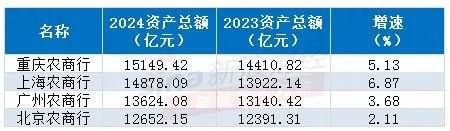
Core Viewpoint - The performance reports of major rural commercial banks in China for 2024 show a mixed picture, with asset growth among the leading banks but declining revenues and profits for some, particularly Guangzhou Rural Commercial Bank [1][7][10]. Asset Scale and Growth - By the end of 2024, the total assets of the four major rural commercial banks (Chongqing, Shanghai, Guangzhou, and Beijing) ranged from 1.26 trillion to 1.51 trillion yuan [1][2]. - Chongqing Rural Commercial Bank has the largest asset scale, exceeding 1.5 trillion yuan, with a growth rate of 5.13% [3][4]. - Shanghai Rural Commercial Bank's assets grew by 6.87%, while Beijing Rural Commercial Bank had the lowest growth rate at 2.11% [3][4]. Revenue and Profit Performance - Chongqing Rural Commercial Bank reported a revenue of 282.62 billion yuan, with a slight increase of 1.09%, and a net profit of 115.13 billion yuan, up 5.60% [7]. - In contrast, Guangzhou Rural Commercial Bank experienced a decline in both revenue and net profit, with revenues down 12.79% to 158.32 billion yuan and net profit down 21.02% to 20.81 billion yuan [10][12]. - Beijing Rural Commercial Bank saw an 18.09% increase in revenue to 180.63 billion yuan, but its net profit growth was only 0.71% [7][10]. Asset Quality - Shanghai and Beijing Rural Commercial Banks maintained non-performing loan (NPL) ratios below 1%, while Guangzhou Rural Commercial Bank had the highest NPL ratio at 1.66% [12][14]. - The provision coverage ratio for Guangzhou Rural Commercial Bank was notably low at 184.34%, compared to over 300% for the other banks [12][14]. Loan Composition - Chongqing Rural Commercial Bank's total customer loans and advances reached 714.27 billion yuan, with a growth of 5.55% [3][4]. - The bank's corporate loans grew by 9.26%, while retail loans saw a modest increase of 0.55% [4]. - In contrast, Guangzhou Rural Commercial Bank's personal mortgage loans decreased by 3.05% to 886.98 billion yuan [4]. Strategic Focus - Shanghai Rural Commercial Bank is prioritizing retail finance as a strategic focus, aiming to enhance wealth management and personal credit services [5]. - Guangzhou Rural Commercial Bank has set a goal to improve its operational efficiency and profitability over the next two years [10].