
Chongqing Rural Commercial Bank(601077)

Search documents
重庆农村商业银行(03618) - 2024 - 年度财报
2025-04-10 08:37
Financial Performance - Operating income and net profit grew by 0.98% and 5.97% year-on-year, achieving a dual increase in scale and efficiency[11]. - The company achieved a net profit of RMB 11.79 billion in 2024, an increase of RMB 663.9 million or 5.97% year-on-year[41]. - Net profit for the year was RMB 11,789.1 million, reflecting a year-on-year growth of 5.97%[33]. - The company's net profit increased by CNY 666 million, a growth rate of 5.97%, driven by improved revenue and cost management[119]. - The company's pre-tax profit for 2024 was RMB 12,817.4 million, reflecting an increase of RMB 621.5 million or 5.10% year-on-year[55]. - The company reported a significant increase in revenue, reaching $1.2 billion, representing a 15% year-over-year growth[1]. - The company reported a net profit margin of 12%, an improvement from 10% in the previous year[9]. Asset and Loan Growth - The asset scale, deposit and loan balances increased by 5.12%, 5.10%, and 5.55% respectively compared to the end of the previous year[11]. - Customer loans and advances increased by 5.55% to RMB 714,273 million[34]. - The total amount of loans and advances reached RMB 358.13 billion, an increase of RMB 30.35 billion, representing a growth of 9.26% compared to the end of the previous year[59]. - The balance of loans to technology enterprises increased by 6.3 billion RMB compared to the end of the previous year[12]. - The balance of green loans increased by 11.2 billion RMB, representing an 18% growth compared to the end of the previous year[12]. - The balance of loans to small and micro enterprises increased by 9% compared to the end of the previous year[12]. - The total customer loans and advances amounted to RMB 714.27 billion, with a non-performing loan rate of 1.18%, consistent with the previous year[75]. Non-Performing Loans and Asset Quality - The non-performing loan ratio decreased by 0.01 percentage points compared to the end of the previous year[11]. - The non-performing loan (NPL) ratio was 1.18%, a slight improvement from 1.19% in the previous year[34]. - The non-performing loan ratio stood at 1.18% at the end of 2024, a decrease of 0.01 percentage points from the previous year, indicating stable asset quality[125]. - The overdue loan ratio decreased to 1.32%, down by 0.10 percentage points year-on-year, reflecting effective overdue management[125]. - The company maintained a prudent classification principle for loans, focusing on asset quality monitoring and control, with a significant emphasis on the collection and disposal of non-performing assets[74]. Digital Transformation and Innovation - The company plans to enhance its digital transformation projects to improve service scenarios and functionalities, leveraging big data and artificial intelligence[16]. - The company emphasizes digital transformation, aiming to enhance customer experience and operational efficiency through a "digital rural commercial bank" model[28]. - Digital loan products reached a scale of RMB 156.72 billion, with mobile banking users exceeding 15 million[41]. - The intelligent data decision platform provided a total of 301 million decision services, with a daily average of 822,000 and a decision success rate of 99.9%[110]. - The company launched 14 new digital products, with four products achieving over CNY 10 billion in business growth[111]. Customer and Market Engagement - The total number of customers served reached 28 million, with over 1 million service businesses, further solidifying the competitive advantage[14]. - The number of credit cards and consumer credit balances approached 150 billion RMB[12]. - The balance of credit cards and consumer loans reached RMB 149.18 billion, indicating a strong push for inclusive finance[41]. - The company signed service agreements with 417 enterprises for its treasury system, enhancing its digital transformation efforts[39]. - The company issued loans totaling RMB 41.3 billion to 42,000 small micro market entities, enhancing financing support[99]. Financial Management and Cost Control - The cost-to-income ratio improved, decreasing by 2.04 percentage points to 31.90%[33]. - The average cost of customer deposits was 1.73% in 2024, down from 1.88% in 2023[44]. - The company aims to achieve breakthroughs in total deposits and general loan increments, ensuring robust financial performance[15]. - The company is committed to technological innovation, focusing on digital finance and intelligent risk control to improve service quality[28]. - The company has a streamlined management structure that enhances decision-making efficiency and adaptability to market changes[27]. Strategic Focus and Future Plans - The company aims to become a leading regional bank in China, focusing on "supporting agriculture and small enterprises" and serving the real economy[24][25]. - The company has a strategic focus on the Chengdu-Chongqing economic circle and rural revitalization initiatives, aligning with national development strategies[25]. - The company plans to enhance its financial services across various sectors, including green finance, inclusive finance, and digital finance, to improve service quality and efficiency[159]. - The company aims to implement a development strategy focused on "retail banking, technology-driven operations, and talent enhancement" by 2025[159]. - The company is committed to leveraging market opportunities in Chongqing and expanding its business through tailored financial services[121]. Governance and Leadership Changes - The company is focused on enhancing its governance structure with the recent appointments and transitions among its senior management team[171]. - The company is undergoing a leadership transition with several executives stepping down, including Xie Wenhui and Zhang Peizong, effective in late 2024[168]. - The company appointed new executives, including Sui Jun as the Deputy Secretary of the Party Committee and President since March 2023[166]. - The company has confirmed the appointment of Peng Yulong as a non-executive director starting December 2024, following his previous roles in the Fosun Group[180]. - The company has maintained stability in its board composition, with no significant changes in the shareholdings of current directors during the reporting period[173].
超5000亿“红包雨”!谁最大手笔?
21世纪经济报道· 2025-04-08 11:51
Core Viewpoint - The article highlights the significant increase in cash dividends among listed banks in 2024, with state-owned banks leading in both total dividend amounts and payout ratios, reflecting a strong commitment to shareholder returns [2][7]. Summary by Sections Dividend Distribution Overview - As of April 8, 2024, 23 A-share listed banks have disclosed their annual reports, collectively distributing cash dividends of 56.8862 billion yuan, an increase of over 10.1887 billion yuan year-on-year [2][3]. - The six major state-owned banks are identified as the primary contributors, proposing a total cash dividend exceeding 420 billion yuan, with payout ratios consistently above 30% [7][8]. Individual Bank Performance - Industrial and Commercial Bank of China (ICBC) leads with a cash dividend of 109.773 billion yuan, followed by China Construction Bank and Agricultural Bank of China with 100.754 billion yuan and 84.661 billion yuan respectively [3][8]. - Among joint-stock banks, China Merchants Bank stands out with a dividend payout ratio of 35.32%, distributing over 50 billion yuan [4][9]. Trends in Dividend Frequency and Ratios - The article notes a shift in dividend frequency for state-owned banks to twice a year, enhancing their attractiveness to investors [8][9]. - In contrast, city commercial banks and rural commercial banks generally exhibit lower dividend scales and ratios, with Zhengzhou Bank having the lowest payout ratio at 9.69% [5][9]. Market Valuation and Investor Sentiment - The banking sector is currently experiencing a comprehensive decline in valuation, with an overall price-to-book (PB) ratio below 1, indicating a potential undervaluation of bank stocks [5][17]. - Over 20 banks have announced valuation enhancement plans in response to prolonged low valuations, aiming to improve investor returns and confidence [16][19]. Regulatory and Strategic Considerations - Regulatory bodies have been encouraging listed companies to increase dividend distributions, which has influenced the banks' decisions to enhance their payout strategies [7][12]. - The article emphasizes the importance of maintaining a balance between dividend payouts and capital retention for risk management and growth [10][19].








渝农商行(601077) - 2025 Q1 - 季度业绩
2025-04-08 00:23
Financial Performance - In Q1 2025, the company achieved operating income of RMB 72.24 billion, an increase of 1.35% year-on-year[3] - The total profit for Q1 2025 was RMB 42.39 billion, reflecting an increase of 11.85% compared to the same period last year[4] - Net profit attributable to shareholders was RMB 37.45 billion, up by 6.27% year-on-year[4] - Basic earnings per share for Q1 2025 were RMB 0.33, an increase of 6.45% from RMB 0.31 in Q1 2024[3] - The weighted average return on equity (annualized) was 12.00%, a slight decrease of 0.01 percentage points from the previous year[3] Assets and Liabilities - As of March 31, 2025, total assets reached RMB 16,103.30 billion, a year-on-year increase of 6.30%[4] - The total liabilities increased to RMB 14,749.64 billion, marking a 6.78% rise from the end of the previous year[4] Loan Quality - The non-performing loan ratio stood at 1.17%, a decrease of 0.01 percentage points from the end of last year[4] - The provision coverage ratio was 363.30%, remaining stable compared to the previous year-end[4] Financial Data Disclaimer - The company warns that the preliminary financial data may differ from the final report, with expected discrepancies not exceeding 10%[5]
消费贷进退:交行规模增超90%,张家港行减逾42%!个别行消费贷不良率激增近8个百分点|年报观察
Xin Lang Cai Jing· 2025-04-07 12:20
Core Viewpoint - The A-share listed banks are experiencing significant changes in their business structures, particularly in the consumer loan sector, amidst a challenging macroeconomic environment and tightening interest margins [1][2]. Group 1: Consumer Loan Growth - The total consumer loan balance has surged by nearly 750 billion yuan, with most banks reporting substantial increases in their consumer loan portfolios [3][5]. - Among 23 listed banks, only six reported a decrease in consumer loan balances for 2024, with Ping An Bank seeing the largest reduction of 70.63 billion yuan [5]. - Major banks like Postal Savings Bank, China Construction Bank, and Agricultural Bank of China have reported double-digit growth in consumer loans, with increases of 17.88%, 26.21%, and 38.03% respectively [6][7]. Group 2: Risk Management Concerns - Industry insiders express concerns about rising non-performing loans (NPLs) in the consumer loan sector, indicating that banks must tighten risk controls as economic cycles fluctuate [2][12]. - Several banks, including Industrial and Commercial Bank of China and Agricultural Bank of China, have reported increases in their consumer loan NPL ratios, highlighting the need for enhanced risk management strategies [12][13]. - The rapid growth of consumer loans has raised alarms about potential risks, with banks emphasizing the importance of maintaining asset quality and effective post-loan management [12][14]. Group 3: Regulatory Changes and Market Dynamics - In March, regulatory changes extended the repayment period for consumer loans from five to seven years and increased the maximum loan amount, aiming to support consumer spending [10]. - Following these changes, banks quickly halted low-interest consumer loans to prevent a price war that could lead to increased risks [12]. - The competitive landscape for consumer loans is shifting, with banks focusing on the relatively lower costs and stable returns associated with consumer lending compared to corporate lending [9].




深度:“对等关税”对我国银行业影响:息差额外压力,资产质量稳健,投资价值凸显
ZHONGTAI SECURITIES· 2025-04-06 12:42
Investment Rating - The report maintains an "Overweight" rating for the banking sector [2] Core Insights - The impact of "reciprocal tariffs" on China's banking industry is profound, leading to additional pressure on loan demand and net interest margins, while asset quality remains stable. The investment value of bank stocks is highlighted, particularly for large banks, China Merchants Bank, and quality city commercial banks [7][12][14] Summary by Sections 1. Impact Mechanism of "Reciprocal Tariffs" on Bank Stocks - The economic impact includes weakened external demand, pressuring the credit demand and asset quality of banks [12][14] - Policy measures may boost retail credit demand through increased monetary easing [12][14] - Investment sentiment shifts towards banks due to enhanced dividend value amidst rising risk aversion [12][14] 2. Credit Demand: Pressure Points and Support - Economic growth pressure leads to declining credit growth, with a potential credit increment shortfall of CNY 2.139 billion in 2025 [15][19] - Export-related customer demand is expected to decline, while consumption-related customers may receive support from policy measures [27][28] 3. Net Interest Margin: Pressure Points and Support - A decline in credit growth could lead to a 14 basis points drop in net interest margins [33] - Monetary policy adjustments, including potential rate cuts, may exert additional pressure on margins [33][34] - The long-term outlook suggests that net interest margins are nearing their bottom, estimated at 1.24% [39][46] 4. Asset Quality: Pressure Points and Support - The impact on asset quality is manageable, with export-related sectors facing direct effects from tariffs [48] - The real estate sector's pressure is expected to ease, while retail sector non-performing loans may improve under supportive policies [48] 5. Investment Recommendations - The report emphasizes the dividend characteristics of bank stocks, recommending a focus on large banks and quality city commercial banks [7][12][14]

本周聚焦:23家上市银行零售资产质量:不良率上行,大行加大信用成本计提力度
GOLDEN SUN SECURITIES· 2025-04-06 10:18
Group 1 - The retail non-performing loan (NPL) ratio of 23 listed banks continues to rise, with a slight decrease in overall NPL ratio to 1.25% as of Q4 2024, down 2bps from Q4 2023. However, retail loan NPL ratios have generally increased, with state-owned banks seeing an average rise of 29bps compared to Q4 2023 [1][2][3] - The average retail credit cost for listed banks in 2024 is 1.24%, a decrease of 3bps year-on-year. State-owned banks have a lower average retail credit cost of 0.99%, attributed to a higher proportion of lower-risk personal housing loans [2][3] - Looking ahead, banks are expected to manage retail loan risks by tightening customer eligibility and employing various asset disposal strategies, with the impact on asset quality being relatively controllable [4] Group 2 - The report highlights that the retail loan structure of banks has shifted, with personal housing loans making up an average of 60.9% of the total retail loans for state-owned banks, which is 17.6 percentage points higher than the sample average [2][16] - Specific banks such as Ping An Bank and Everbright Bank have seen a decrease in retail credit costs, with Ping An Bank's credit cost dropping by 34bps year-on-year, largely due to a reduction in credit card NPLs [3][4] - The report suggests that banks like Postal Savings Bank have improved their asset quality, with a notable decrease in consumer loan NPLs by 12.2 billion yuan, resulting in a NPL ratio decline of 47bps to 1.34% [4][8]

部分上市农商行信用卡不良率攀升
Zhong Guo Jing Ying Bao· 2025-04-05 22:13
信用卡不良资产包密集挂牌 本报记者 郭建杭 北京报道 随着上市银行2024年年报陆续发布,数据显示多家上市农商行信用卡不良率较上年末有上升。 近日多家上市农商行年报中披露2024年信用卡业务情况。例如,常熟农商行年报数据显示,2024年不良 贷款率总体稳定,略有上升。具体来看,该行2024年不良贷款率为0.77%,其中个人贷款不良率为 0.94%,较上年年末上升0.16个百分点,信用卡不良率更是由2023年年末的1.40%大幅提升至4.14%,上 升幅度达2.74个百分点。 重庆农商行的年报数据显示,截至2024年年末,该行不良贷款率为1.18%,较上年年末下降0.01个百分 点。2024年个体经营户和小微企业主均面临经营压力,个人贷款不良生成压力依然存在。由个人消费贷 及信用卡贷款组成的"其他贷款",其不良率由上期末的1.49%上升至本期末的2%,其他贷款的规模由上 期末的11.78亿元上升为16.08亿元。年报指出,逾期管控取得成效,截至2024年年末,重庆农商行逾期 贷款占比1.32%,较上年年末下降0.10个百分点。 此外,2024年农商行信用卡发放规模也有变化。 常熟农商行数据显示,信用卡贷款规模逐 ...
每周股票复盘:渝农商行(601077)股本结构稳定,无变动发生
Sou Hu Cai Jing· 2025-04-04 00:37
Core Points - As of March 28, 2025, Chongqing Rural Commercial Bank (601077) closed at 6.02 CNY, a 2.91% increase from the previous week's 5.85 CNY [1] - The bank's market capitalization is currently 69.959 billion CNY, ranking 2nd out of 10 in the rural commercial bank sector and 197th out of 5140 in the A-share market [1] Company Announcements - As of March 31, 2025, there have been no changes in the registered and issued shares of Chongqing Rural Commercial Bank's H-shares and A-shares [1] - The registered share capital consists of 2,513,336,041 H-shares and 8,843,663,959 A-shares, with a par value of 1 CNY per share, totaling 11.357 billion CNY [1] - The number of issued shares remains unchanged, with 2,513,336,041 H-shares and 8,843,663,959 A-shares, and there are no treasury shares [1] - The report submitted to the Hong Kong Stock Exchange by the Executive Director and President, Sui Jun, emphasizes the need for specific records in the case of share buybacks or redemptions [1]
透视A股银行2024年报:净息差持续收窄,关注个人经营贷不良
Di Yi Cai Jing· 2025-04-03 10:37
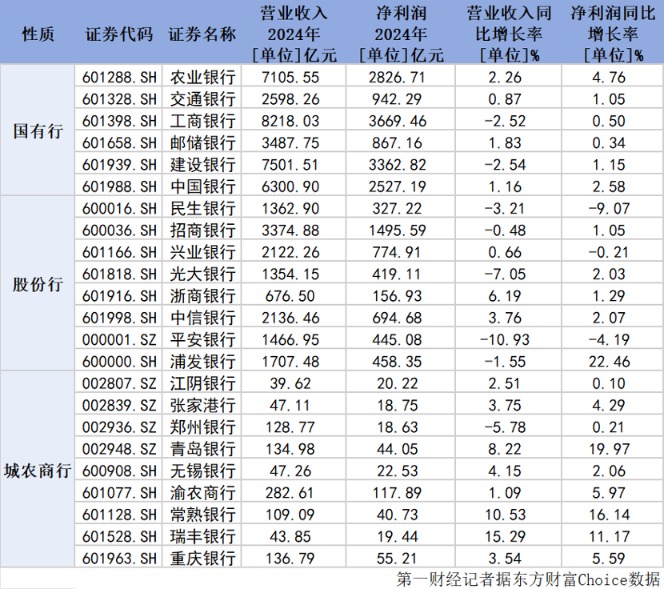
Core Insights - The financial reports of 23 A-share listed banks for 2024 show stable revenue and profit, with total revenue at 5.04 trillion yuan and net profit at 1.93 trillion yuan, reflecting a slight year-on-year decline of 0.6% in revenue and a growth of 1.88% in profit [1][2][3] Revenue and Profit Analysis - Total revenue for the 23 listed banks in 2024 is 5.04 trillion yuan, down 0.6% from the previous year [2] - The six major state-owned banks reported a total revenue of 3.52 trillion yuan, a decrease of 94.25 billion yuan from last year [2] - Among the state-owned banks, Construction Bank and Industrial and Commercial Bank experienced revenue declines of 2.54% and 2.52%, respectively [2] - In contrast, most city and rural commercial banks showed revenue growth, with eight banks reporting increases, including Ruifeng Bank and Changshu Bank, which grew by 15.29% and 10.53% respectively [2] Net Profit Performance - The net profit for the 23 listed banks totaled 1.93 trillion yuan, marking a year-on-year increase of 1.88% [3] - State-owned banks achieved a combined net profit of 1.42 trillion yuan, with Agricultural Bank leading the growth at 4.76% [3] - Among the listed joint-stock banks, three reported declines in net profit, with Minsheng Bank experiencing a notable drop of 9.07% [3] Net Interest Margin Trends - The average net interest margin for the 23 listed banks in 2024 was 1.65%, down from 1.83% in 2023, reflecting a decrease of 19 basis points [5][6] - The net interest margin for major state-owned banks is generally below 1.5%, with only Postal Savings Bank exceeding this threshold at 1.87% [6][7] Asset Quality and Risks - Overall asset quality among listed banks is improving, with most banks reporting a decline in non-performing loan (NPL) ratios [9] - However, there are structural risks, particularly in personal operating loans, which have seen a significant increase in both scale and NPL ratios, averaging 1.81% across ten banks, up 29 basis points from 2023 [9][10] - The total balance of personal operating loans across 19 banks reached 8.32 trillion yuan, a 40.8% increase from the previous year [9][10]


上市银行2024年年报综述:营收降幅收敛,分红稳定关注股息配置价值
Ping An Securities· 2025-04-03 00:42
Investment Rating - The report maintains an "Outperform" rating for the banking sector, indicating a positive outlook compared to the broader market [1]. Core Insights - The report highlights that the net profit of listed banks is expected to grow by 1.8% year-on-year for 2024, with a notable increase in growth rate compared to the first three quarters [4][10]. - Revenue decline is narrowing, with a projected revenue growth rate of -0.6% for 2024, an improvement from -1.6% in the previous quarters [11][14]. - The report emphasizes the importance of domestic economic recovery and the impact of recent growth-stabilizing policies on banking performance [14]. Summary by Sections 1. Profitability Breakdown - The net interest income for listed banks is expected to decline by 2.3% in 2024, an improvement from a 3.2% decline in the first three quarters [11][12]. - Non-interest income, particularly from investment gains, is projected to increase by 28% due to falling bond yields, partially offsetting revenue pressures [11][12]. - The report notes that the cost-to-income ratio has increased to 32.8%, reflecting a 0.5 percentage point rise year-on-year [7]. 2. Operational Analysis - Asset growth for listed banks has decreased to 7.2%, with loan growth at 7.7%, indicating stable overall growth despite a slight decline [22][23]. - The annualized net interest margin is projected to decrease to 1.43%, primarily due to asset pricing pressures [24]. - The report indicates that the quality of assets remains stable, with non-performing loan ratios showing slight fluctuations but overall stability [7][22]. 3. Dividend and Investment Recommendations - The report highlights a stable dividend payout ratio, with 9 banks increasing their dividend rates compared to the previous year [7]. - Investment recommendations focus on "pro-cyclical and high dividend" strategies, with an average dividend yield of 4.3% for the sector, which remains attractive compared to risk-free rates [7][8]. - Specific banks recommended for investment include Chengdu Bank, Suzhou Bank, and Ningbo Bank, which are expected to benefit from regional economic recovery [8][14].